


US Tax Forms
IRS Form 8962 for NRIs: Premium Tax Credit and APTCIRS Form 8962 for NRIs: Premium Tax Credit and APTC
Written by Shubham Jain
If you are an NRI with U.S. tax obligations and you pay income tax in India or another foreign country, you may be able to use the U.S. Foreign Tax Credit (FTC) to reduce double taxation. In many cases, IRS Form 1116 is the form used to calculate and claim that credit.
However, Form 1116 is not required simply because you are an NRI or because you paid tax in India. Your U.S. tax status, source of income, type of foreign tax, and eligibility for the Foreign Tax Credit must first be considered.
For example, an Indian citizen who is an NRI under Indian tax rules but a U.S. resident alien may have U.S. tax obligations on worldwide income. If that person pays qualifying income tax in India, Form 1116 for NRIs may become relevant.
This guide explains when NRIs may need Form 1116, when it may not be required, how its four main parts work, and why some NRIs may need more than one Form 1116.
IRS Form 1116, officially titled Foreign Tax Credit (Individual, Estate, or Trust), is used to calculate the allowable Foreign Tax Credit for qualifying foreign taxes.
The 2025 form can be attached to Form 1040, Form 1040-SR, Form 1040-NR, Form 1041, or Form 990-T.
For NRIs, Form 1116 commonly becomes relevant when there is an India-U.S. cross-border tax situation.
Suppose you are an Indian citizen who qualifies as a U.S. resident alien. You continue to earn income from India and pay qualifying Indian income tax on that income. Because U.S. resident aliens are generally subject to U.S. federal tax on worldwide income, the Indian income may also enter your U.S. tax calculation.
The Foreign Tax Credit may reduce the resulting double-tax burden, while Form 1116 is generally used to calculate how much credit the U.S. tax rules actually allow.
The important distinction is:
Form 1116 is conditionally relevant to NRIs.
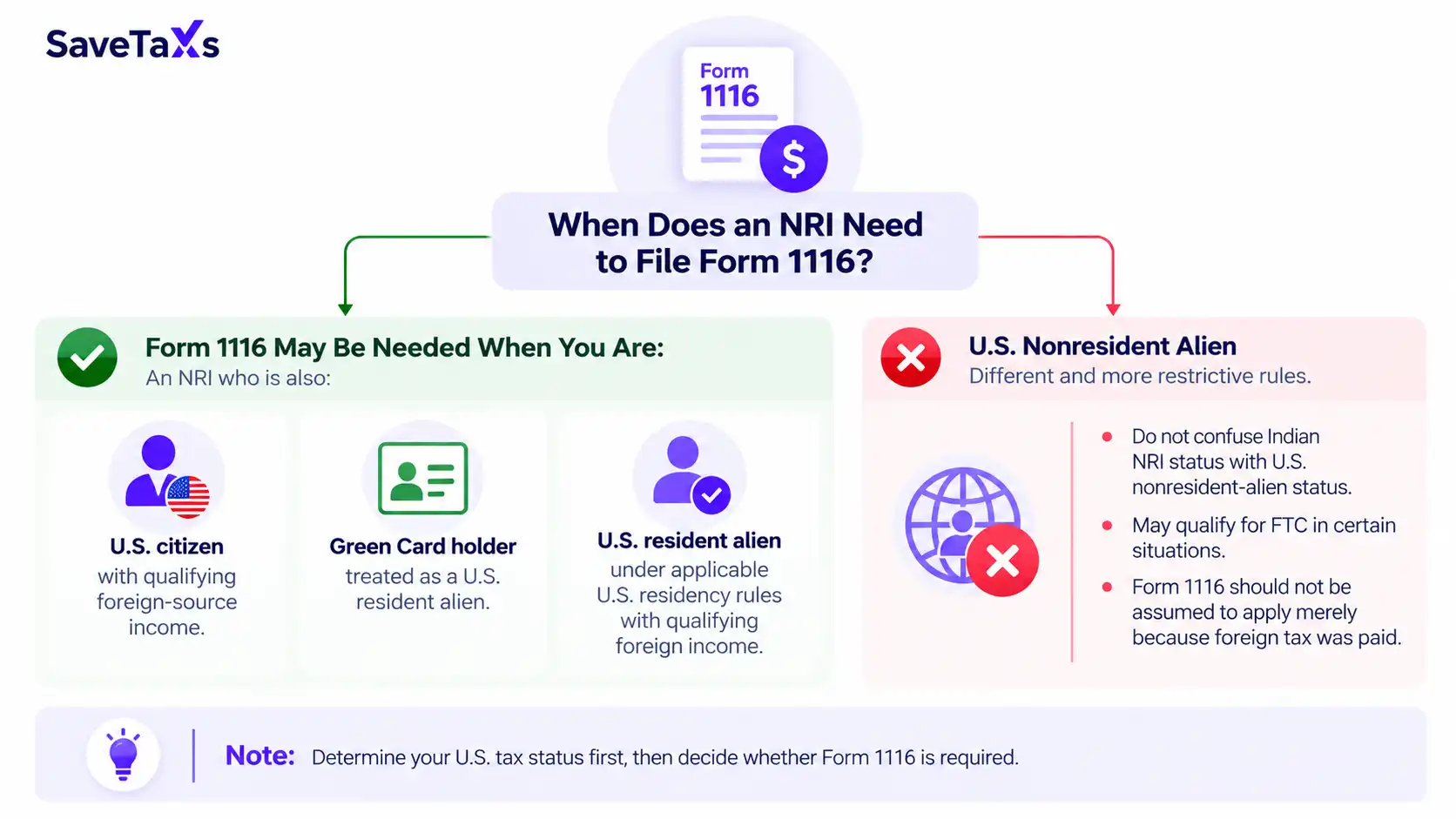
An NRI may need the form when they are eligible for a U.S. Foreign Tax Credit and cannot use the exception that allows certain individuals to claim a limited credit without Form 1116.
This commonly affects an NRI who is also:
For example, an NRI working in the United States may continue receiving interest, dividends, business income, or other taxable income from India. If qualifying Indian income tax is paid and the income is also relevant for U.S. taxation, Form 1116 may be required to determine the allowable FTC.
Do not confuse Indian NRI status with U.S. nonresident-alien status.
They are two different tax classifications.
The FTC rules for U.S. nonresident aliens are more restrictive. A nonresident alien may qualify for FTC in certain circumstances, but Form 1116 should not be assumed to apply merely because foreign tax was paid.
Therefore, an NRI should determine their U.S. tax status before deciding whether Foreign Tax Credit Form 1116 is required.
Not everyone claiming a Foreign Tax Credit needs to file Form 1116.
An individual may elect to claim a limited FTC without Form 1116 if all applicable IRS requirements are satisfied.
Among the important conditions, foreign-source gross income generally must consist of qualifying passive income such as interest and dividends and be reported on qualified payee statements. Total creditable foreign taxes must also not exceed:
$300 if you are not filing Married Filing Jointly.
$600 if you are Married Filing Jointly.
Other requirements apply, so the dollar threshold alone is not enough. IRS guidance, for example, also includes conditions concerning how the income and foreign taxes are reported and, for certain dividend income, the applicable holding period.
Suppose an NRI who is a U.S. resident alien receives foreign dividends reported on an appropriate U.S. tax statement and only $150 of qualifying foreign tax was paid.
The taxpayer should not automatically conclude that Form 1116 is unnecessary just because $150 is below $300.
They must satisfy all requirements for the election.
If those requirements are not satisfied, Form 1116 may still be necessary.
One of the most important parts of Form 1116 instructions is correctly identifying the category of foreign-source income.
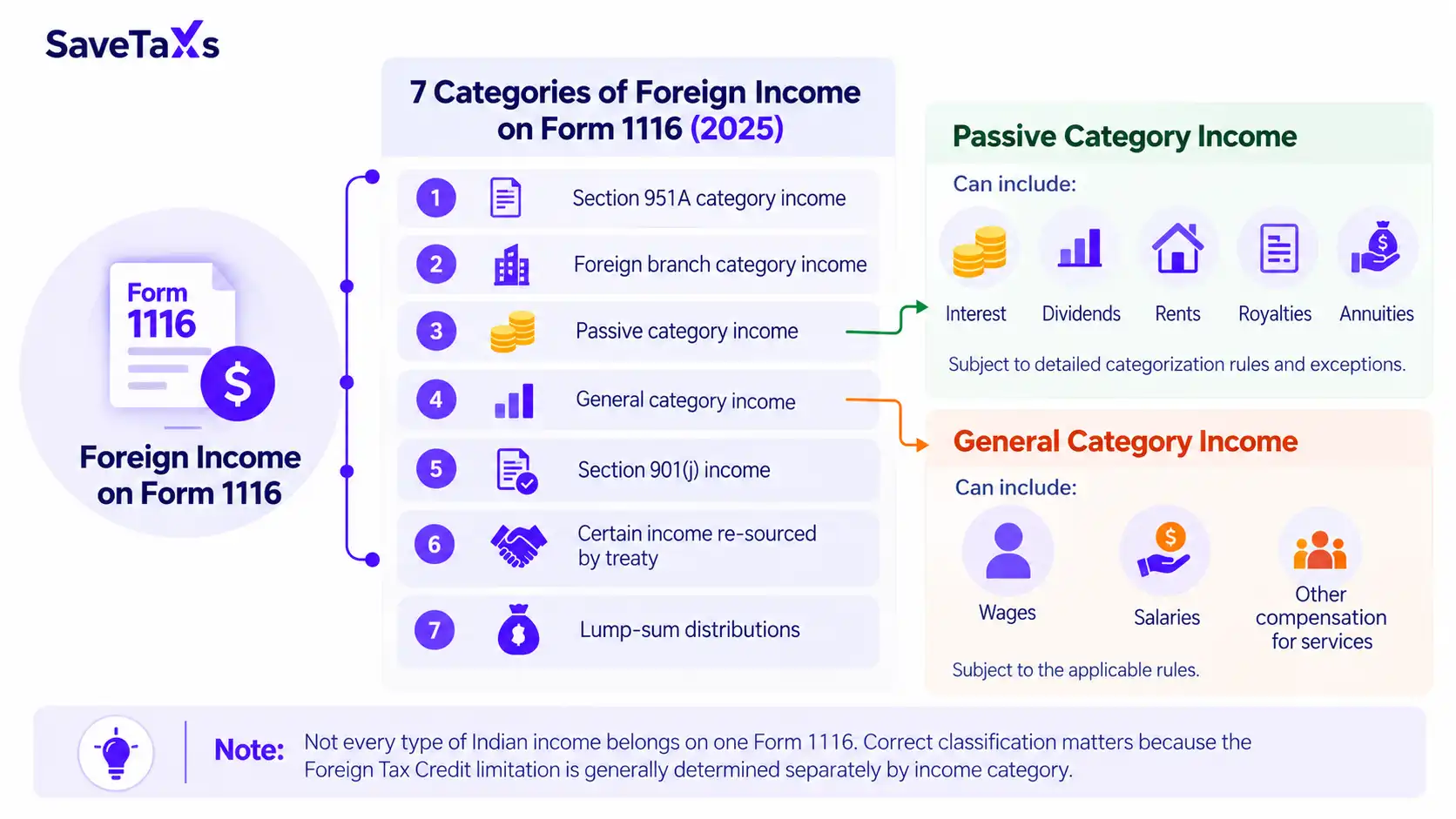
The 2025 Form 1116 lists seven categories:
For many individual NRIs, passive and general category income are particularly relevant.
This can include income such as:
subject to the detailed categorization rules and exceptions.
General category income can include wages, salaries, and other compensation for services, subject to the applicable rules.
An NRI should not assume that every type of Indian income belongs on one Form 1116. Correct classification matters because the Foreign Tax Credit limitation is generally determined separately by income category.
The purpose of this section is to explain the structure of how to file Form 1116, rather than provide a line-by-line substitute for the IRS instructions.
Part I reports taxable income or loss from sources outside the United States for the category selected at the top of the form.
For an NRI with Indian income, this is where applicable foreign-source income for the selected category enters the calculation.
The form also accounts for relevant deductions and losses when determining foreign-source taxable income.
This step matters because the FTC limitation is based on taxable foreign-source income rather than simply the gross amount earned abroad.
Part II reports the applicable foreign taxes paid or accrued.
The form asks whether the credit is being claimed on a paid or accrued basis and provides fields for foreign taxes associated with dividends, rents and royalties, interest, and other items.
Amounts ultimately need to be reported in U.S. dollars as required by the form.
For an NRI who paid tax in India, simply copying the amount of Indian TDS (Tax Deducted at Source) without determining the qualifying foreign tax can produce an incorrect FTC.
Part III determines the credit allowed for the selected category.
This is where the Foreign Tax Credit limitation becomes particularly important.
Broadly, the FTC is designed to prevent foreign taxes from offsetting more U.S. income tax than is attributable to the relevant foreign-source income.
The IRS states that the maximum current-year credit is generally limited to the allocated U.S. tax imposed on the foreign income or the qualifying foreign tax paid/accrued, whichever is less.
Therefore:
Indian tax paid ≠ automatically the U.S. Foreign Tax Credit allowed.
Part IV summarizes the separate credits calculated through Part III.
When multiple Forms 1116 are filed, Part IV is generally completed on one Form 1116 to combine the appropriate credits from the separate forms, subject to specified exceptions.
For 2025, there is also an important change for taxpayers filing only one Form 1116: the IRS instructions require completion of the applicable Part IV summary rather than simply leaving Part IV unused.
NRIs using older Form 1116 examples should therefore make sure they are following instructions for the correct tax year.
You generally use a separate Form 1116 for each applicable category of foreign-source income.
This is particularly relevant for NRIs with several types of Indian income.
For example, assume an NRI has foreign income that falls into both passive and general categories.
Those categories generally cannot simply be combined onto one Form 1116. Separate forms may be required so the FTC limitation can be determined for each applicable category.
However, receiving income from multiple countries does not necessarily mean you need a completely separate Form 1116 for every country.
Within a particular income category, Form 1116 provides separate columns and lines for reporting applicable amounts from different foreign countries or territories.
The distinction is important:
Multiple countries do not automatically mean multiple Forms 1116. Multiple applicable income categories generally do.
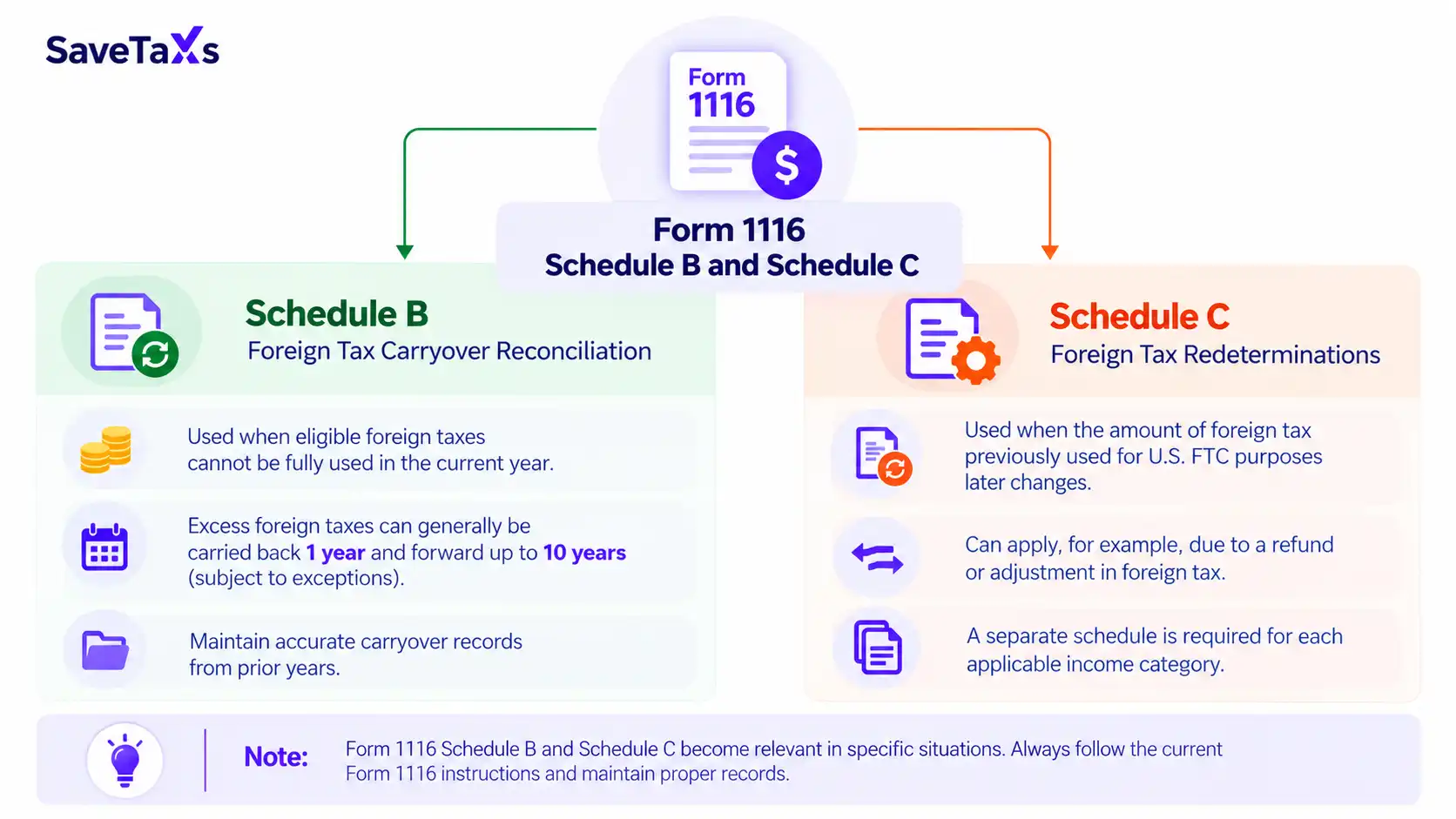
Some NRIs may also encounter Schedule B or Schedule C of Form 1116.
Schedule B is associated with foreign tax carryovers.
It becomes relevant when eligible foreign taxes cannot be fully used in the current year and carryover rules apply.
The broader Foreign Tax Credit rules generally allow eligible excess foreign taxes to be carried back 1 year and forward up to 10 years, although exceptions exist.
NRIs with unused FTC from prior years therefore need to maintain accurate carryover records rather than simply recalculating the current year's Indian taxes.
Schedule C deals with foreign tax redeterminations.
This can become relevant when the amount of foreign tax previously used for U.S. FTC purposes later changes—for example, because of a refund or adjustment.
The current Schedule C requires a separate schedule for each applicable income category.
This can be especially important in cross-border cases where the final Indian tax liability changes after the original U.S. return was filed.
Consider Priya, an Indian citizen living in the United States.
Priya qualifies as an NRI under Indian tax rules but is a U.S. resident alien for federal income-tax purposes.
She earns a salary in the United States and also receives interest and dividend income from investments in India. Qualifying Indian income tax is paid on some of her Indian income.
Because Priya is a U.S. resident alien, her applicable Indian income may also enter her U.S. tax calculation.
She first determines whether the Indian taxes qualify for the U.S. Foreign Tax Credit.
Next, she identifies the appropriate Form 1116 category for the foreign-source income. Interest and dividends will often fall within passive category income, although classification rules and exceptions must still be checked.
She then reports the relevant foreign-source income in Part I and qualifying foreign taxes in Part II.
Part III determines the allowable credit after applying the FTC limitation.
Finally, the applicable credit is summarized through Part IV.
If Priya also has foreign income belonging to another FTC category, she may need an additional Form 1116 for that category.
The important point is that Priya does not file Form 1116 merely because she is an NRI or because India deducted tax.
Her U.S. tax status, foreign-source income, qualifying foreign taxes, income category, and FTC eligibility determine whether and how Form 1116 applies.
One common mistake is assuming that NRI status automatically requires Form 1116. It does not. Indian residential status and U.S. tax status are separate questions.
Another is treating every Indian tax payment as creditable. GST, stamp duty, property taxes, and other levies should not automatically be treated as foreign income taxes eligible for FTC.
NRIs should also avoid combining different FTC income categories onto one Form 1116 when separate forms are required.
Another potential error is using the gross Indian tax withheld as the credit without determining the taxpayer's actual qualifying foreign tax liability.
Finally, do not rely on an older Form 1116 when preparing a current return. Form requirements can change between tax years, including how Part IV is completed.
IRS Form 1116 is an important U.S. tax form for certain NRIs who pay qualifying income tax in India or another foreign country and want to claim the U.S. Foreign Tax Credit.
But Form 1116 is not an “NRI form.”
Its applicability depends on your U.S. tax status, foreign-source income, qualifying foreign tax, FTC category, and whether you qualify for the limited exception to filing Form 1116.
For an NRI with India-U.S. income, the correct sequence is to determine FTC eligibility first and then determine whether Form 1116 is required.
If it is required, correctly identifying the income category, foreign-source taxable income, qualifying foreign taxes, and applicable FTC limitation is essential.
This article is for general informational purposes only and does not constitute tax, legal, financial, or investment advice. Laws, regulations, rates, and procedures may change over time and may vary based on individual circumstances.
While SaveTaxs makes reasonable efforts to keep the information accurate and up to date, readers should verify applicable rules with official authorities or consult a qualified professional before making decisions based on this information.
Vipul Jain is the Co-Founder of SaveTaxs and a tax expert with experience in Indian and NRI taxation. He advises individuals, NRIs, and businesses on tax filing, tax planning, capital gains, DTAA, and compliance matters. He focuses on making complex tax concepts simple and helping taxpayers make informed, compliant decisions. See Full Bio

Want to read more? Explore Blogs
_1786539671275.webp&w=828&q=75)