


US Tax Filing and Compliance
How to Report Indian Rental Property on Schedule EHow to Report Indian Rental Property on Schedule E
Written by Hatim Dudhiyawala
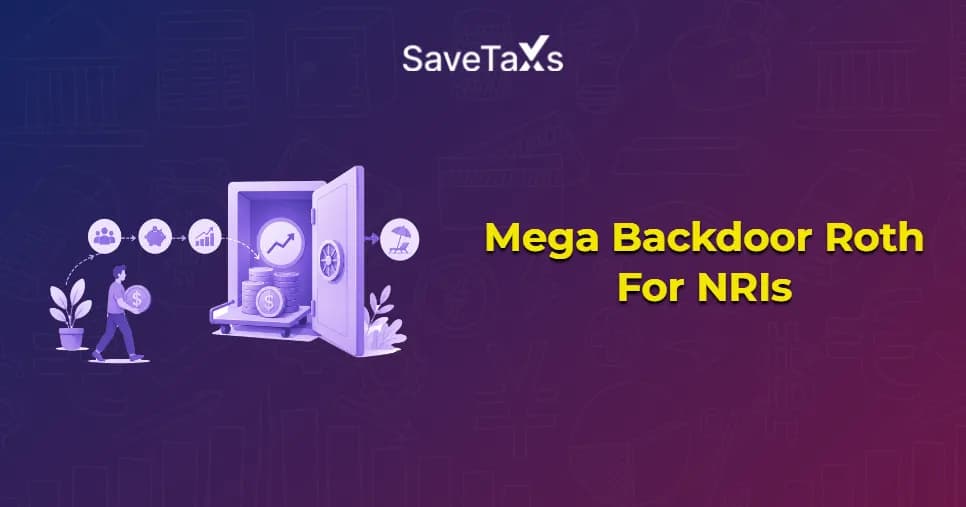
If you are an NRI living and working in the United States and have already maximized your regular 401(k) contributions, your employer’s plan may offer another retirement-saving opportunity known as the Mega Backdoor Roth. This is not a separate retirement account. Instead, it is a strategy that uses voluntary after-tax 401(k) contributions followed by an eligible Roth conversion or rollover. When properly structured, Roth investment growth can receive favorable U.S. tax treatment, including tax-free treatment of qualified distributions.
In this guide, we will understand exactly how this smart retirement savings strategy for NRIs works, how the Mega Backdoor Roth 401(k) works, who is eligible, and what you, as an NRI, specifically need to think about before using it.
Let us understand what a Mega Backdoor is in the simplest language. A Mega Backdoor Roth is a strategy that can allow an eligible participant to put substantially more money into Roth retirement savings than the standard IRA contribution limit. It generally involves making voluntary after-tax employee contributions to a qualifying 401(k) plan and then moving those funds to a Roth 401(k) through an in-plan Roth conversion or, where permitted, to a Roth IRA through an eligible rollover.
However, here's a difference to consider: A traditional backdoor Roth IRA generally uses a small portion of the IRS contribution limit, which is $7,500 for 2026. Whereas the Mega Backdoor Roth functions within the 401(k), it is tied to the far larger overall defined contribution limit under IRC Section 415(c): $72,000 for the year 2026. This gap between the two limits is exactly where the "mega" hails from.
The following are the ways to make your mega backdoor Roth strategy work for NRIs:
You may first make pre-tax or designated Roth elective deferrals up to the $24,500 elective-deferral limit for 2026. If your plan also permits voluntary after-tax contributions, additional contributions may be possible within the overall annual-additions limit, subject to the plan’s rules and applicable compensation limits.
If you are age 50 or older, you may be eligible to make an additional $8,000 catch-up contribution in 2026. If you attain age 60, 61, 62, or 63 during 2026, the higher catch-up limit is $11,250 instead.
In case your plan permits this, you can contribute an additional after-tax dollar that is beyond your regular deferral, up to the overall combined limit. This is not the same as your Roth contributions; it generally is a separate category, and the contributions under it are also known as the "after-tax" or the voluntary after-tax contributions; however, not every plan offers this option.
At the moment the after-tax money is in the plan, just convert it to Roth status, either through an in-plan Roth conversion, which is moving it to the Roth 401(k) bucket with the same plan, or the same in-service withdrawal to a separate Roth IRA. Once the after-tax money is in the plan, it may be moved to Roth through an in-plan Roth conversion or, where permitted, through an eligible in-service distribution and rollover to a Roth IRA. Converting promptly can minimize investment earnings that accumulate before the conversion. The original after-tax contribution generally represents basis and is not taxed again, while earnings on those contributions are generally treated as pre-tax amounts and may be taxable when converted.
Savetaxs helps NRIs file their IRS taxes and manage their finances in the US.
To be eligible for the Mega Backdoor Roth means:
NRIs generally, with only investments or rental income, cannot use this strategy. This is so because the amount generated from investments or rental income does not create a 401(k) elective or deferral eligibility.
The eligibility rules for 401(k) contributions and IRA contributions are different and should not be treated as interchangeable.
For NRIs who are genuinely self-employed and operate an eligible U.S. business, a properly structured Solo 401(k) may provide another way to implement a Mega Backdoor Roth strategy. However, the plan must permit the relevant voluntary after-tax contributions and Roth conversion or rollover features, and contributions remain subject to applicable compensation and plan limits.
The following table demonstrates a clear difference between Mega Backdoor Roth vs Backdoor Roth IRA.
| Particulars | Backdoor Roth IRA | Mega Backdoor Roth |
|---|---|---|
| Where Does It Happen? | A traditional IRA, followed by a Roth conversion. | A 401(k) or Solo 401(k) plan. |
| 2026 Contribution Space | $7,500 combined traditional/Roth IRA contribution limit, or $8,600 for individuals age 50+. | Potentially up to $47,500 of additional after-tax contribution capacity when the participant makes the full $24,500 elective deferral and has no employer or other annual additions, subject to plan and compensation limits. |
| Requires a Special Plan Feature? | No. A standard traditional IRA can generally be used. | Yes. The plan must generally allow after-tax contributions and an eligible Roth conversion or in-service withdrawal. |
| Main Risk | The pro-rata rule may apply if you hold other pre-tax IRA money. | Investment growth on after-tax funds may become taxable if the conversion is delayed. |
| Best Suited For | Taxpayers eligible to make an IRA contribution whose income may limit or eliminate direct Roth IRA contributions, subject to applicable IRA and conversion rules. | High earners whose 401(k) plan permits voluntary after-tax contributions and an eligible Roth conversion or rollover. |
In a nutshell, the Mega Backdoor Roth vs. the Backdoor Roth IRA ultimately comes down to scale and plan availability.
The IRA version does not require participation in an employer-sponsored retirement plan. However, the taxpayer must still satisfy the applicable IRA contribution and conversion rules, including the requirement for sufficient taxable compensation for a regular IRA contribution.
Under U.S. federal tax rules, the treatment is generally straightforward when after-tax contributions are converted promptly, although any earnings that accumulate before the conversion may be taxable.
India provides specific relief for eligible foreign retirement benefit accounts. Under the Income-tax Act, 1961, the relevant provision was Section 89A. Under the Income-tax Act, 2025, the corresponding provision is Section 158. The Income Tax Department’s 2026 forms guidance identifies Form 10-EE for exercising the option, subject to the applicable conditions.
Because qualified Roth distributions may be tax-free in the United States, you should not assume that Section 158 automatically applies to a U.S. Roth 401(k) or Roth IRA. Section 158 contains specific conditions for a “specified account,” including the manner in which the income is taxed in the notified country. The Indian treatment of a U.S. Roth account should therefore be evaluated based on the account’s characteristics, U.S. tax treatment, Indian domestic law, and the India-U.S. DTAA.
Now, there is no lie that this area is quite unwavering; also, this actually is not something to assume works cleanly across both countries without professional confirmation. Further, the US tax efficiency of the Roth account is quite established. Because the benefits hold up straight once they are taxed as an Indian resident, the worldwide income is a separate question that further needs its own dedicated review, specifically from someone who has especially worked through the NRI retirement account cases before.
The following table demonstrates the contribution limits for a Mega Backdoor Roth Strategy in 2026:
| Category | Limit For 2026 |
|---|---|
| Standard employee deferral (pre-tax + Roth Combined) | $24,500 |
| Catch-up contributions (ages of 50-59 and 64+) | Additional $8,000 |
| Super catch-up (ages 60-63) | Additional $11,250 instead of the standard catch-up. |
| Overall combined limit (employee + employer + after-tax) | $72,000 |
| The approximate mega backdoor after-tax space (there is no employer match) | Up to $47,500 |
Here is a detail that needs your attention, which is: catch up the contributions, and do not expand the available after-tax space here, as they are applicable only to your regular elective deferral and not to the after-tax category used for the mega backdoor strategy.
Here, the employee's contributions also reduce the available after-tax room dollar-for-dollar, as everything is counted toward the same $72,000 ceiling. If your employer contributes $8,000 to your 401(k), the remaining space available for voluntary after-tax contributions generally decreases by $8,000.
Beginning in 2026, participants whose prior-year wages from the plan sponsor exceeded $150,000 generally must make their catch-up contributions on a Roth basis, subject to the applicable rules. This requirement applies to catch-up contributions and does not automatically convert ordinary voluntary after-tax 401(k) contributions into Roth contributions. This particular rule will impact the catch-up contribution. It does not convert ordinary after-tax contributions to Roth contributions automatically.
One of the biggest benefits of the Mega Backdoor Roth for NRIs is the ability to move more of your retirement savings into the Roth account. This is because the normal Roth IRA is much smaller than the annual contribution limit. The Mega Backdoor Roth does provide considerably more space when the employer's plan supports it.
The money held in the overall Roth account can generally grow without the annual US tax. Further, qualified withdrawals may be tax-free under United States rules if the required holding period and additional withdrawal conditions are satisfied.
Unlike direct Roth IRA contributions, designated Roth 401(k) contributions are generally not subject to the Roth IRA income phase-out limits. However, participation remains subject to the employer plan’s eligibility rules and applicable contribution limits. This generally makes it useful for the high-income professional who cannot really contribute to the Roth IRA directly.
This provides tax diversification. You might hold some of the retirement money in the accounts that are designated as pre-tax accounts and some in Roth accounts. This provides you with much more flexibility while deciding on how to withdraw money after retirement.
The following are certain risks that you as an NRI must look out for:
Your Mega Backdoor Roth is not necessarily available under a 401(k) plan. This plan needs to allow voluntary after-tax contributions and a method for moving that money into the Roth account.
Ask the plan administrator the following questions:
Ensure that you have no confusion between the Roth 401(k) contributions and after-tax 401(k) contributions. They are separate contribution categories.
The original after-tax contributions generally represent tax basis and are not taxed again when converted to Roth. However, investment earnings that accumulate before the conversion are generally pre-tax amounts and may be taxable when converted.
Any quick or automatic conversion will reduce the taxable amount. It does not necessarily make every conversion completely tax-free in each and every situation.
Here, the employer plans need to satisfy the nondiscrimination testing, which is nothing but a rule to prevent the plan from favoring any employees with high payments. Such rules have the ability to limit the after-tax contributions made by highly compensated employees.
Your plan needs to return the segment of your contributions, if in the case where it fails the applicable test. Henceforth, the amount shown on the plan website might not always be the full and final amount that remains in the account.
Here, the US Roth Benefits Will not automatically bind the authorities of taxation in India. After you have become a tax resident in India, India might just examine the account with respect to its own regulatory framework.
However, here the treatment might also depend on whether you are an ROR (a resident ordinarily taxed on worldwide income), an RNOR ( a resident who has limited foreign income taxation), or a non-resident under Indian law.
Before you move back to India, ensure you keep the records of:
Certainly, these records will help you with separating your original contributions from the investment growth if India has later taxes or more questions on the withdrawal.
As a self-employed NRI, you may use a Solo 401(k) only when genuinely eligible. The Solo 401(k) plan document must permit the relevant voluntary after-tax contributions and the Roth conversion or eligible rollover features needed for the strategy.
With respect to the contribution, it is also limited by the eligible compensation from the business. Now, Simply opening a Solo 401(k) does not create unlimited Mega Backdoor Roth space. Contributions remain subject to applicable annual-addition, compensation, and plan limits.
Let us assume that Shruti works in the United States on an H-1B visa. Her employer's 401(k) permits after-tax contributions and automatic in-plan Roth conversions.
In 2026, she makes $24,500 in regular employee elective deferrals, and her employer contributes another $10,000.
So the approximate remaining space is:
$72,000-$24,500-$10,000 = $37,500
Shruti contributes this amount gradually through payroll. Further, her plan converts every contribution to the Roth 401(k) as soon as the deposit is made. This is because the money here is converted quickly, and the small investment grows before conversion.
Then Shruti plans to come back to India in three years after working in the USA. For this, she kept all the records of her contributions, conversion, account earnings, and the US tax forms. However, before moving back to India, she took advice from a cross-border tax professional to analyze and review how her accounts can be taxed and then disclose after her Indian residential status changes.
Savetaxs helps NRIs with expert assistance on Mega Backdoor for NRIs
For NRIs the Mega Backdoor Roth is useful when:
Here, the decision must consider both countries. Meaning you should have a strategy that works well under the taxation laws of the United States and may produce a different result after you are considered taxable in India on worldwide income.
In a nutshell, a Mega Backdoor Roth strategy can help eligible high-earning NRIs place substantially more retirement savings into a Roth account than the standard Roth IRA contribution limit allows. However, this is not a separate retirement account or a guaranteed benefit. This, in fact, is a trail of steps that work only for the 401(k) plan that permits them.
If you may return to India, review the Indian tax and reporting treatment before assuming that the U.S. tax-free treatment of qualified Roth distributions will also apply in India. Here, your planning should consider your US retirement benefit as well as possible treatment in India.
How Savetaxs can help you plan your Mega Backdoor Roth is by understanding the US and India tax implications of the Mega Backdoor Roth strategy. Our experts will help you by reviewing your 401(k) contributions, Roth conversion, US tax residency, and the potential Indian tax and reporting requirements. Further, we help you make informed retirement decisions while planning for a future move between India and USA.
This article is for general informational purposes only and does not constitute tax, legal, financial, or investment advice. Laws, regulations, rates, and procedures may change over time and may vary based on individual circumstances.
While SaveTaxs makes reasonable efforts to keep the information accurate and up to date, readers should verify applicable rules with official authorities or consult a qualified professional before making decisions based on this information.
Shubham Jain is the Founder of SaveTaxs and has extensive experience in Indian and NRI taxation. He advises individuals, NRIs, and businesses on tax filing, tax planning, capital gains, DTAA benefits, fund repatriation, and compliance matters. He regularly writes about taxation and related financial topics. His focus is on making complex tax concepts easy to understand. Through his articles, he helps taxpayers stay informed, avoid common mistakes, and stay compliant with Indian tax laws. See Full Bio

Want to read more? Explore Blogs
_1788419836913.webp&w=828&q=75)
_1788418477564.webp&w=828&q=75)