US Tax Filing and Compliance
FEIE Reporting Errors: Corrective Measures for NRIsFEIE Reporting Errors: Corrective Measures for NRIs
Written by Hatim Dudhiyawala
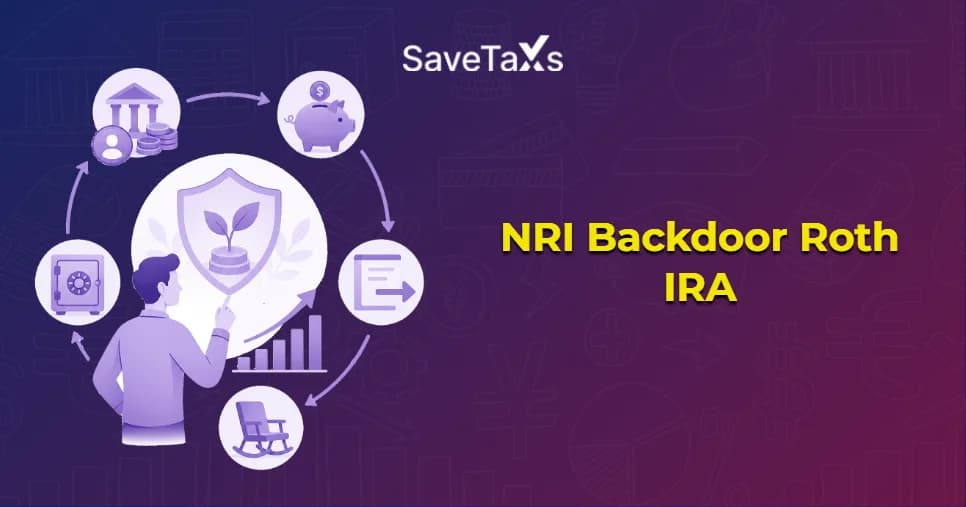
Are you a high-income earner wanting to contribute to a Roth? You must be aware that Higher-income taxpayers may be unable to make a full direct contribution to a Roth IRA because Roth IRA contribution limits are subject to income phase-outs. A Backdoor Roth IRA can be an alternative for eligible taxpayers. However, not to worry, as there is one strategy that can help you with this situation, called a Backdoor Roth IRA.
The Backdoor Roth IRA is a strategy in which you don't contribute directly to a Roth IRA. Instead, you first contribute to a traditional IRA and later convert it to a Roth.
It is a legal strategy that involves complex tax paperwork and confusing pitfalls. Keep reading further to know more about the NRI backdoor Roth IRA strategy. We will understand how it works, who qualifies for this, the pro-rata rule, and much more.
A backdoor Roth IRA is a legal strategy for high-income earners. In this, anyone whose income is too high to contribute directly to a Roth IRA can instead contribute to a traditional IRA with after-tax money. After that, they can convert the contributions into a Roth IRA.
However, remember that it's just a workaround, so don't look for a special type of account termed a backdoor Roth. According to the IRS, anyone can contribute to a traditional IRA, regardless of their income, provided they didn't claim the tax deduction. Also, it allows anyone to convert traditional IRA money to a Roth IRA separately. Now, when you combine these two permitted moves, it is called a backdoor Roth.
As mentioned, it's for high-income earners, but do NRIs count in this? Let's see that.
Yes, if an NRI has U.S. earned income, like wages or self-employment, taxed in the U.S., they can use the backdoor Roth IRA strategy. However, investment or rental income will not be counted, as IRA contributions require taxable compensation.
For NRIs, this is the only important rule for eligibility. However, For IRA contribution purposes, compensation excluded under the Foreign Earned Income Exclusion or foreign housing exclusion generally does not count as compensation. Therefore, someone whose compensation is entirely excluded may not have sufficient compensation to make an IRA contribution. Additionally:
In simple words, you will not qualify for the IRA contribution under current rules if your only connection to the US is through investment or rental income.
Now, it's clear that an NRI can contribute to a backdoor Roth IRA, provided the conditions are met. Further, let's understand how the backdoor Roth IRA strategy works for NRIs.
Avoid any confusion with U.S. tax filing and file with 100% accuracy and confidence with Savetaxs.
Here's how the backdoor Roth IRA strategy works for NRIs:
Either open or use an existing traditional IRA and contribute using after-tax dollars up to the annual limit. Remember that you cannot purposefully claim the usual tax deduction for this contribution, as doing so would compromise the strategy's main purpose.
After your contribution settles in the traditional IRA, you can convert it to a Roth IRA. There is no IRS deadline requiring an immediate conversion. However, converting soon after the nondeductible contribution can minimize taxable earnings that may arise before the conversion.
Now comes the main part: filing IRS Form 8606. So, you generally file Form 8606 to report the nondeductible Traditional IRA contribution and to calculate the taxable and nontaxable portions of a Roth conversion. If the contribution and conversion occur in the same tax year, the relevant information can generally be reported on the same year's Form 8606.
It's mandatory to do this to prevent paying tax on the same income twice, as it shows the IRS that this money has been taxed already and must not be taxed again.
Next comes another question. Can I contribute as much as I want to a backdoor Roth IRA? Well, no, there are limits on how much you can contribute to a backdoor Roth IRA. Let's see this.
For 2026, you can directly contribute to a Roth IRA if your modified adjusted gross income (MAGI) is below $153,000 for single filers, or $242, 000 for married filing jointly, and above $168,000 for single filers and $252,000 for married couples. Since direct contributions are not allowed, this is when the backdoor route becomes useful.
| ---- | 2025 | 2026 |
|---|---|---|
| Annual IRA contribution limit | $7,000 ($8,000 if aged above 50) | $7,500 ($8,600 if aged above 50) |
| Roth phase-out begins (single) | $150,000 | $153,000 |
| Roth phase-out ends (single) | $165,000 | $168,000 |
| Roth phase-out begins (married filing jointly) | $236,000 | $242,000 |
| Roth phase-out ends (married filing jointly) | $246,000 | $252,000 |
One key point to note: The income cap does not restrict the backdoor Roth IRA process itself. There is no limit on the amount you can contribute to a non-deductible traditional IRA or convert it to a Roth account. Instead, it only states who needs to use this indirect method of funding a Roth IRA.
That's all about the Roth IRA contribution limit. Moving further, let's discuss the tax implications of a backdoor Roth IRA for NRIs.
The tax implications of a backdoor Roth IRA depend mainly on one thing, which is whether you already hold other traditional IRA money.
For easy understanding, let's look at an example.
Assume you have $27,000 total in traditional IRAs, with roughly $7,000 newly contributed after tax and $20,000 from an old pre-tax 401(k) rollover. In this case, instead of just the growth, 74% of any amount you convert will be taxed.
This is one reason the pro-rata rule can be a trap for many: a lot of people end up assuming they only need to consider their new contribution, and that is where they go wrong, as the IRS looks at everything.
Moreover, this is what a lot of NRIs do. If incoming rollovers are accepted in your current employer's 401(k) plan, you can move your pre-tax traditional IRA balance into that 401(k). This will remove it from the pro-rata calculation because 401(k) balances are not considered in this specific formula.
To better understand, let's look at a table that differentiates between a backdoor Roth IRA, a Roth IRA, and a Traditional IRA.
The table below lists the key differences between traditional IRA vs Roth IRA vs backdoor Roth IRA
| Features | Traditional IRA | Roth IRA (Direct Contributions) | Backdoor Roth IRA |
|---|---|---|---|
| Contributions | May be deductible or nondeductible | After-tax | Nondeductible Traditional IRA contribution |
| Growth | Generally tax-deferred | Generally tax-free if properly distributed
|
Roth growth can be tax-free when qualified |
| Direct income limit | Deduction may have limits | Yes | No income limit on conversion |
| Withdrawals | Generally taxable to extent taxable | Qualified withdrawals generally tax-free | Same Roth IRA withdrawal rules |
| RMDs during owner's lifetime | Generally yes | No | No |
When you withdraw funds from traditional IRAs in retirement, they are taxed as ordinary income because you likely have a deduction going in. Conversely, Qualified Roth IRA distributions are generally tax-free under U.S. tax rules. Nonqualified distributions may be subject to income tax and/or the 10% additional tax depending on the circumstances. However, to enjoy this benefit, you need to fulfill the account's holding period and age requirements.
Next, let's look at some common mistakes NRIs make when they choose to set up a backdoor Roth IRA.
Here are some common mistakes that an NRI must avoid when choosing the backdoor Roth IRA strategy:
Avoid these mistakes to prevent issues or repercussions. Finally, to recap everything, we will look at an example.
Jatin is an NRI who works as a computer engineer in the U.S on an H-1B visa. He satisfied the substantial presence test and hence was classified as a resident alien for tax purposes. He files the standard Form 1040 with W-2 wages well above the Roth IRA income phase-out.
He had made regular 401(k) contributions through his employer for years. Apart from that, he also has an old traditional IRA worth $15,000 from a rollover of a previous employer's 401(k), which is completely pre-tax.
He wanted to include Roth Savings as well. Hence, he contributed $7,000 to a new traditional IRA using after-tax money. Jatin planned to convert it to a Roth IRA shortly thereafter. However, before he invested, he contacted his financial advisor, a move that proved helpful.
His financial advisor told him he might encounter the pro rata rule, as his existing $15,000 pre-tax IRA balance would trigger it. It means that around 68% of his conversion will be subject to taxation, rather than what he expected to be tax-free.
Before converting, Jatin rolled the old $15,000 pre-tax IRA balance into his 401(k), thereby avoiding it from the pro-rata calculation entirely. After that, he converted his new $7,000 contribution to Roth, and he owed no tax on the conversion. Also, to document both the contribution and the conversion, he filed Form 8606.
By considering his case, we can understand that, just as the contribution is important, it's also crucial to check for old, forgotten IRA balances before converting.
Enjoy expert U.S. tax consulting with Savetaxs.
For NRIs with U.S. wages whose income has outgrown the direct Roth IRA income limits, the backdoor Roth IRA is the most convenient option. However, it's neither automatic nor available to every NRI. To determine whether this strategy will work well for you or will result in an unexpected tax bill, two important factors are earned income eligibility and the pro rata rules.
Moreover, we have now learned that an old 401(k) rollover or a forgotten IRA balance can easily complicate the math and how important it is to consider your U.S. tax residency. That said, to avoid any issues or stress, it's worth contacting an expert at Savetaxs before making your first contribution.
At Savetaxs, we have an entire team of cross-border financial advisors who can help you get everything right from the start. Our team can help you determine your correct U.S. tax residency, understand all the rules, and ensure compliance throughout the process. Connect with us right away, as our team is working 24/7 across all time zones to help you whenever you feel stuck.
Note: This guide is for information purposes only. The views expressed in this guide are personal and do not constitute the views of Savetaxs. Savetaxs or the author will not be responsible for any direct or indirect loss incurred by the reader for taking any decision based on the information or the contents. It is advisable to consult either a CA, CS, CPA or a professional tax expert from the Savetaxs team, as they are familiar with the current regulations and help you make accurate decisions and maintain accuracy throughout the whole process.
Hatim Dudhiyawala is a Certified Public Accountant (CPA) with SaveTaxs and specializes in Indian and NRI taxation. He advises individuals, NRIs, and businesses on income tax filing, capital gains taxation, DTAA benefits, fund repatriation, and tax compliance. With experience in cross-border tax matters, Hatim helps taxpayers understand complex regulations and make informed decisions. Through his articles, he shares practical insights to help readers stay compliant and manage their tax obligations with confidence. See Full Bio

Want to read more? Explore Blogs