NRI Income Tax Compliance
Documents Required for NRI to Buy Property in IndiaDocuments Required for NRI to Buy Property in India
Written by Vipul Jain
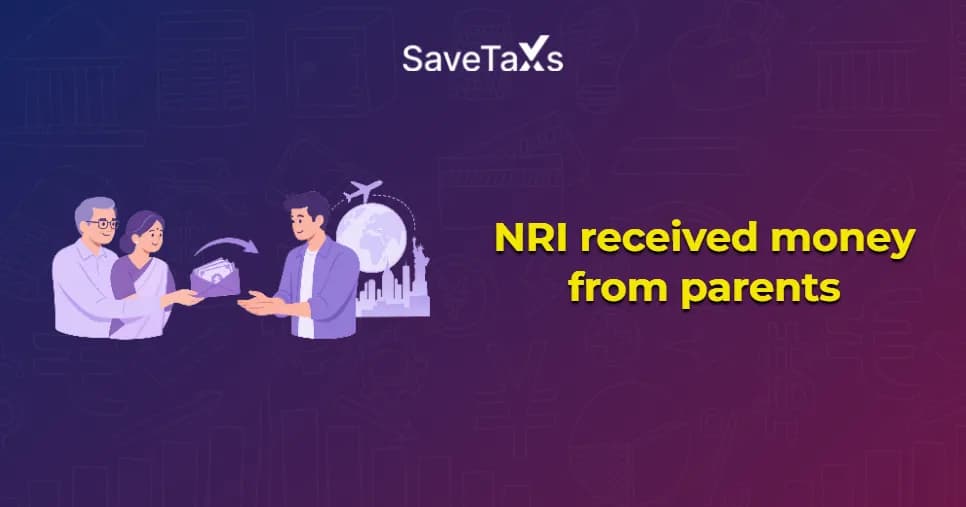
Imagine you are an NRI living in the US. To help you with your property down payment, your father in India sends you INR 20,00,000. Later, while preparing your tax documents, you might wonder whether this money is taxable in India, since it's a substantial amount moved across borders.
This is a common issue faced by most NRIs like you. Money received by an NRI from parents as a genuine gift is not taxable in India, whether it is INR 5 lakh, INR 10 lakh, or more. This is because gifts received from specified relatives are not taxable in India, regardless of the amount. In simple terms, whether money sent by a relative to an NRI is taxable in India depends on your relationship with the sender and the nature of the transfer.
Still confused and want to know more? Read the blog and learn how gift taxation works in India for NRIs.
An NRI gift from parents refers to any transfer of money, property, or assets given by parents to their NRI children without any consideration or monetary returns. In simple words, it is a genuine gift sent by Indian parents to their NRI children. It is not taxable in India as a genuine gift from a parent, regardless of whether you are:
Here is an important point to consider. The amount you receive should be a genuine gift from a parent, not payment for business income or services. Also, keep the original gift amount and any income you generate from India separate.
This was all about what an NRI gift from India is. Next, let's look at why this gift from parents is generally not taxable, regardless of the amount.
Connect with Savetaxs and fulfill your tax obligations in India on time and maximize your refunds.
A gift from parents to an NRI child is not taxable in India because parents fall under the category of specified relatives, and gifts received from them are not taxable, regardless of the amount. Under section 56(2)(x) of the Income Tax Act, 1961, certain money, property, and other assets received without consideration from relatives are excluded from tax. For tax years governed by the Income Tax Act, 2025, the corresponding provision is section 92.
Under the Income Tax Act, 1961, for gift purposes, the term "relative" has a specific meaning. It includes the spouse, siblings, lineal ascendants, descendants of the individual or spouse, and the spouses of these persons. In simple terms, it includes parents, grandparents, children, grandchildren, siblings, siblings of either parent, siblings of the spouse, and spouses of the specified persons.
Here, non-relatives include cousins and distant relatives who do not fall within the specified-relative definition. In addition, a gift from them is taxable if it exceeds INR 50,000 in a financial year.
For instance, if an NRI receives INR 25 lakh from a resident parent, it is not taxable as a gift in India even if it exceeds INR 50,000. Here, you should not calculate the taxable amount as:
INR 25,00,000 - INR 50,000 = INR 24,50,000 taxable
As mentioned earlier, the INR 50,000 threshold applies to gifts received from a non-relative. In the example above, if an NRI receives the same amount (INR 25,00,000) from a friend, it will be taxable in India. This is because a friend falls under the category of a non-relative. In addition, the full amount is taxable, not just the excess.
That is why an NRI doesn't pay tax on money received from parents. Next, let's look at when the INR 50,000 threshold applies to gifts sent to NRIs.
The INR 50,000 gift threshold limit applies to NRIs when they receive the amount from non-relatives. So, if the total value of gifts received from non-relatives in a financial year exceeds INR 50,000, the whole amount is taxable in India, subject to applicable tax rules and exceptions.
For instance, if an NRI receives:
Here, the aggregate exceeds the INR 50,000 threshold. So, under the applicable gift provision, tax applies to the entire amount, not only the excess. Section 56(2)(x) applies for relevant earlier tax years, while Section 92 applies for tax years governed by the Income Tax Act, 2025.
However, any gift an NRI receives on the occasion of their marriage is covered by the statutory exception to the INR 50,000 threshold. The tax treatment applies regardless of:
*Note: This exception only applies to an NRI who is getting married. It does not apply to NRI parents or other family members for gifts received during the wedding.
This is about when the INR 50,000 threshold applies to NRIs. Now, moving forward, let's clarify what counts as a genuine gift.
A gift is genuine when received voluntarily, without any consideration or expectation of something in return. Money received by an NRI from parents in India is considered a genuine gift if the parents intended to give you the money voluntarily, without any consideration or payment for something else.
Confused? Look at the table below and get an overview of what counts as a genuine gift.
| Transactions | How the transfer is analyzed |
|---|---|
| Father transfers INR 10,00,000 as a gift | Gift |
| Mother transfers INR 4,00,000 for financial support | Generally considered a gift but depends on facts |
| Parents pay for professional services | Income/payment for services |
| Parents repay money that you previously lent them | Repayment of loan |
| Parents transfer money as part of an asset purchase | Transaction consideration |
| Parents provide a formal loan | Loan |
So, do not consider every transaction in which you, as an NRI, received money from parents in India. Now, moving ahead, let's know how much money can parents gift to NRI child.
Under FEMA regulations and the Liberalised Remittance Scheme (LRS), a resident individual may make permitted remittances up to USD 250,000 per financial year (April-March), subject to applicable conditions. This is not a blanket tax exemption for either the parents or the NRI child. This means the INR 50,000 threshold does not apply to a genuine gift from Indian parents to an NRI, regardless of the amount.
For instance:
In addition, parents can make these transactions to an NRI subject to the applicable FEMA, RBI, banking, remittance, and documentation requirements.
*Important Point to Consider: In case of gifting to an NRI, the Income Tax Act and FEMA operate separately.
In simple terms, money received by an NRI from parents is not taxable as a genuine gift under the Income Tax Act, but it still requires compliance with FEMA rules.
In the next section, let's briefly review the FEMA rules NRIs should consider.
As mentioned earlier, even if a gift from a parent is not taxable under the Income Tax Act, it should comply with FEMA regulations. Under the LRS, a resident individual may make permitted remittances up to USD 250,000 per financial year. With that in mind, check the nature of the gift, the permitted method of transferring money, the account type, and any applicable FEMA limits or conditions, separate from Income Tax laws. It is specifically essential when:
*Note: You cannot apply the income tax exemption as evidence to comply with FEMA rules. In addition, for large-amount transfers, first check the applicable FEMA requirements and documentation requirements of your bank.
This covers the FEMA rules NRIs should consider when receiving money from parents. Now, moving ahead, let's know in which account an NRI should receive money.
A permitted rupee gift from an Indian resident to an NRI close relative is generally credited to the NRO account, subject to applicable FEMA/RBI conditions. This is because an NRO account is used for managing income generated in India and other permitted rupee receipts in India. In contrast, an NRE account is a rupee account for non-residents and is used for permitted credits such as inward remittances from outside India, subject to applicable RBI rules. Eligible funds in an NRO account may generally be repatriated up to USD 1 million per financial year, subject to applicable FEMA/RBI conditions, tax compliance, and documentation requirements.
*Note: Generally, for a permitted rupee gift from an Indian resident to an NRI close relative, the amount is credited to the NRO account. However, based on where the funds originated, the nature of the transaction, and applicable FEMA/RBI rules, the account type and transfer route are determined.
Now, let's see what happens if you invest money gifted by your parents.
If you invest money gifted by an Indian parent, the gift is not taxable as a gift in India, but the income it generates may be taxable. In simple terms, both the gift and the income generated from the gift face two different tax treatments.
For instance, your parents send you INR 10,00,000, and you invest it in your country of residence. The tax treatment of the income generated from that investment depends on the applicable rules of the country of residence and the nature of the investment. Here is how it works:
In simple terms, a gift from parents to NRI child that is not taxable as a gift does not make the future income generated from that gift tax-free. So, if you invest the gifted money and it generates income, you may be liable to pay tax on it depending on the nature and location of the investment and your applicable tax status.
Moving ahead, let's see: does your NRI residential status matter when receiving money from parents in India?
Yes, your residential status matters, but for a broader reason, not for receiving a gift from parents. Under Indian income tax law, your residential status helps in determining your tax obligations in the country for the current financial year. This is because not every individual living outside India is an NRI for Indian tax purposes; residential status is determined under the applicable statutory tests.
It becomes important if you have the following income in India:
The NRI residential status matters in determining your tax obligations when you have a source of income in India. Moving forward, let's find out whether you need to report the gift in your ITR.
A genuine gift received from your parents is not taxable as a gift in India. However, whether you need to report the gift in your ITR depends on the applicable return form and disclosure requirements. The gift itself does not automatically create an ITR filing obligation. Your tax liability in India depends on your other sources of funds and residential status in India.
Although gifts from your parents or relatives are not taxable, it is advisable to keep clear records. This is because if the transaction is large, you should be able to easily explain it:
This helps you answer tax officials if they question the transaction. Moving ahead, let's know the documents you should keep when receiving a gift from a parent.
You should keep the following documents with you when receiving a monetary gift from your parents:
Keep these documents with you when receiving a gift from your parents in India. Now, moving forward, let's consider what happens if your parents send you money regularly.
Even if your parents send you money regularly, it can still be not taxable in India if each transfer is a genuine gift from a specified relative. Parents fall under the specified relatives in the gift tax law, and any genuine gift you receive from them is not taxable, regardless of the amount.
However, regular and large transactions need attention to identify the purpose and supporting documents. For instance, there is a clear difference between:
Further, if the money transferred is a genuine gift, keep proper records that clearly define its nature. If it is a loan repayment, salary, or other income, document it accordingly. Let's better understand this with examples.
It is a genuine gift that you are receiving from your mother. Although it exceeds the INR 50,000 threshold, it is not taxable in India. This is because a specified relative sent it to an NRI as a gift. Maintain a record of the transaction and follow the applicable transfer rules.
You invested INR 10,00,000, a gift received from your parents in India, into an investment and earned INR 60,000 interest. The tax treatment of the interest depends on where the investment is held and your applicable tax status. If the investment is outside India, the interest may be taxable under the rules of that jurisdiction. If the investment is in India, the interest may be taxable in India under the applicable rules.
Now, moving ahead, common mistakes NRIs should avoid when receiving money from parents living in India.
Here are some of the common mistakes that NRIs should avoid when receiving gifts from India:
These are key things to consider when receiving a gift from parents living in India. Now, let's look at a few things NRIs should consider when receiving a gift from parents through a quick checklist.
With Savetaxs, get clear guidance based on your relationship with the donor and your residential status in India.
You need to consider the following things when receiving money from parents:
So, when you receive money from your parents, use this checklist for a quick overview.
Lastly, from the above information, it is clear that a genuine gift from Indian parents to an NRI is not taxable as a gift in India regardless of the amount. However, it must be a genuine gift, not a repayment. This is because parents fall under the specified relative category under the Indian gift tax rules. In addition, the INR 50,000 threshold limit does not apply to them.
Furthermore, if you are still confused about whether money received from parents is taxable for an NRI and need assistance, connect with Savetaxs. We have a team of cross-border tax experts who help you better understand your tax obligations in India.
This article is for general informational purposes only and does not constitute tax, legal, financial, or investment advice. Laws, regulations, rates, and procedures may change over time and may vary based on individual circumstances.
While SaveTaxs makes reasonable efforts to keep the information accurate and up to date, readers should verify applicable rules with official authorities or consult a qualified professional before making decisions based on this information.
Hatim Dudhiyawala is a Certified Public Accountant (CPA) with SaveTaxs and specializes in Indian and NRI taxation. He advises individuals, NRIs, and businesses on income tax filing, capital gains taxation, DTAA benefits, fund repatriation, and tax compliance. With experience in cross-border tax matters, Hatim helps taxpayers understand complex regulations and make informed decisions. Through his articles, he shares practical insights to help readers stay compliant and manage their tax obligations with confidence. See Full Bio

Want to read more? Explore Blogs