NRI Income Tax Compliance
How Much Gold Is Allowed From Dubai to India? Guide To 2026 LimitsHow Much Gold Is Allowed From Dubai to India? Guide To 2026 Limits
Written by Shubham Jain


If you've seen the word “repatriable” on an NRI bank, investment, or financial document, you may wonder exactly what it means. In this guide, we'll explain the repatriable meaning, how repatriable funds work, and how they differ from non-repatriable funds.
Repatriable generally means money or an asset can be transferred to another country or jurisdiction, subject to applicable rules.
Repatriable funds can be transferred abroad when the relevant legal, banking, tax, and foreign-exchange requirements are satisfied.
NRE and FCNR(B) accounts are examples of Indian accounts with repatriable features for eligible non-residents.
Repatriable does not mean unrestricted, because the source and nature of funds can determine what transfer rules apply.
Non-repatriable funds are generally subject to restrictions on transferring the balance outside India, although specific exceptions can apply.
NRO balances have specific repatriation rules rather than being treated in exactly the same way as NRE balances.
Before transferring funds internationally, you should verify the current requirements with your bank and the applicable official regulations.
Repatriable means capable of being transferred or returned to another country or jurisdiction, subject to applicable laws and conditions. The term is commonly used for money, investments, income, or other financial assets that can legally be moved across borders.
For example, if an eligible NRI holds funds in an account that permits repatriation, those funds may be transferred outside India through the permitted banking process. The exact requirements depend on the type and source of the funds.
Repatriable funds are funds that may be transferred abroad when the relevant legal, tax, and banking requirements are satisfied. Therefore, “repatriable” describes an ability or permitted status; it does not mean that a transfer is automatically available without documentation or restrictions.
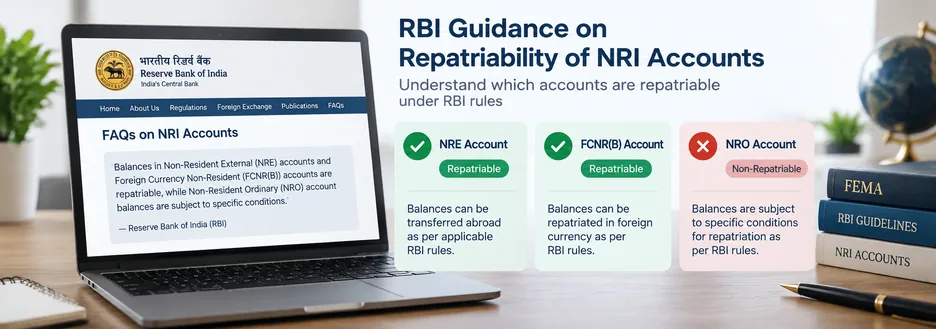
In Indian financial usage, the term is particularly relevant to NRI banking and foreign-exchange transactions. RBI guidance identifies NRE and FCNR(B) accounts as repatriable, while NRO accounts have different repatriation treatment.

Repatriability matters because it determines whether and under what conditions funds can be moved across international borders. This distinction can be important when an NRI receives income in India, maintains an Indian bank account, or holds Indian investments.
For example, two accounts may both contain money belonging to an NRI, but the applicable repatriation rules can differ depending on the account and the nature of the balance.
Moreover, repatriable does not mean unrestricted. FEMA, RBI directions, tax requirements, banking procedures, and transaction-specific conditions can affect an actual transfer.
Get Expert Advise on Your Fund Repatration
Repatriable funds are funds that are eligible for transfer outside the country under the rules applicable to those funds. The key factor is not simply who owns the money but also where it came from and which regulatory provisions apply.
For example, RBI guidance states that NRE account balances are repatriable, while NRO account balances have separate rules and permitted exceptions.
For an NRI, repatriable generally describes money or assets in India that can be transferred outside India under applicable foreign-exchange rules. NRE and FCNR(B) accounts are commonly associated with repatriable funds.
For example, an eligible NRI holding funds in an NRE account may be able to remit those funds abroad through the permitted banking channels. By contrast, an NRO account has distinct rules governing the repatriation of its balance.
If you are researching NRI Bank Accounts, compare the account type and its repatriation rules before choosing an account.
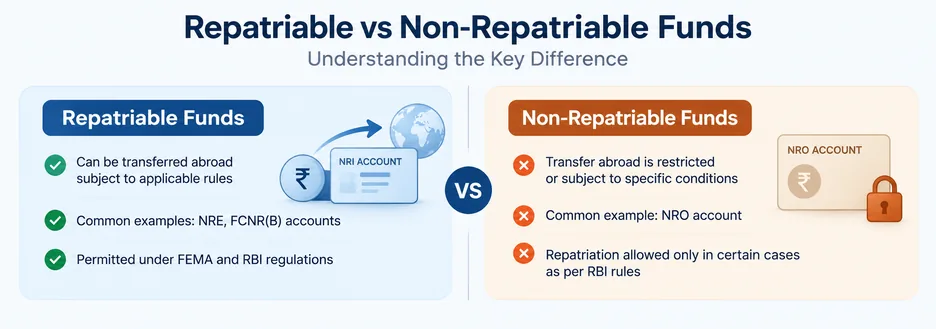
Repatriable funds can generally be transferred abroad under applicable rules, while non-repatriable funds are subject to greater restrictions on such transfers.
| Feature | Repatriable | Non-Repatriable |
|---|---|---|
| Basic meaning | Eligible for permitted overseas transfer | Transfer abroad is restricted or subject to specific exceptions |
| Common NRI example | NRE/FCNR(B) balances | Certain NRO balances |
| Conditions | Banking and regulatory requirements may apply | Specific exceptions and limits may apply |
| Key consideration | Source and nature of funds | Source, nature, and applicable repatriation rules |
RBI guidance specifically distinguishes NRE and FCNR(B) accounts from NRO accounts for repatriability purposes.
The repatriability of money depends on its source, account or asset type, ownership, and the regulations applicable to the transaction. This is why you should not assume that every amount held by an NRI has identical repatriation treatment.
For example, RBI guidance permits certain NRO balances to be remitted abroad subject to specified conditions, while NRE balances have repatriable status.
In addition, tax compliance can be relevant when money is transferred internationally. The Income Tax Department provides procedures and forms for certain foreign remittances, and current requirements depend on the nature of the payment and applicable tax provisions.
You can determine whether funds are repatriable by identifying their source and checking the rules applicable to the relevant account, investment, or transaction. A practical review can follow these steps:
Identify the source of funds, such as salary, investment income, sale proceeds, or interest.
Identify the account or asset type, because different categories can have different repatriation treatment.
Check applicable RBI and FEMA requirements for the transaction.
Confirm tax and documentation requirements before initiating the transfer.
Ask your authorised dealer bank to confirm the applicable remittance process.
Before repatriating money, verify the source of the funds, applicable foreign-exchange rules, tax requirements, and documentation with your bank. This is especially important when the money comes from investments, property transactions, or other regulated sources.
For example, an NRI transferring money from an NRO account should not assume that the entire balance is automatically repatriable because NRO balances are governed by specific RBI rules and conditions.
Money Transfer From India to Abroad
If the transaction involves complex tax or regulatory issues, obtaining professional advice before initiating the transfer can help prevent documentation or compliance problems.
Repatriable means that money or an asset is capable of being transferred across borders under applicable rules and conditions. For NRIs, the term commonly appears in connection with Indian bank accounts, investments, income, and overseas transfers.
Ultimately, repatriability depends on the source and nature of the funds and the rules governing the specific transaction. If you are planning an actual transfer, check the current RBI, FEMA, tax, and banking requirements rather than relying only on the label “repatriable.”
This article is for general informational purposes only and does not constitute tax, legal, financial, or investment advice. Laws, regulations, rates, and procedures may change over time and may vary based on individual circumstances.
While SaveTaxs makes reasonable efforts to keep the information accurate and up to date, readers should verify applicable rules with official authorities or consult a qualified professional before making decisions based on this information.
Shubham Jain is the Founder of SaveTaxs and has extensive experience in Indian and NRI taxation. He advises individuals, NRIs, and businesses on tax filing, tax planning, capital gains, DTAA benefits, fund repatriation, and compliance matters. He regularly writes about taxation and related financial topics. His focus is on making complex tax concepts easy to understand. Through his articles, he helps taxpayers stay informed, avoid common mistakes, and stay compliant with Indian tax laws. See Full Bio
Want to read more? Explore Blogs