
NRI Income Tax Compliance
Top Reasons NRIs Trust SaveTaxs for Tax ComplianceTop Reasons NRIs Trust SaveTaxs for Tax Compliance
Written by Hatim Dudhiyawala

If you have Indian income while living abroad, you've probably already checked your annual tax filing obligations. However, September can create an important mid-year tax checkpoint, particularly because an advance-tax instalment may fall due. In this guide, you'll find the September 2026 NRI tax compliance checklist, including applicable deadlines, TDS and tax-credit reviews, documents to collect, and actions to complete before the month ends.
September advance tax can be relevant when an NRI's estimated tax liability meets the applicable threshold after considering TDS and other credits.
15 September 2026 is the key advance-tax instalment date for taxpayers subject to the regular instalment schedule for Tax Year 2026–27.
AIS and Form 26AS should be reconciled with Indian income, TDS, TCS, and tax payments before relying on the available tax-credit position.
Rental income, interest, investments, salary, and property transactions can create different Indian tax obligations for NRIs.
September does not impose the same compliance requirements on every NRI; applicability depends on income, transactions, tax liability, and the taxpayer's circumstances.
Tax Year 2026–27 is governed by the Income Tax Act, 2025 for income earned from 1 April 2026 onward.
Review, reconcile, pay or file, and retain records is a practical four-step approach for September compliance.
An NRI tax compliance checklist is a practical review of the Indian tax payments, TDS, records, transactions, and deadlines that apply to an NRI based on their individual tax situation.
First, the checklist is taxpayer-specific rather than universal. For example, an NRI earning only exempt income may have very different September obligations from an NRI receiving rent, bank interest, dividends, and capital gains from India.
Moreover, September 2026 falls within Tax Year 2026–27, which is governed by the Income Tax Act, 2025 for income earned from 1 April 2026 onward. The Income Tax Department confirms that advance-tax payments for Tax Year 2026–27 are governed by the new Act.
An NRI tax compliance checklist identifies the tax actions an NRI should review based on Indian income, transactions, and applicable deadlines.
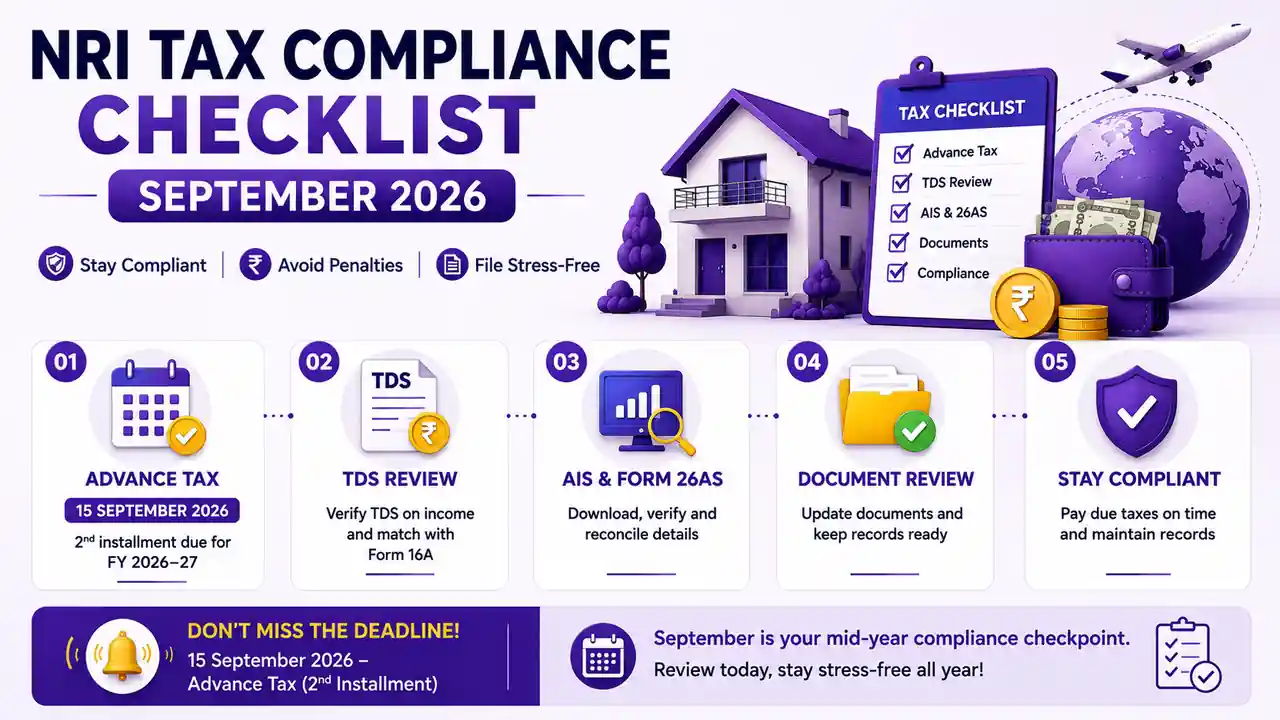
September 2026 matters because 15 September is the second regular advance-tax instalment deadline for taxpayers who are required to pay advance tax under the quarterly instalment system.
First, the Income Tax Department's guidance states that taxpayers with estimated annual tax payable of ₹10,000 or more, after applying the relevant advance-tax rules, generally fall within the advance-tax requirement. For the regular instalment schedule, 45% of the annual advance-tax liability is due by 15 September, after accounting for advance tax already paid.
Second, the September review is useful even when no payment is due. NRIs should reconcile their Indian income, TDS, and available tax-credit information before determining whether additional tax payment or other compliance action is required.
Statistic: The advance-tax threshold remains ₹10,000 of estimated tax payable under the Income Tax Act, 2025. — Source: Income Tax Department, 2026
The September 2026 NRI tax compliance checklist focuses first on advance tax and then on TDS, income records, transactions, and supporting documents.
| September 2026 action | Who should review it? | Key date/action |
|---|---|---|
| Advance-tax instalment | NRI with applicable estimated tax liability | 15 September 2026 |
| TDS reconciliation | NRI receiving salary, rent, interest or other TDS-applicable income | Review during September |
| AIS/Form 26AS review | NRI with Indian income or reported transactions | Review and reconcile |
| Income review | NRI with rent, interest, investments, salary or other Indian income | Update estimated annual position |
| Tax-payment records | NRI who has paid advance/self-assessment tax | Match challans with tax records |
| Transaction documentation | NRI with investments or property transactions | Collect and retain supporting records |
Advance tax is a prepayment of estimated income tax during the tax year, and NRIs are not automatically exempt simply because they live outside India.
First, estimate your Tax Year 2026–27 Indian tax liability and subtract eligible TDS, TCS, and advance-tax credits already available. If the resulting liability meets the applicable advance-tax threshold, check whether the September instalment is required.
For example, an NRI receives ₹6 lakh of Indian rental income and ₹2 lakh of interest during the year, while only part of the expected tax is covered by TDS. The NRI should recalculate the projected tax position before 15 September rather than assuming the TDS fully settles the liability.
For September 2026, the regular second advance-tax instalment is due by 15 September and brings cumulative advance-tax payment to 45% of the annual liability, after considering earlier instalments.
Please Check Dedicated Savetaxs Advance-Tax Guide
TDS reconciliation means comparing tax deducted from your Indian income with the TDS actually reflected in your tax records.
First, check TDS on salary, rent, interest, dividends, property-related payments, and other applicable income. For example, an NRI receiving monthly rent may see TDS deducted by the tenant but should still verify that the tax credit is correctly reported.
Second, review Form 26AS and AIS. The Income Tax Department states that Form 26AS contains information including TDS, TCS, advance tax, self-assessment tax, specified financial transactions, property-sale TDS, and certain demand or refund information. AIS contains broader reported information, including TDS/TCS, SFT information, tax payments, demand/refund and other data.
Calculate Your TDS on Savetaxs NRI TDS Calculator
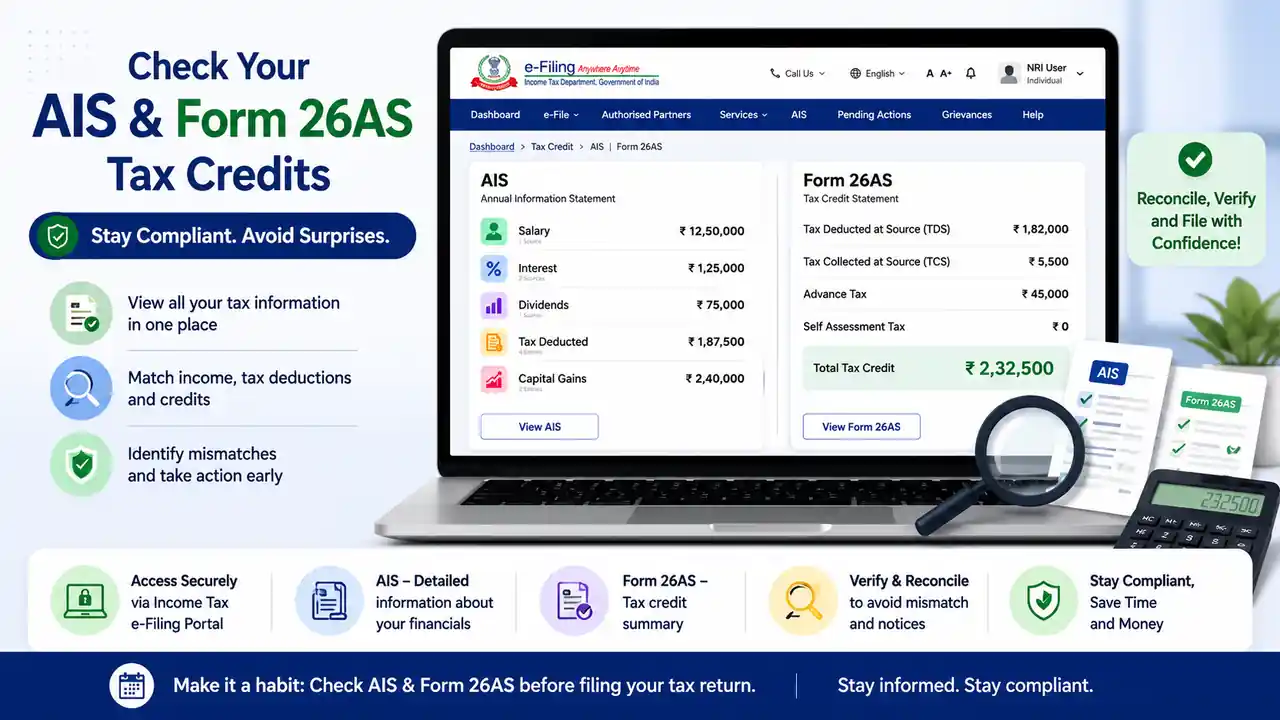
Indian income review means updating your estimate of taxable income for the current tax year using actual receipts and transactions recorded through September.
First, review rental income and interest income. Include rent actually received or receivable as applicable and reconcile interest reported by Indian banks and financial institutions against your own statements.
Second, review investment and capital-gain transactions. For example, if you sold mutual funds or shares during the year, retain transaction statements and purchase information so the eventual tax computation can be supported.
Third, check Indian property transactions if you bought or sold property during the year. Property transactions can involve separate TDS and documentation requirements, so they should not be treated as ordinary bank-income entries.
Check Savetaxs NRI Property-Tax Guide
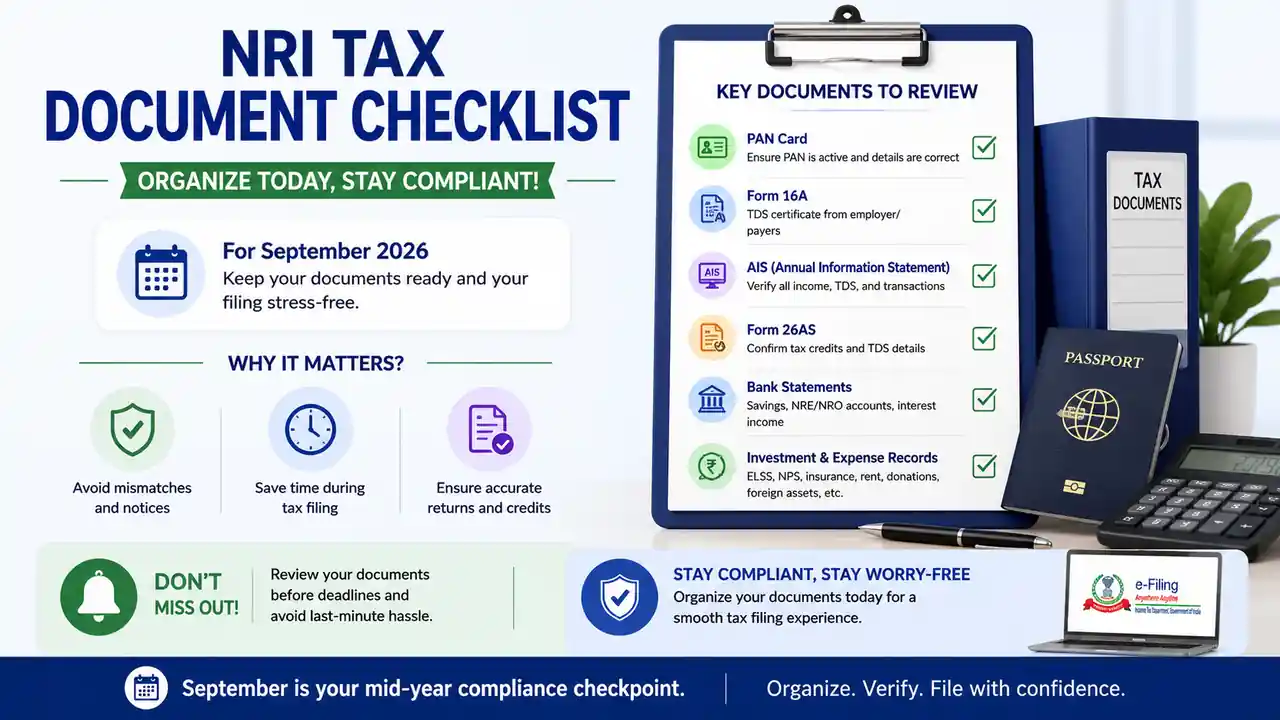
An NRI document checklist is a collection of tax, banking, income, and transaction records needed to support the current-year tax position.
First, keep the following records updated:
PAN and e-Filing account details
TDS certificates, including applicable Form 16A
AIS and Form 26AS
Indian bank statements
Rental agreements and rent receipts
Investment statements and transaction reports
Property purchase or sale documents
Advance-tax and other tax-payment challans
Records supporting foreign-tax or DTAA claims, where relevant
Second, compare documents rather than simply downloading them. A tax record is useful only when the amount reported by the payer, the amount credited to you, and the tax credit shown by the department are consistent.
For example, if your bank statement shows ₹1,00,000 of interest but your available tax records show a materially different amount, investigate the difference before finalising your tax estimate.
The Income Tax Department confirms that Form 16A is a quarterly TDS certificate containing the amount deducted, nature of payment, and related TDS-payment information.
Savetaxs NRI Income Tax Filing
September tax compliance applies differently depending on the NRI's income sources and transactions.
First, an NRI with salary income should review employer TDS and projected annual tax liability, particularly if other Indian income exists. The Income Tax Department states that salary TDS for Tax Year 2026–27 is governed by the Income Tax Act, 2025.
Second, an NRI with rental income should reconcile rent, TDS, bank receipts, and estimated tax liability. An NRI with significant rent but insufficient TDS may need to evaluate advance tax.
Third, an NRI investor should review interest, dividends, capital gains, and corresponding TDS or TCS information.
Fourth, an NRI selling property should retain sale documents, transaction statements, TDS records, and supporting cost information. A property sale can require additional analysis beyond this September checklist.
Finally, an NRI with no material Indian taxable income or applicable tax liability may have no September payment to make. However, reviewing available tax information can still help identify unexpected TDS, reported transactions, or outstanding demands.
Not every September tax requirement applies to every NRI; applicability depends on factors such as Indian-source income, estimated tax liability, TDS, and relevant financial transactions.
Tax tools can simplify the September review by helping you estimate liability and identify potential TDS gaps.
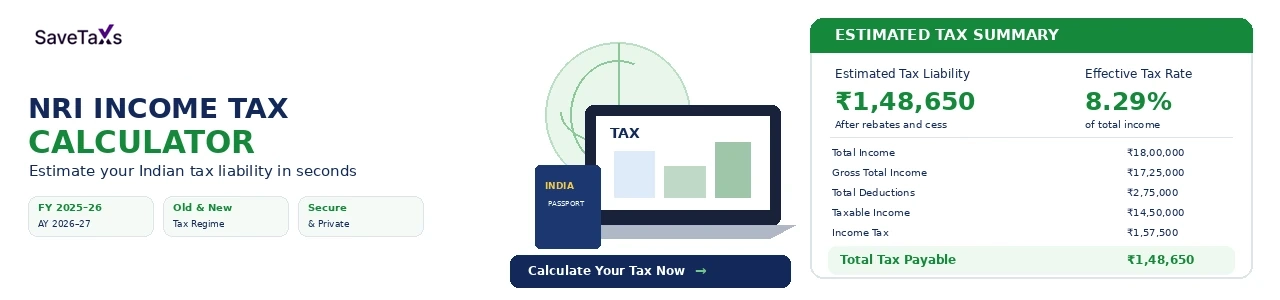
First, an NRI Income Tax Calculator can help estimate the projected tax position using current income information. Use the result as a planning estimate rather than treating it as a substitute for a complete tax computation.
Second, an NRI TDS Calculator can help estimate withholding on applicable income and compare expected TDS with your projected liability.
Free alternatives can also help with verification. For example, the Income Tax Department e-Filing portal provides access to AIS, Form 26AS, tax-payment services, and related compliance facilities.
The September action plan is simple: identify, reconcile, pay or file, and retain.
First, identify whether the 15 September advance-tax instalment applies to you. Second, reconcile Indian income against TDS, TCS, AIS, Form 26AS, and tax-payment records.
Third, complete any required tax payment and retain the challan. Finally, save supporting documents for rental income, investments, bank interest, salary, and property transactions.
For example, an NRI earning rental and investment income can complete the review by estimating annual income, checking TDS, reviewing AIS and Form 26AS, calculating the remaining tax exposure, and making any required advance-tax payment.
A practical NRI compliance review should follow four steps: identify applicable obligations, reconcile income and tax credits, complete required payments or filings, and retain supporting records.
September 2026 is an important tax-review checkpoint for NRIs, particularly because the second regular advance-tax instalment may be due on 15 September.
Moreover, the correct approach is not to assume that every NRI has the same obligation. Instead, review your Indian income, estimate your tax liability, reconcile TDS and tax credits, check AIS and Form 26AS, and identify transactions that require additional documentation.
For September 2026, NRIs should verify applicable deadlines using current Income Tax Department and CBDT guidance rather than relying on a generic tax calendar.
Before closing the month, use this final checklist:
Check whether the 15 September 2026 advance-tax instalment applies.
Estimate Tax Year 2026–27 Indian taxable income.
Reconcile TDS and TCS with AIS and Form 26AS.
Check Indian rental, interest, salary, investment, and property income.
Match advance-tax payments with challan records.
Collect missing TDS certificates and supporting documents.
Complete any applicable payment or compliance action.
Retain records for future tax filing and reconciliation.
This article is for general informational purposes only and does not constitute tax, legal, financial, or investment advice. Laws, regulations, rates, and procedures may change over time and may vary based on individual circumstances.
While SaveTaxs makes reasonable efforts to keep the information accurate and up to date, readers should verify applicable rules with official authorities or consult a qualified professional before making decisions based on this information.
Vipul Jain is the Co-Founder of SaveTaxs and a tax expert with experience in Indian and NRI taxation. He advises individuals, NRIs, and businesses on tax filing, tax planning, capital gains, DTAA, and compliance matters. He focuses on making complex tax concepts simple and helping taxpayers make informed, compliant decisions. See Full Bio
Want to read more? Explore Blogs