


Investment & Financial Planning
NRI Property Sale: How to Calculate Capital Gains TaxNRI Property Sale: How to Calculate Capital Gains Tax
Written by Shubham Jain

_1768307231.webp&w=3840&q=75)
Many NRIs, when investing in the Indian stock market, often get confused between an NRE demat account and an NRO demat account. Despite their similarities in being used by NRIs, these accounts are often confused and misunderstood with each other. Although both accounts are for NRIs, but have unique features and serve different purposes.
Further, to help you out, this blog aims to provide you understanding of the key differences between these account types. It helps you in making the correct decision that matches your financial goals. So read on and clear all your doubts about these accounts.
A non-resident external (NRE) demat account is crafted for NRIs who want to invest in the stock market of India. Through an NRE account, you can hold and trade securities in India while having your primary income earned overseas. This demat account is linked to your NRE savings account. It further facilitates easy repatriation and transfers.
Now, let' know the key features of an NRE demat account.
The key features of an NRE demat account are as follows:
This was all about the NRE demat account and its features. Moving ahead, let's know about the NRO demat account and its features.
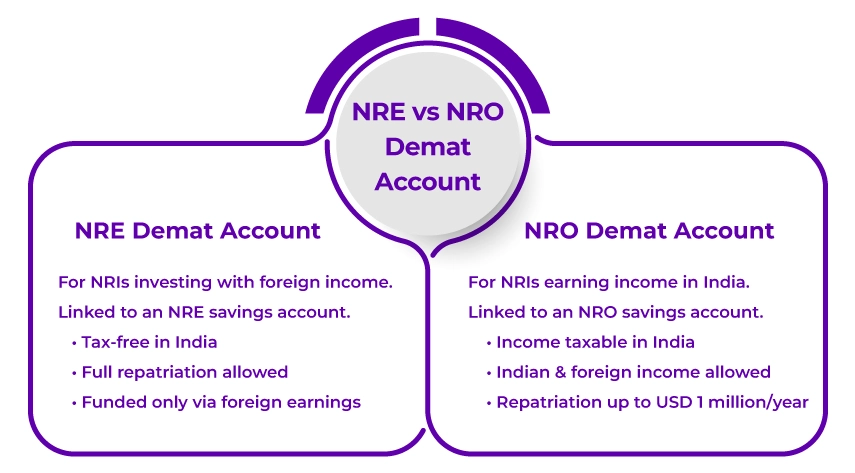
A Non-resident Ordinary (NRO) demat account is for those NRIs who have Indian income sources. For instance, rental income, pensions, or dividends. An NRO demat account helps you to manage and invest your Indian earnings in Indian securities. Additionally, this demat account is also linked to your NRO savings account, helping you manage your local funds.
Further, let's know the key features of an NRO demat account.
Here is the list of key features of an NRO demat account:
So, this is what an NRO demat account is and its key features. Now that you have a basic idea of both the demat accounts, let's look at the key differences between them.
To properly take advantage of the unique features and use the service, it is important to understand the key difference between NRE vs NRO demat accounts. Considering this, to help you out, the table below shows the difference between the two accounts:
| Basis | NRE Account | NRO Account |
|---|---|---|
| Meaning | These accounts are designed for NRIs to manage and transfer their earnings from overseas to India. | On the other hand, NRO accounts are designed for NRIs who want to manage their investments and income sourced within India. |
| Taxability | In NRE accounts, earnings are not taxable in India, including interest income. | The earnings from these accounts are subject to Indian taxes, including earned income from interest. |
| Repatriability | It allows full fund repatriation, including the principal and interest amounts, to the resident country. | Earned interest is repatriable. However, the principal amount repatriation is restricted by specific amount limits. |
| Joint Account | An NRE account can be held jointly with another NRI. | An NRO account can be held with both an NRI and an Indian resident. |
| Deposits and Withdrawals | Deposits in an NRI account should be made in foreign currency, while withdrawals should be in Indian Rupees (INR). | Deposits in an NRO account can be made in both Indian and foreign currencies. However, withdrawals should only be made in INR. |
| Exchange Rate Risk | Exposed to fluctuations in exchange rates, which impact the deposit value. | Exchange rate fluctuation does not create any impact on it, as the account manages INR deposits and withdrawals. |
| Fund Transfer | You can transfer funds from one NRE account to another or from one NRE account to an NRO or resident account. | Funds can only be transferred to an NRO account or a resident account. In the NRO account, transfer of funds to NRE accounts is not permitted. |
| Currency Fluctuation | Currency fluctuations are sensitive due to the foreign currency component. | Currency fluctuation in this account is not sensitive, as the account primarily operates with INR. |
These were the key differences between NRE and NRO demat accounts. Further, you can open both the demat accounts for NRIs if you have diverse sources of income and investment goals.
Connect with Savetaxs, with expert guidance, file your taxes in India, and stay compliant with the tax laws of the country.
Lastly, knowing the difference between NRE vs. NRO demat accounts for NRI investments is vital in India. NRE accounts help you keep and convert your foreign currency into INR. Additionally, allows you to repartiate funds fully without any restrictions. In contrast, an NRO account allows you to deposit both Indian and foreign currency; however, interest is taxable. It totally depends on your investment goals and income sources, which demat account you choose.
Further, if you are new to the financial markets and facing issues in opening an NRI demat account, connect with Savetaxs. We have a team of financial experts who can help you open a bank account. Additionally, choosing the right investment options as per your financial goals.
This article is for general informational purposes only and does not constitute tax, legal, financial, or investment advice. Laws, regulations, rates, and procedures may change over time and may vary based on individual circumstances.
While SaveTaxs makes reasonable efforts to keep the information accurate and up to date, readers should verify applicable rules with official authorities or consult a qualified professional before making decisions based on this information.
Vipul Jain is the Co-Founder of SaveTaxs and a tax expert with experience in Indian and NRI taxation. He advises individuals, NRIs, and businesses on tax filing, tax planning, capital gains, DTAA, and compliance matters. He focuses on making complex tax concepts simple and helping taxpayers make informed, compliant decisions. See Full Bio

Want to read more? Explore Blogs

_1781845771869.webp&w=828&q=75)
_1778936280179.webp&w=828&q=75)