US Tax Filing and Compliance
Is an S Corporation Worth It? Costs, Tax Benefits and Decision ChecklistIs an S Corporation Worth It? Costs, Tax Benefits and Decision Checklist
Written by Shubham Jain

Determining reasonable compensation is an important compliance responsibility for an S corporation whose owner works in the business. The salary should reflect the services the owner performs, not simply the amount the owner wants to withdraw or the tax savings the business hopes to achieve.
The IRS does not prescribe one salary amount or a universal percentage of business profit for every S corporation owner. When a shareholder performs services for the corporation, reasonable compensation generally depends on the facts and circumstances, including the owner's duties, experience, time devoted to the business, comparable compensation, and how the company generates revenue.
This guide explains how to assess reasonable compensation, what evidence can support the decision, and how to respond to potential IRS scrutiny.
Reasonable compensation is the amount an S corporation pays a shareholder-employee for services performed for the company. Compensation for those services is generally treated as wages and subject to applicable employment-tax and payroll-reporting requirements.
Under IRS guidance, an S corporation must determine and pay reasonable compensation to a shareholder-employee for services performed before treating payments to that shareholder as non-wage distributions. This requirement depends on the services performed and the payments made or owed; it does not automatically require wages for a shareholder who performs no services and is not entitled to compensation.
The rule matters because a shareholder-employee may contribute labor, professional expertise, management, or other services that help generate business revenue. Those services need to be evaluated when determining compensation.
For example, a consultant who personally delivers client projects performs different work from an owner who mainly oversees employees and business assets. Their compensation decisions may require different supporting evidence.
The objective is not to find the lowest possible salary. It is to determine an amount that can be reasonably supported by the work performed and the circumstances of the business.
Get expert help with S Corp tax returns and compliance.
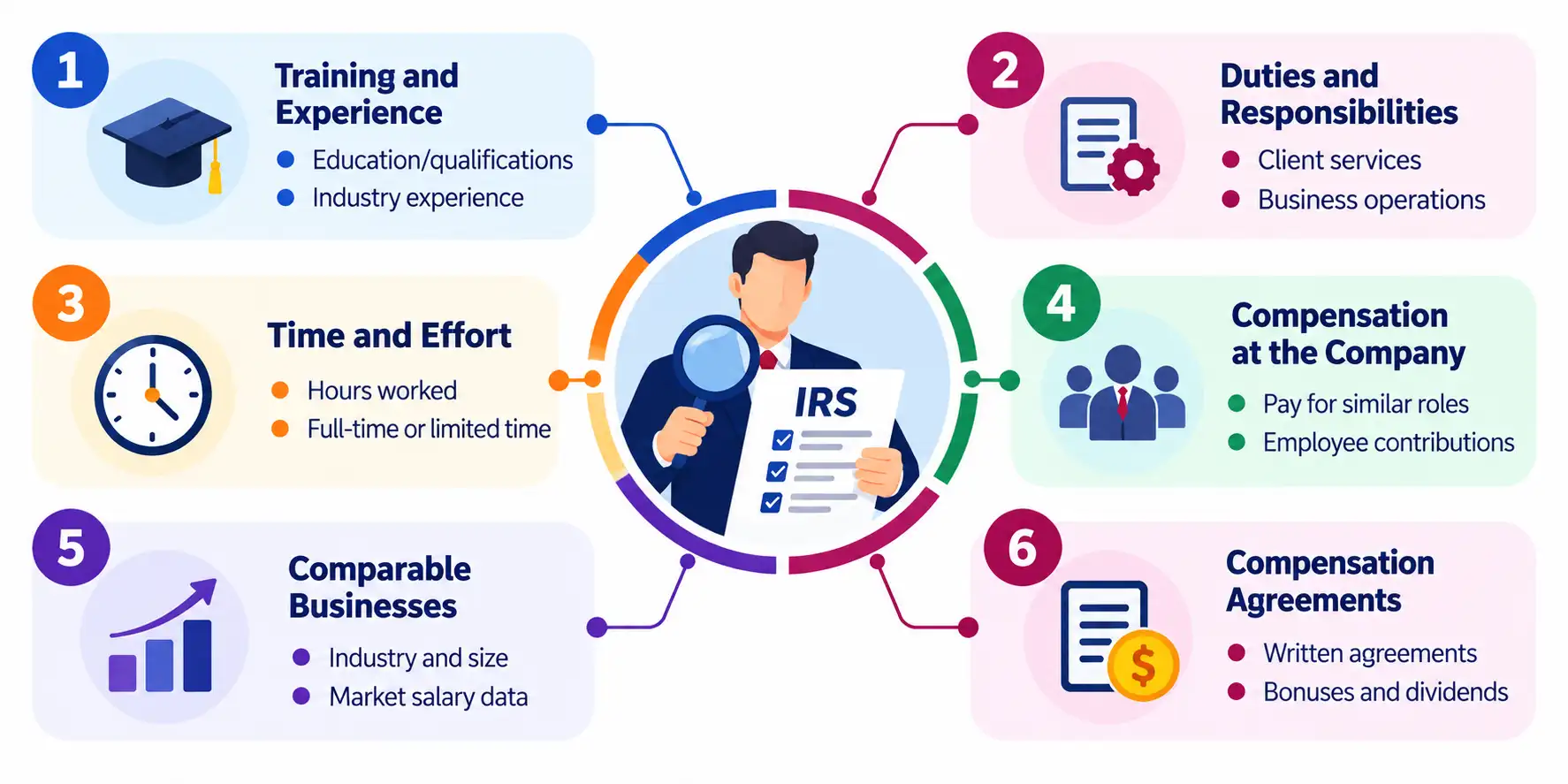
The IRS considers several factors when examining shareholder-employee compensation. No single factor automatically determines the correct salary; the overall facts matter.
An owner's education, professional qualifications, technical knowledge, industry experience, and specialized skills can influence the compensation that would ordinarily be paid for the work.
A business owner performing specialized professional services may require a different comparison from an owner performing routine administrative duties.
Identify the work the owner actually performs. Responsibilities may include:
The analysis should reflect the owner's real responsibilities rather than relying only on a title such as CEO, president, or managing member.
The number of hours an owner works and the time spent on different responsibilities can help establish the value of their services.
A full-time owner who performs revenue-generating work may require a different compensation analysis from an owner who contributes limited time to management.
Maintain realistic records of working hours and responsibilities where practical. These records can help explain how the salary decision was reached.
Review what the company pays non-shareholder employees who perform comparable work. Also consider whether employees perform services that generate revenue independently of the owner.
For instance, if a consulting firm's employees deliver most client projects, the owner's role may be primarily managerial. The compensation analysis should reflect both the owner's management work and any direct client services.
Market compensation data can help establish a reasonable benchmark. Comparisons should reflect similar roles, experience levels, industries, business sizes, and geographic markets.
Useful sources may include government wage statistics, credible salary surveys, relevant job listings, and industry-specific compensation information.
A general salary average is not enough on its own. The company should be able to explain why the selected comparison is relevant to the owner's actual duties.
The IRS also identifies factors such as compensation agreements, the timing and manner of bonuses paid to key employees, dividend history, and the use of formulas to determine compensation.
These records can help explain how the business arrived at its compensation amount and whether the arrangement is consistent with its actual operations.
Official reference: IRS —S Corporation Compensation and Medical Insurance Issues.
An important part of the IRS analysis is understanding how the S corporation generates its gross receipts.
The IRS identifies three major sources:
This distinction helps explain the role the shareholder plays in generating the company's income.
If the owner personally performs the services that generate business revenue, the value of that work is relevant to reasonable compensation.
For example, an owner who personally handles client consulting, design work, or professional services should evaluate the market value of those services when determining compensation.
If non-shareholder employees perform much of the revenue-generating work, the owner's role may focus more on supervision, operations, or management.
That does not mean the owner's services have no value. Administrative and managerial work supporting employees can also be relevant to compensation.
Some businesses rely heavily on machinery, equipment, facilities, or other capital assets. The compensation analysis should consider the owner's actual services alongside the role those business resources play in generating revenue.
The source of gross receipts is one factor, not a standalone formula. The corporation should consider the shareholder's direct work and any management or administrative services supporting employees or business assets. This analysis helps determine which payments represent compensation for services; it does not automatically classify all remaining profits as distributions.
The appropriate analysis depends on how the business operates.
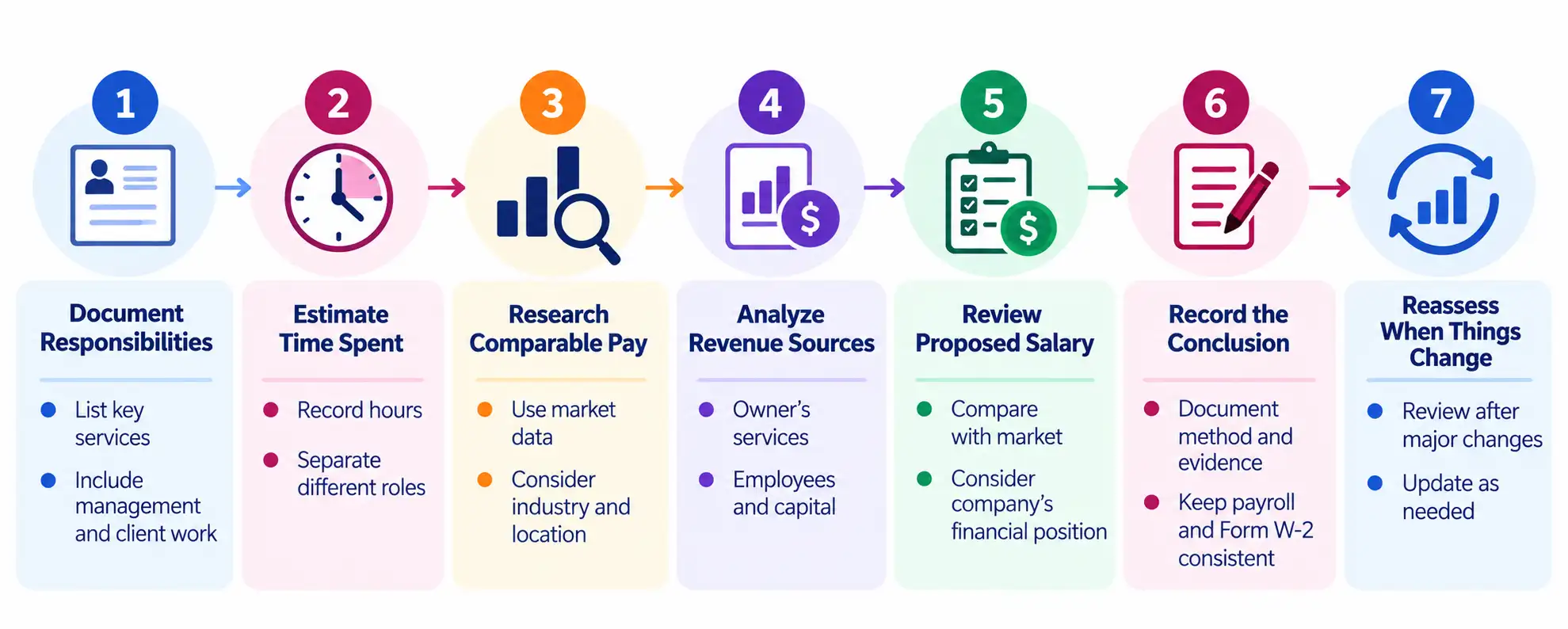
The IRS does not prescribe a universal salary calculator or fixed salary-to-profit percentage for determining reasonable compensation. Business owners can use a structured process to evaluate their compensation decision.
Step 1: Document the owner's responsibilities.
Prepare a clear description of the services performed, including management, client work, sales, technical duties, and administration.
Step 2: Estimate the time devoted to each responsibility.
Record the approximate hours spent on different activities. Where the owner performs several roles, distinguish between those responsibilities instead of treating the job as a single generic position.
Step 3: Research comparable compensation.
Identify credible market data for similar jobs, considering industry, location, experience, and the scale of the business. Save the sources used.
Step 4: Analyze the company's revenue sources.
Evaluate how much of the business's revenue is associated with the owner's services, employees, and capital or equipment. Consider the owner's managerial contribution to the work performed by others.
Step 5: Review the proposed compensation.
Compare the proposed salary with the duties, time commitment, market data, and business circumstances. Consider the company's financial position, but do not use profitability alone to establish a salary. Also review payments and benefits the shareholder receives directly or indirectly from the corporation, because the overall arrangement may affect how payments are characterized for tax purposes.
Step 6: Record the conclusion.
Prepare a written explanation of the method, evidence, assumptions, and reasons supporting the amount. Ensure the actual compensation payments, payroll records, Form W-2 reporting, and applicable employment-tax filings are consistent with the decision.
Step 7: Reassess when circumstances change.
A salary that was supportable when the business was small may need review after a major change in duties, staffing, services, or operations.
This process helps create a defensible record. It does not guarantee that the IRS will accept the amount, because the result depends on the facts and applicable law.
Documentation should show how the company determined compensation, rather than merely state the amount paid.
A reasonable-compensation file may include:
Keep the records with the company's regular accounting and payroll documentation. The evidence should reflect the facts at the time the compensation decision was made.
Avoid relying on unsupported salary estimates or copying another company's compensation figure without considering the differences between the businesses.
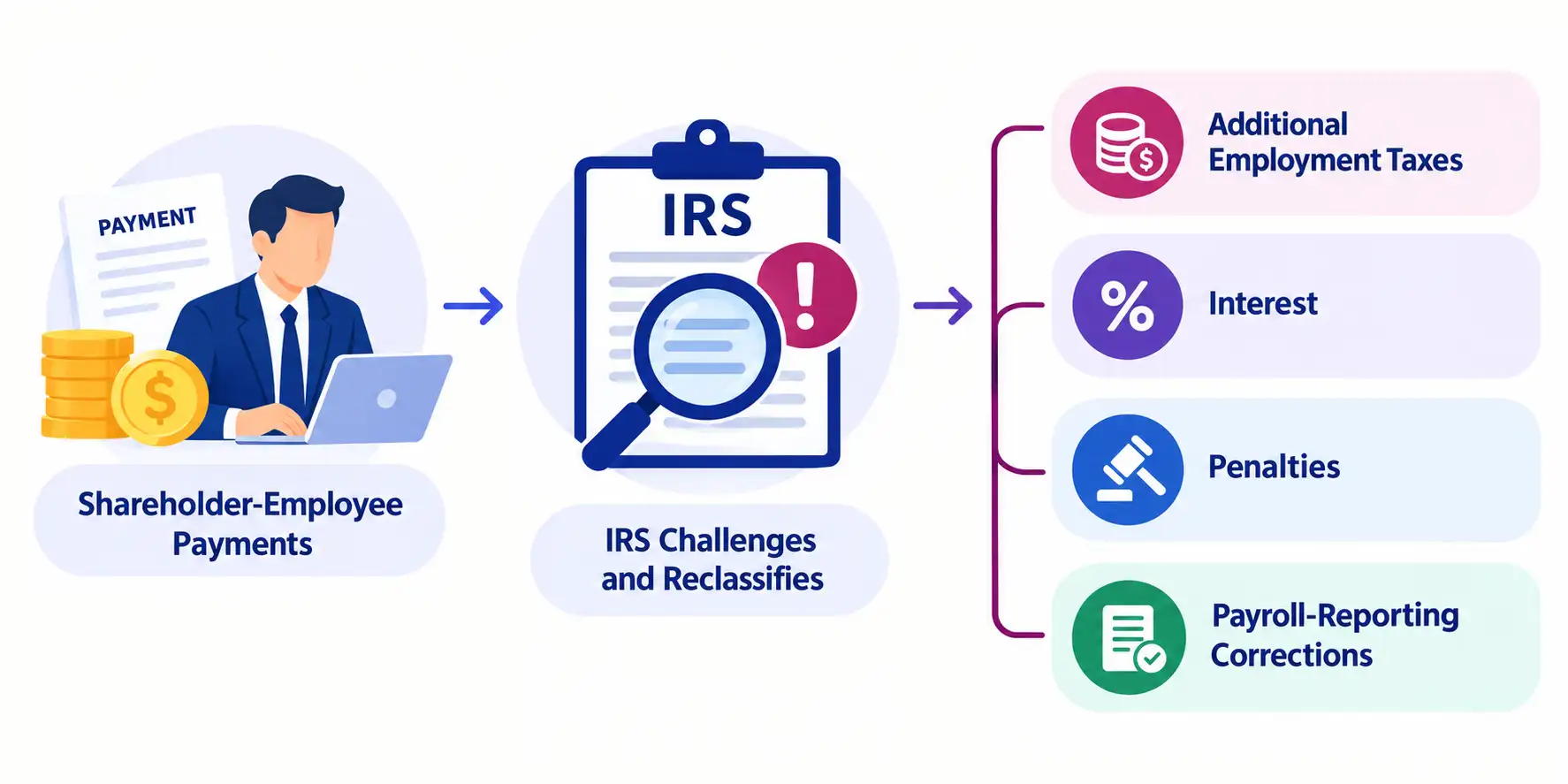
If the IRS determines that payments to a shareholder-employee represent compensation for services rather than non-wage distributions, it may reclassify the relevant amounts as wages. Depending on the facts and applicable law, the corporation may owe additional employment taxes, interest, penalties, and payroll-reporting corrections.
The IRS has examined these issues in litigation, including David E. Watson, P.C. v. United States, 668 F.3d 1008 (8th Cir. 2012). The case illustrates that the salary reported by an S corporation shareholder may be challenged when the evidence does not adequately reflect the value of the services performed.
The outcome of any case depends on its facts and applicable law. There is no single salary threshold that guarantees protection from an IRS challenge.
If compensation is questioned, the business should be prepared to explain the owner's actual duties, the evidence used to evaluate pay, and how the compensation amount was determined.
Get guidance on S Corp taxation, costs, and business compliance.
Review the compensation decision when circumstances change significantly, including when:
A periodic review helps keep the compensation analysis aligned with the owner's current role. It also gives the company an opportunity to update its supporting records before questions arise.
Determining reasonable compensation is an important part of S corporation compliance and can help reduce the risk of payroll tax adjustments. Understanding your responsibilities, evaluating fair market pay, and maintaining proper documentation can help you stay compliant.
For guidance on S Corporation taxation and compliance, connect with SaveTaxs. Our team of professional CPAs, Enrolled Agents, and tax experts helps business owners manage tax obligations and stay compliant with U.S. tax laws.
This article is for general informational purposes only and does not constitute tax, legal, financial, or investment advice. Laws, regulations, rates, and procedures may change over time and may vary based on individual circumstances.
While SaveTaxs makes reasonable efforts to keep the information accurate and up to date, readers should verify applicable rules with official authorities or consult a qualified professional before making decisions based on this information.
Vipul Jain is the Co-Founder of SaveTaxs and a tax expert with experience in Indian and NRI taxation. He advises individuals, NRIs, and businesses on tax filing, tax planning, capital gains, DTAA, and compliance matters. He focuses on making complex tax concepts simple and helping taxpayers make informed, compliant decisions. See Full Bio

Want to read more? Explore Blogs