US Tax Filing and Compliance
Is an S Corporation Worth It? Costs, Tax Benefits and Decision ChecklistIs an S Corporation Worth It? Costs, Tax Benefits and Decision Checklist
Written by Shubham Jain


SFOP eligibility depends on whether you meet the applicable IRS non-residency test, whether your failure to report foreign income, pay required tax, or submit required information returns and FBARs resulted from non-willful conduct, and whether you satisfy the other eligibility requirements. For joint-return filers, both spouses must meet the applicable non-residency requirement.
The Streamlined Foreign Offshore Procedures (SFOP) provide a route for eligible individual U.S. taxpayers residing outside the United States to correct certain tax and foreign financial reporting failures. You may qualify even if you have never filed a U.S. tax return, provided you meet the applicable requirements.
Living abroad, paying tax in another country, or making an honest mistake does not automatically establish eligibility. Your residency, filing history, reasons for non-compliance, and any disqualifying circumstances must be assessed together.
|
Eligibility requirement |
What you need to establish |
|---|---|
|
Individual taxpayer |
You fall within the individual taxpayer population covered by the streamlined procedures. |
|
Non-residency test |
You meet the applicable test in at least one of the relevant three tax years. |
|
Qualifying reporting failure |
You failed to report gross income from a foreign financial asset and pay tax as required by U.S. law, potentially alongside related FBAR or international information return failures. |
|
Non-willful conduct |
Your failures resulted from negligence, inadvertence, mistake, or a good-faith misunderstanding of the law. |
|
No disqualifying examination or investigation |
You are not barred from the procedures because of an IRS civil examination or criminal investigation. |
|
Complete submission |
You can provide the required tax returns, information returns, FBARs, and Form 14653 certification, as applicable. |
Source: IRS Streamlined Foreign Offshore Procedures.
Passing one requirement does not establish overall eligibility. Meeting the residency test does not prove non-willfulness, and a convincing explanation of an honest mistake does not overcome a failure to meet another applicable requirement.
Eligible taxpayers generally remain responsible for tax and applicable interest. SFOP provides specified penalty relief when its requirements are satisfied; it does not eliminate the underlying tax liability.
The IRS applies different tests depending on whether you are a U.S. citizen or lawful permanent resident (green card holder), or another taxpayer within the relevant category.
Generally, the residency test looks at at least one of the most recent three tax years for which the U.S. federal income tax return due date, including a properly applied extension, has passed. The precise covered years depend on the applicable filing circumstances and IRS rules.
Official rule: In at least one relevant year, you must have had no U.S. abode and must have been physically outside the United States for at least 330 full days.
Both conditions must be met. Spending 330 full days outside the United States is insufficient if you do not also satisfy the no-U.S.-abode requirement.
The IRS applies the concept of abode under Internal Revenue Code Section 911 and its associated rules. Abode concerns the nature and location of your living arrangements and personal life; it is not determined solely by citizenship, immigration status, or ownership of a home.
Keeping a dwelling in the United States does not automatically establish that your abode was in the country. Conversely, having a foreign mailing address does not prove that your abode was abroad.
When assessing your circumstances, consider:
Where your regular home and personal life were centered during the relevant year.
How many full days you were physically outside the United States.
Whether your U.S. visits were temporary or your living arrangements indicated that your abode remained in the country.
Whether you can substantiate your travel dates and living arrangements.
Example: A U.S. citizen who lives and works in India may meet the test, but the conclusion depends on the relevant year's travel history and abode circumstances—not simply the person's current address.
For individuals who are neither U.S. citizens nor lawful permanent residents, the applicable test is different.
Official rule: You generally meet the SFOP non-residency requirement if you did not meet the substantial presence test under Internal Revenue Code Section 7701(b)(3) in at least one of the relevant three years.
The substantial presence test generally uses a weighted calculation of days spent in the United States during the current year and the two preceding years, subject to applicable exceptions.
It is not the same as the 330-full-day test. A foreign national who spends considerable time in the United States may still meet the SFOP non-residency requirement if the applicable substantial presence test is not met in a qualifying year.
Practical takeaway: Identify your taxpayer category before assessing residency. Do not apply the 330-day rule to everyone.
If you are submitting a joint return under SFOP, both spouses must meet the applicable non-residency requirement. One spouse's eligibility does not automatically establish the other's eligibility.
This distinction matters when spouses have different travel histories, immigration statuses, or living arrangements.
For example, one spouse may have lived abroad throughout the relevant year, maintained an abode abroad, and spent more than 330 full days outside the United States. The other spouse may have spent extended periods in the United States and may not meet the same test.
The couple should not assume that a joint SFOP submission is available simply because one spouse qualifies. Have both spouses' circumstances assessed before deciding on the appropriate filing arrangement.
Non-willful conduct is a separate and essential SFOP eligibility requirement. The IRS describes it as conduct resulting from negligence, inadvertence, or mistake, or a good-faith misunderstanding of the requirements of the law.
The key question is why you failed to meet your U.S. tax reporting obligations, not simply whether you eventually discovered the error.
The following circumstances may be relevant, depending on the complete facts:
Unintentional omission of foreign income: You did not realize that interest from an overseas bank account had to be reported on your U.S. tax return.
Misunderstanding of U.S. tax obligations: You believed that paying tax in your country of residence meant you had no further U.S. filing obligations.
An inadvertent reporting error: You or your tax preparer mistakenly omitted foreign income or an account from required reporting.
Lack of awareness of separate reporting requirements: You understood your income tax obligations but did not realize that a foreign account might also require an FBAR.
These circumstances do not automatically establish non-willfulness. Your explanation must accurately reflect what happened and be consistent with the available evidence.
Using a tax preparer does not automatically establish non-willfulness, nor does a preparer's mistake automatically disqualify you.
The IRS expects a detailed explanation of the circumstances surrounding the reporting failures. Its SFOP frequently asked questions explain that the narrative should cover relevant personal and financial background, the source of funds in foreign accounts, account activity, and interactions with professional advisors.
Suppose your accountant prepared your U.S. returns but did not ask about an Indian bank account. You assumed the accountant had considered your overseas assets. That background may be relevant, but the assessment must also consider what information you provided, what you understood about your obligations, and whether you knew the account required disclosure.
Facts suggesting deliberate concealment or knowing non-compliance require particular scrutiny. Potential warning signs include:
Omitting foreign income after receiving clear advice that it was reportable.
Providing false information about foreign accounts.
Taking steps specifically intended to conceal assets from tax authorities.
Continuing to omit income after becoming aware of the reporting obligation.
These facts warrant professional assessment before you certify that your conduct was non-willful.
Important: Form 14653 requires a truthful, fact-specific explanation. Include favorable and unfavorable facts, and ensure that your certification accurately reflects your circumstances.
Yes, but never having filed a U.S. tax return does not automatically disqualify you from SFOP. The procedure can accommodate eligible taxpayers who need to file delinquent returns as well as those who need to amend previously filed returns.
The standard submission generally covers:
Three tax-return years: The most recent three years for which the U.S. tax return due date, including a properly applied extension, has passed.
Six FBAR years: The most recent six years for which the FBAR due date has passed.
These are separate reporting periods. Determine the applicable years using the IRS and FinCEN rules.
|
Your filing history |
What it means for the assessment |
|---|---|
|
You never filed required U.S. tax returns |
SFOP may be available if all applicable eligibility requirements are met. |
|
You filed returns but omitted foreign income |
Amended returns may be required for the covered tax years. |
|
You missed required international information returns |
Identify and prepare the applicable information returns. |
|
Identify the required FBARs for the covered six-year period. |
|
|
Some years were compliant and others were not |
Review the filing history, reporting failures, and required coverage periods together. |
|
You previously attempted a disclosure or received penalties |
Have earlier filings and assessments reviewed before selecting a route. |
The Streamlined Domestic Offshore Procedures (SDOP) generally require taxpayers to have previously filed U.S. tax returns, if required, for each of the relevant three years. SDOP also involves a separate 5% miscellaneous offshore penalty under its applicable rules.
SFOP can accommodate eligible taxpayers who need to file delinquent returns. It generally provides relief from specified penalties when its requirements are satisfied, while tax and interest remain payable.
This distinction is particularly relevant to U.S. citizens living abroad who have never filed federal income tax returns.
Do not choose between the procedures based only on filing history. Residency, non-willfulness, the nature of the reporting failure, and all other eligibility conditions must be assessed together.
For a focused comparison, see our SFOP vs. SDOP guide.
Before seeking an eligibility assessment, collect:
Copies of previously filed U.S. federal income tax returns.
A list of years for which returns were not filed or require correction.
Foreign bank account statements and investment records.
Information about foreign income, including interest, dividends, and rental income.
Previously filed FBARs and international information returns, if any.
Relevant communications with tax preparers or other advisors.
Travel records and evidence of your living arrangements during the relevant residency years.
These records help establish the extent of the reporting problem and the reasons it occurred.
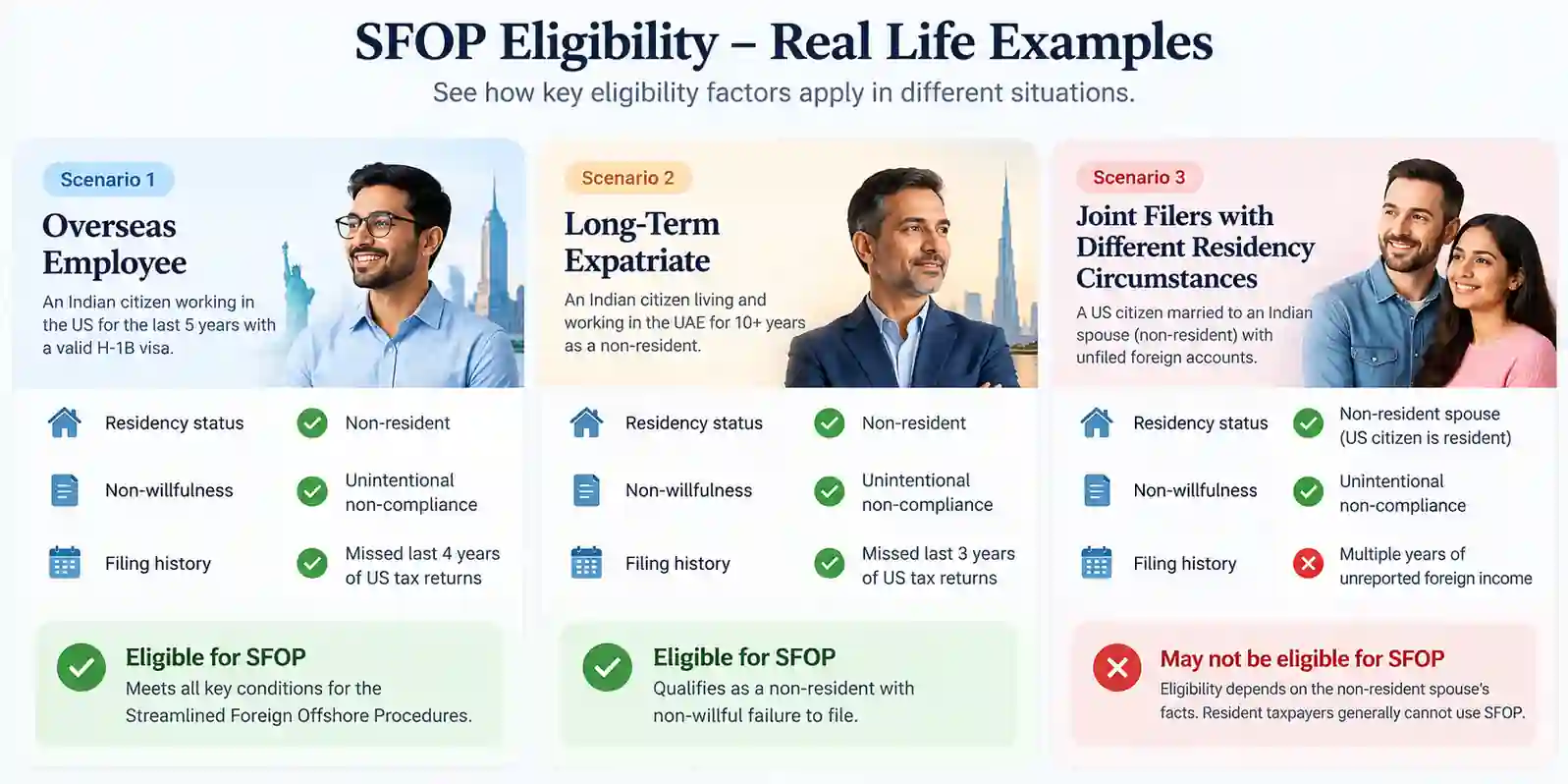
The following hypothetical examples illustrate how the principal requirements interact. They are not IRS rulings or guarantees of eligibility.
A U.S. citizen lives and works in India, files U.S. tax returns, and reports salary income but inadvertently omits interest from Indian bank accounts. The individual also discovers that some required FBARs were never filed.
Eligibility assessment: The individual may qualify if at least one relevant year meets both the no-U.S.-abode and 330-full-day requirements, the reporting failures were non-willful, and all other applicable conditions are satisfied.
Previously filed returns are not themselves an obstacle. The relevant questions are why the income was omitted and which filings need correction.
Next step: Gather the returns, bank statements, travel records, and a factual explanation of the reporting error.
A U.S. citizen moved abroad as a young adult and has lived overseas for decades. The individual never filed U.S. federal income tax returns because they believed paying tax in their country of residence was sufficient.
Eligibility assessment: The absence of previous returns does not automatically prevent SFOP eligibility. If the individual meets the applicable residency test, the failures were non-willful, and all other requirements are satisfied, SFOP may be an appropriate route to investigate.
The individual must still determine which returns were required and identify any foreign income and information reporting obligations.
Next step: Reconstruct the filing history and document the reasons for non-filing before making a non-willfulness certification.
A married couple has filed joint U.S. tax returns. One spouse lives and works abroad and satisfies the applicable SFOP non-residency test. The other spouse spends substantial time in the United States and may not satisfy the same requirement.
Eligibility assessment: The couple cannot assume that a joint SFOP submission is available merely because one spouse qualifies. Both spouses must meet the applicable non-residency requirement.
Next step: Have each spouse's residency, filing history, and reporting failures reviewed before deciding on the appropriate filing arrangement.
SFOP is not appropriate for every taxpayer with undisclosed foreign income or assets. Certain circumstances require a separate professional assessment.
If you do not satisfy the applicable SFOP non-residency requirement, do not assume that your current residence abroad is sufficient. SDOP may be worth evaluating if you meet its separate requirements, or another compliance route may be appropriate.
If the facts suggest intentional concealment or deliberate non-compliance, seek advice from a qualified U.S. tax professional or attorney before certifying that your conduct was non-willful.
The IRS Criminal Investigation Voluntary Disclosure Practice may be relevant when a taxpayer is concerned about willful conduct and potential criminal liability. It has separate requirements and consequences; it is not an automatic substitute for SFOP.
The IRS states that streamlined procedures are unavailable to taxpayers subject to a disqualifying IRS civil examination or criminal investigation by IRS Criminal Investigation.
If you have received an examination notice or know that a criminal investigation is underway, obtain professional advice before proceeding.
Foreign corporations, trusts, retirement arrangements, investment structures, previous disclosure attempts, and assessed penalties can introduce issues that are not resolved simply by meeting the residency test.
For example, ownership of a foreign corporation may create additional reporting obligations and potentially require an assessment of the Section 965 transition tax, depending on the facts and relevant tax years. IRS guidance on streamlined procedures and Section 965.
An eligibility review should identify these complications before a filing route is selected.
Use this checklist to organize your facts before seeking professional advice. It is a preliminary screening tool, not an official IRS eligibility determination.
Completing this checklist does not establish eligibility. Your complete facts must be assessed against the applicable IRS requirements.
If you believe you may qualify, evaluate your circumstances against the IRS requirements before preparing a submission.
A professional eligibility review should establish:
Which non-residency test applies and whether you satisfy it.
Whether the facts support a non-willfulness certification.
Which tax returns, FBARs, and international information returns may be required.
Whether an examination, investigation, prior penalty, or unusual foreign asset issue affects your options.
SaveTaxs provides U.S. tax compliance support for individuals with cross-border tax and foreign asset reporting concerns. If you need help determining whether SFOP fits your circumstances, explore our SFOP filing assistance.
The objective is to identify the correct compliance route, explain the underlying facts accurately, and prepare the required filings consistently.
SFOP eligibility depends on the interaction of residency, non-willful conduct, qualifying foreign reporting failures, and the other IRS requirements. No single factor, including living abroad or having made an honest mistake, establishes eligibility on its own.
Start by identifying the correct non-residency test, reconstructing your filing history, and documenting why the reporting failures occurred. If your situation involves joint returns, potentially willful conduct, an IRS examination, or complex foreign assets, seek professional advice before deciding how to proceed.
This article is for general informational purposes only and does not constitute tax, legal, financial, or investment advice. Laws, regulations, rates, and procedures may change over time and may vary based on individual circumstances.
While SaveTaxs makes reasonable efforts to keep the information accurate and up to date, readers should verify applicable rules with official authorities or consult a qualified professional before making decisions based on this information.
Hatim Dudhiyawala is a Certified Public Accountant (CPA) with SaveTaxs and specializes in Indian and NRI taxation. He advises individuals, NRIs, and businesses on income tax filing, capital gains taxation, DTAA benefits, fund repatriation, and tax compliance. With experience in cross-border tax matters, Hatim helps taxpayers understand complex regulations and make informed decisions. Through his articles, he shares practical insights to help readers stay compliant and manage their tax obligations with confidence. See Full Bio

Want to read more? Explore Blogs