US Tax Filing and Compliance
Is an S Corporation Worth It? Costs, Tax Benefits and Decision ChecklistIs an S Corporation Worth It? Costs, Tax Benefits and Decision Checklist
Written by Shubham Jain

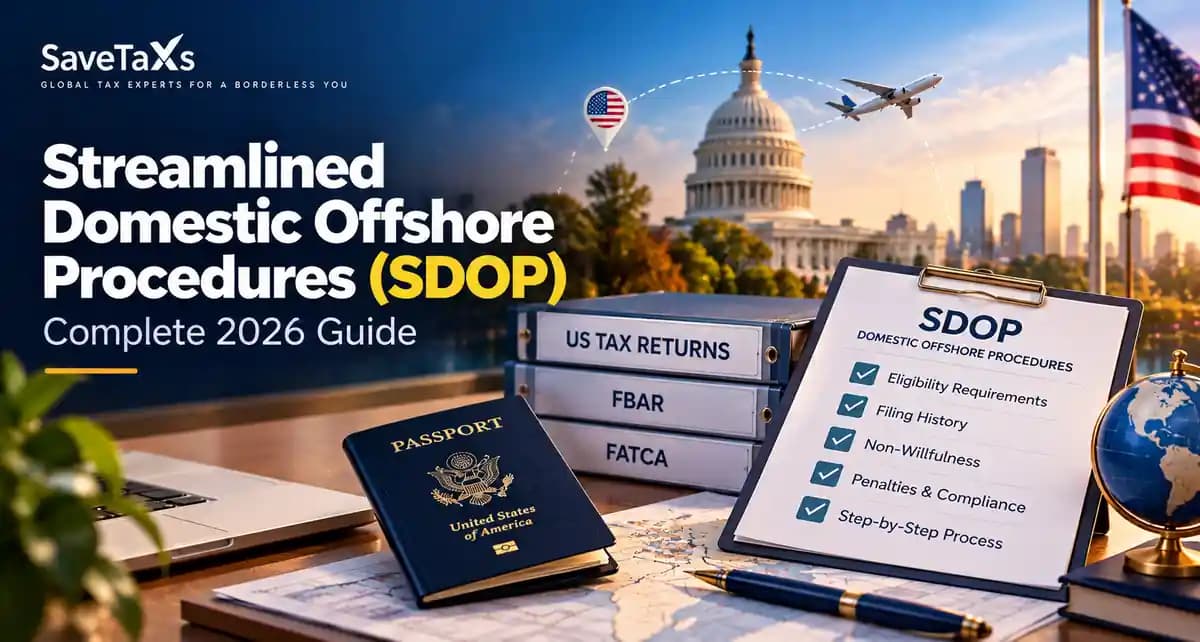
The Streamlined Domestic Offshore Procedures (SDOP) help eligible U.S. taxpayers residing in the United States correct certain non-willful failures to report foreign income, financial accounts, and other foreign financial assets. If you filed your U.S. tax returns but omitted foreign income or required international reporting forms, SDOP may provide a way to correct those failures through amended tax returns, applicable information returns, delinquent FBARs, and a 5% miscellaneous offshore penalty calculated under IRS rules. Before filing, it is essential to understand SDOP eligibility, the penalty calculation, required forms, and how the procedure differs from the Streamlined Foreign Offshore Procedures (SFOP). This guide explains the process, common risks, and practical steps taxpayers should consider in 2026.
Who may qualify: Eligible taxpayers residing in the United States whose relevant offshore tax reporting failures were non-willful.
Tax returns: Generally, amended returns for the most recent three covered tax years, subject to IRS rules.
FBARs: Required delinquent FBARs for the most recent six covered years.
Certification form: Form 14654, Certification by U.S. Person Residing in the United States for Streamlined Domestic Offshore Procedures.
Miscellaneous offshore penalty: Generally 5% of the highest aggregate year-end value of assets included in the penalty base under IRS rules.
Original returns: SDOP cannot be used to file delinquent original federal income tax returns.
Tax and interest: Additional tax and applicable interest generally remain payable.
The applicable tax years depend on the filing due dates, extensions, and submission circumstances. Review the IRS SDOP guidance before determining which years to include.
The Streamlined Domestic Offshore Procedures are part of the IRS Streamlined Filing Compliance Procedures. They are intended for eligible taxpayers who need to correct certain past U.S. tax and foreign financial asset reporting failures that resulted from non-willful conduct.
Depending on the taxpayer's circumstances, a submission may involve:
Amended federal income tax returns.
Required international information returns.
Delinquent FBARs filed with FinCEN.
Form 14654, including a detailed certification of non-willful conduct.
Payment of additional tax and applicable interest.
Payment of the applicable 5% miscellaneous offshore penalty.
SDOP does not automatically erase all tax liabilities or guarantee that the IRS will accept a submission. Taxpayers must meet the eligibility requirements, provide accurate information, and follow the applicable filing and payment instructions.
For a broader explanation of both streamlined procedures, read SaveTaxs Streamlined Filing Compliance Procedures guide.
Eligibility depends on residency, filing history, the nature of the reporting failures, and whether the taxpayer can truthfully certify that the conduct was non-willful.
SDOP is generally intended for eligible taxpayers residing in the United States who do not meet the applicable non-residency requirement for SFOP.
The SFOP residency test is specific. Citizenship alone, the location of a foreign bank account, or a general description of where someone lives is not enough to determine eligibility. The applicable test must be assessed for the relevant period and circumstances.
If you may qualify as a taxpayer residing outside the United States under the IRS rules, review the IRS SFOP guidance before selecting a procedure.
SDOP generally requires previously filed U.S. federal income tax returns for each of the most recent three covered tax years for which a return was required.
SDOP is not available for filing delinquent original federal income tax returns. If you never filed a required original return for a covered year, do not assume that SDOP is the appropriate route. Your filing history needs to be reviewed before choosing a compliance procedure.
Your circumstances may involve omitted foreign income, unreported foreign financial accounts, or missing international information returns.
Depending on your situation, the relevant requirements may include:
Reporting interest, dividends, or other income from foreign accounts.
Filing FBARs using FinCEN Form 114.
Filing Form 8938, Statement of Specified Foreign Financial Assets.
Filing applicable Forms 3520, 3520-A, 5471, 5472, 8621, or 926.
Not every missed form automatically makes a taxpayer eligible for SDOP. The underlying reporting obligation, asset type, filing history, and other requirements must be considered.
If you are unsure whether an account must be reported on an FBAR, Form 8938, or both, read SaveTaxs FBAR vs. Form 8938 guide.
The IRS requires a truthful certification that the relevant failures resulted from non-willful conduct. This generally includes conduct resulting from negligence, inadvertence, mistake, or a good-faith misunderstanding of legal requirements.
For example, a taxpayer may have misunderstood the U.S. reporting obligations associated with an overseas account or may have inadvertently omitted foreign interest from a return.
However, a late discovery does not automatically establish non-willfulness. Taxpayers should explain the actual facts and circumstances that led to the reporting failures. Intentional concealment or other potentially willful conduct requires a different analysis.
Form 14654 must be accurate and complete. If you have concerns about potential willfulness, consult a qualified U.S. tax attorney before making a disclosure.
Other eligibility restrictions may apply. For example, the streamlined procedures generally are not available to taxpayers whose relevant returns are already under an applicable IRS civil examination or who are under criminal investigation by IRS Criminal Investigation.
The effect of an IRS notice or other contact depends on the specific circumstances. Do not assume that every notice automatically disqualifies you—or that every notice is irrelevant. Review the nature and status of the IRS action before proceeding.
SDOP may be unsuitable or require specialist review if you:
Never filed required original U.S. federal income tax returns for the relevant period.
Cannot truthfully certify non-willful conduct.
Have facts suggesting intentional concealment or potentially willful non-compliance.
Are subject to an IRS examination or criminal investigation that affects your eligibility.
Have complex foreign corporations, trusts, partnerships, retirement arrangements, or investments.
Are unsure whether SDOP, SFOP, the Delinquent FBAR Submission Procedures, or another compliance option applies.
Choosing a procedure before establishing eligibility can create additional risks. The correct approach depends on the taxpayer's filing history, conduct, assets, and the nature of the reporting failures.
SDOP and SFOP are both IRS Streamlined Filing Compliance Procedures, but they have different eligibility tests and penalty treatment.
| Feature | SDOP | SFOP |
|---|---|---|
| General audience | Eligible taxpayers who do not meet the applicable SFOP non-residency requirement | Eligible taxpayers who meet the applicable non-residency requirement |
| Tax-return period | Generally three covered tax years | Generally three covered tax years |
| Filing history | Requires previously filed returns for the covered years; cannot be used for delinquent original returns | May accommodate delinquent original or amended returns, depending on the circumstances and IRS requirements |
| FBAR period | Generally six covered years | Generally six covered years |
| Miscellaneous offshore penalty | Generally 5% under the applicable penalty-base rules | No miscellaneous offshore penalty for eligible taxpayers who properly use SFOP |
| Certification form | Form 14654 | Form 14653 |
The distinction is not simply whether a taxpayer has foreign bank accounts. The applicable residency test, filing history, conduct, and other IRS requirements determine which procedure may be available.
Review the official SDOP guidance and SFOP guidance before deciding which route to pursue.
The 5% miscellaneous offshore penalty is a central part of SDOP. However, it is not simply 5% of every foreign asset a taxpayer owns today.
The IRS identifies a specific penalty base using the applicable foreign financial asset reporting rules and the covered tax-return and FBAR periods. The calculation considers the taxpayer's personal financial interest in the relevant assets and their year-end values.
Depending on the facts, the penalty base may include:
Foreign financial accounts that should have been reported on an FBAR but were not.
Foreign financial assets that should have been reported on Form 8938 but were not.
Foreign financial accounts or assets associated with gross income that was not reported for a covered tax year.
The IRS applies different rules to the six-year FBAR period and the three-year tax-return period. The penalty computation must identify the relevant assets for each applicable year rather than treating all foreign assets as automatically included in every year.
The IRS provides specific rules and distinctions that may affect the penalty base.
Foreign real estate: Directly owned foreign real estate that is not reportable on an FBAR or Form 8938 is not included in the penalty base merely because it is located outside the United States. Related financial accounts may still be reportable.
Signature authority only: An account over which a taxpayer has authority but no personal financial interest is not included in the penalty base solely because the taxpayer has signature authority. Separate FBAR reporting obligations may still apply.
Foreign corporations: The penalty base generally includes the taxpayer's interest in the stock of a foreign corporation rather than the corporation's underlying financial accounts, unless the entity is disregarded for U.S. federal tax purposes. The applicable entity classification and reporting requirements matter.
Delinquent Forms 3520 or 5471: Filing an information return late does not automatically exclude an asset from the penalty base. The IRS has specific rules concerning foreign financial assets and whether they were reported on timely filed information returns.
For the detailed rules, consult the IRS SDOP frequently asked questions.
If you own a foreign company, review SaveTaxs guide to IRS Form 5471 and foreign corporation reporting. If you hold foreign mutual funds, the PFIC tax rules guide may also be relevant.
The general calculation process is:
Identify foreign financial accounts with a personal financial interest that should have been, but were not, reported on an FBAR for each of the six covered FBAR years.
Identify foreign financial assets that should have been, but were not, reported on Form 8938 for each of the three covered tax-return years.
Identify foreign financial accounts or assets for which gross income was not reported for each covered tax-return year.
Determine the taxpayer's personal financial interest in each asset and its value as of December 31 of the applicable year.
Apply the IRS rules for assets that were already compliant for a relevant reporting requirement.
Aggregate the included values for each year and identify the highest aggregate amount.
Multiply the applicable highest aggregate amount by 5%.
The specific assets included may differ from year to year. An asset should not be included automatically in every year's calculation without checking the applicable reporting rules.
Suppose a taxpayer reviews the relevant records and, after applying the IRS inclusion and exclusion rules, determines that the aggregate values of assets included in the penalty base are as follows:
| Applicable year | Illustrative aggregate value |
|---|---|
| Year 1 | $120,000 |
| Year 2 | $165,000 |
| Year 3 | $205,000 |
| Year 4 | $190,000 |
| Year 5 | $180,000 |
| Year 6 | $175,000 |
In this simplified illustration, the highest aggregate value is $205,000.
Highest aggregate value: $205,000
Penalty rate: 5%
Illustrative miscellaneous offshore penalty: $10,250
This is a mathematical illustration, not a substitute for completing Form 14654. A real SDOP calculation must identify the correct assets for the six-year FBAR period and the three-year tax-return period, account for previously compliant reporting where required, and follow the IRS valuation rules. Additional tax and statutory interest may also be payable.
The required documents depend on the taxpayer's reporting history and assets. A submission may include:
Form 1040-X: Amended federal income tax returns for the applicable covered years.
International information returns: Applicable forms may include Forms 8938, 3520, 3520-A, 5471, 5472, 8621, or 926.
FinCEN Form 114 (FBAR): Required delinquent FBARs for the applicable covered years.
Form 14654: The signed SDOP certification, including the explanation of non-willful conduct and the penalty computation.
Tax and interest payment: Payment of additional tax and applicable interest.
Miscellaneous offshore penalty payment: Payment of the calculated 5% penalty.
Not every taxpayer needs every form listed above. The required documents should be determined from the actual reporting obligations and facts.
For additional background, see SaveTaxs guides to Form 8938 reporting and FBAR penalties and late-filing relief.
Review your residency status, filing history, conduct, and any relevant IRS examination or investigation status. Determine whether SDOP is the appropriate procedure before preparing the submission.
Identify the three covered tax years based on the applicable return due dates and any properly applied extensions. Do not assume the same years apply to every taxpayer or every submission date.
Collect foreign bank statements, investment records, income statements, entity documents, and other supporting records. Identify unreported income and missing reporting forms.
Prepare complete and accurate amended federal income tax returns for the required covered years. Include the international information returns that apply to your circumstances.
Remember that SDOP cannot be used to file delinquent original federal income tax returns.
Determine which of the six covered FBAR years require delinquent filings. Submit the required FBARs electronically through the FinCEN BSA E-Filing System and follow the applicable instructions.
Prepare the SDOP certification and provide an accurate explanation of the facts and circumstances that led to the reporting failures. The explanation should be specific, truthful, and consistent with the supporting records.
Calculate the miscellaneous offshore penalty using the IRS asset-base rules. Separately determine any additional tax and applicable interest. Keep records supporting the valuation of each included asset.
The IRS specifies how the amended returns, certification, supporting forms, and payments must be prepared and submitted. Follow the current instructions for identifying the package as a streamlined domestic offshore submission.
Check the current IRS mailing address, payment method, and submission requirements immediately before filing. Do not rely on an old address or previously downloaded instructions without confirming they remain applicable.
Keep copies of the submitted returns, FBAR confirmations, Form 14654, asset valuations, account statements, tax and interest calculations, and payment evidence. These records support the filing and may be needed if the IRS requests further information.
For the latest requirements, forms, and submission instructions, refer to the official IRS SDOP page.
For taxpayers who qualify and properly complete the procedure, SDOP provides a structured way to correct specified offshore tax reporting failures.
Potential benefits include:
Correcting omitted foreign income on prior tax returns.
Filing required international information returns.
Bringing covered FBAR filings up to date.
Applying the IRS's specified penalty treatment to eligible submissions.
Establishing a more complete record of foreign income and financial asset reporting.
SDOP is conditional, and it is not the right procedure for every situation.
Potential risks include:
Inaccurately certifying non-willful conduct.
Understating the penalty base or omitting reportable assets.
Filing incomplete or inaccurate amended returns.
Missing required FBARs or international information returns.
Using SDOP when the taxpayer is ineligible.
Assuming the procedure guarantees acceptance or eliminates every possible liability.
Taxpayers should evaluate eligibility and the relevant facts before signing Form 14654. Professional review can be especially important for foreign companies, trusts, investment funds, and other complex assets.
Consider a hypothetical U.S. resident who previously filed federal income tax returns but did not report interest earned in an Indian bank account. The taxpayer also failed to file required FBARs and may have missed another international information return.
After discovering the omissions, the taxpayer should first determine whether the failures were non-willful, confirm the relevant filing history, and establish whether SDOP is available. The taxpayer would then identify the required amended returns and FBARs, calculate any additional tax and interest, and determine which assets belong in the penalty base.
If eligible, the taxpayer may need to submit amended returns, required information returns, delinquent FBARs, Form 14654, and the required payments. The penalty must be calculated using the applicable IRS rules—not simply by multiplying the current bank balance by 5%.
If the taxpayer had never filed required original returns or the facts suggested intentional concealment, the correct compliance route would need further analysis before filing.
Correcting offshore tax reporting failures may involve more than amending a tax return. Eligibility, non-willful conduct, international information returns, FBAR obligations, and the 5% penalty calculation must be considered together.
SaveTaxs provides FBAR and FATCA filing support for NRIs in the United States, including guidance on foreign asset reporting, late filings, and streamlined compliance options. The appropriate procedure depends on your individual circumstances and eligibility.
Important: This article is for general educational purposes only and is not individualized tax, legal, or financial advice. IRS rules and filing instructions may change. Consult a qualified U.S. tax professional before making an SDOP submission.
This article is for general informational purposes only and does not constitute tax, legal, financial, or investment advice. Laws, regulations, rates, and procedures may change over time and may vary based on individual circumstances.
While SaveTaxs makes reasonable efforts to keep the information accurate and up to date, readers should verify applicable rules with official authorities or consult a qualified professional before making decisions based on this information.
Hatim Dudhiyawala is a Certified Public Accountant (CPA) with SaveTaxs and specializes in Indian and NRI taxation. He advises individuals, NRIs, and businesses on income tax filing, capital gains taxation, DTAA benefits, fund repatriation, and tax compliance. With experience in cross-border tax matters, Hatim helps taxpayers understand complex regulations and make informed decisions. Through his articles, he shares practical insights to help readers stay compliant and manage their tax obligations with confidence. See Full Bio

Want to read more? Explore Blogs