

US Tax Forms
IRS Form 8962 for NRIs: Premium Tax Credit and APTCIRS Form 8962 for NRIs: Premium Tax Credit and APTC
Written by Shubham Jain

What if I tell you that, as a green card holder or citizen, if you engage in foreign transactions such as investing money in a foreign business or transferring property to a foreign corporation, you may trigger IRS reporting? Wondering why it is so? This is because the US government wants a record of when a US taxpayer moves valuable property outside the country, and that is IRS Form 926 for you.
The form does not calculate your taxes; it only provides information about your involvement in a foreign corporation. If you do not fill out this form, you can face a penalty of up to 10% of the transferred value. This is capped at $100,000 per transfer unless the failure was not willful.
Still confused and want to know more about IRS Form 926? This blog provides you with complete information about this form. So read on and clear all your doubts.
As its name states, IRS Form 926 is the Return by a US Transferor of Property to a Foreign Corporation. Considering this, US persons, including citizens, green card holders, and resident aliens, use this form to report specific types of property transfers to foreign corporations under section 6038B of the Internal Revenue Code (IRC).
In simple terms, when you move your equipment, stock, intellectual property, or any other asset to a foreign company, the IRS wants to have complete information about it. For instance, when you moved the asset, what was its market value, and how much you own in the foreign corporation after your contribution.
The key purpose of filling out this form is to prevent tax evasion and ensure that US taxpayers correctly report and pay taxes on their transferred property. Additionally, this form does not calculate your tax obligation; it only provides information about transferred assets, when it happened, and what you own after the transfer. Further, the IRS uses this information to monitor compliance with U.S. international tax reporting requirements and identify transfers that may require additional review under the tax law.
Further, reportable property includes:
This was all about IRS Form 926. Moving ahead, let's know who needs to fill out this form.
With Savetaxs, fulfill your US tax obligations on time with complete accuracy.
Here are the six categories of filers that need to fill out IRS Form 926:
*Special Rule for Domestic Partnerships: US partnerships involved with a foreign corporation do not file IRS Form 926 themselves; instead, each partner in it files this form with their tax return.
Considering this, if you are a US person and you have engaged in a property transfer to a foreign or Indian corporation, you need to fill out this form regardless of where you currently reside. To provide you with a better idea of it, here are some situations where you need to fill out this form:
So this was all about who should file IRS Form 926. Moving further, let's know what transfers need to be reported in this form.
Under the IRS Form 926, the property moves from a U.S. person to a foreign entity is defined broadly. It includes both tangible and non-tangible assets, and because of this, many US taxpayers get confused about what should be reported on the form. To provide you with an overview, the table below showcases the types of property covered in the IRS Form 926.
| Property Type | Included in IRS Form 926 | Examples | What this generally triggers |
|---|---|---|---|
| Cash | Yes | Capital investment in a foreign company | If the transfer is more than $100,000 or you own 10%+ right in the foreign corporation after the transfer |
| Tangible Property | Yes | Equipment, overseas real estate | Property should be valued and reported |
| Intangible Property | Yes (high scrutiny) | Goodwill, software, trademarks | This is often closely reviewed by the IRS |
| Business Assets | Yes | Moving an operating US business overseas | Often includes several reporting forms |
| Securities or Shares | Yes | Transferring stock to a foreign corporation | Reporting depends on ownership percentage |
These are the property transfers that you need to report in IRS Form 926. Moving forward, let's know about the exceptions to this form.
Not every foreign transaction needs to be reported in IRS Form 926. Considering this, common exceptions to filing Form 926 include:
The above situations are fact-specific. Considering this, the filing exception completely depends on your foreign ownership percentage and how your transactions were reported. Now, moving ahead, let's know how to file IRS Form 926.
Here is how you should fill out IRS Form 926:
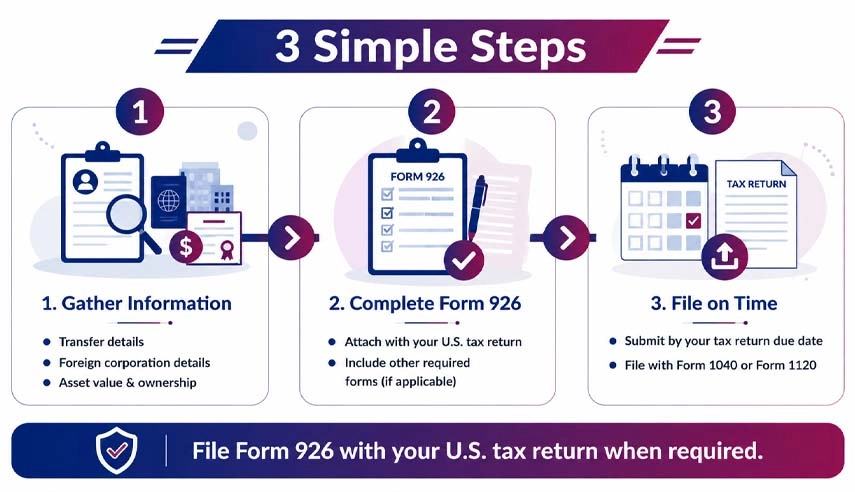
So, this is how you should file IRS Form 926. Moving further, let's know the penalties of not filing the form.
The penalties for not filing out IRS Form 926 are as follows:
| Penalty Type | Amount |
|---|---|
| Standard tax penalty for not filing Form 926 | 10% of the fair market value of your transferred property |
| Per-transfer cap if not filing out the form was non-willful | up to $100,000 per transfer |
| Willful not filing of Form 926 | No cap; IRS penalties can be increased by $100,000 and may also include criminal prosecution |
| Statute of limitations impact | Failure to file Form 926 may extend the statute of limitations for the related tax return under the applicable Internal Revenue Code provisions. |
Here, the statute of limitations is important to consider, as at any time the IRS can audit your tax return for the year you did not file Form 926. In case you non-willfully missed filing Form 926, you can opt for Streamlined Filing Procedures offered by the IRS. Through this, you can fulfill your missed filing obligations without paying the standard IRS penalties, provided it was non-willful and you file it before getting the notice from the IRS.
These are the penalties for not filing Form 926. Moving forward, let's know the common filing mistakes you should avoid when filing this form.
Common filing mistakes to avoid when filing IRS Form 926 include:
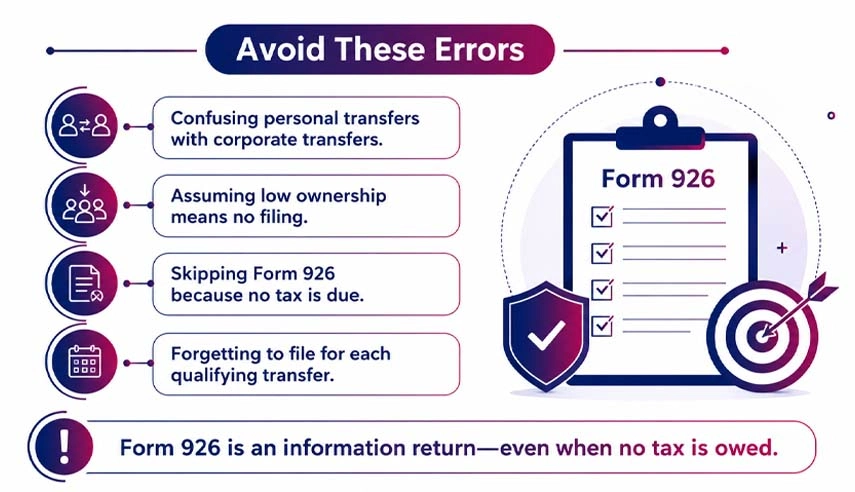
These are the common filing mistakes to avoid when filing IRS Form 926. Further, let's understand this form through an example.
Anjali is an India-American who decided to fund her family's textile manufacturing business in India. Its business structure is a private limited company. In several installments, within eight months, she transferred a total of $145,000 to her family business and received 7% ownership in it. She assumed that as her ownership in her Indian business is less than 10%, she did not need to file IRS Form 926. However, the amount she transferred was more than $100,000, which triggers the form reporting requirement, and she was unaware of this.
When her accountant learned about this, they corrected the missed reporting by filing Form 926 and providing an appropriate explanation based on her circumstances, along with a written explanation and a statement of reasonable cause for the delay, since the omission happened because of incomplete information.
Anjali's case shows why you should not consider only one situation when transferring cash or assets to a foreign corporation, and why you should have complete information.
Connect with Savetaxs and clear all your doubts about IRS Form 926 with expert guidance.
Lastly, IRS Form 926 is a form that U.S. taxpayers use to report their contributions to foreign businesses. As this form does not trigger any tax obligation, it is overlooked by many US persons engaged in foreign business. Non-compliance with it results in a penalty of 10% of the fair market value of the transferred property.
Further, if you have transferred property or cash to a foreign company or are planning to invest in an overseas business, filing Form 926 is vital. Additionally, if you need assistance knowing whether this form applies to you or filling it out, connect with Savetaxs. The CAs and EAs in our team help you determine your eligibility and file the form.
This article is for general informational purposes only and does not constitute tax, legal, financial, or investment advice. Laws, regulations, rates, and procedures may change over time and may vary based on individual circumstances.
While SaveTaxs makes reasonable efforts to keep the information accurate and up to date, readers should verify applicable rules with official authorities or consult a qualified professional before making decisions based on this information.
Shubham Jain is the Founder of SaveTaxs and has extensive experience in Indian and NRI taxation. He advises individuals, NRIs, and businesses on tax filing, tax planning, capital gains, DTAA benefits, fund repatriation, and compliance matters. He regularly writes about taxation and related financial topics. His focus is on making complex tax concepts easy to understand. Through his articles, he helps taxpayers stay informed, avoid common mistakes, and stay compliant with Indian tax laws. See Full Bio

Want to read more? Explore Blogs

_1786539671275.webp&w=828&q=75)