US Tax Filing and Compliance
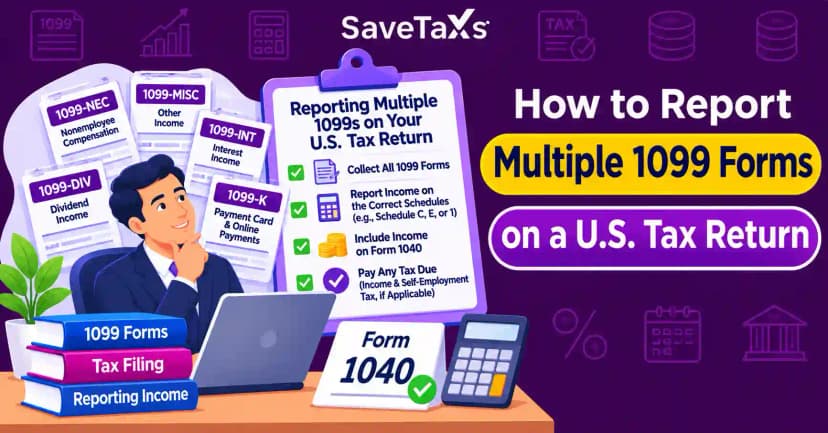
How to Report Multiple 1099 Forms on a U.S. Tax Return: A Guide for NRIsHow to Report Multiple 1099 Forms on a U.S. Tax Return: A Guide for NRIs
Written by Hatim Dudhiyawala


Schedule 1-A is a new schedule to Form 1040 introduced for tax year 2025 under the One Big Beautiful Bill Act (OBBBA), also known as the Working Families Tax Cuts. It allows eligible individuals to calculate four additional federal income tax deductions: qualified tips, qualified overtime compensation, qualified passenger vehicle loan interest and an enhanced deduction for seniors.
The deductions are available for tax years 2025 through 2028. Eligible taxpayers may generally claim them whether they take the standard deduction or itemize deductions. Each deduction has its own eligibility rules, annual limit, Social Security number (SSN) requirements and modified adjusted gross income (MAGI) phaseout.
Important: “No tax on tips” and “no tax on overtime” are shorthand descriptions. These deductions do not remove tips or overtime from gross income. Qualified tips and overtime generally remain subject to applicable Social Security and Medicare taxes, and self-employed individuals may owe self-employment tax. A deduction reduces taxable income; it is not a dollar-for-dollar tax credit or refund.
Tax-year note: The detailed form references, reporting lines and examples below use the 2025 Schedule 1-A and 2025 IRS instructions. The deductions are legislated for 2025–2028, but use the form and instructions for the specific tax year you are filing because reporting requirements and guidance can change.
Key takeaways
Schedule 1-A covers four deductions: qualified tips, qualified overtime, qualified passenger vehicle loan interest and an enhanced deduction for seniors.
For 2025, the maximums are $25,000 for tips, $12,500 for overtime ($25,000 for married filing jointly), $10,000 for qualifying vehicle-loan interest and $6,000 per eligible senior.
Each deduction has a separate MAGI threshold and phaseout formula. Crossing a threshold does not always eliminate the deduction immediately.
Eligible taxpayers may generally claim Schedule 1-A deductions whether they itemize or take the standard deduction.
A valid SSN for employment is required for the tips, overtime and senior deductions. An ITIN alone does not meet that requirement.
Eligible nonresident aliens may claim certain deductions on Form 1040-NR, but generally cannot claim the vehicle-loan-interest deduction.
Schedule 1-A, titled Additional Deductions, is attached to an eligible taxpayer’s Form 1040, Form 1040-SR or Form 1040-NR. It is not a separate tax return. Taxpayers use it to calculate the four deductions and transfer the total to their individual income tax return.
For tax year 2025, the total from Schedule 1-A, line 38, is generally reported on Form 1040 or Form 1040-SR, line 13b, or Form 1040-NR, line 13c. A taxpayer completes only the parts that apply. If you do not qualify for any of the four deductions, you generally do not need to file Schedule 1-A.
The following limits and phaseout thresholds are from the 2025 Schedule 1-A and its instructions.
| Deduction | Maximum 2025 deduction | MAGI phaseout begins | Phaseout calculation |
|---|---|---|---|
| Qualified tips | $25,000 per return | $150,000 for single, head-of-household or qualifying-surviving-spouse filers; $300,000 for married filing jointly | $100 for each complete $1,000 above the threshold |
| Qualified overtime | $12,500; $25,000 for married filing jointly | $150,000 for single, head-of-household or qualifying-surviving-spouse filers; $300,000 for married filing jointly | $100 for each complete $1,000 above the threshold |
| Qualified passenger vehicle loan interest | $10,000 | $100,000 for all statuses other than married filing jointly; $200,000 for married filing jointly | $200 for each $1,000 or portion of $1,000 above the threshold |
| Enhanced deduction for seniors | $6,000 per eligible person; up to $12,000 if both spouses qualify and file jointly | $75,000 for single, head-of-household or qualifying-surviving-spouse filers; $150,000 for married filing jointly | The $6,000 amount is reduced by 6% of the MAGI excess |
These are deduction limits, not guaranteed tax savings. The amount a taxpayer can claim depends on qualifying income or interest, MAGI, filing status and other conditions. Married taxpayers generally must file jointly to claim the tips, overtime and senior deductions. The vehicle-loan-interest deduction follows different rules.
For many taxpayers, Schedule 1-A MAGI starts with adjusted gross income (AGI) on line 11b of the 2025 Form 1040, Form 1040-SR or Form 1040-NR. Part I of Schedule 1-A adds back certain excluded amounts when applicable, including excluded Puerto Rico income and amounts from Form 2555 and Form 4563. Do not automatically substitute gross wages, take-home pay or taxable income for MAGI. Use Part I and the instructions for the return you are filing.
The 2025 Schedule 1-A has six parts. Complete the sections that apply to the deductions you are claiming.
| Part | Purpose |
|---|---|
| Part I | Calculate modified adjusted gross income (MAGI) |
| Part II | Calculate the qualified tips deduction |
| Part III | Calculate the qualified overtime deduction |
| Part IV | Calculate the passenger vehicle loan interest deduction |
| Part V | Calculate the enhanced deduction for seniors |
| Part VI | Add the allowable deductions and calculate the total |
For 2025, the Part VI total is transferred to Form 1040 or Form 1040-SR, line 13b, or Form 1040-NR, line 13c.
Eligible workers may deduct up to $25,000 of qualified tips for 2025. This is a combined limit per return. Married couples filing jointly do not receive a separate $25,000 limit for each spouse.
The worker must receive tips in an occupation that customarily and regularly received tips on or before December 31, 2024, and the occupation must appear on the Treasury and IRS List of Occupations that Receive Tips. The final regulations list more than 70 occupations across areas such as food service, entertainment, hospitality, home services, personal services, wellness, recreation, transportation and delivery.
A qualified tip generally must be paid voluntarily by a customer, not be subject to negotiation, and be determined by the customer or payor. It must be paid in cash or a cash-equivalent medium, including qualifying credit-card, debit-card and electronic payments. For employees, qualifying tips may also be received through a tip-sharing arrangement.
A mandatory service charge or automatic gratuity is generally not a qualified tip if the customer cannot disregard or modify it. For example, an automatic service charge added to a large-party bill without an option to change it is not automatically treated as a voluntary tip merely because the employer distributes it to employees.
The law also excludes tips received in the course of a specified service trade or business (SSTB). The IRS has provided transition relief for workers in listed tipped occupations while further guidance on the SSTB determination is pending. Because this restriction can depend on the employer's or business's activities, check current IRS guidance before claiming the deduction.
Self-employed individuals may qualify if their occupation and tips meet the requirements. However, the deduction cannot exceed the net income limitation for the trade or business in which the tips were earned. The IRS generally calculates this limit using business income minus deductions allocable to that business (other than the qualified-tip deduction). The limit applies separately to each business.
For 2025, Forms 1099-NEC, 1099-MISC and 1099-K did not separately identify tips. The IRS allowed qualifying tips to be included in the aggregate amounts reported on those forms, provided the taxpayer kept reliable records—such as platform earnings statements, point-of-sale reports, receipts or daily tip logs—to substantiate the tip amount. Cash tips that were not included in the aggregate amount reported on an applicable Form 1099 generally cannot be included in the 2025 self-employed tip deduction.
For employees, the amount may be determined using Form W-2 information, employer statements, tip reports or Form 4137, as applicable. The IRS instructions explain how to calculate the qualified amount when tips were not separately identified on a 2025 information return.
The person who received the qualified tips must generally have an SSN that is valid for employment and was issued by the Social Security Administration by the return due date, including extensions. On a joint return, the spouse who received qualified tips must meet the SSN requirement. An ITIN alone does not satisfy it. Married taxpayers generally must file jointly; married filing separately does not qualify.
The deduction begins to phase out when MAGI exceeds $150,000 for single, head-of-household or qualifying-surviving-spouse filers, or $300,000 for married couples filing jointly. The 2025 calculation reduces the capped deduction by $100 for each complete $1,000 above the applicable threshold.
Example: A single worker receives $40,000 in qualified tips and has MAGI of $170,000. The deduction is first capped at $25,000. MAGI is $20,000 above the $150,000 threshold, resulting in a $2,000 reduction (20 × $100). The potential deduction is $23,000, assuming all other requirements are met.
For 2025, tips and overtime were not always separately identified on employer and payor forms. Keep the supporting statements and calculations used to determine the amount claimed. If you already filed a 2025 return and the final tipped-occupation rules affect your eligibility, the IRS says you may amend the return. See its guidance on claiming the no-tax-on-tips deduction and amended returns and the Instructions for Form 1040-X.
Eligible employees may deduct up to $12,500 of qualified overtime compensation for 2025. The maximum is $25,000 for married couples filing jointly. If both spouses receive qualified overtime, the $25,000 limit applies to their combined amount.
The deduction generally covers only the overtime premium required under section 7 of the Fair Labor Standards Act (FLSA) for a covered, nonexempt employee. For a standard time-and-a-half payment, the qualifying amount is generally the additional half of the employee's regular rate—not the entire overtime payment.
For most eligible employees, the FLSA requires overtime pay for hours worked beyond 40 in a workweek at a rate of at least 1.5 times the regular rate. Certain public-sector, law-enforcement and other roles may have special FLSA work-period rules. Extra pay does not qualify simply because an employer labels it overtime. Weekend or holiday premiums not required by the FLSA, and overtime paid only under state law or an employment agreement to an FLSA-exempt employee, generally do not qualify.
Assume an employee earns $20 per hour and receives time-and-a-half for one eligible overtime hour:
| Pay component | Amount |
|---|---|
| Regular hourly rate | $20 |
| Total overtime-hour payment | $30 |
| Regular-rate portion | $20 |
| Potential qualified overtime premium | $10 |
Only the additional $10 may qualify. Where payroll records show the total amount paid for standard time-and-a-half overtime hours, the FLSA premium can generally be calculated as one-third of that total.
The phaseout begins when MAGI exceeds $150,000 for single, head-of-household or qualifying-surviving-spouse filers, or $300,000 for married filing jointly. For 2025, the deduction is reduced by $100 for each complete $1,000 above the threshold. An excess below $1,000 does not create a phaseout increment.
The employee who received the qualified overtime must have an SSN valid for employment, issued by the return due date including extensions. Married taxpayers generally must file jointly. For 2025, Forms W-2 and 1099 did not have to separately identify qualified overtime, so payroll statements, employer calculations and hours-worked records may be needed to support the amount. The IRS instructions describe methods for calculating the premium when it is not separately shown.
Eligible taxpayers may deduct up to $10,000 of qualified passenger vehicle loan interest paid or accrued during the year. The deduction applies to qualifying interest—not the vehicle's purchase price, loan principal, lease payments or every cost associated with owning a vehicle.
The loan generally must have been originated by the taxpayer after December 31, 2024, and the proceeds must have been used to purchase the vehicle. It must be secured by a first lien on that vehicle. The vehicle must be for personal use and not expected to be used predominantly for business or commercial purposes. Lease payments do not qualify. Certain refinanced loans may qualify, but special limits apply.
The vehicle must be new to the taxpayer, meaning its original use starts with the taxpayer. It must be a car, minivan, van, SUV, pickup truck or motorcycle, manufactured primarily for use on public streets, roads and highways, have at least two wheels, have a gross vehicle weight rating below 14,000 pounds, and have undergone final assembly in the United States. A used vehicle does not qualify.
The vehicle identification number (VIN) must be included on the tax return. The vehicle information label at the dealership or the plant-of-manufacture information may help establish where final assembly occurred. The National Highway Traffic Safety Administration's VIN Decoder can also help identify the plant of manufacture. Interest already deducted elsewhere on the return, such as as a business expense, cannot be deducted a second time under Schedule 1-A.
The $10,000 maximum begins to phase out when MAGI exceeds $100,000 for filing statuses other than married filing jointly, or $200,000 for married filing jointly. The deduction is reduced by $200 for each $1,000 or portion of $1,000 above the applicable threshold. Unlike the tips and overtime phaseouts, even a partial $1,000 excess counts as a full increment.
Example: A single taxpayer has $12,000 of otherwise qualifying interest and MAGI of $110,000. The $10,000 cap applies first. MAGI is $10,000 above the threshold, creating a $2,000 reduction (10 × $200). The potential deduction is $8,000, subject to the other requirements.
For tax year 2025, an eligible individual may claim an additional deduction of up to $6,000 if they were born before January 2, 1961. This birth-date test generally means the taxpayer reached age 65 by the end of 2025.
A married couple filing jointly may claim up to $12,000 if both spouses meet the age and SSN requirements. This enhanced deduction is separate from—and in addition to—the existing additional standard deduction available to qualifying taxpayers age 65 or older.
The phaseout begins when MAGI exceeds $75,000 for single, head-of-household or qualifying-surviving-spouse filers, or $150,000 for married couples filing jointly. The $6,000 amount for each eligible person is reduced by 6% of the amount by which MAGI exceeds the applicable threshold. On a joint return where both spouses qualify, the calculation applies to each eligible spouse's $6,000 amount.
Example: A single eligible senior has MAGI of $85,000. The amount above the $75,000 threshold is $10,000. Six percent of that excess is $600, leaving a potential deduction of $5,400 ($6,000 − $600), assuming all other requirements are met.
The taxpayer—and the spouse, if claiming the deduction on a joint return—must have an SSN valid for employment and issued by the return due date, including extensions. Married taxpayers generally must file jointly. An ITIN alone does not satisfy the SSN requirement.
These schedules serve different purposes on a federal income tax return.
| Schedule | Main purpose | Effect on the return |
|---|---|---|
| Schedule 1 | Reports additional income and adjustments to income | Entries can increase income or reduce income in arriving at AGI |
| Schedule 1-A | Calculates the four additional deductions for tips, overtime, qualifying vehicle-loan interest and seniors | Reduces taxable income but does not reduce AGI |
| Schedule A | Reports itemized deductions, such as eligible medical expenses, state and local taxes, mortgage interest and charitable contributions | Used instead of the standard deduction when itemizing; reduces taxable income |
Schedule 1-A does not replace Schedule 1 or Schedule A. You may generally claim eligible Schedule 1-A deductions whether you take the standard deduction or itemize on Schedule A. Because Schedule 1-A deductions do not change AGI, they may affect taxable income without changing calculations that are based on AGI.
Indian citizenship or NRI status does not, by itself, determine whether someone is a U.S. resident alien or nonresident alien for federal income tax purposes. A non-U.S. citizen may be treated as a U.S. tax resident under the Green Card Test or Substantial Presence Test, subject to exceptions and applicable treaty rules. U.S. tax residents generally file Form 1040; nonresident aliens generally file Form 1040-NR.
The 2025 Form 1040-NR instructions allow eligible nonresident aliens to claim certain Schedule 1-A deductions, but not all four:
U.S. tax residents, including qualifying Green Card holders: May be eligible for all four deductions if they meet each deduction's requirements.
Nonresident aliens filing Form 1040-NR: May be eligible for the qualified tips deduction, qualified overtime deduction and enhanced senior deduction. They are generally not eligible for the qualified passenger vehicle loan interest deduction.
Married nonresident aliens: A nonresident alien filing Form 1040-NR generally cannot use married filing jointly status. Because the tips, overtime and senior deductions generally require a joint return when the taxpayer is married, a married nonresident alien filing Form 1040-NR as married filing separately will generally not qualify for those deductions. A qualifying nonresident alien married to a U.S. citizen or resident alien may be able to elect to be treated as a U.S. resident and file a joint Form 1040. That election has broader tax consequences, including potential inclusion of worldwide income.
ITIN holders: An ITIN does not replace the employment-valid SSN required for the tips, overtime and senior deductions. A person with only an ITIN should not assume they qualify for those three deductions.
The IRS revised its 2025 Form 1040-NR instructions on January 29, 2026, to clarify that nonresident aliens are generally not eligible for the vehicle-loan-interest deduction. The instructions also state that special rules available to certain residents of India who were students or business apprentices under Article 21(2) of the U.S.–India income tax treaty do not extend to the enhanced senior deduction. Review the current Instructions for Form 1040-NR before claiming Schedule 1-A deductions on a nonresident return.
A taxpayer claiming one or more deductions should generally:
Determine the correct tax return. Establish whether Form 1040, Form 1040-SR or Form 1040-NR applies. U.S. tax residency—not Indian citizenship alone—determines which return generally applies.
Collect supporting records. Gather Forms W-2 and 1099, employer statements, payroll records, tip logs, loan statements, purchase documents and vehicle details.
Calculate MAGI. Complete Part I of Schedule 1-A using the applicable Form 1040 or Form 1040-NR instructions.
Identify qualifying amounts. Separate qualified tips from mandatory charges, the FLSA overtime premium from regular overtime wages, and qualifying vehicle-loan interest from principal or other costs.
Apply limits and phaseouts. Check the deduction cap, filing status, SSN rules and MAGI calculation for each deduction.
Complete Schedule 1-A and transfer the total. For 2025, transfer line 38 to Form 1040 or Form 1040-SR, line 13b, or Form 1040-NR, line 13c.
| Deduction | Examples of supporting records |
|---|---|
| Qualified tips | Form W-2, Forms 1099, Form 4137 where applicable, employer tip statements, tip-pool records, platform earnings statements, point-of-sale reports and daily tip logs |
| Qualified overtime | Form W-2 or Form 1099, payroll statements, employer calculations, regular-rate records and hours-worked records |
| Vehicle-loan interest | Loan agreement, lender interest statement, purchase contract, VIN, vehicle information label and evidence of U.S. final assembly |
| Senior deduction | Date-of-birth records, SSN information and income records used to calculate MAGI |
For 2025, Forms W-2 and 1099 did not always separately identify qualified tips or overtime. Keep the records and calculations used to support the amounts reported on Schedule 1-A.
Treating every tip as qualified; mandatory service charges are not automatically tips.
Including self-employed cash tips that do not meet the 2025 Form 1099 reporting rule.
Deducting all overtime wages instead of only the FLSA-required premium.
Ignoring the net-income limit for self-employed tips.
Applying the wrong phaseout rounding method: tips and overtime use complete $1,000 increments; vehicle interest counts each $1,000 or portion; the senior deduction uses a 6% calculation.
Assuming the MAGI threshold is an immediate cutoff.
Claiming interest on a used vehicle, lease or vehicle without U.S. final assembly.
Using an ITIN where an employment-valid SSN is required.
Applying all four deductions to Form 1040-NR; nonresident aliens are generally not eligible for the vehicle-loan-interest deduction.
Assuming Schedule 1-A eliminates Social Security, Medicare or self-employment tax.
Schedule 1-A provides four additional federal income tax deductions for eligible individuals for tax years 2025 through 2028. The maximum amounts can be valuable, but the deductions are not automatic. Taxpayers must establish that their tips, overtime compensation, vehicle-loan interest or age meet the specific rules, then apply the correct annual limit and MAGI phaseout.
For NRIs and foreign nationals, the first step is to determine whether Form 1040 or Form 1040-NR applies. Eligible nonresident aliens may claim certain Schedule 1-A deductions, but generally cannot claim the passenger vehicle loan interest deduction. Filing status and the employment-valid SSN rules can also affect eligibility. Reviewing the current IRS instructions and retaining supporting records can help reduce filing errors.
This article is for general informational purposes only and does not constitute tax, legal, financial, or investment advice. Laws, regulations, rates, and procedures may change over time and may vary based on individual circumstances.
While SaveTaxs makes reasonable efforts to keep the information accurate and up to date, readers should verify applicable rules with official authorities or consult a qualified professional before making decisions based on this information.
Hatim Dudhiyawala is a Certified Public Accountant (CPA) with SaveTaxs and specializes in Indian and NRI taxation. He advises individuals, NRIs, and businesses on income tax filing, capital gains taxation, DTAA benefits, fund repatriation, and tax compliance. With experience in cross-border tax matters, Hatim helps taxpayers understand complex regulations and make informed decisions. Through his articles, he shares practical insights to help readers stay compliant and manage their tax obligations with confidence. See Full Bio

Want to read more? Explore Blogs