US Tax Filing and Compliance
How to Revoke an S Corporation ElectionHow to Revoke an S Corporation Election
Written by Vipul Jain


For Non-Resident Indians (NRIs) living and working in the United States, year-end is a useful time to review financial records, check tax-related documents and identify information that may be needed for the upcoming tax filing season. Your financial activities may extend across both countries, involving a US salary, Indian bank accounts, investments, retirement accounts or other financial assets.
Waiting until tax season to collect these records can make it harder to identify missing statements, reconcile income or establish the details of foreign financial accounts. A review before December 31, 2026, gives you an opportunity to organize the records relating to the 2026 tax year and prepare for filing your 2026 US tax return in 2027.
This checklist focuses on tax record preparation and filing readiness. It does not replace detailed guidance on salary taxation, RSUs, capital gains, foreign tax credits or foreign account reporting. Instead, it explains which records NRIs should review and keep ready, with links to more detailed resources where necessary.
An NRI's financial records may be spread across US employers, banks, brokerage platforms, retirement providers and Indian financial institutions. Collecting information from these different sources can take time, particularly when statements are issued in different formats or currencies.
A year-end review can help you:
For example, an Indian professional working in California may receive a Form W-2 from a US employer, earn interest from an Indian bank account and hold investments through an Indian brokerage account. Reviewing these records together can help identify information that may need to be considered when preparing the US tax return.
The purpose is to establish a complete record of the year's financial activity, not to repeat tax calculations or make investment decisions at year-end.
Get expert help reviewing your foreign account records and reporting requirements.
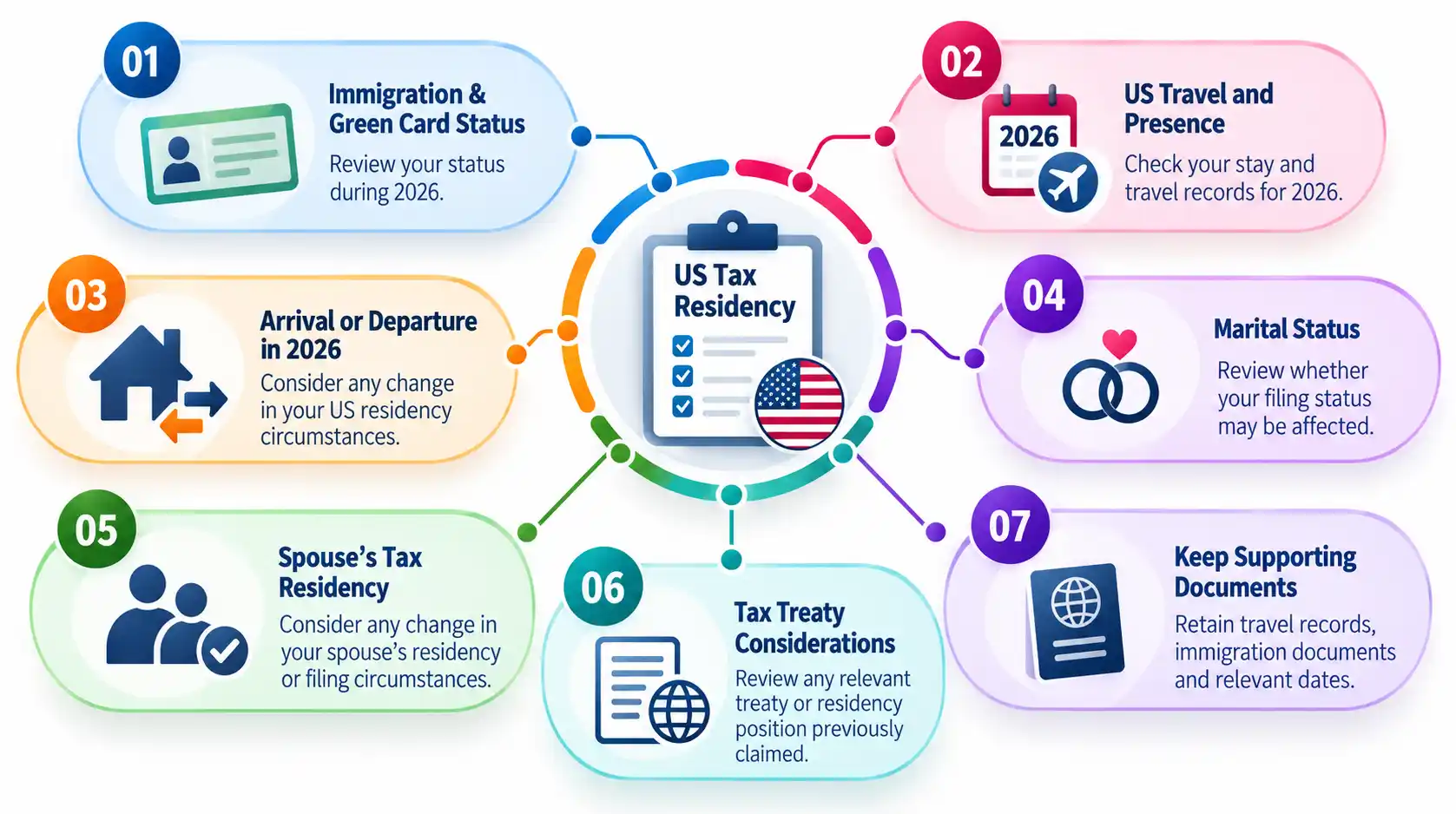
Before organizing your tax documents, review your US tax residency status for 2026. Immigration status, Indian residential status and US tax residency are not interchangeable.
For US federal income tax purposes, a non-US citizen may generally be treated as a resident alien if they meet the Green Card Test or Substantial Presence Test. Certain elections, exceptions and tax treaty provisions may also affect the result. The applicable rules should be assessed based on your individual circumstances.
If you are a US tax resident, your worldwide income is generally subject to US income tax. If you are a nonresident alien, different rules generally apply, including rules concerning US-source income and income effectively connected with a US trade or business. Therefore, do not assume that every NRI has the same US reporting obligations.
Review the following information:
If you moved to the US or left the country during 2026, retain travel records, immigration documents and relevant dates. You may need to examine whether dual-status rules apply.
For detailed guidance, refer to the IRS rules on determining an individual's US tax residency status.
Your US income documents are an essential part of preparing the annual tax return. Employers, banks, brokers and other payers may issue information returns reporting payments made during the year.
Keep the following documents in one place:
| Document | What to retain |
|---|---|
| Form W-2 | Wage and salary information reported by your employer |
| Form 1099-INT | Interest income reported by banks and other financial institutions |
| Form 1099-DIV | Dividend income and distributions |
| Form 1099-B | Brokerage-reported proceeds from securities transactions |
| Form 1099-R | Retirement plan distributions, pensions or annuities |
| Form 1099-NEC | Nonemployee compensation, where applicable |
| Form 1099-MISC | Other reportable miscellaneous income, where applicable |
| Form 1099-K | Reportable payment transactions, where applicable |
| Form 1095-A | Health Insurance Marketplace coverage information, if applicable |
Also retain:
Some tax documents may not arrive until January or February 2027. The year-end task is to identify which forms you expect, confirm that your contact details with the relevant institutions are current and collect the supporting records already available.
If you receive salary or equity compensation from a US employer, keep the relevant statements and transaction records. For detailed explanations of the tax treatment, refer to the existing Savetaxs guides on US salary income taxation for NRIs and US tax on Indian ESOPs for NRIs.
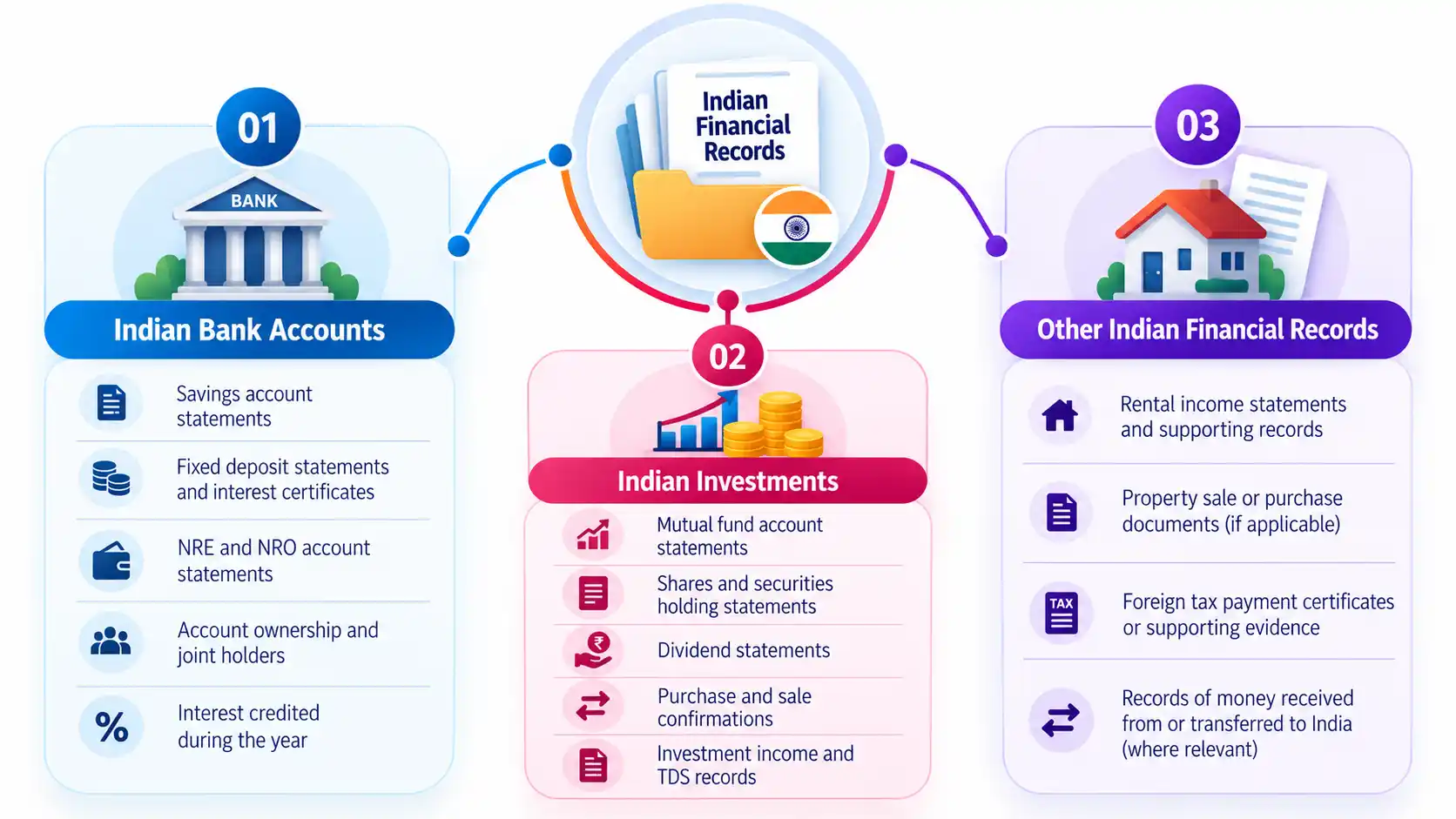
If you are a US tax resident, Indian financial activities may also be relevant to your US tax reporting. The records you need depend on your tax residency, income sources, account ownership and the nature of the financial activity.
Do not assume that income or assets can be ignored simply because they are located in India or because the income has already been taxed there.
Organize the following records, where applicable:
Indian bank accounts
Indian investments
Other Indian financial records
For example, an NRI working in the US may continue to hold an Indian fixed deposit and receive interest in an NRO account. The individual should retain the bank's annual interest certificate and account statements rather than relying only on the amount credited to the account.
Keep records of the income, relevant dates, currency and taxes paid. If a foreign income item needs to be reported on a US return, the applicable reporting and currency-conversion rules must be assessed separately.
This section is about organizing evidence, not explaining the taxation of each Indian income source. For detailed guidance, refer to the Savetaxs India-US cross-border tax planning guide.
Foreign financial accounts deserve particular attention when an NRI is living in the US and may qualify as a US tax resident.
Depending on your circumstances, you may need to consider reporting requirements such as the Foreign Bank Account Report (FBAR) and FATCA Form 8938. These are separate reporting requirements, and filing one does not automatically satisfy the other.
For your year-end records, prepare a list of relevant foreign accounts and assets, including:
Include relevant Indian savings accounts, fixed deposits, brokerage accounts and other financial accounts when assessing whether they fall within the applicable reporting rules.
A US person generally must file an FBAR if they have a financial interest in, or signature or other authority over, foreign financial accounts and the aggregate value of those accounts exceeds $10,000 at any time during the calendar year. The requirement is based on the aggregate value, not on whether the accounts generated taxable income.
For the 2026 calendar year, retain account details and maximum balance information so that the reporting position can be assessed accurately.
Form 8938 is a separate reporting requirement for specified foreign financial assets. Whether you need to file it depends on your taxpayer category, filing status, residence and the value and type of assets involved.
Do not assume that every Indian bank account or investment automatically has to be reported on Form 8938. Review the applicable asset definitions, exceptions and reporting thresholds.
Also remember that FBAR and Form 8938 are not interchangeable. Depending on your circumstances, you may have to file one, both or neither.
For more information, refer to the Savetaxs FATCA Form 8938 guide and the official IRS instructions.
If you hold investments in the US or India, collect the statements and transaction records needed to establish what happened during the 2026 tax year.
Useful records include:
For example, an NRI working in the US may hold shares through a US brokerage account and mutual funds through an Indian investment platform. Keeping the respective statements together helps identify transactions and income that may need to be reviewed when preparing the return.
Do not rely solely on a year-end portfolio summary. Transaction-level records may be needed to establish acquisition dates, proceeds and cost basis.
If you received or sold Indian employer equity, retain the relevant grant, vesting, exercise, purchase and sale records. The tax treatment of these transactions is a separate subject and should be assessed using the applicable rules.
For detailed information, refer to the existing Savetaxs guide on US tax on Indian ESOPs for NRIs.
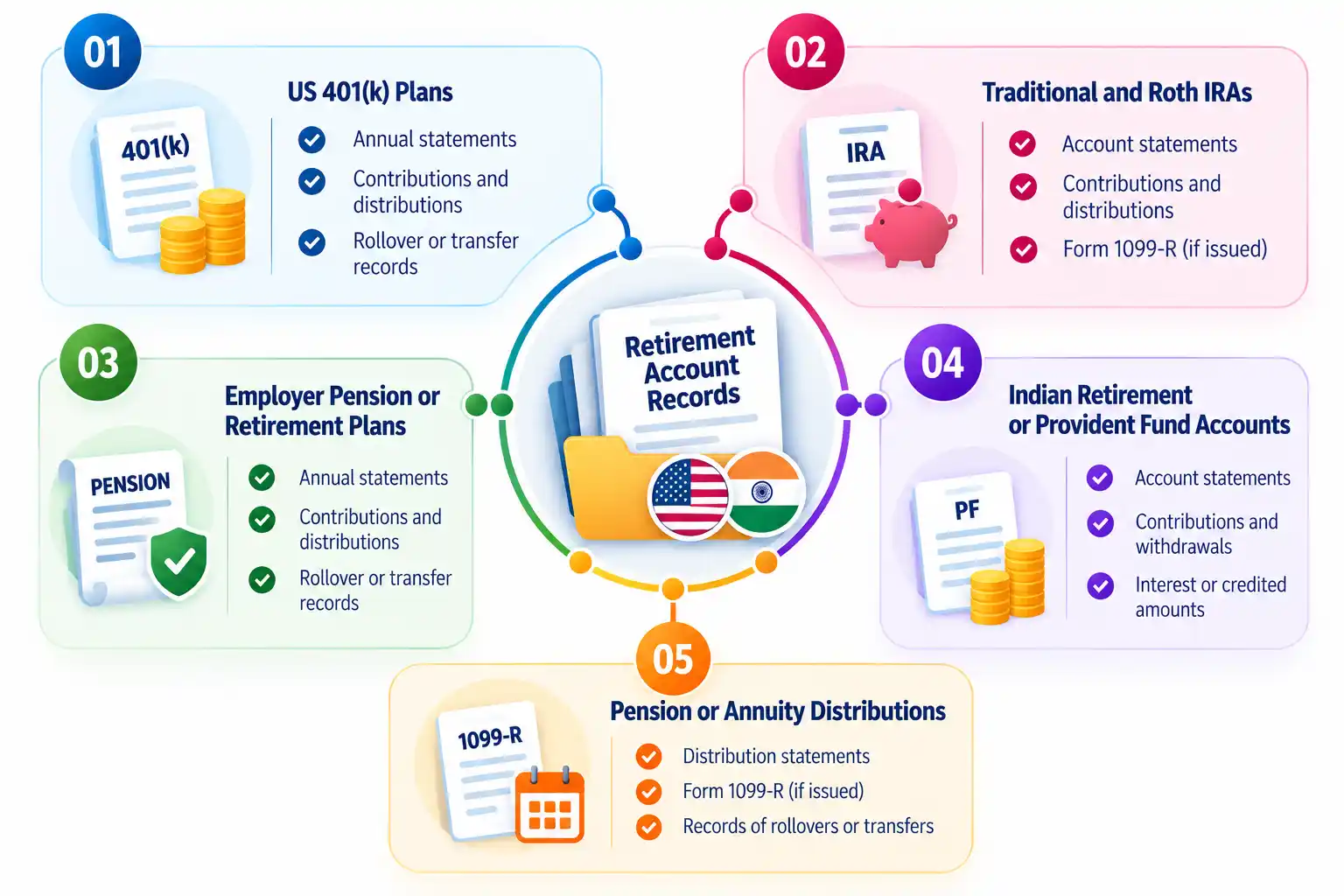
Retirement accounts can involve different reporting and tax rules depending on the account type, the country in which it is maintained, and your US tax residency.
Collect relevant documents for accounts such as:
Retain records of contributions, distributions, rollovers and account transfers during 2026. If you received a distribution, keep the relevant tax statement, including Form 1099-R where issued.
For Indian retirement accounts, keep statements showing contributions, withdrawals, interest or other credited amounts, along with the account terms where available.
Do not assume that a US retirement account and an Indian retirement account receive identical tax treatment. Their reporting requirements may differ, and the treatment can depend on your residency and the nature of the account.
This checklist does not cover retirement tax optimization, Roth conversions or detailed retirement-account taxation. Its purpose is to help you retain the documents needed for a proper review.
If you have a US 401(k) and are considering a future move to India, you can also refer to the Savetaxs guide on managing a 401(k) after returning to India.
Before the end of 2026, organize the records that help establish what you have already reported and paid.
Keep the following documents:
If you received an IRS notice during the year, retain the complete notice and any response submitted. Do not assume that a payment confirmation alone establishes that the related tax issue has been resolved.
Prior-year returns can also help identify information that may need to be reviewed again, such as carryforward amounts or previously reported foreign financial assets.
The objective is to create a reliable record of your previous filings and payments. Detailed estimated-tax calculations and withholding strategies are outside the scope of this checklist.
Once you have collected your records, organize them so that you can locate the required information during tax preparation.
A simple folder structure can help:
| Folder | Documents to save |
|---|---|
| 01 – Personal and Residency | Passport and travel records, immigration documents, filing-status information |
| 02 – US Income | W-2, 1099 forms, pay statements and other income records |
| 03 – India Income | Indian bank interest certificates, investment income and other relevant records |
| 04 – Foreign Accounts | Account details, bank statements, maximum balances and ownership information |
| 05 – Investments | Brokerage statements, purchase and sale confirmations, cost-basis records |
| 06 – Retirement | 401(k), IRA, pension and distribution statements |
| 07 – Tax Payments | Estimated-tax confirmations, withholding records and state tax payments |
| 08 – Previous Returns | Prior-year federal and state returns, transcripts and IRS correspondence |
Use clear file names that include the institution, document type and tax year. For example:
Keep digital copies in a secure location and retain original documents where required. Avoid sharing sensitive financial records through unsecured channels.
Some information returns will be issued after December 31, 2026. Mark those documents as pending and reconcile them when received. If a corrected form arrives, retain it and use the corrected information when preparing your return.
Use this consolidated checklist to check your preparation progress before the 2026 calendar year closes.
Completing this review does not automatically mean that your tax return is ready to file. It gives you a more organized record of your financial activities and helps identify documents or reporting questions that may need further attention.
Get support with US tax filing and cross-border documentation.
For NRIs living in the US, year-end tax preparation should include a review of both US and Indian financial records. Organizing income documents, foreign account details, investment statements, retirement records and previous tax filings before the 2026 calendar year closes can make the 2027 tax filing process more structured.
The most important step is to maintain complete and accurate records rather than relying on memory or collecting documents only when the return is due. If your financial activities span India and the US, review the applicable reporting requirements carefully and seek qualified tax advice where your circumstances require a more detailed assessment.
This article is for general informational purposes only and does not constitute tax, legal, financial, or investment advice. Laws, regulations, rates, and procedures may change over time and may vary based on individual circumstances.
While SaveTaxs makes reasonable efforts to keep the information accurate and up to date, readers should verify applicable rules with official authorities or consult a qualified professional before making decisions based on this information.
Shubham Jain is the Founder of SaveTaxs and has extensive experience in Indian and NRI taxation. He advises individuals, NRIs, and businesses on tax filing, tax planning, capital gains, DTAA benefits, fund repatriation, and compliance matters. He regularly writes about taxation and related financial topics. His focus is on making complex tax concepts easy to understand. Through his articles, he helps taxpayers stay informed, avoid common mistakes, and stay compliant with Indian tax laws. See Full Bio

Want to read more? Explore Blogs