US Tax Filing and Compliance
How to Report Multiple 1099 Forms on a U.S. Tax Return: A Guide for NRIsHow to Report Multiple 1099 Forms on a U.S. Tax Return: A Guide for NRIs
Written by Hatim Dudhiyawala


Choosing a US tax planning advisor can be difficult for NRIs who have financial responsibilities in both India and the United States. You may have US employment income, Indian property, bank accounts, investments, or other financial interests that need to be considered when reviewing your tax position. An advisor who understands only one country's tax system may not be equipped to assess the full picture.
The right professional should have appropriate US tax credentials, relevant experience with India–US tax situations, clear communication practices, and a well-defined engagement process. Before hiring anyone, NRIs should verify the advisor's qualifications and understand exactly what the professional will handle.
This guide explains how to evaluate a US tax planning advisor, what questions to ask, and which warning signs to consider before signing an engagement.
NRIs with financial connections to India and the United States may need to consider tax obligations in both countries. Their requirements can depend on their tax residency, income sources, investments, property ownership, and other financial activities.
For example, an NRI living and working in the US may also earn rental income from property in India. Another taxpayer may hold Indian investments while having US filing and foreign-asset reporting responsibilities. A person returning to India after working in the US may need to review the tax implications of the move.
These situations can involve different tax rules, reporting requirements, and filing responsibilities. An advisor should understand how to identify the relevant issues in each country and when coordination with an Indian tax professional is necessary.
An individual's Indian residential status and US federal tax residency are separate determinations. For US tax purposes, a non-US citizen may generally be treated as a resident alien if they meet the Green Card Test or Substantial Presence Test, subject to applicable exceptions and treaty provisions. US citizens and resident aliens are generally subject to US tax on worldwide income, while nonresident aliens are generally taxed under different source-based rules. An advisor should establish the relevant tax status before assessing filing and reporting obligations.
Before hiring an advisor, check whether they have handled situations similar to yours, such as:
The purpose is not simply to find someone who prepares a US tax return. It is to find a professional who can identify the tax issues relevant to your circumstances and explain the limits of their role.
Get guidance on coordinating your tax requirements across India and the United States.
Before discussing fees or services, verify the professional credentials of the person who will handle your US tax matters. Different qualifications provide different levels of authority and professional responsibility.
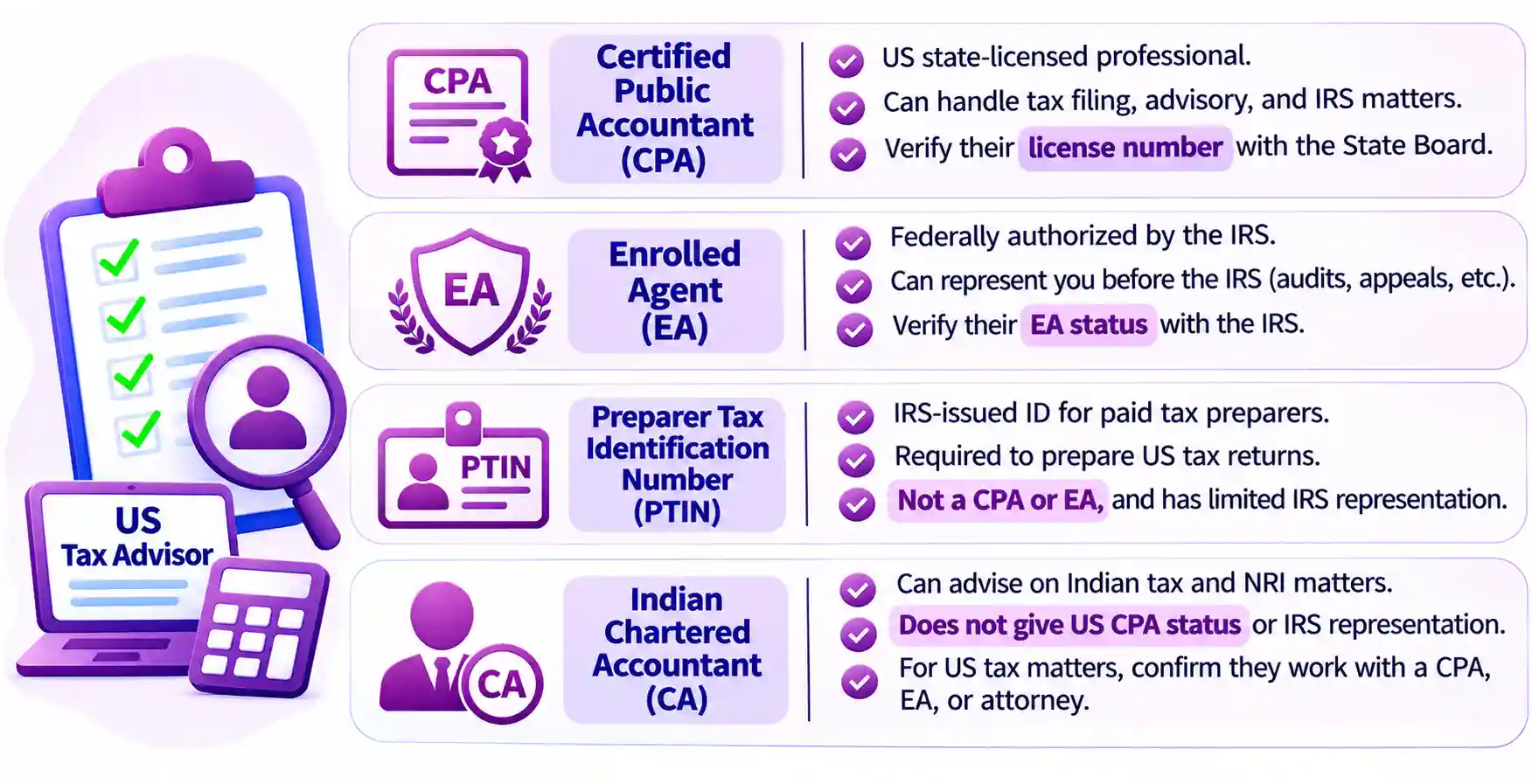
A Certified Public Accountant is licensed by a state board of accountancy in the United States. CPAs may provide tax preparation, accounting, advisory, and IRS representation services within the scope of applicable professional and licensing rules.
If an advisor claims to be a CPA, ask for their licence number and issuing jurisdiction. Check the licence through the relevant State Board of Accountancy or an available CPA verification directory. A valid CPA licence confirms professional status, but it does not by itself establish experience with India–US cross-border taxation.
An Enrolled Agent (EA) is a federally authorized tax professional who has earned the right to represent taxpayers before the IRS. Applicants generally qualify by passing all three parts of the IRS Special Enrollment Examination and meeting the IRS suitability requirements. Certain former IRS employees may qualify through an alternative experience-based route. EAs must meet continuing education requirements and renew their enrollment periodically. Before hiring an EA, verify their current status and ask about their experience with India–US tax matters.
EAs have unlimited representation rights before the IRS. This means they can represent taxpayers in matters such as audits, collections, and appeals, subject to applicable rules.
If an advisor identifies as an EA, verify their current status through the IRS and ask whether their experience includes the type of cross-border tax matters relevant to you.
A Preparer Tax Identification Number (PTIN) is an IRS-issued identification number generally required for individuals who are compensated for preparing, or assisting in preparing, all or substantially all of a US federal tax return, claim for refund, or certain other IRS forms, subject to specified exceptions. All Enrolled Agents must also maintain a valid PTIN.
A PTIN is not equivalent to a CPA or EA qualification and does not by itself provide unlimited IRS representation rights. Certain non-credentialed preparers who participate in the IRS Annual Filing Season Program may have limited representation rights for returns they prepared and signed. Ask who will prepare and sign your return and verify that the responsible paid preparer has a valid PTIN.
An Indian Chartered Accountant may advise on Indian tax matters, including NRI taxation and Indian income tax compliance. However, an Indian CA qualification does not automatically confer US CPA status or unlimited representation rights before the IRS.
If your situation involves both countries, clarify whether the advisor has the required US tax qualifications or works with a suitably qualified US tax professional. An Indian CA may handle Indian tax compliance and advise on Indian tax matters within the scope of their professional authorization. However, the qualification alone does not confer unlimited representation rights before the IRS. If US federal tax representation is required, confirm that the person is also an attorney, CPA, or Enrolled Agent authorized to represent taxpayers before the IRS.
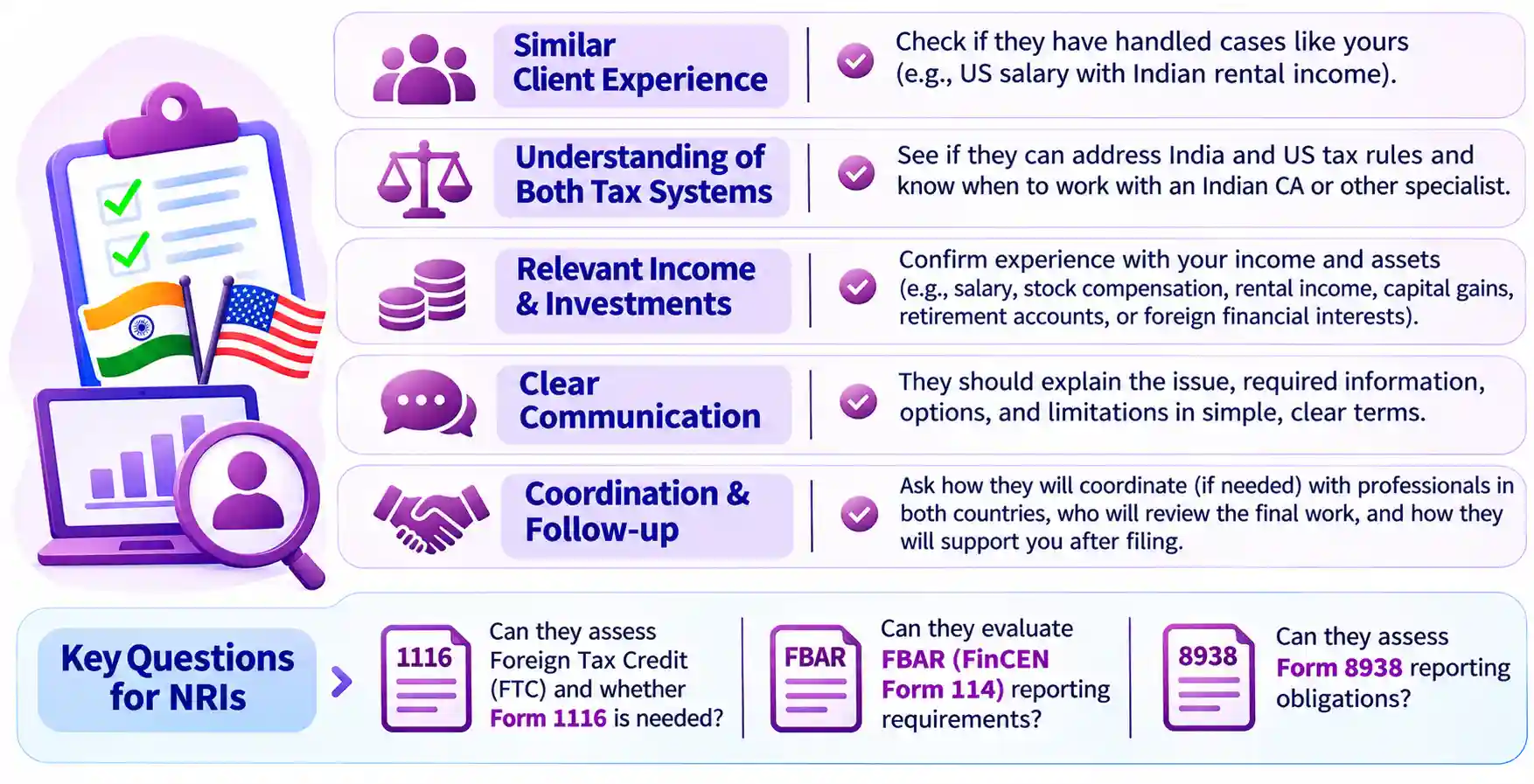
Credentials are an important starting point, but relevant experience helps determine whether an advisor can handle your specific requirements.
A professional may be experienced in preparing standard US individual tax returns but may have limited exposure to taxpayers with Indian income, investments, property, or financial accounts. Ask for details about the types of cross-border situations they regularly handle.
Consider these factors:
Ask whether the advisor has worked with clients who have circumstances comparable to yours. For example, if you receive US salary income and Indian rental income, check whether the advisor understands how to review both income sources and identify the applicable filing responsibilities.
Ask how the advisor approaches situations involving Indian and US tax obligations. They should be able to explain which matters they handle directly and when they coordinate with an Indian CA or another specialist.
Your advisor should be familiar with the categories relevant to your circumstances. These may include employment income, stock compensation, rental income, capital gains, retirement accounts, or foreign financial interests.
You do not need an advisor who claims to handle every possible tax issue. You need one who can clearly identify whether your specific requirements fall within their experience.
A suitable advisor should explain the issue, the information needed, the available options, and any limitations in understandable language. Be cautious if the professional avoids answering reasonable questions or gives conclusions without reviewing your circumstances.
If your tax position requires input from professionals in both countries, ask how information will be shared, who will review the final work, and who will answer questions after filing.
For US citizens and resident aliens with Indian-source income, ask whether the advisor can assess foreign tax credit eligibility and limitations, including whether Form 1116 may be required. If you hold Indian financial accounts or other foreign financial assets, ask whether the advisor can evaluate separate reporting obligations such as FBAR (FinCEN Form 114) and Form 8938. These requirements have different rules and thresholds, and one filing does not automatically satisfy the other.
For more context on the types of issues an advisor may need to understand, read our guide to India–US cross-border tax planning.
A consultation is an opportunity to assess the advisor's experience, communication, and responsibilities. Prepare questions that relate directly to your financial situation.
Have you handled cases similar to mine? Ask about experience with your income sources, residency circumstances, investments, or property interests. The advisor should be able to describe relevant experience without disclosing confidential client information.
Who will personally review and sign my tax return? Confirm whether the person you are speaking with will handle the work or whether it will be assigned to another preparer. Ask for the responsible professional's credentials.
Do you handle both Indian and US tax matters? If not, ask whether you will need a separate Indian tax professional and how coordination between the professionals will work.
What services are included in your engagement? Clarify whether the work covers tax planning, return preparation, foreign reporting, representation, or only selected services. Do not assume that one service automatically includes all the others.
Will you review my foreign financial account and asset reporting obligations? Ask whether the advisor will assess FBAR and Form 8938 requirements, where applicable, or whether these services are outside the engagement.
How will you communicate updates and document requests? Ask about communication channels, expected response times, document-sharing procedures, and who will be your main contact.
What happens if I receive an IRS notice after filing? Confirm whether post-filing assistance or IRS representation is included, available separately, or outside the engagement.
How are your fees calculated? Ask for a written fee estimate, the services included, and the circumstances that could lead to additional charges.
The answers should help you understand whether the advisor's experience and service structure match your tax requirements.
Before hiring a tax advisor, review the engagement terms carefully. A professional discussion may sound comprehensive, but the written agreement should explain what you are actually paying for.
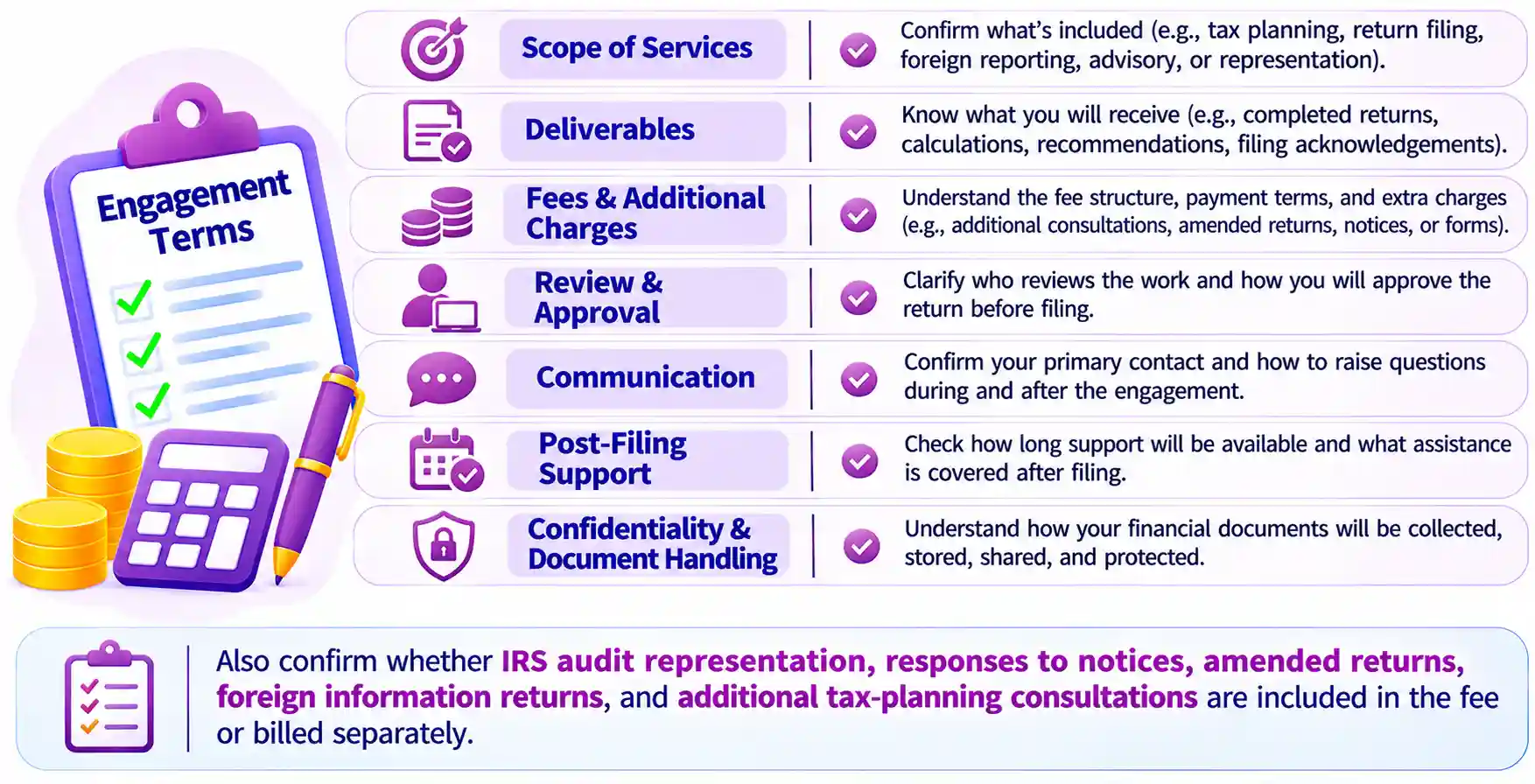
Check the following points:
Confirm whether IRS audit representation, responses to notices, amended returns, foreign information returns, and additional tax-planning consultations are included in the quoted fee or billed separately.
Do not rely only on a verbal promise that the advisor will manage everything. The written engagement should define the work, responsibilities, exclusions, and fees.
An advisor's qualifications and experience matter, but their professional conduct is equally important. Watch for warning signs before sharing sensitive financial documents or authorizing work.
The IRS also advises taxpayers to check preparer credentials, understand representation rights, avoid refund-related guarantees, and choose a preparer who remains available after filing.
Never sign a blank or incomplete tax return. Review the completed return before it is filed, confirm that the information is accurate, and make sure any refund is directed to your own bank account rather than the preparer's account.
Before proceeding, verify the professional's credentials, understand the engagement terms, and make sure you are comfortable with how your tax information will be handled.
Get professional support to understand your US tax filing and cross-border compliance requirements.
Choosing a US tax planning advisor is not just about finding someone who can prepare a tax return. NRIs with financial connections to India and the United States should assess the professional's credentials, relevant cross-border experience, communication process, and responsibility for the work.
Before hiring an advisor, verify their qualifications, ask questions about similar cases, and review the engagement terms in writing. These steps can help you choose professional support that matches your actual tax requirements.
At Savetaxs, NRIs can explore support for US tax filing, India–US tax coordination, and cross-border tax planning. If your situation involves tax obligations in both countries, review the US tax filing support for NRIs and India–US tax planning services to understand the available assistance.
This article is for general informational purposes only and does not constitute tax, legal, financial, or investment advice. Laws, regulations, rates, and procedures may change over time and may vary based on individual circumstances.
While SaveTaxs makes reasonable efforts to keep the information accurate and up to date, readers should verify applicable rules with official authorities or consult a qualified professional before making decisions based on this information.
Shubham Jain is the Founder of SaveTaxs and has extensive experience in Indian and NRI taxation. He advises individuals, NRIs, and businesses on tax filing, tax planning, capital gains, DTAA benefits, fund repatriation, and compliance matters. He regularly writes about taxation and related financial topics. His focus is on making complex tax concepts easy to understand. Through his articles, he helps taxpayers stay informed, avoid common mistakes, and stay compliant with Indian tax laws. See Full Bio

Want to read more? Explore Blogs