-for-401(k)_1790057066765.webp&w=828&q=75)
US Tax Filing and Compliance
Net Unrealized Appreciation (NUA) for 401(k): A Guide for NRIs Moving to IndiaNet Unrealized Appreciation (NUA) for 401(k): A Guide for NRIs Moving to India
Written by Vipul Jain

TIN, the taxpayer identification number, is a broader term for any number used to identify the taxpayer on IRS tax returns. An ITIN (Individual Taxpayer Identification Number) is issued to individuals who are not eligible for an SSN but are required to file a U.S. tax return. An SSN, Social Security number is used for U.S. citizens and authorized workers in the U.S. Although both the SSN and the ITIN look similar, they serve very different purposes, and understanding which is applicable to your situation is key to filing your taxes, claiming DTAA treaty benefits, and complying with IRS tax requirements.
In this guide, we will talk about the difference between an SSN and ITIN, who qualifies for each, when you may apply, how to transition from an ITIN to an SSN, and certain common mistakes that NRAs in the US should avoid.
SSN is an abbreviation for Social Security Number. It is used by the Social Security Administration (SSA) to identify citizens of the US and noncitizens authorized to work in the country. SSN is tied to the employer, Social Security benefits, and a wider identity in the United States.
ITIN is an abbreviation for Individual Taxpayer Identification Number; it is issued by the IRS, not the SSA. This number is just to let people meet U.S. tax requirements when they are not eligible to obtain an SSN. ITIN is a nine-digit format identical to an SSN but will always start with the number 9.
In simpler terms: An SSN says you can work here. An ITIN says you owe, or interact with, United States taxes, and here is your number for that.
The following demonstrates the clear difference between the SSN vs ITIN for NRIs.
| Particular | SSN | ITIN |
|---|---|---|
| Issued By | The Social Security Administration | IRS |
| Who is eligible | US citizens, green card holders, work-authorized visa holders. | Non-resident with a US tax obligation ineligible for SSN. |
| Issued to work-authorized individuals | Yes | No |
| Social Security benefits | Yes | No |
| Earned Income Tax Credit Eligibility | Yes | No |
| Use to file the US tax returns | Yes | Yes |
| Expires | No | Yes, after three consecutive years of non-use. |
| Application Form | Form SS-5 | Form W-7. |
One of the most important lines in this table is the expiration column. An ITIN expires if you do not use it. Meaning, if your ITIN number was not included on a filed return for three consecutive tax years, it will expire on December 31 of the third year, and you will need to renew it before filing it again.
File your taxes in India with expert guidance, ensuring 100% compliance and accuracy throughout the process.
You need an SSN if you are authorized to work in the United States. This generally includes.
To apply for an SSN, you need to complete Form SS-5 and submit it in person at the SSA office, along with proof of identity, immigration status, and work authorization. There are no fees, and the processing generally takes about two to four weeks.
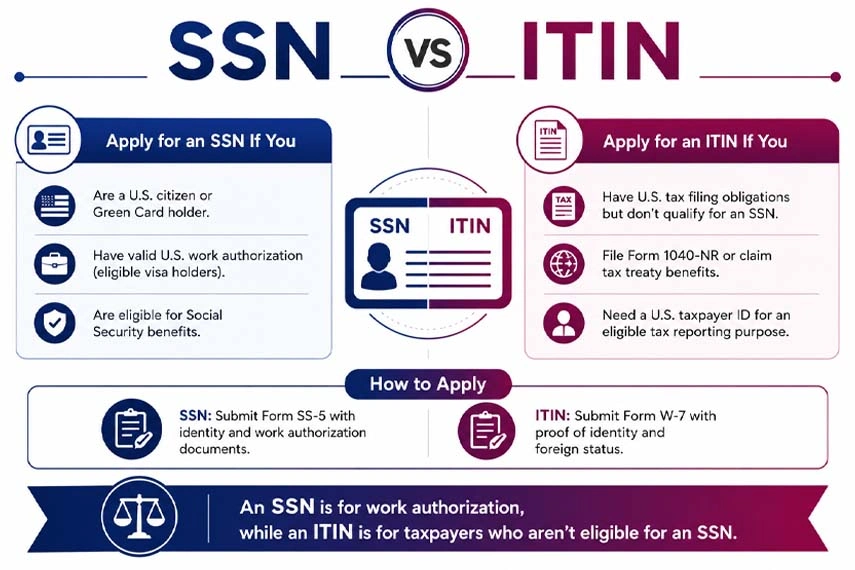
You will need an ITIN if you have US tax filing or reporting obligations, but you are not eligible to get an SSN. This will cover a wide range of NRI situations.
Ensure that wanting a US bank account or a credit card is not a justified reason to have an ITIN. Then the IRS requires you to have a document showing your tax purpose and application; without one, your application is often rejected.
To apply for this, you will have to file Form W-7 along with the documents proving both your foreign status and yur identity. For this, a valid passport is generally the strongest single document to satisfy both requirements at once. If you do not have one, you will need at least two documents from the IRS's approved list, and note that the IRS requires the original or certified copies, not notarized copies or photocopies.
To be honest, this is not really a choice that we encounter; it is generally determined by your work authorization status. Use the following points as a quick self-check.
Nehal lives in Delhi and holds a great portfolio of US stocks through an American brokerage. She has no US work authorization and has never set foot in the country for employment, but her dividend income creates a US tax filing obligation, and she wants to claim the reduced DTAA tax treaty withholding rate instead of the default rate. She is not eligible for an SSN; Nehal applies for an ITIN using her Form W-7, submitting her passport as proof of her foreign status and her identity.
After her ITIN was issued, she used it to file Form 1040-NR and to support her treaty claim with her broker; it has nothing to do with work authorization, only with her United States tax obligations.
Yes, you can replace your ITIN with an SSN if you submit a request. If you later on become eligible for an SSN. For instance, if you move to the US on a work visa after previously filing for an ITIN. You must:
The IRS does not allow you to hold and use both the SSN and an ITIN at the same time. Once you qualify for an SSN, the IRS will reject any further ITIN applications, and using an ITIN and continuing to file with it will lead to creating mistakes that will further complicate your tax history.
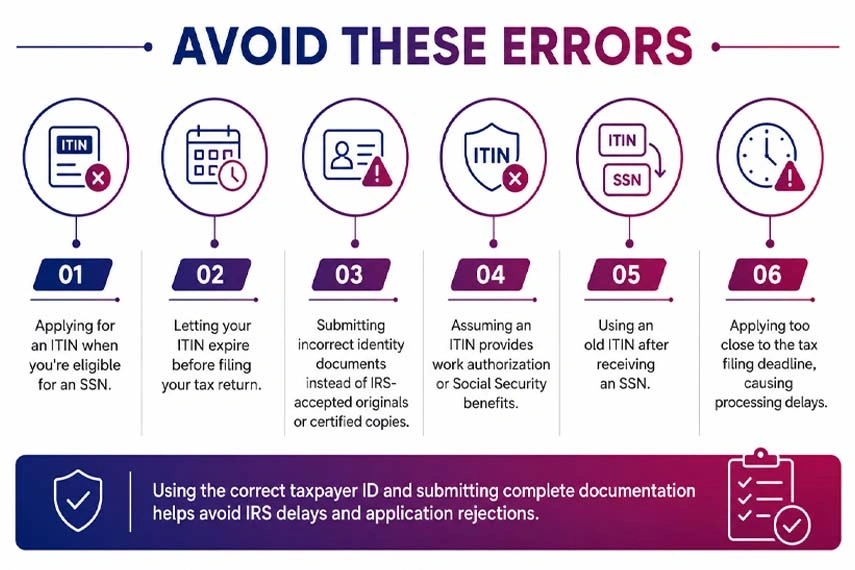
The following are the common mistakes that you should avoid as a nonresident alien:
NRAs, our expert CPAs will help you with US tax planning, filing, and cross-border tax management
As a nonresident, understanding the difference between the SSN and the ITIN is an important first step for nonresidents understanding the tax system in the United States. While an SSN is required for individuals with U.S. work authorization, an ITIN allows those without any employment eligibility to fulfill their U.S. tax obligations and claim applicable tax treaty benefits.
Before you apply, confirm which identification number matches your current immigration status and tax status, as using the wrong one can delay the tax filing and create unnecessary administrative issues. In case you are unsure about your eligibility or need assistance with an ITIN application or the SSN application, talking to a professional consultant will help ensure you follow the correct SSN or ITIN application process.
At Savetaxs, we help you prepare application forms such as the ITIN (Form W-7) and can also assist with the documentation needed for SSN-related processing to ensure that the forms you file are accurate.
Connect with us as we serve our clients 24/7 across all time zones.
This article is for general informational purposes only and does not constitute tax, legal, financial, or investment advice. Laws, regulations, rates, and procedures may change over time and may vary based on individual circumstances.
While SaveTaxs makes reasonable efforts to keep the information accurate and up to date, readers should verify applicable rules with official authorities or consult a qualified professional before making decisions based on this information.
Vipul Jain is the Co-Founder of SaveTaxs and a tax expert with experience in Indian and NRI taxation. He advises individuals, NRIs, and businesses on tax filing, tax planning, capital gains, DTAA, and compliance matters. He focuses on making complex tax concepts simple and helping taxpayers make informed, compliant decisions. See Full Bio

Want to read more? Explore Blogs