-for-401(k)_1790057066765.webp&w=828&q=75)
US Tax Filing and Compliance
Net Unrealized Appreciation (NUA) for 401(k): A Guide for NRIs Moving to IndiaNet Unrealized Appreciation (NUA) for 401(k): A Guide for NRIs Moving to India
Written by Vipul Jain

The nonresidents and expatriates are advised to keep their IRS tax records for at least three years from the date of filing the return and for two years from the date you have paid the tax, whichever is later. Specifically, expats should keep their tax filing records longer because foreign-related forms extend the statute of limitations, and the IRS has more time to assess penalties on international filings.
Further, the IRS can audit the non-resident return even years after the return is filed. Foreign accounting itself carries a long look-back window. And if the IRS ever has questions about their treaty claims, withholding credit, or residency status, you will need to produce the documentation you have filed months or years ago.
In this blog, we will discuss what to keep, how long to keep it, and how you can store the documents safely.
For the easiest and simplest U.S. tax situations, the IRS has three years from your filing date to audit your income tax return. But as a nonresident, the window will be extended significantly.
This matters specifically for NRIs because the non-resident return often involves claiming benefits under the DTAA tax treaty, foreign income exclusion, and foreign account disclosures, each of which the IRS may want to verify years later.
Furthermore, if your residency status was never ambiguous, for instance, you were close to the Substantial Presence Test threshold or claimed the Closer Connection Exception, your travel documents and the records related to immigration that year become the evidence you may need to defend your filing position.
The following are the tax records that you, as a nonresident in the US, must keep.
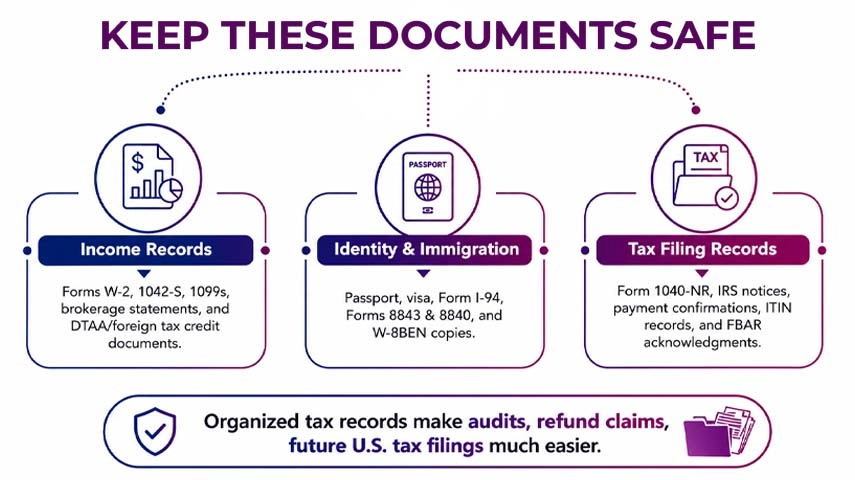
Keep all types of documents that show what you have earned in the US and how much tax against your earnings was withheld.
These records include documents that show your residency status and are often the first thing the IRS asks for if they question your non-resident filing.
Keep all the copies and documents related to your IRS notices and tax returns safe. Such as:
Savetaxs helps nonresidents file their IRS taxes in US under expert guidance and with 100% compliance.
The following table demonstrates the minimum tax record retention period of the documents that nonresidents in the US must maintain.
| Document Type | Minimum Retention Period |
|---|---|
| Filed tax return (1040-NR, 1040) | Permanently, never discard them. |
| W-2, 1042-S, 1099 Forms | 7 years from the filing date. |
| FBAR filing confirmations | 6 years (FBAR has its own 6-year statute) |
| Form 8938 (FATCA) | 6 years |
| The foreign tax credit records | 7 years |
| Passport & immigration records | Keep the documents of all the years you filed as a nonresident; it is recommended to keep them permanently. |
| Investment Purchase records | Until you sell that particular asset + 3 years. |
| IRS Notices & correspondence. | Permanently |
| Treaty benefit documentation. | 7 years from the date it was claimed. |
Now, if you are in doubt about any kind of document, whether it is on the above-mentioned list or not, just keep it. Because the cost of not having the document when the IRS asks for it is far higher.
The following are tips for storing your documents safely.
Digital Storage as the primary method: Scan all the physical documents and save them as PDFs. Organize the files by tax year; further, create a folder for each year (e.g., US Tax 2024) and save all the documents there.
Store all the digital copies in at least two places.
Physical Storage As Backup
After digital storage, to be doubly secure, keep all the real paperwork in a secure, waterproof folder or a file box organized year by year. Storing everything in a secure, locked cabinet or a safe is ideal for sensitive documents like passport copies and ITIN copies.
Naming convention tip: When you are naming the file while storing it, include the year, form type, and source in the name format. For example: "2024_Form1042S_ICICI_Dividends.pdf" or "2024_W2_UniversityOfTexas.pdf". Naming the files in order makes the retrieval fast when you need a specific document quickly.
Arya is an NRI based in Pune who held F-1 student status at a university in the United States from 2018 to 2023. He filed Form 1040-NR each year and claimed the treaty benefit under Article 21 of the India-US DTAA. After graduating and returning to India in 2023, he assumed his US tax obligations were fulfilled.
However, in late 2025, he received an IRS notice for the tax year in 2021, questioning the treaty exemption claimed on the scholarship income. Further, the IRS wants the documentation showing Arya was a citizen of India present in the US primarily for educational purposes in that year.
Now that Arya has organized all the digital copies for every year's records, such as his Form 1040-NR, Form 8843, passport scans with entry/exit stamps, and his university enrollment verification, he further responded to the notice within two weeks with complete end-to-end supporting documentation. The matter was quickly resolved with no additional taxes owed.
If Arya has discarded those records after he returned to India, reconstructing everything again would be time-consuming, expensive, and potentially incomplete.
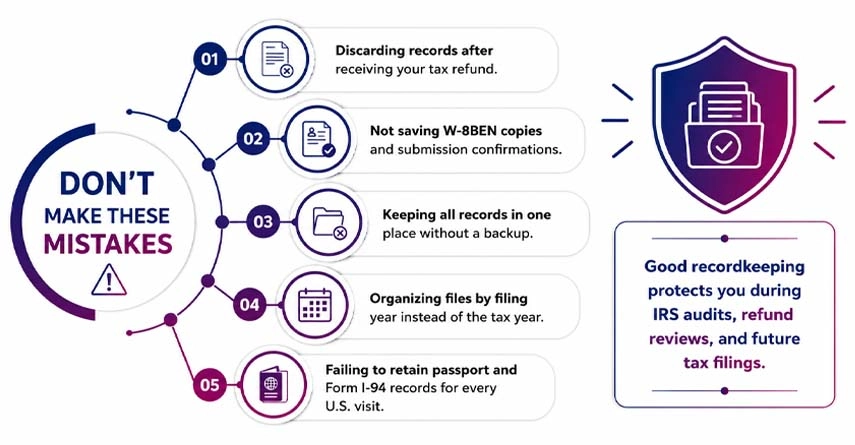
The following are some of the common recordkeeping mistakes to avoid:
Savetaxs provides expert-backed 24/7 NRI tax consultation.
Filing your US tax return is the visible part of nonresident tax compliance. What happens next is quiet, but it is equally important.
It is advisable to keep your tax records organized, stored in at least two locations, and retained for the full applicable period. For most of the documents, keeping them stored for seven years is practically minimal. However, keep the filed return, immigration records, and IRS notices permanently.
As a taxpayer, it will take just a few minutes each year to scan and file your documents. This small investment of your time will save you from the stress and cost of reconstructing the documents later.
This article is for general informational purposes only and does not constitute tax, legal, financial, or investment advice. Laws, regulations, rates, and procedures may change over time and may vary based on individual circumstances.
While SaveTaxs makes reasonable efforts to keep the information accurate and up to date, readers should verify applicable rules with official authorities or consult a qualified professional before making decisions based on this information.
Vipul Jain is the Co-Founder of SaveTaxs and a tax expert with experience in Indian and NRI taxation. He advises individuals, NRIs, and businesses on tax filing, tax planning, capital gains, DTAA, and compliance matters. He focuses on making complex tax concepts simple and helping taxpayers make informed, compliant decisions. See Full Bio

Want to read more? Explore Blogs