-for-401(k)_1790057066765.webp&w=828&q=75)
US Tax Filing and Compliance
Net Unrealized Appreciation (NUA) for 401(k): A Guide for NRIs Moving to IndiaNet Unrealized Appreciation (NUA) for 401(k): A Guide for NRIs Moving to India
Written by Vipul Jain

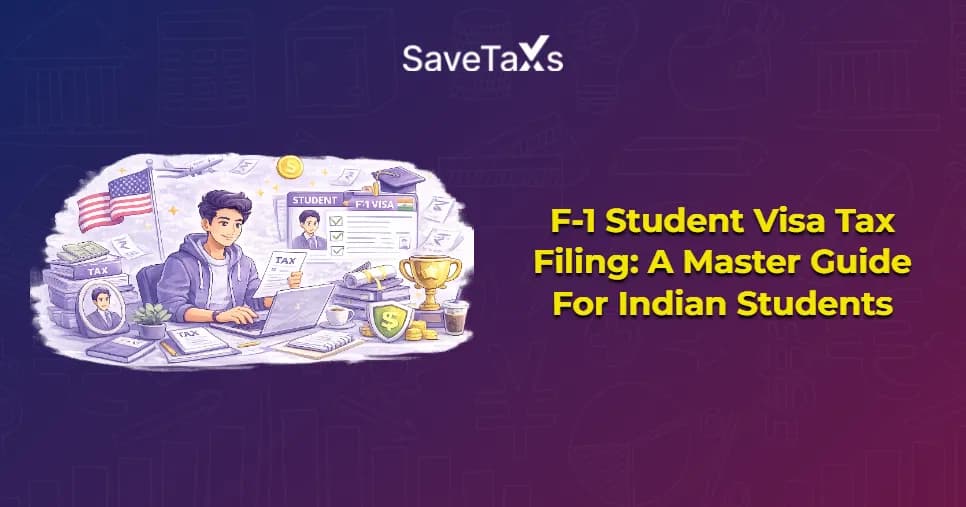
As an Indian student in a new country, tax filing would be the last thing on your mind because adjusting to a new university, a new city, and a completely different country is a task in itself. But if you are an Indian student studying in the United States on an F-1 visa, the Internal Revenue Service has specific requirements that apply to you, and failing to meet them can cause problems ranging from withheld refunds to visa complications.
However, the good news is that an F-1 international student tax return is manageable once you understand the basics. This guide will take you through everything you need to know, such as what form to file, whether you owe any tax or not, how the Indian-US tax treaty helps you, and the mistakes that Indian students make.
You are required to file a US tax return if you have received any kind of income in the United States during the year. But here is something many students miss: even if you had zero income, you may still need to file a form.
You must file if you have:
You must file even with no income if:
You were physically present in the United States at any point during the tax year; in this case, you need to file Form 8843.
Form 8843 is not an income tax return; it is more of a statement indicating that you were in the United States on an F-1 visa and are therefore exempt from the substantial presence test (explained below). It just takes about 10 minutes to complete and file the form. Ensure that the form is filed by June 15 if you had no income, or by April 15 if you did not have income and are filing along with Form 1040-NR.
Savetaxs helps NRIs file their ITR in India with utmost respect.
Before you go ahead and file anything, you must know whether you are a resident alien or a nonresident alien for the purpose of US taxation. This is not about your immigration status, and it is purely a tax-based classification.
The following forms are required for F-1 student tax filing.
The following are the steps for filing taxes as an Indian F-1 student.
Confirm that you are a non-resident alien as aforementioned. If you have been in F-1 status for more than five years, get professional guidance before assuming your status.
You may have the following documents handy, such as the:
If you do not have an SSN and earned income, you will need an ITIN. Apply for it using Form W-7; you can do this when you file your tax return.
Fill in your personal details, the visa information, and the school information. If filing with a return, attach it to your 1040-NR. If filing on its own (no income ), mail it separately.
Report all the US source income, including wages from the W-2, the taxable scholarship, amounts from the 1042-S, and any other income source. Apply any treaty exemption in the appropriate section. Calculate your tax liability after the deductions and credits.
File it by April 15. Pay any tax you owe by April 15 even if you file an extension. If you had too much tax withheld, the IRS will refund the difference, which is why filing it is worth doing even if you think you owe nothing.
Where you should file: Form 1040-NR must be e-filed using the tax software that supports a non-resident return. Other than this, you can mail the completed form to the IRS, as addressed in the instructions.
The India-USA Double Taxation Agreement tax treaty contains provisions that are extremely valuable for Indians, and many don't know its benefits for Indian students. The following are some of the tax treaty benefits for Indian students in the USA.
Article 21(2) of the India-US DTAA: This exempts scholarship and fellowship income from taxation in the US for Indian students in the US. Especially, the grants, scholarships, and the fellowships received from outside the US are not taxable in the US, even if you are physically present in the US when you receive them.
That aside, under Article 21(1), an Indian student in the US for full-time education is exempt from the US tax on remittances from India, provided the purpose is maintaining education or training.
On-campus employment income: Now this is where the DTAA for Indian students gets much better. With respect to the treaty, Indian students are eligible for an exemption on their first $5,000 of wages earned in the United States per year. However, this exemption requires you to proactively notify the employer's payroll department and complete the appropriate withholding exemption form, as this $5,000 benefit is not automatically applicable.
How To Claim Treaty Benefits: When filing Form 1040-NR, you declare the treaty exemption in the designated section (typically under "Income exempt from tax under a treaty). Identify Article 21 of the India-US treaty and the exempt amount.
Important Limitation: You can only claim the treaty exemption if you have not previously claimed it in the prior years beyond the limit and if you are in the US primarily for educational purposes. The total exemption period under the treaty is typically not 5 years from the date of the first arrival in the US; however, it is advisable to confirm this with a tax professional for your specific situation.
The following are common tax mistakes:
Priya arrived in the United States in August 2023 with an F-1 visa to pursue a master's degree in CA at the University of Texas. During the year 2024, her second calendar year in the US, she worked 20 hours per week on campus, earning $12,000 in wages. She has also received a $3,000 departmental scholarship that has covered living expenses beyond tuition.
Her employer correctly withheld federal income tax but did not withhold Social Security or Medicare taxes as required for F-1 students. The university issued her a Form W-2 for her wages and a Form 1042-S for her scholarship.
Priya has filed Form 1040-NR and Form 8843 by April 15. She claimed the India-US treaty exemption under Article 21 for the first $5,000 of wages, reducing her overall taxable income to $6,000. The $3,000 scholarship for living expenses was taxable, but after the standard deduction available to non-residents (a limited amount relative to their expenses), her total federal tax was approximately $1,200.
She had $ 1,600 withheld by her employer during the year, so she received a $400 federal refund. She also filed a state return for Texas, which has no state income tax, so no state return was required.
Savetaxs helps international students and scholars get through complex US IRS tax laws
Yes, F-1 student tax filing often seems complicated at first, but when you understand the rules, it generally follows a consistent, manageable pattern. The key points to remember here are:
Always file Form 8843, even if you earn no income. If you earned any income, file Form 1040-NR by April 15. Avoid using the standard tax software available to residents. You shall claim the India-US treaty benefits you are entitled to, especially the $5000 wage exemption. And check your W-2; if Social Security or Medicare tax was withheld, you are owed a refund.
For most Indian F-1 students during their first five calendar years in the United States, complying with the applicable U.S. tax filing requirements is important regardless of whether they expect a refund. The cost of not filing, including the potential complications with future visa applications and missed refunds, is far higher than the time it takes to file it correctly.
In case your situation is tough, such as you have multiple sources of income, school disruptions, or a fair-year state transition, consult a tax professional who has expertise with non-resident student returns; it is worth the investment.
Savetaxs provides end-to-end assistance to help international students and scholars get through the complex maze of US non-resident tax laws. We ensure 100% IRS compliance, assist you with required forms, and help you maximize the tax treaty benefits and correct erroneous tax withholdings. Connect with us as we serve our clients 24/7 across all time zones.
This article is for general informational purposes only and does not constitute tax, legal, financial, or investment advice. Laws, regulations, rates, and procedures may change over time and may vary based on individual circumstances.
While SaveTaxs makes reasonable efforts to keep the information accurate and up to date, readers should verify applicable rules with official authorities or consult a qualified professional before making decisions based on this information.
Vipul Jain is the Co-Founder of SaveTaxs and a tax expert with experience in Indian and NRI taxation. He advises individuals, NRIs, and businesses on tax filing, tax planning, capital gains, DTAA, and compliance matters. He focuses on making complex tax concepts simple and helping taxpayers make informed, compliant decisions. See Full Bio

Want to read more? Explore Blogs