-for-401(k)_1790057066765.webp&w=828&q=75)
US Tax Filing and Compliance
Net Unrealized Appreciation (NUA) for 401(k): A Guide for NRIs Moving to IndiaNet Unrealized Appreciation (NUA) for 401(k): A Guide for NRIs Moving to India
Written by Vipul Jain

_1786439108161.webp&w=3840&q=75)
Have you ever searched "LRS limit for NRIs" when transferring money from India? Well, many NRIs have this misconception that, like Indian residents, there is also a FEMA LRS limit for NRIs. However, it is not so. The Liberalized Remittance Scheme applies to Indian residents only. But this does not mean NRIs can have no remittance limitation in India. Considering this, NRIs also have specific rules governing money transfers between India and other countries under FEMA.
Want to know what they are? This blog provides you with complete information about it. So read it and clear all your doubts.
The Liberalized Remittance Scheme (LRS) was introduced by the Reserve Bank of India (RBI) on February 4, 2004, and it is a part of FEMA. This scheme lets Indian residents transfer up to USD 250,000 per financial year for a wide range of purposes without RBI approval. When the scheme was first introduced, the remittance amount was limited to USD 25,000, but it has been revised from time to time since then.
The scheme serves the purposes of both current and capital accounts. This includes transferring money overseas for education, medical treatment, travel, gifts (current account purposes), buying property overseas, opening a foreign bank account, and investing in foreign funds and shares (capital account purposes).
This was all about FEMA's Liberalized Remittance Scheme (LRS). Moving ahead, let's know why NRIs get confused between FEMA LRS and NRI remittance.
When searching for "LRS for NRIs," most people miss the most important part of the LRS definition: the scheme is only applicable to Indian residents. However, "resident" under FEMA isn't purely a day-count test. Under FEMA Section 2(v), an individual is generally treated as a "person resident in India" if they've stayed in India for more than 182 days during the preceding financial year but this is qualified by the purpose and intent of the stay. Someone who leaves India for employment, business, or under circumstances indicating an intention to stay outside India for an uncertain period is treated as a non-resident under FEMA, even if they haven't yet completed 182 days abroad. The reverse also holds for someone returning to settle in India. This is different from the day-count test under the Income Tax Act, which is why your FEMA residency status and your Income Tax residency status can genuinely diverge, especially in the year you move.
Once you're classified as a non-resident under FEMA, you're not permitted to hold a resident savings account, and — most importantly for this discussion you fall outside the LRS framework altogether. This means NRIs don't have an LRS remittance limit to worry about at all; instead, they operate under the separate NRE/NRO/FCNR repatriation rules covered later in this piece.
Further, let's talk about the common myth that surrounds most NRIs in India.
Myth vs. Fact: "Under LRS limit, NRI Can Remit Up to USD 250,000 Every Year."
Fact: This is a complete myth, as discussed earlier; this is the LRS limit for Indian residents, and as mentioned above, there is no LRS available for NRIs.
Truth: NRIs do have repatriation rules under FEMA that depend on their NRE, NRO, and FCNR account types.
It is not such a big thing to get confused between the LRS and the NRI remittance scheme, as both of them come under the FEMA regulations. Additionally, both include money transfer across borders. However, to avoid FEMA violations, it is vital to understand both LRS and NRI remittances, as both have different eligibility, forms, tax treatment, and repatriation limits.
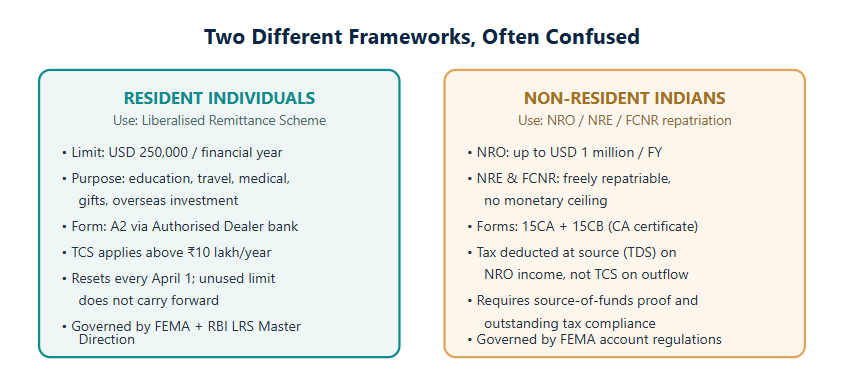
So, this is why NRIs get confused between FEMA LRS and remittance limits for NRIs. Moving further, let's know about the LRS limit, purpose, and rules for Indian residents.
As mentioned earlier, even though FEMA LRS does not apply to NRIs, understanding it is vital for them. This is because they frequently interact with it when they send gifts or money to their parents, spouses, or children in India. To give you an idea, the table below shows the LRS threshold limit, purposes, and rules for Indian residents remitting money overseas.
| Particulars | Description |
|---|---|
| Eligible Remitters | Indian residents, including minors (with counter signature of guardian) |
| Annual Remittance Limit | USD 250,000 per individual, per financial year (April 1 to March 31) |
| Limit Type | Across all purposes and banks cumulative, tracked against your PAN card. Additionally, it gets reset every financial year with no carry-forward option. |
| Permitted Current Account Uses | Overseas medical treatment, education, donations, gifts and maintenance of relatives |
| Permitted Capital Account Uses | Buying property overseas, investing in foreign bonds, shares or funds (subject to Overseas Investment Regulations), opening a foreign bank account. |
| Not Eligible | Partnership firms, businesses, corporates, LLPs, trusts and HUFs; these entities do not fall under FEMA LRS; they have separate FEMA regulations. |
| Prohibited Uses | Indian residents cannot remit funds for buying lottery tickets, margin trading, and other transactions under the Current Account Transaction Rules of FEMA |
When NRIs Come in This Picture: When an Indian resident parent or sibling living in India remits funds to their NRI children or sibling for education, maintenance, or gift, they need to follow the LRS limits. Here, the USD 250,000 limit is counted against the Indian sender, not the NRI receiver.
This was all about the LRS threshold limit, purposes, and rules for resident Indians. Moving forward, let's know when TCS applies to LRS remittances.
Tax Collected at Source (TCS) on foreign remittances was first introduced under Section 206C(1G) of the Income Tax Act, 1961, effective October 2020, giving Indian banks the authority to collect TCS on LRS remittances exceeding the applicable threshold. Since then, the rate structure has been revised several times — most notably in October 2023, and again from April 2025 and April 2026. As of April 1, 2026, this provision has been carried forward into the Income tax Act, 2025 (which replaced the 1961 Act), so remittances made today are governed by the corresponding section of the new Act rather than Section 206C(1G) of the old one.
TCS is an advance tax, not an additional cost, it's credited against the remitter's overall tax liability, and any excess collected can be claimed back as a refund when filing the ITR.
Here's how TCS currently applies to LRS remittances:
| Purpose of Remittance | TCS Rate |
|---|---|
| Medical treatment or education, self-funded, up to INR 10,00,000 per year | Nil |
| Medical treatment or education, self-funded, above INR 10,00,000 per year | 2% |
| Education funded by an eligible loan from a specified financial institution | Zero, regardless of the amount |
| Abroad tour packages | 2% from the first rupee, no threshold tax exemption |
| All other purposes (property, investment or gift)- up to INR 10,00,000 per year | Nil |
| All other purposes (property, investment or gift), more than INR 10,00,000 per year | 20% |
Importance of PAN Card: Under the PAN-Aadhaar linkage requirement carried forward into the Income-tax Act, 2025, if you do not have a PAN card or haven't linked it to Aadhaar, you may face a higher TCS rate. Since TCS is a resident-remitter concept tied to LRS, it does not apply to outward remittances NRIs make from their NRE, NRO, or FCNR accounts on those, TDS applies to the underlying income instead, along with a chartered accountant's certification.
So, this was all about TCS on LRS remittance. Moving ahead, let's know what repatriation limits apply to NRIs in India.
As mentioned earlier, there is no LRS available for NRIs that restricts them from transferring money from India to overseas. Considering this, to maintain the cash-flow balance in the country, FEMA applies repatriation restrictions on the bank accounts of NRIs, i.e., NRE, NRO and FCNR. For your reference, the table below shows the repatriation restrictions for NRI accounts.
| Type of NRI Account | Repatriation Limit | Note |
|---|---|---|
| NRE (Non-Resident External) | You can repatriate any amount without any limitation. | This account contains your foreign-earned income. This includes both principal and interest amounts, which are transferable freely without taxes. |
| FCNR (Foreign Currency Non-Resident) | Allows repatriation freely without any limitation. | This includes foreign currency term deposits. This account also allows complete repatriation of principal and interest amounts without any taxation. |
| NRO (Non-Resident Ordinary) | Up to USD 1 million per financial year | This account holds India-sourced income including rent, dividends, sale proceeds and pension. Repatriation is limited and requires proper documents. |
These are the repatriation restrictions that NRIs face in India. Moving further, let's know about the NRO repatriation limit in detail.
Although NRIs do not face any repatriation restrictions when it comes to NRO accounts, they do face some restrictions. As mentioned earlier, using the NRO account, NRIs can transfer up to USD 1 million per financial year. This includes all things such as the sale of Indian property, dividends, accumulated rental income, pension, and similar India-sourced funds. Additionally, before the payment, they have to follow some procedures; this involves:
Unlike FEMA LRS, here the repatriation limitation is up to USD 1 million per financial year. This is not a "spending allowance"; it is a repatriation limit on funds that are in the NRO account.
Now, moving forward, let's know the situations where LRS impacts NRIs.
Fulfill your US tax obligations on time without any issue and with complete accuracy.
Even though the LRS does not directly apply to NRIs, there are some situations when it impacts their life. These are:
So, these are some situations where NRIs are affected by LRS. Moving ahead, let's know the common mistakes NRIs should avoid when remitting funds.
Common mistakes NRIs should avoid when making fund repatriation overseas:
These are some of the common mistakes that NRIs should avoid when remitting funds overseas. Moving further, let's get an idea of fund repatriation through a checklist.
Here is a checklist you need to follow when transferring funds overseas:
This is a quick checklist that you should consider when transferring money overseas.
Get personalized guidance as per your tax situation in the US.
Lastly, FEMA LRS is associated with overseas remittance, and it applies to Indian residents only; there are no remittance limits for NRIs. This scheme restricts fund repatriation overseas to up to USD 250,000 per financial year per individual. So, when NRIs do repatriation, they do not need to worry about the LRS. For you, there are different repatriation rules under FEMA depending on the bank account type (NRE, NRO or FCNR) you used. Further, understanding these is vital for legally compliant and smooth international transfers. Additionally, the LRS scheme is available only to individuals; it does not include entities such as corporations, partnerships, HUFs, LLPs, and more.
If you are not sure about FEMA regulations, how to transfer funds from an NRO account without crossing the threshold limit or obtaining Form 145/146, connect with Savetaxs. We have a team of experienced NRI tax and FEMA specialists who provide complete assistance with cross-border money transfer, documentation, and tax compliance. Additionally, our experts ensure that you transfer money overseas legally, safely, and without any delays. So, get in touch with us today and get personalized guidance on your financial situation.
This article is for general informational purposes only and does not constitute tax, legal, financial, or investment advice. Laws, regulations, rates, and procedures may change over time and may vary based on individual circumstances.
While SaveTaxs makes reasonable efforts to keep the information accurate and up to date, readers should verify applicable rules with official authorities or consult a qualified professional before making decisions based on this information.
Shubham Jain is the Founder of SaveTaxs and has extensive experience in Indian and NRI taxation. He advises individuals, NRIs, and businesses on tax filing, tax planning, capital gains, DTAA benefits, fund repatriation, and compliance matters. He regularly writes about taxation and related financial topics. His focus is on making complex tax concepts easy to understand. Through his articles, he helps taxpayers stay informed, avoid common mistakes, and stay compliant with Indian tax laws. See Full Bio

Want to read more? Explore Blogs