NRI Income Tax Compliance
Income Tax Forms Renamed in 2026: Old vs New Form NumbersIncome Tax Forms Renamed in 2026: Old vs New Form Numbers
Written by Vipul Jain
Understanding residency and taxation rules is important for Overseas Citizens of India (OCI) cardholders, especially as many may mistakenly believe that their tax obligations are solely determined by their OCI status. However, taxation in India mainly depends on an individual's residency status as outlined in the Income Tax Act.
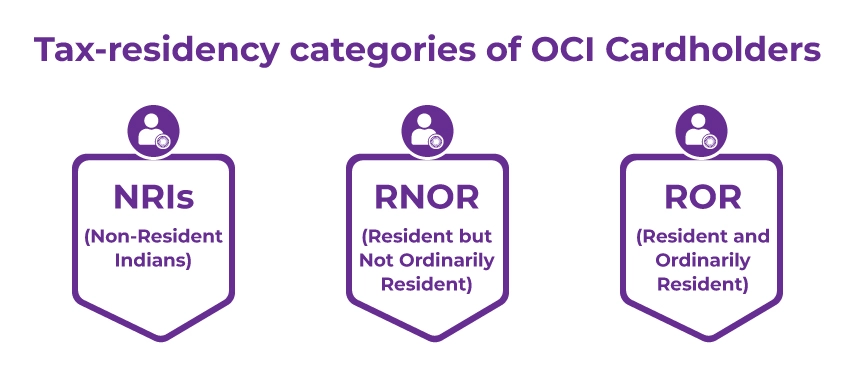
This helps differentiate between Non-Resident Indians (NRIs), Residents but not ordinarily resident (RNOR), and resident and ordinarily resident (ROR), with each status having distinct tax implications. Similarly, the confusion arises due to different criteria under various laws, specifically between the Income Tax Act and the Foreign Exchange Management Act (FEMA). In this blog, you will get an overview of the residency rules for OCI holders, the impact on taxation, and much more.
Before diving into the residency rules, let's clear a common misconception. Several OCI cardholders assume that their taxability in India depends only on the OCI card itself. However, that's wrong as it depends entirely on your residency status under the Income Tax Act.
India classifies individuals, including OCI holders, into three tax-residency categories, NRI, RNOR, and ROR, based on the duration of stay in the country. Let's understand this better:
To qualify as an NRI for tax purposes, you must:
Here is how the NRI status will affect your taxability:
The RNOR status is a transitional status for OCI holders (Overseas Citizen of India) and returning NRIs (Non-Resident Indians) who have recently returned from abroad but do not meet the duration of stay criteria to be considered full residents.
You qualify as RNOR when your stay meets residency conditions but doesn't fulfill the length of stay needed to reach the next category.
Here is how the RNOR status will affect your tax obligation:
You will qualify as an ROR if you fulfill both of the following requirements:
Here is how the ROR status will affect your taxability in India:
Stay prepared to file your ITR and pay your taxes on time with expert assistance.
It's important to understand that the OCI card does not automatically determine residency status. Instead, it's the duration of stay in India that determines your tax categorization. An OCI cardholder could end up in different tax situations based entirely on the days he/she have spent in India:
The key difference between an NRI and an OCI is that an NRI remains an Indian citizen, while an OCI is a foreign national of Indian origin who holds specific long-term residency rights. Here is a table detailing some more differences between an NRI vs an OCI:
| Particulars | Non-Resident Indian (NRI) | Overseas Citizen of India (OCI) |
|---|---|---|
| Eligibility | An individual can be called an Indian resident if he/she live in India for less than 182 days. | Any foreign national eligible to become a citizen of India after 1950, or someone who belonged to a territory that became a part of India after 1947. |
| Application | You get the NRI status automatically when you meet the eligibility criteria. | You need to apply for an OCI card using the Indian government's online portal. |
| Investment Options | NRIs are allowed to invest in commercial/residential property. However, they cannot invest in agricultural, farmhouse, or plantation property. | Similar to an NRI, OCI cardholders can also invest in commercial/residential property, but not in agricultural, farmhouse, or plantation property. |
| Tax Implication | The income received through receipts and investments will be subject to taxation in India. | Global income will be taxed in India for OCI holders. |
| Documentation | Overseas residential proof |
|
An OCI cardholder must keep these taxation rules in mind in India to ensure compliance:
Say goodbye to stressful paperwork and enjoy an easy OCI application process.

India uses two different laws - the Income Tax Act and FEMA (Foreign Exchange Management Act) to determine your residency and tax status. This dual framework often creates confusion amongst individuals: Your status under each law can be different, as these two laws follow different rules. Here is why the mismatch happens:
Here are some common situations that confuse OCI holders the most:
This situation arises when a returning OCI holder has not yet stayed long enough to shift tax status despite the intentions to stay in India. While foreign income is not taxable, individuals must convert NRE/NRO accounts to comply with the FEMA regulations.
In this situation, an individual stays in India for over 182 days but continues to consider their stay temporary. Their global income becomes taxable, but since they are recognized as an NRI for FEMA purposes, certain NRE/NRO rules may still apply.
Understanding the implications of NRE and NRE accounts is essential for OCI holders:
Get 100% accuracy and peace of mind with your taxes by choosing the experts.
Understanding India's taxation system as an OCI cardholder can be complex due to the specific regulations under both the Income Tax Act and FEMA. Determining how residency status impacts your taxability is crucial for OCI holders to comply with both legal frameworks. By understanding the various tax statuses (NRI, RNOR, ROR) and the requirements of NRE and NRO accounts, OCI holders can effectively plan their tax obligations and financial management.
Furthermore, if you have confusion regarding your residential status or your tax liability, connect with Savetaxs. We have a team of professionals who can assist you with determining your residency status and your tax obligations accurately. They will ensure you stay compliant and avoid any kind of legal consequences. Contact us right away.
This article is for general informational purposes only and does not constitute tax, legal, financial, or investment advice. Laws, regulations, rates, and procedures may change over time and may vary based on individual circumstances.
While SaveTaxs makes reasonable efforts to keep the information accurate and up to date, readers should verify applicable rules with official authorities or consult a qualified professional before making decisions based on this information.
Shubham Jain is the Founder of SaveTaxs and has extensive experience in Indian and NRI taxation. He advises individuals, NRIs, and businesses on tax filing, tax planning, capital gains, DTAA benefits, fund repatriation, and compliance matters. He regularly writes about taxation and related financial topics. His focus is on making complex tax concepts easy to understand. Through his articles, he helps taxpayers stay informed, avoid common mistakes, and stay compliant with Indian tax laws. See Full Bio
Want to read more? Explore Blogs