-for-401(k)_1790057066765.webp&w=828&q=75)
US Tax Filing and Compliance
Net Unrealized Appreciation (NUA) for 401(k): A Guide for NRIs Moving to IndiaNet Unrealized Appreciation (NUA) for 401(k): A Guide for NRIs Moving to India
Written by Vipul Jain
One of the most common questions that comes across in the minds of non-resident aliens living in the US is, "Can NRIs file US taxes without an SSN?" Yes, you can file a US tax return without an SSN (Social Security Number). Not having it does not stop you from filing your tax return in the US. Now, the question is: how can a non-resident without an SSN file a US tax return? To overcome this situation, the IRS built a separate system, i.e., the Individual Taxpayer Identification Number (ITIN). You can apply for it using Form W-7.
Further, if you are an NRI, an international student, a dependent, or a spouse living in the US without an SSN, then this blog is for you. Here you get complete information about how, without an SSN, you can file US tax returns through an ITIN in detail. So read on and clear all your doubts.
The simple and quick answer to this question is no. To file US taxes, you actually need a valid taxpayer identification number, and for most people in the US (NRIs, international students, dependents, or spouses), it is not an SSN. These individuals can file their US taxes using an ITIN instead of an SSN. It works exactly like an SSN when filing US taxes. Considering this, here is what an ITIN can do and cannot do.
So, no, you do not need an SSN to file US taxes. Moving ahead, let's know who can file US taxes without an SSN.
Several groups of people file US taxes without an SSN using an ITIN. These are as follows:
*Note: If you get an SSN even when you do not apply for it, then do not apply for an ITIN. This is because the IRS treats SSN and ITIN eligibility as mutually exclusive. Considering this, once you have an SSN, you do not need to apply for an ITIN.
This was all about who can file US taxes without an SSN. Moving ahead, let's know when you should apply for an ITIN instead of an SSN.
You should apply for an ITIN when you are confirmed that you do not qualify for an SSN. A quick way to check for this is:
| Situation | Use |
|---|---|
| Authorized to work in the US or eligible through visa status | Apply for SSN |
| Spouse or dependent with no work authorization, claimed on US tax return | Apply for ITIN |
| Non-resident alien with no work authorization but US filing requirement | Apply for ITIN |
| Already have an SSN | Do not apply for ITIN |
Further, in case you applied for an SSN, but the Social Security Administration has denied your application, keep the letter by your side. This is because when you apply for an ITIN, the IRS requires proof of SSN ineligibility.
So, this is when you should apply for an ITIN instead of an SSN. Moving forward, let's know how to file US taxes without an SSN.
Savetaxs helps non-residents to file US taxes with expert guidance and 100% compliance.
Filing U.S. taxes without an SSN follows a different application process than the standard return. This is mainly because you need to submit your ITIN along with your tax return. To provide you with an idea, here is how you file U.S. taxes without an SSN.
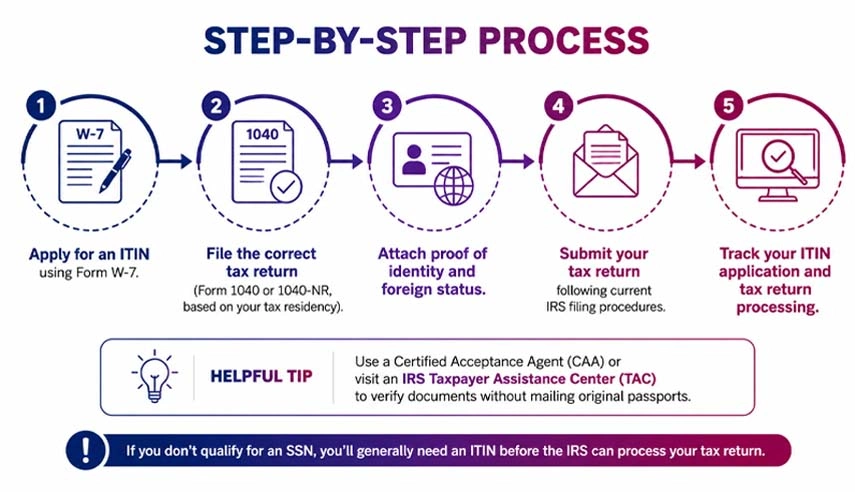
Form W-7 is the document used to apply for an ITIN application. A few essentials:
Which IRS form you use depends on your residency status in the US, not on your visa category:
In the form, leave the SSN field blank; the IRS fills it in once the ITIN is assigned.
You need to provide your identity and foreign status proof when filing your US tax return using an ITIN. Considering this, the preferred documents by the IRS for this include a valid, unexpired passport, as it fulfills both requirements on its own. In case you do not submit your passport, you need to submit at least two other qualified documents.
Additionally, to avoid mailing you your original documents, you can use two other ways:
This is how you can file US taxes without an SSN. Moving further, let's know the common tax filing scenarios for NRIs when they file US taxes without an SSN.
Here are some common tax filing scenarios for NRIs without an SSN:
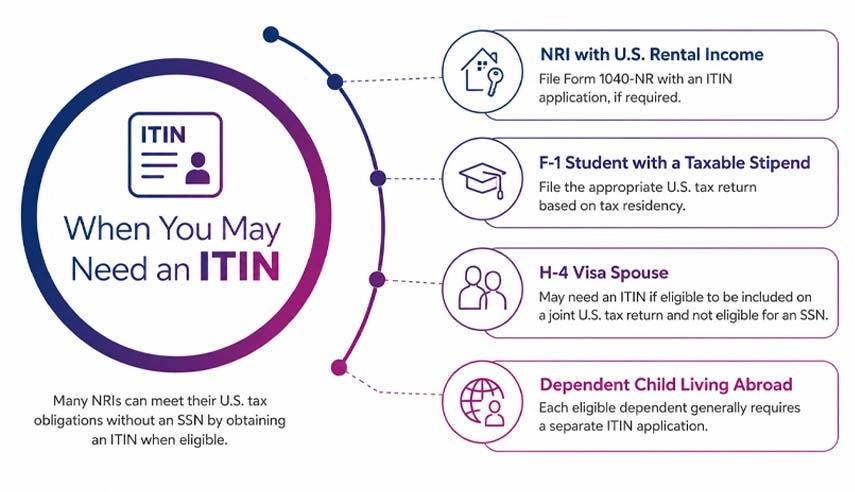
An NRI who owns property in the US and earns rental income from it needs to file US taxes even without living there. Considering this, they would file US tax returns using Form 1040-NR along with an attached ITIN application.
An international student getting a taxable scholarship or stipend, but with no SSN and no work authorization. Here, the student should file the appropriate U.S. tax return based on their tax residency status, together with an ITIN application if one is required.
A spouse on an H-4 visa with no work authorization needs an ITIN to be mentioned on the joint tax return of their partner. If the couple is otherwise eligible to file a joint U.S. tax return under the tax rules, the spouse may need an ITIN if they do not qualify for an SSN.
NRIs claiming for their dependent children who live outside the U.S. often need a separate ITIN application for each child. Additionally, they need to submit extra documents to provide proof of their dependent relationship, where required.
These are some common tax filing scenarios for NRIs when they file US taxes without an SSN. Moving forward, let's know the common mistakes NRIs should avoid when applying for an ITIN in the US.
Common mistakes that NRIs should avoid when applying for an ITIN:
So, these are some mistakes that NRIs should avoid when applying for an ITIN in the US.
At Savetaxs, we provide expert-backed 24/7 US tax consultation to NRIs and green card holders.
Lastly, the answer to the most common question, "Can NRIs file US taxes without an SSN?" is yes, they can file US taxes without an SSN using an ITIN. Considering this, not having an SSN does not shut down your US tax filing requirement. If you do not qualify for an SSN, you can simply fulfill your US tax obligation by applying for an ITIN and filing the tax return in the country using it. To obtain an ITIN, you need to file Form W-7 and attach it to your US tax return.
Further, if you need assistance in applying for an ITIN, connect with Savetaxs. We have a team of tax experts who help you obtain an ITIN without any issue and provide you with assistance in filing your US tax returns on time with complete accuracy.
This article is for general informational purposes only and does not constitute tax, legal, financial, or investment advice. Laws, regulations, rates, and procedures may change over time and may vary based on individual circumstances.
While SaveTaxs makes reasonable efforts to keep the information accurate and up to date, readers should verify applicable rules with official authorities or consult a qualified professional before making decisions based on this information.
Vipul Jain is the Co-Founder of SaveTaxs and a tax expert with experience in Indian and NRI taxation. He advises individuals, NRIs, and businesses on tax filing, tax planning, capital gains, DTAA, and compliance matters. He focuses on making complex tax concepts simple and helping taxpayers make informed, compliant decisions. See Full Bio

Want to read more? Explore Blogs