US Tax Filing and Compliance
Depreciating Indian Rental Property on a US Tax ReturnDepreciating Indian Rental Property on a US Tax Return
Written by Shubham Jain
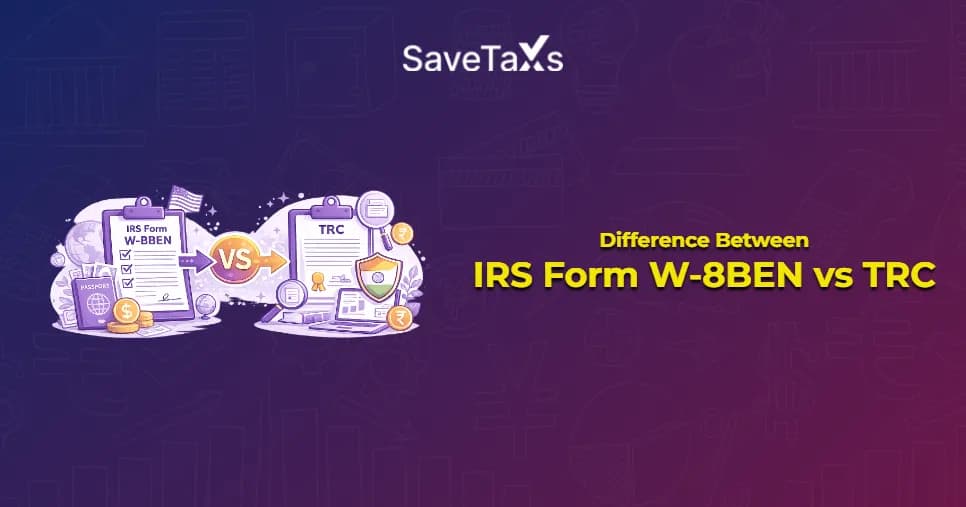
You might have been asked to provide Form W-8BEN if you are an Indian freelancer working with US clients. Also, while looking to avoid double taxation, you have most probably come across the Tax Residency Certificate (TRC). No, both of these forms are neither the same nor do they serve the same purpose. If you mix them up, it might cost you money at tax time.
In simple words, W-8BEN is used to ask your US client to stop over-withholding tax on your earnings. Conversely, a TRC proves your tax residency in a country so that you can claim treaty benefits and avoid being taxed twice on the same income. Most freelancers who work with US clients will eventually need both these forms. Keep reading further to know more about these two forms.
IRS Form W-8BEN is a form submitted by foreign freelancers to their US clients or payment platforms. It confirms that you are not a resident of the US, so that the client does not withhold tax at the default rate.
Not submitting this form will lead the US client to withhold 30% of your payment and send it to the IRS. This withholding rate can be significantly reduced, even to zero, by submitting a correctly filed W-8BEN and ensuring that India's tax treaty with the US is in place. However, this depends on the type of income and the applicable treaty article. Here are some things you need to keep in mind:
A TRC or a Tax Residency Certificate is an official proof issued by a tax authority. It confirms that you are a tax resident of a particular country during the specific financial year. For an Indian freelancer, it is a certificate issued by the Indian Income Tax Department that confirms you are an Indian tax resident. Here is how you can obtain a TRC:
A TRC remains valid only for the financial year specified on it. It means you need to get it renewed every year if you are claiming the treaty benefits regularly.
Under Section 90(4) of the Income Tax Act, the tax authorities can deny you treaty benefits completely if you fail to submit a valid TRC. This applies even if you are a resident of India. It means this will potentially lead you to pay full tax in both countries on the same income.
SaveTaxs handles complex US and local taxes so you save money.
The table below lists the key differences between IRS Form W-8BEN vs TRC:
| Factor | IRS Form W-8BEN | Tax Residency Certificate (TRC) |
|---|---|---|
| Issued By | You (self-certification) | Indian Income Tax Department |
| Given to | Your US client or payment platform | Foreign tax authority or client as proof of tax residency |
| Purpose | Reduces/avoids US withholding tax | Proves Indian tax residency for claiming treaty benefits |
| Validity | It remains valid for up to 3 calendar years | It remains valid only for one financial year and must be renewed every year |
| Filed With | Client only and never with the IRS | Applied for through Form 10FA as issued as Form 10FB |
In short, W-8BEN tells who is paying you and how much they have to withhold. On the other hand, TRC serves as proof of your residency for tax purposes, so treaty rates apply correctly on both sides.
We will understand the answer to this question with the help of an example of a freelancer's point of view:
Ankit is a UI/UX designer working full-time in Pune for a US-based SaaS company as an independent contractor. Before the first payment, his client asks him to provide a W-8BEN. So, Ankit submits it to avoid the standard 30% withholding. However, later, when Ankit wanted to claim the concessional withholding rate available under the India-US treaty, his client's finance team requested supporting proof of his Indian residency.
So, Ankit applies for a TRC by submitting Form 10FA and receives Form 10FB, then he shares it along with his W-8BEN. This combination allows him to claim the reduced treaty rates rather than the default rates. Also, it supports his claim for a foreign tax credit while filing his Indian return. To make it easier, here is a quick checklist:
Let Savetaxs handle the stressful and complex paperwork so you don't have to.
Form W-8BEN for Indian freelancers and TRC for NRIs serve two different purposes in the same journey. While one manages withholding at the US end, the other proves your tax residency for treaty purposes on both sides. Generally, Indian freelancers who earn consistently from US clients require both forms to avoid overpaying tax and claim relief during return filing in India.
Since treaty eligibility, domestic tax rules, and documentation requirements depend on the type of income and applicable tax laws, it is advisable to seek professional advice before relying on these forms for tax planning. Moreover, if you need expert assistance with tax planning or any NRI-related tax queries, contact an expert at Savetaxs. We have an entire team of experts who can help you clear any doubts and guide you throughout the tax filing process. Contact us right away, as our team is actively working 24/7 across all time zones.
This article is for general informational purposes only and does not constitute tax, legal, financial, or investment advice. Laws, regulations, rates, and procedures may change over time and may vary based on individual circumstances.
While SaveTaxs makes reasonable efforts to keep the information accurate and up to date, readers should verify applicable rules with official authorities or consult a qualified professional before making decisions based on this information.
Vipul Jain is the Co-Founder of SaveTaxs and a tax expert with experience in Indian and NRI taxation. He advises individuals, NRIs, and businesses on tax filing, tax planning, capital gains, DTAA, and compliance matters. He focuses on making complex tax concepts simple and helping taxpayers make informed, compliant decisions. See Full Bio

Want to read more? Explore Blogs