



Investment & Financial Planning
FCNR Deposit Interest Rates in 2026FCNR Deposit Interest Rates in 2026
Written by Hatim Dudhiyawala

There are a lot of investment instruments available in India when it comes to financial planning. Two very popular options that stand out for the unique benefits are the Equity-linked savings scheme (ELSS) and the unit-linked insurance plans (ULIPs).
ELSS is a type of diversified equity mutual fund that mainly invests in equity. It's popular for its tax-saving benefits and potential to offer high returns. On the other hand, ULIP is a type of financial instrument that combines the benefits of both a life insurance plan and an investment. In this blog, we will learn about the differences between ELSS vs ULIPs. We will also cover their key features, tax implications, and ideal choice for NRIs.
ELSS (Equity Linked Savings Schemes) are a type of mutual fund that invests mainly in equities. It has a mandatory lock-in period of three years. These funds offer high long-term growth potential and come with tax-savings benefits under Section 80C of the Income Tax Act, 1961.
ELSS is suitable for both medium-term and long-term goals. You can invest any amount in an ELSS. However, contributions of only Rs. 1,50,000 will be considered for tax deductions. Additionally, you can keep investing in this scheme even after the mandatory lock-in period of three years is completed.
Below are some key features of an ELSS:

A ULIP (Unit Linked Insurance Plan) is a financial product that combines life insurance with investment. A part of the investment goes towards allocating insurance coverage, and the remaining part is invested in a mix of market-linked funds like equity, debt, or balanced funds.
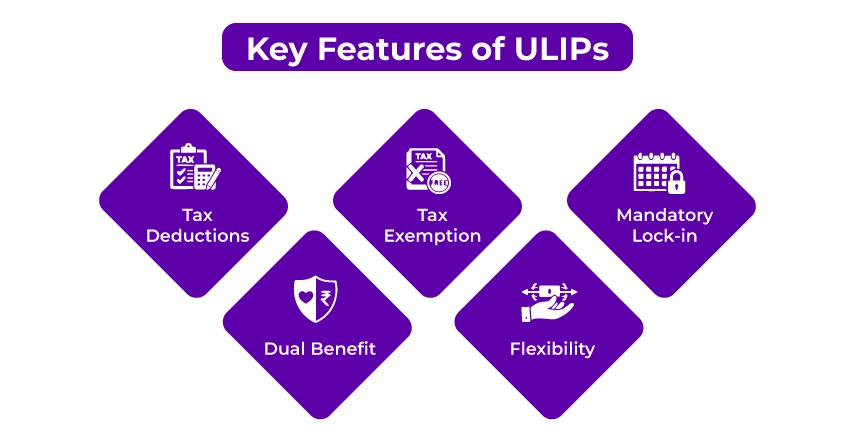
You can claim a tax deduction of the contribution made to a ULIP to a limit of up to Rs. 1,50,000 under Section 80C of the Income Tax Act. ULIPs (Unit-linked Insurance Plans) have a lock-in period of five years. During the lifecycle of the investment, you are allowed to switch from equity to debt or hybrid based on the objective of your investment.
Below are some key features of an ULIPs:
Consider the table below to understand the main differences between ELSS vs ULIPs:
| Parameters | Unit-Linked Insurance Plan (ULIP) | Equity-Linked Savings Scheme (ELSS) |
|---|---|---|
| Main Purpose | A combo of life insurance and investment. | Pure investment/tax-saving equity mutual fund. |
| Lock-in Period | Five years from the start of the policy | Three years from each installment. |
| Performance/Returns | The returns generated by the ULIPs completely depend on the investment option you select while purchasing the plan. | The returns are not guaranteed due to the volatility of equity and equity-related instruments. |
| Tax Benefit Under Section 80C | Up to Rs. 1.5 lakh per year limit under 80C on eligible premiums. | Same Rs. 1.5 lakh per year deduction under the old regime, available to NRIs with Indian taxable income. |
| Maturity/exit tax | Small-premium ULIPs: maturity exempt; high-premium ULIPs are taxed like equity LTCG at 12.5% for gains exceeding Rs. 1.25 lakhs. | Equity Long-term Capital Gains: 0% up to Rs. 1.25 lakh; 12.5% above. |
| Costs and Transparency | Multiple charges (mortality, allocation, admin, fund management). It is complex to decode. | Low-cost and clearly visible fund expense ratio with no insurnace charges. |
| Liquity and Flexibility | Surrender or partial withdrawal is allowed only after five years. Fund switches are allowed only within ULIP and are subject to policy rules. |
Partial/complete exit allowed after three years. These are easy to switch to other funds by redeeming and reinvesting. |
| Insurance Cover | Built-in life cover (sum assured or fund value, whichever is higher) | None, you need to buy term insurance separately. |
| Suitability for NRIs | Useful if you particularly wish to combine life cover and disciplined long-term investing and can commit for 10-15 years. | Ideal if you want Indian equity exposure along with tax saving and clean separation from insurance. |
Understanding tax implications on ELSS and ULIP is essential, as it plays a major role when NRIs make a choice. Although both products offer tax benefits, the way the amount is taxed at exit is different. Let's understand this in detail:
Both ELSS and ULIP qualify for tax deduction under Section 80C of the Income Tax Act.
So, both ELSS and ULIPs offer the same tax-saving benefit at the investment stage.
This is the point where the real difference begins.
ELSS is treated as an equity mutual fund. So, here is how ELSS mutual fund taxation works:
It means that ELSS is tax-efficient; however, it is not completely free from tax at the time of exit.
Proceeds received from ULIPs' maturity are generally exempt from taxation, provided that specific conditions are fulfilled:
If the conditions are met, both investments' returns remain exempt from taxation, making ULIPs attractive from a tax-free maturity perspective.
Let Savetaxs experts help you meet your tax deadlines effortlessly and on time.
NRIs must also consider Tax Deducted at Source (TDS)
For most of the NRIs who have taxable income in India, and specifically those who can buy a separate term plan easily, ELSS is suitable for them. It works better as it has:
ULIPs are ideal for NRIs when:
Hire an expert from Savetaxs and get a highly profitable, tax-efficient strategy tailored for you.
Both ELSS and ULIPs have their unique characteristics and offer certain benefits. Choose ELSS mutual funds if your focus is on generating wealth with high growth potential and a shorter lock-in period. Furthermore, if you seek a combination of life insurance coverage and flexible investment options as per your changing needs, opt for ULIPs.
Additionally, to make an informed decision, it's essential to consult with an expert at Savetaxs. We have a team of experts who can guide you in choosing the best investment options based on your financial goals. They will also help you navigate your tax implications based on the investment option you choose so that you stay compliant. Connect with us right away and avoid any confusion about investing in India as an NRI.
Note: This guide is for information purposes only. The views expressed in this guide are personal and do not constitute the views of Savetaxs. Savetaxs or the author will not be responsible for any direct or indirect loss incurred by the reader for taking any decision based on the information or the contents. It is advisable to consult either a CA, CS, CPA or a professional tax expert from the Savetaxs team, as they are familiar with the current regulations and help you make accurate decisions and maintain accuracy throughout the whole process.
Shubham Jain is the Founder of SaveTaxs and has extensive experience in Indian and NRI taxation. He advises individuals, NRIs, and businesses on tax filing, tax planning, capital gains, DTAA benefits, fund repatriation, and compliance matters. He regularly writes about taxation and related financial topics. His focus is on making complex tax concepts easy to understand. Through his articles, he helps taxpayers stay informed, avoid common mistakes, and stay compliant with Indian tax laws. See Full Bio

Want to read more? Explore Blogs
_1781845771869.webp&w=828&q=75)
_1778936280179.webp&w=828&q=75)
_1778936089630.webp&w=828&q=75)