US Tax Filing and Compliance
Is an S Corporation Worth It? Costs, Tax Benefits and Decision ChecklistIs an S Corporation Worth It? Costs, Tax Benefits and Decision Checklist
Written by Shubham Jain

When you purchase U.S. real property from a foreign person, the buyer generally withholds 15% of the purchase price under FIRPTA. However, it doesn't mean that every U.S. property sale will be subject to the standard 15% FIRPTA withholding rate. The rate can be reduced to 10% or eliminated entirely in certain residential transactions.
Here, the main focus is not how much profit the seller made or how long the NRI owned the property. Besides, these rules mainly focus on the amount realized from the sale and whether the buyer acquired the property to use as a residence. Now, for NRIs, understanding this difference is important. This is because the decision about how much of the sale proceeds is withheld depends on identifying the applicable rule before closing.
Moreover, for qualifying residence purchases in which the amount realized is $300,000 or less and the residence-use requirements are met, FIRPTA withholding can be avoided under an IRS exception. Simultaneously, for residence purchases in which the amount realized exceeds $300,000 but not more than $1 million, a reduced FIRPTA 10% withholding rate applies. There is a lot more to know about the FIRPTA 0% and 10% withholding rules for NRIs. To help you out, we will cover everything you need to know about these rules in this blog.
The FIRPTA withholding can be eliminated under the $300,000 residence exception when:
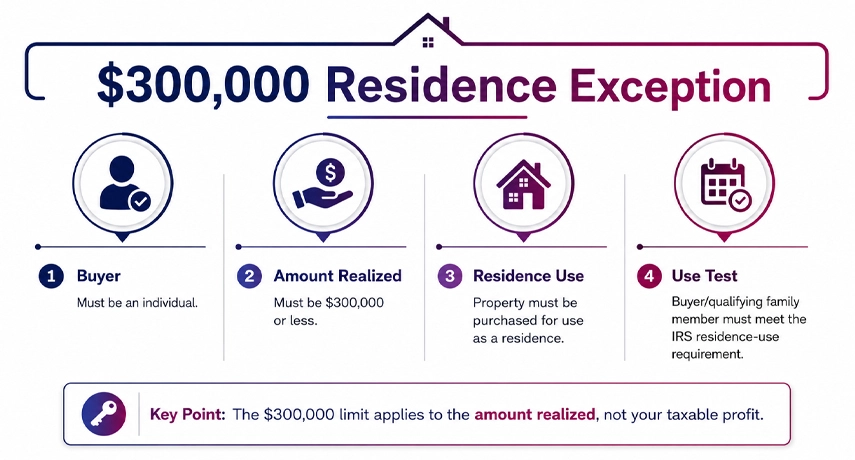
If all of these requirements are satisfied, FIRPTA withholding is generally not required under the $300,000 residence exception. Let's understand these in detail.
According to the IRS, the $300,000 residence exception does not apply when the actual buyer is not an individual.
For example, suppose you are an NRI, and you sell a $280,000 property to an LLC, which intends to rent it out. Now, in this case, because the property is sold to an LLC rather than an individual, the FIRPTA 0% withholding will not apply.
The amount realized must not exceed $300,000 to claim this residence exception. Additionally, the total sale price does not equal your actual taxable profit. It means FIRPTA withholding will apply to the entire transaction amount, while the seller's actual taxable gain will be calculated separately.
Hence, the 0% FIRPTA will not apply when your personal profit is under $300,000. It will look at the total sale price and not your actual profit or taxable gain.
The buyer must purchase the property with the intent to use it as a residence. Also, they must meet the IRS residence-use test. So, the test basically requires the buyer or a qualifying family member to live at the property for at least 50% of the days the property is used by any person during each of the first two 12-month periods after the purchase.
Days when the property is empty will not be counted in the calculation of property use. It means just saying that "I may stay at the property occasionally" will not help.
To claim the $300,000 exception and the 0% withholding rate, you must comply with these three key requirements. Now comes the second part: 10% withholding. Next, we will understand when the 10% withholding rate applies.
File your U.S. taxes with accuracy and confidence at Savetaxs.
Contrary to the $300,000 residence exception, a qualifying residence whose transactions exceed $300,000 but not more than $1 million will generally be subject to the 10% withholding. A reduced FIRPTA 10% withholding rate is offered by the IRS in the following situations:
Hence, it's advisable not to refer to the complete 10% rule as a "FIRPTA exemption," as it can be misleading. Don't assume that the FIRPTA withholding has vanished; it's just reduced from the general 15% rate to 10%. To understand better, let's look at an example.
An NRI sells a U.S. home for $650,000. Now, the buyer is an individual who intends to use the property as a residence. He also satisfies the FIRPTA residence-use requirements. In this case, the applicable withholding can be:
10% applied because the amount exceeded $300,000. If the reduced residence rate was not applied, the standard withholding would be 15%, so in this case the calculation will generally be:
Here, the difference is that $32,500 of additional amount would have been withheld at closing if the 15% rate had applied.
The standard FIRPTA withholding rate is 15%, but if the buyer meets the residence test, the withholding rate can change based on the price. But what is this residence test? Let's understand that next.
The FIRPTA residence test remains the same for both the $300,000 exception and the reduced 10% rule.
So, the test basically requires the buyer or a member of their family to live in the property for at least 50% of the number of days the property is used by any person during each of the first two 12-month periods after the purchase. Vacant days are not considered during the calculation.
Suppose the property is occupied by someone for 200 days during the first 12-month period and remains vacant for the other 165 days. Because vacant days are excluded, the calculation uses 200 days. If the buyer or a qualifying family member resides at the property for all 200 of those days, the residence-use percentage is 100%, which satisfies the 50% requirement for that period.
Since vacant days are not counted, only the 200 active days will be considered. Now, because the rule requires you to live at the property for 50% of the days, but you satisfied 100%, you will pass the test easily.
So, this means the residence test will look at the days the property was actually occupied, not when it was vacant.
The buyer may not be able to stay at the property at all times. So, according to the IRS, the buyer might be considered as living at the property on any days a close family member stays there. The family member can be a spouse, sibling, ancestor, or lineal descendant.
But when can this matter? Suppose a buyer wants to purchase the property for a parent or an adult child to occupy. So, in such situations, this exception can help.
Further, it's clear the buyer's intent to use the property as a residence really matters. But does the NRI seller's residence use also matter? Having said that, let's learn the answer to this question.
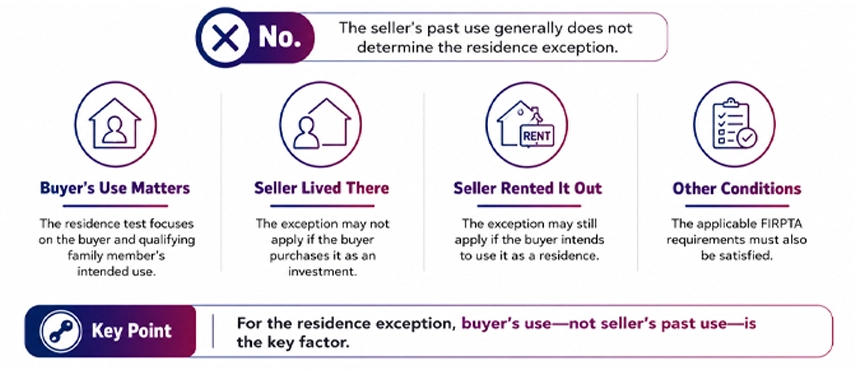
If we consider the 0% and 10% rules, an NRI seller's own resident use doesn't matter there. It's because the residence test primarily focuses on how the buyer or a qualifying family member uses the property after the transaction, rather than on whether the NRI seller previously lived in the property.
Understanding this difference becomes important in some situations. So, let's discuss more about this with the help of examples:
Rajesh is an NRI who owns a U.S. house. Before moving abroad, he lived in the house for several years and later sold it to an investor. However, the investor purchased the house with the intent to rent it out or hold it as an investment.
Now, although Rajesh used the property personally as a residence, it doesn't qualify the property to claim the residence-based FIRPTA exception. It's because the buyer's intent matters, and in this case, it didn't satisfy the residence requirement.
Hence, the seller's past residence in the property will not be considered or matched with the buyer.
Jay is an NRI who owns a U.S. apartment, which he has rented out to tenants. Later, Jay sells the property to an individual buyer who intends to use it as their residence.
Now, in this case, just because Jay didn't personally live in the property doesn't mean the residence rule doesn't apply. Since the buyer intends to use the property as a residence, it may satisfy the relevant residence condition, and the FIRPTA withholding rules may apply. However, it applies only when the buyer meets all other FIRPTA requirements.
So here the key difference between the two is:
| Situation | Seller's Past Use | Buyer's Intended Use | Relevance to Residence Rule |
|---|---|---|---|
| NRI lived there, and an investor purchases the property | Seller lived there | Investment/rental | Seller's past residence does not create the exception |
| NRI rents the property, and an individual buys it | Seller did not live there | Buyer's plan to live there | Buyer's intent to use it as residence may support the exception |
By looking at the examples, we can see that, in U.S. tax calculations, the seller's past use of the property may matter. However, if we are only considering the FIRPTA residence exception, this question doesn't matter much.
As mentioned above, to claim the 10% withholding rate, your realized amount may be over $300,000 but not more than $1 million. So, what if your amount exceeds this $1 million threshold? Let's understand that next.
If your realized amount exceeds $1 million, the 10% residence rate will not apply. According to the current Form 8288 instructions, the 10% rate applies to qualifying property purchases used as a residence where the amount realized is $1 million or less, subject to the separate $ 300,000-or-less rule.
Hence, even if the property is purchased for residential use, it will revert to the standard FIRPTA withholding framework if the realized amount exceeds $1 million. However, another exception or withholding reduction mechanism may help avoid this.
To better understand this, let's use an example.
An NRI seller sells a home for $1.2 million. The buyer purely intends to use that property as his principal residence. However, in this case, the 10% withholding rate will not apply.
Although the buyer intended to use the property as a personal residence, the amount realized exceeds the $1 million threshold. Hence, the 10% rate will not apply. Moreover, if the regular tax amount withheld from your sale is much higher than your real tax bill, you can apply for a FIRPTA withholding certificate.
The amount realized must not exceed $1 million if you wish to claim the 10% withholding rate. However, the main question is: does the buyer automatically receive the exception, or do they need to file a separate IRS form? Let's understand this.
No, there is no need to file Form 8288 with the IRS to claim the $300,000 residence exception. However, the buyer and closing parties must ensure they fulfill the applicable residence-use conditions and notifications. They must also ensure that everything is properly documented.
If the buyer has not satisfied the residence-use conditions but is counting on the exception, they may be held responsible for failing to withhold. This situation will be subject to the applicable rules for potential changes.
If you are still confused, let's clear it up. Next, to understand both the 0% and 10% FIRPTA withholding rules for NRIs, we will look at some examples.
Here are a few examples of the 0% and 10% FIRPTA rules to help you better understand them.
An NRI sells an apartment for $275,000 to an individual buyer. The buyer intends to use the property as a home and also fulfills the requirements under the FIRPTA residence-use test.
In this case, since the realized amount is under $300,000 and the buyer is an individual with intent to use the property as a residence, no withholding will be required under the $300,000 residence exception.
In the second situation, an NRI sells a house for $700,000. Now, the buyer is an individual who intends to use it as a residence and meets the applicable residence requirements. However, the buyer will still not qualify for the FIRPTA 0% withholding because the realized amount exceeds $300,000. Hence, they will fall under the 10% withholding rule.
So, potential FIRPTA withholding would be calculated as:
An NRI sells a property for $250,000, but the buyer intends to rent it out for investment. Although the price is below $300,000, that alone will not allow the buyer to claim the residence exception. This is because the buyer did not acquire the property to use as a qualifying residence. As a result, the special 0% or 10% withholding rule will not apply.
An NRI sells a house for $1.3 million to an individual who intends to use the property as a residence. However, since the realized amount exceeds $1 million, the special 10% residence will not apply.
The standard 15% FIRPTA withholding rate will apply, unless another exception or withholding reduction is claimed. In this case, the result would be $195,000.
Instead, the seller will check whether another FIRPTA exception applies or a withholding certificate is in place.
But you must be thinking, aren't the FIRPTA residence rule and withholding certificate the same? No, don't get confused, as these are two different mechanisms. Having said that, let's understand the difference between these two next.
These are two separate mechanisms, and it's important to get this point clear. The table below lists the difference between FIRPTA residence rules vs withholding certificate:
| Factor | FIRPTA Residence Rules | FIRPTA Withholding Certificate |
|---|---|---|
| Main basis | Sale amount + buyer residence use | Seller's expected tax liability or other permitted grounds |
| $300,000 or less | Possible 0% | May also be relevant in other situations |
| $300,000 - $1 million | Possible 10% | Separate alternative |
| IRS application | No IRS filing for the basic $300,000 residence exception | Yes |
| Main form | No Form 8288-B for automatic exception | Generally Form 8288-B |
| Main timing | Applied during transfer based on the transaction facts | Application must generally be submitted before the transfer |
Now, suppose the residence-based rules do not apply. In this case, the seller can separately assess whether a withholding certificate could reduce or eliminate withholding, depending on the applicable circumstances. If you want to know about the full application process, check our blog FIRPTA Withholding Certificate: How to Reduce Withholding in Advance.
While understanding the FIRPTA residence rules and withholding certificate helps you plan ahead, you might find yourself in a situation where the FIRPTA has already been withheld. Hence, next we will understand what happens after that.
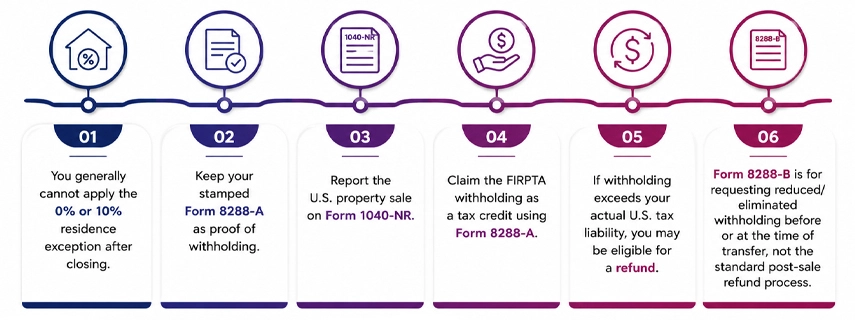
You cannot perform a review for residence analysis to apply 0% or 10% if a property closing has already been completed and FIRPTA withholding has been submitted to the IRS. This process is different from the regular tax-return reconciliation process. Hence, don't get confused and make mistakes.
If FIRPTA withholding has already occurred, the seller should retain the stamped Form 8288-A as evidence of the tax withheld. A foreign individual generally reports the U.S. property sale on Form 1040-NR and claims credit for the FIRPTA withholding shown on Form 8288-A. If the withholding exceeds the seller's actual U.S. tax liability, the excess may generally be recovered through the applicable refund process. Form 8288-B is primarily used to apply for a FIRPTA withholding certificate to reduce or eliminate withholding; it is not simply the standard post-sale refund form.
Moreover, to learn about the post-sale process in detail, check: How to Claim a FIRPTA Refund Using Form 1040-NR.
Lastly, we will learn about the common FIRPTA 0% and 10% mistakes to avoid.
As an NRI, if you want to claim the 0% and 10% FIRPTA withholding rules, you must avoid the following mistakes:
Avoid the stress of filing U.S. taxes by seeking expert assistance from Savetaxs.
After reading the blog, it should now be clear to you that FIRPTA withholding will not always be limited to the standard 15% rate when an NRI sells U.S. real property. Certain transactions that qualify may receive 0% withholding when the realized amount is $300,000 or less or 10% withholding when the realized amount exceeds $300,000 but stays less than $1 million.
Further, if you are an NRI selling U.S. property, you must identify the correct FIRPTA rates before you close. If you need help with the same, connect with an expert at Savetaxs.
At Savetaxs, we have an entire team of experts who can help review the transaction amount, FIRPTA status, buyer-use facts, and, most importantly, whether the sale qualifies for the residence-based 0% and 10% rules. Contact us right away, as we are actively working 24/7 across all time zones.
This article is for general informational purposes only and does not constitute tax, legal, financial, or investment advice. Laws, regulations, rates, and procedures may change over time and may vary based on individual circumstances.
While SaveTaxs makes reasonable efforts to keep the information accurate and up to date, readers should verify applicable rules with official authorities or consult a qualified professional before making decisions based on this information.
Vipul Jain is the Co-Founder of SaveTaxs and a tax expert with experience in Indian and NRI taxation. He advises individuals, NRIs, and businesses on tax filing, tax planning, capital gains, DTAA, and compliance matters. He focuses on making complex tax concepts simple and helping taxpayers make informed, compliant decisions. See Full Bio

Want to read more? Explore Blogs