NRI Income Tax Compliance
How to Claim Excess TDS Refund After Selling Property in India as an NRIHow to Claim Excess TDS Refund After Selling Property in India as an NRI
Written by Shubham Jain

Got a foreign remittances income tax notice from the tax department? Don't panic, as receiving a notice does not always mean you have done something wrong. Often, the notice is sent to confirm or ask you something that has been flagged in their system.
Want to know why you receive the foreign remittance income tax notice, what you need to do, and what happens if you ignore it? Read the blog and get your answers.
Foreign remittance is the process of transferring money from a person or organisation in one country to another in a different country. Under Indian foreign exchange laws, sending money for medical care, education, business purposes, or family assistance is permitted.
Under the Liberalised Remittance Scheme (LRS), resident individuals may remit up to USD 250,000 per financial year abroad for permitted transactions. NRIs may repatriate eligible funds from India subject to applicable FEMA and tax regulations. Common foreign remittance types include:
This was all about foreign remittance. Moving ahead, let's know whether it is taxable in India.
With the expert guidance of Savetaxs, fulfill your tax obligations without any effort on time in India.
Foreign remittance taxation is regulated by the Liberalised Remittance Scheme (LRS) and the Income Tax Act, 1961, as overseen by the Reserve Bank of India (RBI). Additionally, the regulations on it vary depending on whether the remittance is inward, i.e., funds received from abroad, or outward, i.e., funds sent abroad.
Generally, it is not taxable in India as money received as a gift or personal transfer from abroad is exempt from tax. However, if it constitutes income, such as consultancy fees or salary, it is taxed according to the income tax slab of the recipient.
Certain outward remittances may attract Tax Collected at Source (TCS) under applicable provisions of the Income Tax Act, subject to prescribed thresholds and conditions. It is a designated percentage collected as Tax Collected at Source (TCS) by the authorised dealer (AD), generally a bank.
So, foreign remittance is taxable in India; however, it depends on the income type and whether it is inward or outward.
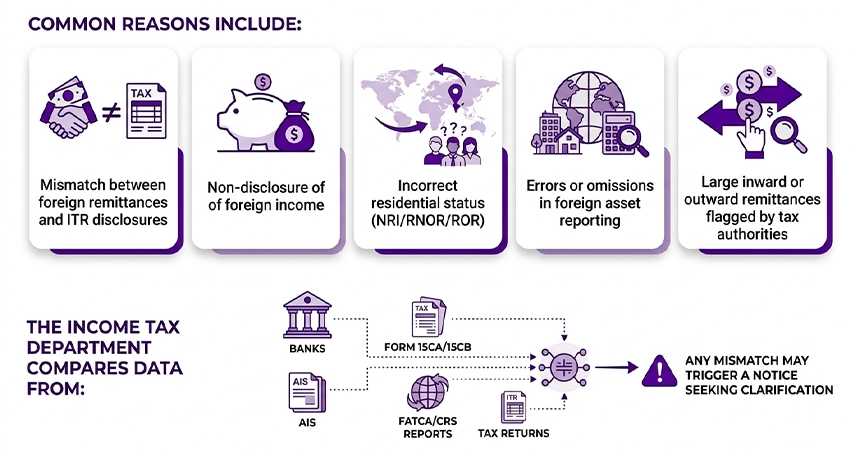
The Income Tax Department of India has access to a lot of financial information from several sources, like international reporting systems (FATCA/ CRS) and banks. The Income Tax Department also receives information through Form 145/146 filings, Annual Information Statements (AIS), banking records, and other reporting mechanisms. So when something in the financial data of NRIs does not match with their ITR or certain income disclosures are not made by them, the tax officials send them a foreign remittance income tax notice. Confused? Here are the most common reasons for receiving this ITR notice.
Upon crossing a certain threshold limit, banks need to report foreign remittances to the income tax department. Considering this, if a large outward or inward remittance is stated up in their records however does not explain in your ITR, then the department flags it.
For instance, if you received INR 30,00,000 from overseas and did not mention it as income or did not properly explain it as a non-taxable transfer, i.e., repatriated it from your own overseas account, you are likely to receive an ITR notice to clarify this income. It is one of the most common reasons that trigger the ITR notice for NRIs and returning Indians. Here, what seems like a normal money transfer for you is considered an unexplained income for income tax purposes.
If you earned income overseas, such as rental income, capital gains, salary, or dividends, and did not mention it correctly as per your residential status in India. In this scenario, under section 148 (reassessment) or section 142(1) (inquiry before assessment), you may receive an income tax notice.
The scope of taxable income varies depending on whether the taxpayer qualifies as an NRI, RNOR, or Resident and Ordinarily Resident (ROR) under the Income Tax Act. However, residents and ordinarily residents (ROR) are liable to pay tax on their global income. After returning to India, in a particular year, you were a ROR and received a foreign income, but did not disclose it, you may receive an ITR notice.
Additionally, if your residential status was determined incorrectly or if you filed ITR as an NRI when you were a resident, that discrepancy can result in a reassessment notice.
For income tax purposes, the residential status in India is calculated on the number of days you stayed in the country during a financial year and, in some cases, over the preceding years. It is not about where you work or live.
Considering this, if you filed your ITR as an NRI, but the records of the department, i.e., immigration data, bank activity, or passport details state you were in India for more than the days you mentioned. Your residential status is questioned by the tax department.
Here, determining the residential status is important because it decides where you are liable to pay tax on your income earned in India (NRI) or global income (resident) for that year in India. In case you are not sure about your residential status, instead of getting a notice, it is advisable to seek help from a CA.
Foreign asset reporting requirements depend on the taxpayer's residential status and the applicable provisions of the Income Tax Act. It is mandatory to file Schedule FA even if the assets do not provide any income during the financial year.
In case you forget to mention your foreign bank account, even if it is not active, or omit overseas inherited property or shares, you may receive an ITR notice for not disclosing these assets. Considering this, under the Black Money Act 2015, failing to disclose foreign assets leads to severe penalties more serious than those under the standard Income Tax Act. This category of non-compliance is treated very seriously by the tax officials.
These are some of the key reasons why NRIs receive an income tax notice on foreign remittance. Moving further, let's know how to respond to these notices.
Do not delay responding to the notice. The response timeline depends on the specific notice and the provisions under which it has been issued. Always refer to the deadline mentioned in the notice, and missing it can result in facing significant issues. Considering this, here is how you should respond to a foreign remittance income notice:
This is how you can respond to an IT notice for foreign remittance in India. Moving forward, let's know the documents required to respond to an IT notice for NRI remittance in India.
To prevent penalties, it is vital to maintain proper documentation and follow the Income Tax and RBI regulations. Considering this, here is the list of documents you need when responding to the income tax notice on foreign remittance in India:
These are the documents you generally need for answering an income tax notice on foreign remittance. Moving ahead, let's know the consequences of ignoring the IT notice for NRI remittance in India.
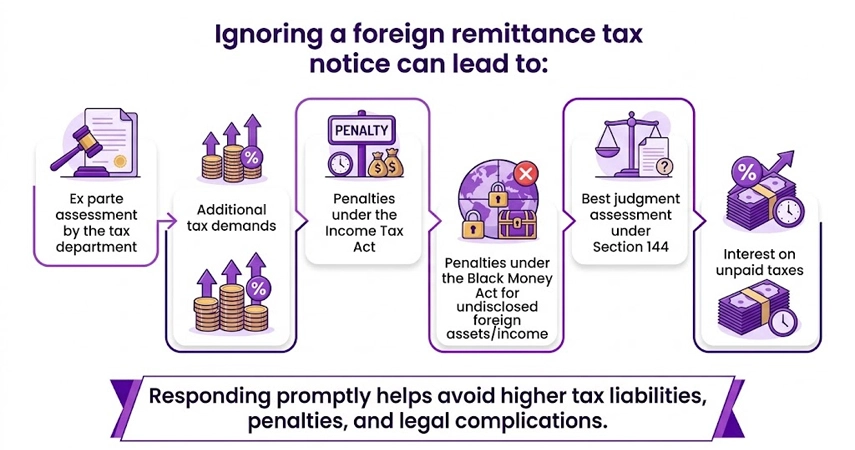
Ignoring an income tax notice for NRIs is not a safe option, especially for foreign remittance, it matters as the consequences can be more serious than for standard domestic notices. Considering this, here is what happens if you do not respond to an income tax notice for NRI foreign remittance in India:
Further, the longer you wait to respond, the fewer options you get.
Connect with Savetaxs and get consultation from top tax professionals.
Lastly, a foreign remittances income tax notice is generally sent by the tax department asking you to clarify something. If your remittances are correct and you file ITR accurately, with the right documents, you can usually clear things. The risk comes from not responding fully, ignoring the notice, or not disclosing foreign assets or income. Considering this, if you are an NRI or a returning Indian who frequently sends or receives money from overseas, you need to track your returns and disclosures to avoid IT notices.
Furthermore, if you are facing issues in responding to the IT notice, connect with Savetaxs. The tax experts in our team will help you answer the notice with a proper explanation. Additionally, we provide you with the guarantee that all your compliance matters will be addressed.
This article is for general informational purposes only and does not constitute tax, legal, financial, or investment advice. Laws, regulations, rates, and procedures may change over time and may vary based on individual circumstances.
While SaveTaxs makes reasonable efforts to keep the information accurate and up to date, readers should verify applicable rules with official authorities or consult a qualified professional before making decisions based on this information.
Vipul Jain is the Co-Founder of SaveTaxs and a tax expert with experience in Indian and NRI taxation. He advises individuals, NRIs, and businesses on tax filing, tax planning, capital gains, DTAA, and compliance matters. He focuses on making complex tax concepts simple and helping taxpayers make informed, compliant decisions. See Full Bio
Want to read more? Explore Blogs