NRI Income Tax Compliance
Income Tax Forms Renamed in 2026: Old vs New Form NumbersIncome Tax Forms Renamed in 2026: Old vs New Form Numbers
Written by Vipul Jain


Receiving an Indian income tax notice while living abroad can be stressful, particularly when you are unsure why the Income Tax Department has contacted you or how quickly you need to respond. The communication may relate to bank interest, a property sale, a tax credit mismatch, a defective return, or an assessment proceeding.
If you receive an Indian income tax notice as an NRI, verify its authenticity, identify the required action, check the response deadline, and gather the relevant evidence before replying. Living outside India does not automatically remove your Indian tax compliance obligations, and believing that you owe no additional tax does not necessarily mean you can ignore the communication.
The correct response depends on the notice, the relevant tax period, and the stage of the proceeding. Here is how to determine your next step.
Follow these steps before submitting a response:
Read the complete notice. Identify the issuing authority, reference number, relevant tax period, legal provision, and reason for the communication.
Check the deadline. Follow the response date specified in the notice and any applicable statutory requirements. Different communications have different time limits.
Verify its authenticity. Use the Income Tax Department's official notice authentication service.
Investigate the issue. Compare the notice with your income tax return, bank records, tax credits, and relevant transactions.
Prepare an evidence-backed response. Address the specific questions raised and attach the documents needed to support your explanation.
Submit and retain proof. Use the prescribed response channel, save the acknowledgement, and monitor further communications.
If the deadline is approaching, prioritize identifying the correct procedure rather than sending an incomplete or unsupported explanation.
For example, an NRI living in the United States might receive a communication questioning interest income reported by an Indian bank. The appropriate response would involve comparing the bank's interest certificate, the relevant tax return, and the department's reported information before explaining the discrepancy.
The objective is not simply to reply quickly. It is to take the correct action before the applicable deadline.
The Income Tax Department provides an online facility to authenticate notices, orders, summonses, letters, and other communications. This is a pre-login service, so you do not need to sign in to your e-filing account merely to authenticate a notice.
Visit the Official Authenticate Notice/Order service and follow the available verification process.
Depending on the option selected, you may need:
PAN and document type.
The relevant assessment year or other year identifier requested by the portal.
Date of issue.
A mobile number accessible to you for OTP verification, where required.
The department's official authentication guidance explains the available verification methods.
What if the notice cannot be authenticated? Recheck the details entered and seek clarification through official channels. Do not assume that every failed verification means the communication is genuine or fraudulent.
The department states that communications issued on or after 1 October 2019 must generally carry a DIN, subject to applicable exceptions and prescribed procedures. Its published guidance also addresses the consequences of communications issued without a DIN. If your notice lacks one, verify the applicable rule and any relevant exception before deciding what action to take.
Never share your e-filing password, OTP, or banking credentials through an unsolicited link. Access the official portal independently when checking your notice.
An income tax notice does not automatically mean that additional tax is payable. It may request information, identify a return defect, propose an adjustment, initiate scrutiny, or communicate an existing demand.
The following table covers common communications under the Income-tax Act, 1961. For Tax Year 2026–27 onwards, the Income-tax Act, 2025 generally applies. The applicable law must be determined by the relevant period and transitional provisions.
| Notice or communication | What it generally means | What to check |
|---|---|---|
| Intimation under Section 143(1) of the 1961 Act | The return has been processed, potentially resulting in an adjustment, refund, or demand | Compare the processed figures with your filed return |
| Proposed adjustment under Section 143(1)(a) of the 1961 Act | The department proposes an adjustment during return processing | Review the proposed change and follow the specified response procedure |
| Defective return notice under Section 139(9) of the 1961 Act | A defect has been identified in the return | Identify the defect and submit the required correction |
| Information request under Section 142(1) of the 1961 Act | The Assessing Officer requests information or supporting documents | Address each request with relevant evidence |
| Scrutiny notice under Section 143(2) of the 1961 Act | The return has been selected for scrutiny assessment | Review the scope of scrutiny and prepare the requested records |
| Reassessment-related communication | The department is examining potentially unassessed income under the applicable reassessment procedure | Check the legal basis, relevant period, deadline, and procedural stage |
| Outstanding demand communication | Tax has been determined as payable or a demand remains unresolved | Reconcile the underlying order, payments, and tax credits |
The Income Tax Department provides a comparison of the 1961 and 2025 Acts. Do not assume that a section number in an older article applies to a current communication.
An intimation following return processing is different from a proposed adjustment that requires a response.
If the department proposes an adjustment, review the explanation provided, compare it with your return and supporting records, and respond through the applicable procedure. If an error has already resulted in a finalized intimation, a rectification request may be appropriate, depending on the circumstances.
Under Section 139(9) of the 1961 Act, a defective return notice identifies a problem that needs correction. The communication specifies the defect and the required response.
The Income Tax Department's e-Proceedings guidance states that a defective-return response is generally due within 15 days of receiving the notice or within the period specified in the notice, with an extension potentially available on request. Check the actual notice and current rules before relying on that period.
Failure to correct a defect within the applicable time may result in the return being treated as invalid, subject to the governing law and circumstances.
These communications can require more substantial work than a routine return-processing adjustment.
An information request may seek bank statements, transaction records, income calculations, or supporting documents. A scrutiny notice concerns an assessment proceeding, while reassessment follows a separate statutory process.
Read the complete notice rather than relying on its heading alone. If the department questions substantial transactions, several tax periods, or complex residential-status issues, obtain professional review promptly.
NRIs may receive notices when information available to the department differs from their returns, tax-credit records, or reported transactions. A mismatch does not automatically establish that income was concealed or that additional tax is due.
Common reasons include the following.
1. Unreported bank interest
Interest from Indian savings accounts, fixed deposits, or other accounts may appear in departmental information but not match the income reported in a return. Check the bank's interest certificate, account records, tax treatment, and the relevant period.
2. Property sales and capital gains
A property transaction may be reported even when the taxpayer has not correctly calculated or disclosed the resulting capital gain. Reconcile the sale consideration, acquisition cost, eligible adjustments, tax withholding, and return disclosures.
3. TDS and tax-credit mismatches
Tax deducted at source (TDS) may not match the credit claimed in the return. Compare Form 26AS, relevant TDS certificates, payment records, and your return before deciding whether a correction or explanation is necessary.
4. AIS, TIS, and transaction discrepancies
The Annual Information Statement (AIS) and Taxpayer Information Summary (TIS) contain information about financial transactions reported to the department. Check whether the transaction is accurate, duplicated, incorrectly attributed, or already accounted for in your return.
5. Incorrect residential-status reporting
Indian tax residential status is determined under the rules applicable to the relevant year, not solely by citizenship or possession of an overseas address. Incorrect status can affect how income is reported and taxed.
If residential status is questioned, review your travel dates, period of stay in India, and any applicable special rules before changing your return or tax position.
Eligible notices and communications can be handled online through the Income Tax Department's e-filing portal. The department's e-Proceedings guidance explains how taxpayers can view and respond to eligible communications without visiting an income tax office.
Sign in to the Income Tax e-Filing portal.
Navigate to Pending Actions → e-Proceedings, where applicable.
Open the relevant communication and review the complete notice.
Identify the questions, discrepancies, and documents requested.
Prepare a point-by-point explanation supported by evidence.
Select the appropriate response option and attach the required files.
Submit through the prescribed workflow.
Save the transaction ID or acknowledgement and monitor further communications.
The available response options depend on the notice type and proceeding status. The portal also warns that a response may not be editable or withdrawable after submission. Review your explanation and attachments carefully before submitting.
The documents depend on the issue raised. Commonly useful records include:
The complete notice and relevant tax-period details.
The filed income tax return and computation of income, if applicable.
Indian bank statements and interest certificates.
Form 26AS, AIS/TIS records, and relevant TDS certificates.
Tax payment challans and other proof of tax paid.
Property purchase and sale documents when capital gains are questioned.
Supporting correspondence and copies of earlier responses.
Organize the evidence around the department's specific questions. A bank-interest discrepancy requires different supporting documents from a property-sale or residential-status issue.
An NRI can authorize a representative for eligible proceedings through the prescribed portal process, subject to applicable requirements. The representative must have the necessary authorization, and the relevant proceeding must permit the arrangement.
The official e-Proceedings user manual explains how to add or withdraw an authorized representative for eligible communications. This can be useful when the taxpayer lives abroad, has difficulty accessing Indian records, or needs help with a complex matter.
The consequences depend on the communication, the applicable law, and the stage of the proceeding. A missed deadline may lead to an adverse adjustment, further assessment action, an outstanding demand, or other consequences where the relevant legal conditions are satisfied.
There is no single response deadline that applies to every income tax notice. Use the deadline specified in the communication and verify any applicable statutory period.
If the deadline has not passed, prioritize a complete and accurate response.
If the deadline has passed:
Check the current status of the proceeding on the official portal.
Determine whether the response facility remains available.
Identify whether an extension, rectification, appeal, or another remedy is legally available in your circumstances.
Seek professional assistance promptly if an order has already been issued or the matter involves significant tax exposure.
The department's e-Proceedings FAQ explains that response availability may depend on the notice type, due date, and whether proceedings remain open or have been blocked.
Do not assume that a late response will automatically be accepted. Equally, do not assume that missing a deadline means no remedy remains. Check the actual proceeding and applicable rules.
If you believe the notice is incorrect, respond according to its procedural stage and support your position with relevant evidence.
If the department's information is wrong: Explain the discrepancy and attach records establishing the correct facts.
If tax has already been paid: Reconcile payment records, TDS credits, and the figures in your return before deciding whether a demand remains payable.
If a finalized intimation contains an error: Determine whether a rectification request is appropriate under the applicable procedure.
If you dispute an outstanding demand: Review the underlying order and use the applicable demand-response or appeal process.
A rectification request is not interchangeable with a response to a proposed adjustment. The correct remedy depends on the nature of the error and the stage of the case.
Even if you believe no additional tax is payable, you may still need to answer a request for information or explain a discrepancy. Tax liability and procedural compliance are separate questions.
Use this decision tree to identify your next step. It is a practical guide, not a substitute for reading the actual notice.
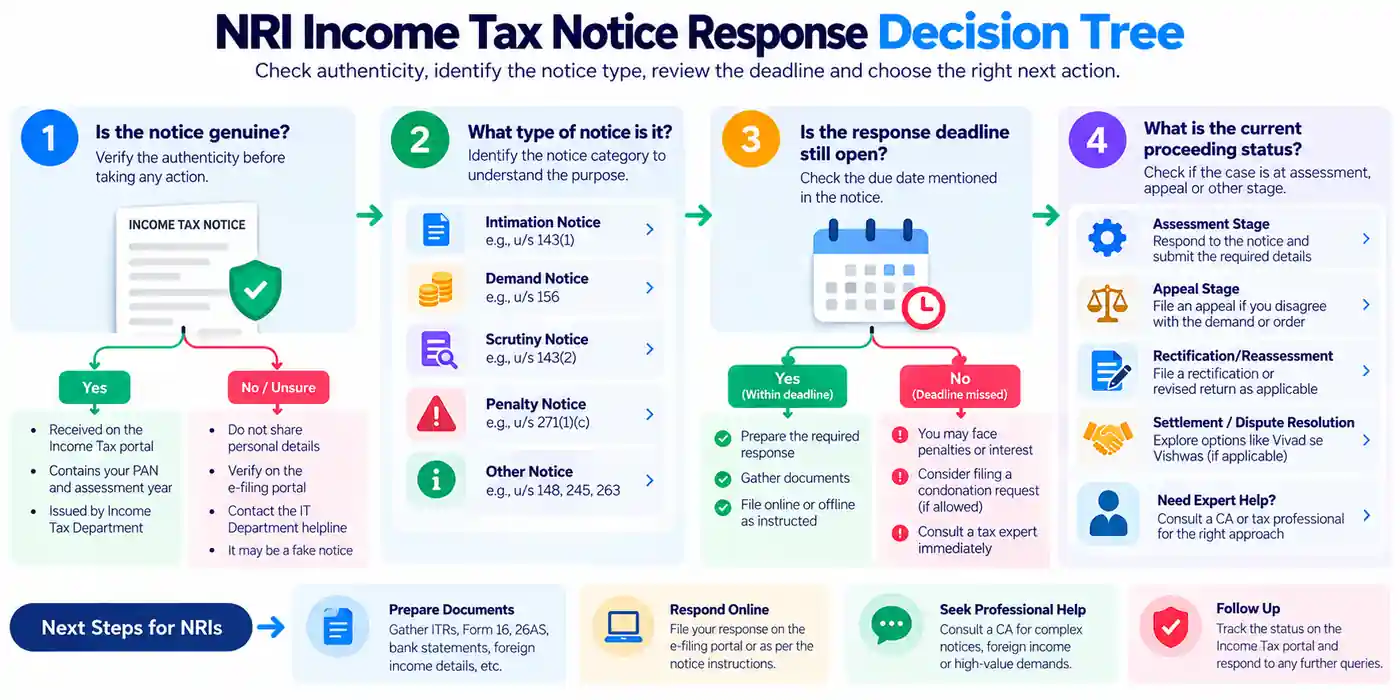
Step 1: Can you verify the notice?
Yes: Read the complete communication and identify the required action.
No or uncertain: Recheck the details and contact the department through official channels before relying on the communication. Do not ignore a potentially genuine notice while investigating.
Step 2: Is the response deadline approaching or already past?
Deadline not passed: Prepare the response and supporting documents promptly.
Deadline passed: Check whether the proceeding is open and which remedies remain available. Seek professional assistance if necessary.
Step 3: What type of communication have you received?
Proposed adjustment: Review the proposed change and respond through the specified procedure.
Defective return notice: Correct the identified defect within the applicable period.
Information request or scrutiny: Answer the specific questions and provide supporting evidence.
Finalized intimation or demand: Reconcile the underlying figures and determine whether payment, rectification, or a dispute procedure is appropriate.
Reassessment-related communication: Review the statutory basis, deadlines, and procedural stage carefully.
Step 4: Can you substantiate your position?
Yes: Submit a clear explanation with relevant evidence and retain the acknowledgement.
No, or the matter is complex: Obtain professional review before choosing a remedy or submitting a response.
The central rule is straightforward: identify the communication first, then select the procedure. Do not choose a remedy solely because it worked for a different notice.
Consider obtaining professional help when the notice involves:
Scrutiny, reassessment, or multiple tax periods.
Significant unexplained transactions or disputed income.
Uncertain residential status or complex cross-border income.
A substantial outstanding demand or potential penalty exposure.
An expired deadline, finalized order, or possible appeal.
Inconsistent records that cannot be reconciled independently.
A tax professional can review the notice, applicable law, underlying return, and available evidence to help determine the appropriate response.
If you are unsure what your notice means or which response procedure applies, Savetaxs can help you review your NRI tax compliance situation and identify the appropriate next steps.
A useful initial review should establish:
Which notice or communication you received.
The relevant tax period and response deadline.
The discrepancy or compliance issue being raised.
Which documents are needed to assess the matter.
Whether the case requires a response, correction, demand resolution, or further professional representation.
Explore NRI income tax assistance from Savetaxs
The appropriate service and remedy will depend on the notice and your circumstances. No professional can guarantee that a notice will be withdrawn or that a particular outcome will follow.
An Indian income tax notice is a specific compliance matter, not automatic proof that you owe additional tax. Verify the communication, identify the applicable law and deadline, investigate the underlying issue, and submit a supported response through the correct channel.
If the notice involves reassessment, a substantial demand, an expired deadline, or inconsistent financial records, seek professional assistance promptly. Acting at the right stage can help you avoid procedural errors and manage your Indian tax obligations while living abroad.
This article is for general informational purposes only and does not constitute tax, legal, financial, or investment advice. Laws, regulations, rates, and procedures may change over time and may vary based on individual circumstances.
While SaveTaxs makes reasonable efforts to keep the information accurate and up to date, readers should verify applicable rules with official authorities or consult a qualified professional before making decisions based on this information.
Vipul Jain is the Co-Founder of SaveTaxs and a tax expert with experience in Indian and NRI taxation. He advises individuals, NRIs, and businesses on tax filing, tax planning, capital gains, DTAA, and compliance matters. He focuses on making complex tax concepts simple and helping taxpayers make informed, compliant decisions. See Full Bio
Want to read more? Explore Blogs