


NRI Income Tax Compliance
How to Claim Excess TDS Refund After Selling Property in India as an NRIHow to Claim Excess TDS Refund After Selling Property in India as an NRI
Written by Shubham Jain

Form 60 is a declaration form that individuals (not Indian companies or firms) or foreign companies must submit if they don't have a PAN (Permanent Account Number) and engage in specific transactions listed under Rule 114B under Section 139A of the Income Tax Act, 1961.
Certain transactions require a PAN to help the government track high-value transactions and prevent the use of black money in the country. Moreover, many individuals may not have a PAN, either because they haven't applied for one or their application is still being processed.
For these individuals, Form 60 provides a solution. They can participate in the transactions specified in Rule 114B of the Income Tax Act, 1961, even without a PAN if they fill out Form 60. Continue reading to learn everything about Form 60.
Form 60 is a document used by individuals except companies or firms to perform transactions outlined in Rule 114B when they lack a PAN for either of the following reasons:
It's important to note that if your total income (excluding agricultural income) exceeds the basic exemption limit, you cannot use Form 60 without applying for a PAN. In this case, you can use Form 60 only if you have submitted a PAN application, and you must include the date of application and the acknowledgement number in column 22 of the form.
Form 60 can be applicable for NRIs (Non-Resident Indians) who don't have a PAN card for specific financial transactions. It acts as a substitute, but there are certain transactions listed under Rule 114B, where an NRI might be exempt from using Form 60, such as when applying for credit/debit cards or payments to hotels/restaurants.
Banks usually accept a passport and overseas address proof for routine NRI accounts such as NRE, NRO, FCNR, and fixed deposits, without the need for Form 60.
The institutions may request Form 60 for NRIs without PAN for certain Rule 114B transactions, depending on internal policies or AML/KYC needs, provided income is under the basic exemption limit, or a PAN application is pending. Along with Form 60, NRIs also need to submit identity/address proofs, such as a passport.
There are situations for NRIs where quoting a PAN (Permanent Account Number) is mandatory. It is mainly required for conducting high-value transactions. The following are the situations where a PAN card is mandatory for NRIs, and Form 60 cannot be used as a substitute, as confirmed by regulatory requirements:
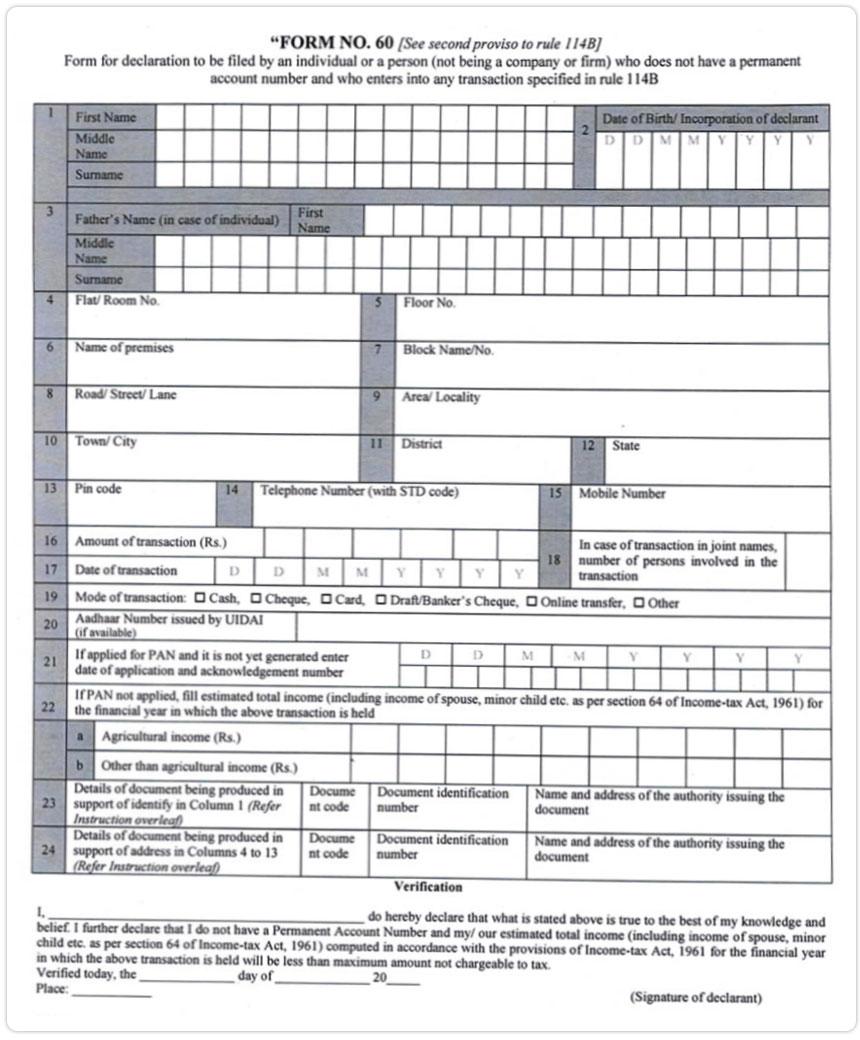
You can get Form 60 of the Income Tax from the official Income Tax Department. Follow the steps below to download Form 60 PDF:
The table below lists the cases in which a PAN card is mandatory. Additionally, you must file Form 60 only if you don't have a PAN card or are waiting for the allotment.
| Transaction Nature | Transaction Value |
|---|---|
| Opening a demat account | Any value |
| Buying or selling an immovable property | Value or value according to the stamp valuation authority of Rs. 10 lakh or more |
| Buying or selling of any motor vehicle except two-wheelers | Any value |
| A fixed deposit with any bank/post office/Nidhi/non-banking financial company | Amount exceeding Rs. 50,000 or an aggregation of more than Rs. 5 lakh during any tax year |
| Opening an account with any banking institution or bank, apart from a basic savings deposit account/ Application made to an institution bank, or a company for a debit or credit card | Any value |
| Payment made in cash against the bill in restaurants or hotels | Amount more than Rs. 50,000 at any one time |
| Payment made for a life insurance premium | Value exceeding Rs. 50,000 in a year |
| Payment for traveling to any foreign country or payment for buying any foreign currency in cash | Exceeding Rs. 50,000 at one time |
| Sale contract or purchase of securities (apart from shares) | Value above Rs. 1 lakh for each transaction |
| Payment made in cash/bank draft/ pay order/ banker's cheque for one or more prepaid payment instruments to a banking company/ co-operative bank/ bank | Aggregating to more than Rs. 50,000 in a financial year |
| Sale/purchase of company shares, contract for sale, or purchase of securities | Exceeding Rs. 1 lakh per transaction |
| Payment to a mutual fund for unit purchases | Exceeding Rs. 50,000 |
| Payment for obtaining bonds issued by the RBI | Exceeding Rs. 50,000 |
| Payment made for acquiring debentures or bonds issued by a company or an institution | Exceeding Rs. 50,000 |
| Cash deposit made to a banking company, co-operative bank, or a bank/post office |
Exceeding Rs. 50,000 during any one day, or Aggregating to more than Rs. 2,50,000 during 9th November, 2016 to 30th December, 2016. |
| Time deposit with a bank/ banking company/ co-operative bank/ post office/ Nidhi/Non-Banking financial companies holding a certificate of registration under the RBI Act to accept or hold deposits from the public | Value beyond Rs. 50,000 or aggregating to more than Rs. 5 lakh during a financial year |
| Purchase in cash of bank drafts/ pay orders/ banker's cheque from a banking company/ co-operative bank/ bank | Exceeding Rs. 50,000 at any one time |
| Buying or selling of goods of any nature other than those listed above in this table | Exceeding Rs. 2 lakh per transaction |
You can make a declaration in Form 60 both online and offline. Submit it to the person with whom you are entering the transaction. Additionally, if a minor participates in a transaction that requires a PAN, the parents/guardians' PAN or Form 60 may be provided.
Non-residents are not required to have a PAN or submit Form 60 for certain transactions listed above. It includes applying for a credit/debit card, payment made against bill in a restaurant or hotel. etc. Additionally, the Central Government, State Government, and the Consular Officers also don't need to provide a PAN/complete Form 60.
Speed up NRI income tax return filing with expert help at Savetaxs.
If PAN has been applied for but not yet allotted, mentioning the date of application and acknowledgment number is sufficient. However, you need to submit some documents along with Form 60 for proof of identity and address, only where a PAN has not been applied for.
For a scenario where you haven't applied for a PAN:
For Association of Persons (Trusts):
For an association of persons (apart from trusts),/ Body of individuals/ local authority/artificial juridical person:
For minors:
For HUFs (Hindu Undivided Family):
You need to fill out the following information in Form 60:
Keep in mind that any discrepancies in the supporting documents will cancel the form, and you will have to resubmit the form.
You may attract the following consequences under the Income Tax Act if you make any false statement in Form 60:
| Amount Involved | Consequence |
|---|---|
| Less than Rs. 25 lakh | Imprisonment for 3 months to 2 years, plus a fine |
| Rs. 25 lakh or more | Imprisonment for 6 months to 7 years, plus a fine |
Access Expert NRI Tax Guidance Anytime, Anywhere with the help of Savetaxs.
Form 60 is an important document required to carry out specific financial transactions when you don't have a PAN. It ensures that such transactions remain trackable and transparent under the Income Tax Act. Ensure to fill out Form 60 accurately to avoid any kind of penalties or transaction rejections. Use the official and latest format, check every detail, and attach every required document for a smooth process.
After reading this blog, you now have an idea about Form 60 and when you should file it. However, filing such forms on your own may be a complex task. If you are someone who finds taxes complicated, contact the experts at Savetaxs. Our team of professionals carries years of experience and knowledge and can provide end-to-end solutions for all your tax needs. Get in touch with our experts right away, as we are working 24/7 across all time zones.
This article is for general informational purposes only and does not constitute tax, legal, financial, or investment advice. Laws, regulations, rates, and procedures may change over time and may vary based on individual circumstances.
While SaveTaxs makes reasonable efforts to keep the information accurate and up to date, readers should verify applicable rules with official authorities or consult a qualified professional before making decisions based on this information.
Vipul Jain is the Co-Founder of SaveTaxs and a tax expert with experience in Indian and NRI taxation. He advises individuals, NRIs, and businesses on tax filing, tax planning, capital gains, DTAA, and compliance matters. He focuses on making complex tax concepts simple and helping taxpayers make informed, compliant decisions. See Full Bio

Want to read more? Explore Blogs
The penalties for making a wrong disclosure on Form 60 are: