



US Tax Forms
IRS Form 8962 for NRIs: Premium Tax Credit and APTCIRS Form 8962 for NRIs: Premium Tax Credit and APTC
Written by Shubham Jain
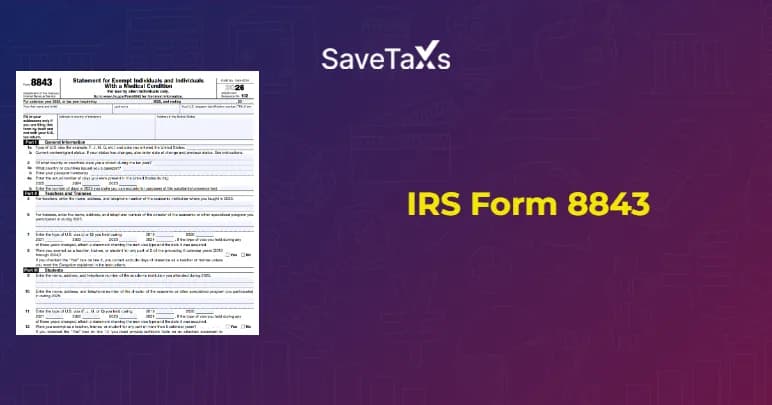
As a foreign national living in the US, whether on an F-1 or J-1 visa, an exchange student, or any other immigrant, you might have heard of Form 8843. Many people generally assume it is for those who have earned income in the US, but that is not right. Form 8843 is a tax form that certain individuals must file with the IRS, even if they have no US income tax obligations. Missing it can create tax compliance issues with your US immigration and tax records.
In his blog, we will understand Form 8843 and its related aspects.
The IRS Form 8843 is officially titled "Statement for Exempt Individuals and Individuals With A Medical Condition." Despite that title, this form is really not a tax return - it is a statement you file to tell the IRS why you should not be counted as a US tax resident for a particular tax year.
The form is specifically used to claim an exemption from the Substantial Presence Test. The test is the IRS formula used to determine whether a foreign national has been in the USA long enough to be treated as a tax resident.
Now, when you are filing Form 8843, you are indirectly telling the IRS that "I was physically present in the US, however, my days here should not count towards the Substantial Presence Test because of my visa status or any other qualifying reason."
This form is filed as a statement, not as part of your IRS tax return, in the traditional sense, and it requires no tax payment on its own.
In a nutshell, Form 8843 is not a tax return but an informational statement. These nonresident individuals are legally required to complete and submit the form, regardless of whether they have earned any US income.
In the US, if you are a nonresident individual, it is important to complete Form 8843 to remain compliant with US compliance requirements and avoid future tax complications related to your visa status. For instance, if you fail to complete Form 8843, it will create a record of non-compliance, and you may experience difficulties when applying for a visa renewal, a change of status, or an adjustment.
There are certain eligibility conditions for individuals required to file Form 8843. These exempt individuals are generally categorized into four groups, including.
To understand Form 8843, you first have to understand the Substantial Presence Test.
The IRS uses this test to determine whether a foreign national qualifies as a US tax resident, which would subject them to US taxation on their worldwide income, just like any other US citizen or green card holder.
The following are the conditions under which you meet the Substantial Presence test.
You were present in the US for at least 31 days during the current year and
Your total weighted days of the year count over the past three years is equal to or exceeds 183 days.
The weighted count is generally calculated as all days in the current year, plus one-third of the days in the prior year, plus one-sixth of the days in the year before that.
When you are filing Form 8843, certain visa holders exclude their days of presence from this calculation. Doing so keeps them categorized as a non-resident alien, which generally means that they are only taxed on the US source income and not on the income they have earned in other countries.
Let us understand this with an example
Priya is an Indian citizen studying in the US on an F-1 visa. She arrived in August 2023 and has been studying consistently since then. Now, by the end of 2025, she has been physically present in the US for more than 183 weighted days. In such a case, without Form 8843, the IRS will categorize Priya as a US tax resident, making her global income, including her Indian fixed deposit interest and rental income from a property her parents manage on her behalf in India, potentially subject to US taxation.
Whereas by filing Form 8843 each year during her F-1 exempt period, priya's U.S. days will be marked as excluded from the presence test. This makes her a non-resident alien for US tax purposes, so her Indian income remains untouched by the IRS.
This is why Form 8843 matters to you even when you do not have any US income to report.
Fulfill your NRI tax obligation on time with Savetax's expert guidance.
In most cases, Form 8843 is filed on paper. There are two ways to do so, depending on whether you are also filing a return.
With Form 1040-NR: If you have US income that requires a return, attach Form 8843 to the 1040-NR and file both together. The 8843 is considered part of the return. If you file the 1040-NR through approved software, the attached 8843 is submitted electronically with it.
Standalone: If you have no tax obligations, please print Form 8843, sign and date Part 1, and then mail the paper form to the address given in the latter part of the blog. There is no e-filing option for Form 8843 sent on its own, so it must be submitted by mail.
Form 8843 is divided into five main parts; however, it may not be necessary for you to complete every section. Henceforth, before you file out the individual parts, you will need to enter the following information.
In this section, you will need to enter basic information about yourself, including:
So this part of the form is specifically for teachers and trainees. The teachers and trainers are expected to provide general information such as:
This part or section of the form is for students to complete. Students will be required to enter the information regarding:
The Form 8843 reflection section is the shortest of the five parts. Although this section is titled "Professional athletes," it specifically means it is for the athletes who are present in the US to participate in a charitable sports event. Individuals completing this section must provide the following information.
Note: The athletes shall also provide verification that the proceeds earned are donated to the charitable organization.
Individuals required to provide this must provide the following information.
If you are mailing your completed form, you can send it to the following address.
Department of the Treasury.
Internal Revenue Service Center.
Austin, TX 73301-0215
USA
The deadlines for Form 8843 follow the same calendar as the standard US tax filing season.
|
Situation |
Form 8843 Due Date |
|---|---|
|
No US income - standalone filing |
15 April of the following year. |
|
With US income filed with Form 1040-NR |
15 April of the following year. |
|
Extension available |
Yes, up to 6 months using Form 4868 (extends to 15 October) |
For example, Form 8843 for the tax year 2025 is due by April 15, 2026.
If you are filing Form 8843 on its own (meaning no income), you can still request an automatic extension using Form 4868, but the extension will only extend the filing deadline, not any payment deadline (however, there is nothing to pay with Form 8843 alone).
For NRIs: If you are living in the US on an F-1 or J-1 visa and return to India at the end of your program, you still need to file Form 8843 for each year you were in the United States. Filing from India is done entirely by post to the Austin, TX address above. If you left the US and are now back in India and have unfiled Form 8843s from prior years, file them as soon as possible- late filing is better than non-filing.
Failing to file Form 8843 when required does not impose a monetary penalty on you directly. However, those consequences can be indirect and meaningful.
You can be classified as a US tax resident: Without Form 8843, your days in the US count towards the Substantial Presence Test. If you cross the threshold, the IRS may treat you as a U.S. resident alien for that year, making your worldwide income taxable in the U.S., including the income earned in India or any other country.
It complicates future US visa and immigration applications: A gap in your US tax compliance records, including missing Form 8843 filings, can raise questions during green card applications, future visa renewals, or immigration proceedings.
Late filing is always better than non-filing: There is no such limitation for Form 8843 as there is for normal tax returns. So, if you have missed filing for a prior year, file the form backdated. Along with it, attach a brief cover letter explaining the reason for the late filing, and then mail it to the Austin Address.
Get expert guidance and start your Indian investment journey easily.
Form 8843 is one of those US tax requirements that often catches many foreign nationals and NRIs off guard in the USA, especially students and exchange visitors who assume that having no income means having no financial obligations.
The reality is quite simple: if you were in the US on an exempt visa category during a particular tax year, you must file Form 8843, whether or not you have income.
For NRIs with Indian income, such as fixed income, fixed deposits, dividends, or other sources, filing Form 8843 is mandatory because it keeps Indian source income outside the scope of the IRS. Skipping it will trigger a classification that will pull your global income into the US tax net.
If you are unsure about filing your obligations, your exemption period, or how Form 8843 interacts with Form 1040-NR for your situation. Savetaxs is here to help you with it. Our CPA experts wll provide detailed consultation on form filing and more, based on your financial and residential profile, and will ensure everything is in compliance. Form 8843 is an informational statement, not a tax return; therefore, our experts file your form in strict compliance with immigration and tax requirements and ensure you maintain good standing with the IRS and the US government.
This article is for general informational purposes only and does not constitute tax, legal, financial, or investment advice. Laws, regulations, rates, and procedures may change over time and may vary based on individual circumstances.
While SaveTaxs makes reasonable efforts to keep the information accurate and up to date, readers should verify applicable rules with official authorities or consult a qualified professional before making decisions based on this information.
Vipul Jain is the Co-Founder of SaveTaxs and a tax expert with experience in Indian and NRI taxation. He advises individuals, NRIs, and businesses on tax filing, tax planning, capital gains, DTAA, and compliance matters. He focuses on making complex tax concepts simple and helping taxpayers make informed, compliant decisions. See Full Bio
Want to read more? Explore Blogs
_1786539671275.webp&w=828&q=75)