
US Tax Forms
IRS Form 8962 for NRIs: Premium Tax Credit and APTCIRS Form 8962 for NRIs: Premium Tax Credit and APTC
Written by Shubham Jain
IRS Form 8582 helps individuals with Passive Activity Loss Limitations. It helps individuals who earn income from businesses and rentals in which they are not actively involved, known as passive activities, determine the loss they can deduct from their US tax return that year. Along with this, the Form lets the individual declare any losses from previous years that they were unable to deduct before; it ensures that no potential tax benefits go unaddressed.
With this Form being in existence, many NRIs think that any investment or rental loss will reduce their overall tax liability, but that really is not the case, as the IRS has imposed passive loss limits on when these losses can be claimed.
Hence, understanding these rules and associated loss limits will help you avoid errors, make better tax planning decisions, and stay compliant with the US tax laws.
In this blog, we will understand the concept behind IRS Form 8582, who needs to file the Form, how losses will be calculated, the step-by-step process to fill out the Form, common mistakes to avoid, and other considerations to keep in mind as an NRI filing Form 8582.
When you invest in US real estate, it involves more than just earning rental income or acquiring properties. Understanding the tax obligations that come with your real estate investment is crucial, and this is where IRS Form 8582 becomes important for noncorporate taxpayers. The Form is particularly important for you if you are going through the PALs (Passive Activity Losses) phase.
The sole purpose behind this Form is to compute and limit the amount of PALs (Passive Activity Losses) that you can claim while filing your US tax returns. Further, it ensures that losses from a business or rental property where you are not actively involved are offset only by matching passive income.
For many US taxpayers, as well as NRIs, Form 8582 is attached to your tax return, Form 1040 or Form 1040-NR.
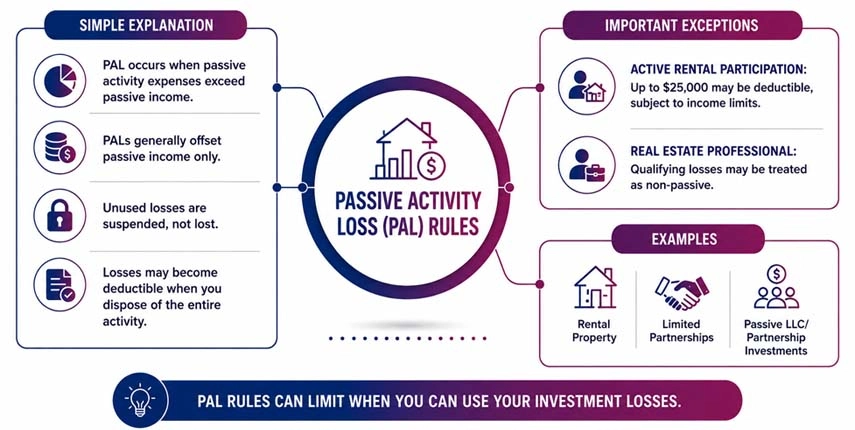
As a real estate investor in the United States, your investments will not always bring you generous profits. This means that, at times, you will not earn enough to cover the costs incurred to maintain the property. When your expenses go beyond the income you earn, you will end up in a situation that is known as Passive Activity Losses (PALs). In a nutshell, a PAL occurs when the deductible losses from the passive activity are more than the income earned from that activity during a tax year.
However, the tricky part is that these passive activity losses can generally be offset only against other passive income. There are important exceptions: if you actively participate in rental real estate, you may deduct up to $25,000 of loss against non-passive income (subject to income limits), and if you qualify as a real estate professional, losses may be fully deductible. Additionally, suspended losses become fully deductible when you dispose of your entire interest in the activity.
For instance, if you do not have any passive income in the year losses were incurred, then the losses are deferred, not waived. Meaning you will be able to use them in the years when you do earn passive income.
The Internal Revenue Service (IRS) does not allow PALs to be offset by income that is not passive income, such as salary, wages, active business income, consulting income, and more, unless an exception is applicable.
Be it Form 8582 or any other, Savetaxs provides 24/7 expert guidance in filing IRS forms, ensuring 100% compliance.
The applicability of an IRS Form 8582 for an NRI depends on the type of US income or the investment an individual holds.
As an NRI, you are liable to file Form 8582 if you:
You should understand that just owning a property in the USA does not mean that you have to file this Form. Form 8582 is relevant when passive losses must be calculated under the IRS limitation rules.
Rahul is an NRI living in India; he owns a rental flat in Texas. During the tax year, he earns $18,000 in rent; however, allowable expenses such as repairs, insurance, mortgage interest, property taxes, and depreciation total $24,000.
Though Rahul is at a loss of $ 6,000, he still cannot deduct the full amount because the passive activity loss rules determine how much is currently allowable. The remaining amount may be classified as suspended passive losses that can be claimed in the upcoming tax year if the eligibility requirements are fulfilled.
You are required to file Form 8582 if you:
Before you file Form 8582, having a clear understanding of the passive activity loss rule is essential.
The IRS categorizes income into various categories. Passive losses are typically offset only by passive income unless an exception applies.
The following table clearly demonstrates the difference between active and material participation, as many taxpayers confuse the two.
Active Participation:
Material Participation:
Real Estate Professional Status:
To qualify, you must meet BOTH tests:
The Passive Activity Losses For Real Estate
Residential or commercial rental properties are the main reason behind the Passive Activity Losses (PALs) from real estate.
The deductible expenses generally include:
Now, if the total income earned is less than the total expenses incurred, a loss situation is created. However, the IRS has limits on how much of that loss can be deducted during a current tax year.
NRIs, whether living in the United States or residing in India, invest in the US economy through investment funds, LLCs, or partnerships.
The investment will be classified as a Passive Investment if the investor is not regularly, substantially, and continuously participating in the day-to-day operation of the business. Any losses from such investment are categorized as PALs (Passive Activity Loss Limitation for Business Investors), which means passive losses must be reported on Form 8582 before any deductions can be claimed. In a nutshell, understanding passive activity loss limitations for business investors is essential.
Generally, the core purpose of the Form is to determine the losses that are deductible at the moment and the losses that must be carried forward.
The calculation of allowable losses considers:
The Form further segregates the passive activities and compares the available passive income to the passive losses. If there is any excess loss, it is not waived off then and there and is carried forward until it can be deducted under the regulatory framework of the IRS.
If you qualify for the special allowance related to rental real estate with active participation, your Modified Adjusted Gross Income (MAGI) affects the allowable deduction. The $25,000 maximum allowance is reduced by 50 cents for every dollar your MAGI exceeds $100,000, and is completely phased out once MAGI reaches $150,000.
Before we start with the process of filing Form 8582, you need to keep the following information ready:
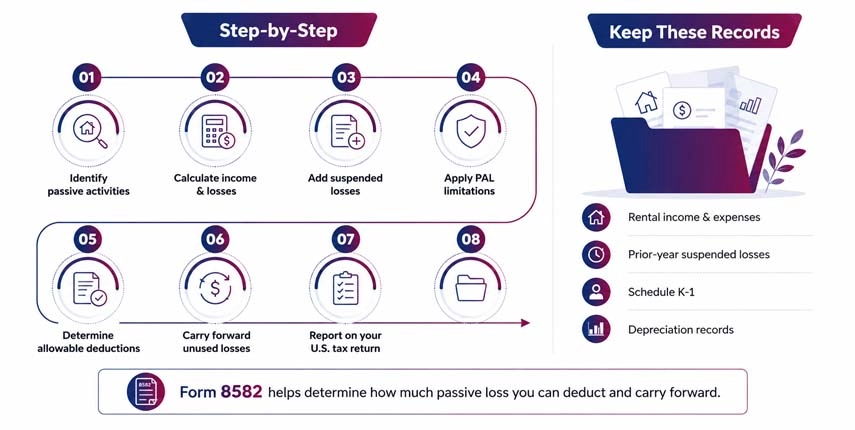
As a taxpayer and a real estate investor in the United States, you need to keep records of the documentation, specifically if the IRS requests you for the supporting records.
The following is a step-by-step process to fill out Form 8582:
Although many tax software programs are available to automatically calculate such situations, as a concerned taxpayer, you should ensure that all the applicable activities have been reported accurately.
With respect to your circumstances and residential status, filing Form 8582 further requires attaching.
If your net investment income exceeds the applicable threshold ($200,000 for single filers, $250,000 for married filing jointly), you may be subject to the Net Investment Income Tax (NIIT), calculated on Form 8960. Passive activity losses reported on Form 8582 affect your net investment income calculation for NIIT purposes. If you have multiple investment activities, you must actively review how this Form interacts before filing.
As an NRI, you must consult a tax professional if you are managing different real estate investments in the United States. A tax professional like Savetaxs can help ensure precise reporting and compliance through expert guidance.
The Form 8582 tax filing deadline is the same as your annual US income tax return, as Form 8582 is filed along with your tax return. If you miss the filing deadline or report passive losses incorrectly, it can delay the processing of your return and might require an amended return to correct the error.
The following table provides a clear understanding of the Form 8582 tax filing due dates:
| Taxpayer | Return Filed With | General Due Date | Extended Due Date |
|---|---|---|---|
| US citizens and residents | Form 1040 | April 15 (typically) | October 15 |
| NRIs and nonresident aliens. | Form 1040-NR | April 15 (if wages subject to US withholding), otherwise June 15 | October 15 |
Here's a quick tip: If you have asked for a tax filing extension for your United States tax return, then that same extension will also be applicable to Form 8582. This is so because the Form is attached to the return rather than being filed separately.
The IRS deadline generally changes with respect to holidays, weekends, and administrative or government announcements; hence, it is strongly recommended to always check the application due date before you proceed with form filing.
On the surface, filing the IRS Form 8582 appears simple, yet taxpayers often make avoidable mistakes that can delay the Form's processing and lead to incorrect tax calculations.
Reporting rental losses as immediately deductible is one of the most common errors. However, under the IRS passive loss rules, many losses are limited and carried forward.
Many taxpayers end up using these terms interchangeably; however, both of these terms have different meanings under the IRS rules.
If you use the wrong classification, it may result in disallowed deductions, IRS notices, penalties, interest charges, and may require filing an amended return to correct the error.
Often, the taxpayer overlooks suspended passive losses from previous years.
Such losses do not generally disappear; they are carried forward and can be deductible in future years when the taxpayer has enough passive income to offset them or when the activity is disposed of in a taxable transaction.
Many NRIs investing in a United States-based partnership or LLC often report the losses without considering whether or not they qualify as passive activities.
Further, the taxpayer must review their Schedule K-1 carefully to report any passive losses on Form 8582.
With respect to your investment activity, you may need to file:
If you forget to file the form or happen to use incorrect supporting forms, it will result in incomplete reporting.
Ignoring The MAGI (Modified Adjusted Gross Income) Limitations
For taxpayers who are claiming the rental real estate exception, they must also review how the MAGI impacts the allowable deductions. Higher income can either eliminate or lower certain rental loss benefits.
As a taxpayer filing Form 8582, you must review the following checklist.
Taking time to thoroughly review your return before filing, especially for complex passive activity situations, can help prevent IRS notices and the need for amended returns.
Savetaxs provides expert-backed cross-border guidance to NRIs to manage their Indian-US finances and Taxes.
In a nutshell, the role of Form 8582 is to ensure that the passive losses are deducted as per the IRS regulatory framework rather than claiming all the losses at once. Specifically for NRIs holding or investing in US limited partnership interests, passive business interests, rental properties, and more, understanding these rules is essential for maintaining accurate tax records. Yes, the calculations related to deductible losses can be complex, but once you understand the concept, the process becomes much more manageable.
However, if you have multiple partner investments, rental properties, and other complex activities in the USA, seeking professional cross-border advice is strongly recommended. Savetaxs is one such tax professional helping file Form 8582 for NRIs by gathering all the required supporting documents, calculating the passive activity losses accurately, and completing the IRS Form 8582 under expert guidance.
Connect with us as we serve our clients 24/7 across all time zones.
This article is for general informational purposes only and does not constitute tax, legal, financial, or investment advice. Laws, regulations, rates, and procedures may change over time and may vary based on individual circumstances.
While SaveTaxs makes reasonable efforts to keep the information accurate and up to date, readers should verify applicable rules with official authorities or consult a qualified professional before making decisions based on this information.
Vipul Jain is the Co-Founder of SaveTaxs and a tax expert with experience in Indian and NRI taxation. He advises individuals, NRIs, and businesses on tax filing, tax planning, capital gains, DTAA, and compliance matters. He focuses on making complex tax concepts simple and helping taxpayers make informed, compliant decisions. See Full Bio

Want to read more? Explore Blogs

_1786539671275.webp&w=828&q=75)