US Tax Filing and Compliance
S Corporation Health Insurance for 2% Shareholders: Tax Rules and DeductionsS Corporation Health Insurance for 2% Shareholders: Tax Rules and Deductions
Written by Shubham Jain

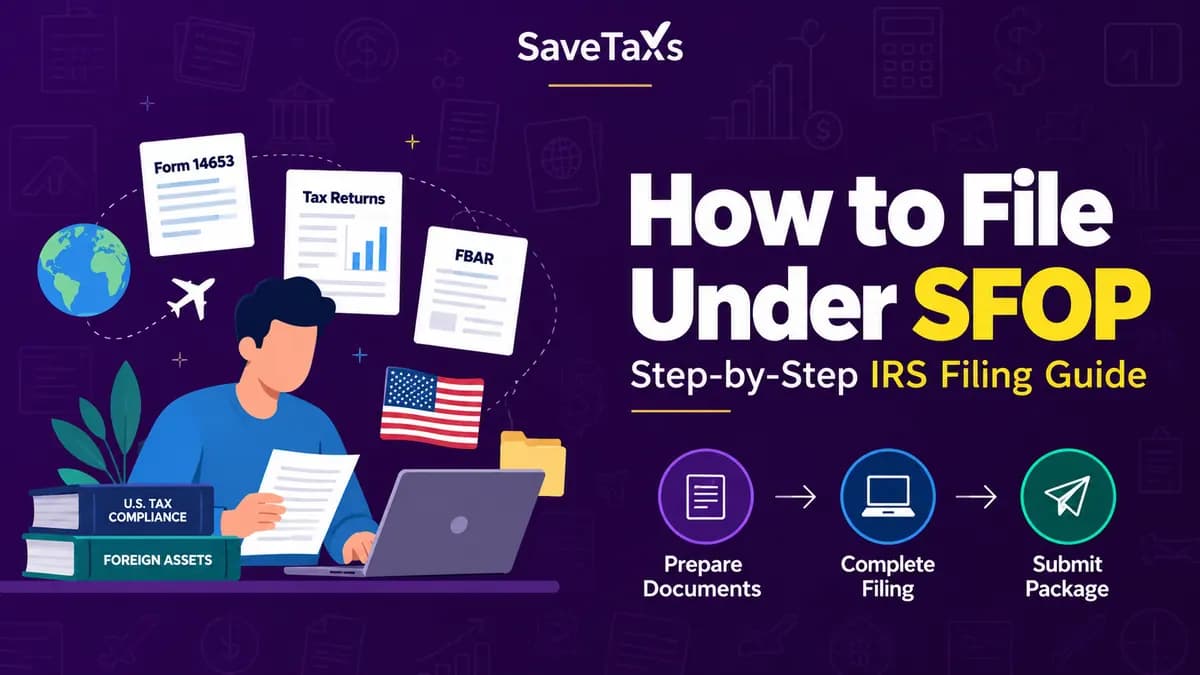
The IRS Streamlined Foreign Offshore Procedures (SFOP) allow eligible individual U.S. taxpayers residing outside the United States to correct certain non-willful failures involving foreign income, tax payments, and international reporting obligations. Taxpayers who meet the requirements and follow the IRS instructions may qualify for relief from specified penalties.
To file under SFOP, you generally need to submit the required federal income tax returns for the most recent three covered tax years, file delinquent Foreign Bank Account Reports (FBARs) for the most recent six covered years, complete Form 14653, pay the tax and applicable interest due, and submit the tax-return package to the IRS. The FBARs are filed separately through FinCEN's BSA E-Filing System.
Eligibility is not automatic. You must meet the applicable non-residency requirements, have qualifying reporting failures involving foreign financial assets, certify that the failures resulted from non-willful conduct, and satisfy the other IRS conditions.
This guide explains how to prepare an SFOP submission, identify the required filing years, gather records, complete Form 14653, and submit the package correctly.
Before preparing returns, check whether SFOP applies to your circumstances.
The procedure is available to eligible individual U.S. taxpayers, including U.S. citizens, lawful permanent residents, and certain other individuals covered by the IRS rules. Your reporting failures must satisfy the non-willfulness requirement, and you must meet the applicable non-residency test.
For U.S. citizens and lawful permanent residents, the non-residency test generally requires that, in at least one of the three most recent covered tax years, you had no U.S. abode and were physically outside the United States for at least 330 full days.
For individuals who are neither U.S. citizens nor lawful permanent residents, the applicable test generally examines whether they met the substantial presence test under Internal Revenue Code Section 7701(b)(3) during at least one of the relevant three years.
For joint-return filers, both spouses must satisfy the applicable non-residency requirement.
You must also have failed to report income from a foreign financial asset and pay tax as required by U.S. law. Related failures to file FBARs or international information returns may also be involved. An unfiled FBAR by itself does not automatically establish eligibility for SFOP.
The IRS defines non-willful conduct as conduct arising from negligence, inadvertence, or mistake, or a good-faith misunderstanding of the requirements of the law.
Certain IRS civil examinations and criminal investigations can make a taxpayer ineligible. You must also satisfy the applicable taxpayer identification number requirements.
If you are eligible for a Social Security number (SSN) but do not have one, you generally cannot use the streamlined procedures to obtain the favorable penalty treatment. If you are not eligible for an SSN and need an Individual Taxpayer Identification Number (ITIN), review the IRS instructions concerning ITIN applications and the streamlined submission process.
Living abroad, paying tax in another country, or believing that you made an honest mistake does not automatically establish eligibility.
For a detailed assessment of the qualifying conditions, read the SaveTaxs SFOP eligibility guide.
SFOP generally requires three covered tax-return years and six covered FBAR years. These periods are determined separately using the applicable due-date rules.
You generally need to submit the required delinquent or amended federal income tax returns for the most recent three years for which the U.S. income tax return due date, including a properly applied extension, has passed.
You generally need to file delinquent FBARs for the most recent six years for which the FBAR due date has passed.
An FBAR is a separate foreign-account reporting requirement administered by the Financial Crimes Enforcement Network (FinCEN). It is not part of Form 1040, and filing a tax return does not automatically satisfy an FBAR obligation.
For a calendar-year taxpayer preparing an SFOP submission after October 15, 2026, the covered periods would generally be:
| Filing obligation | Illustrative covered years |
|---|---|
| Federal income tax returns | 2023, 2024, and 2025 |
| FBARs | 2020, 2021, 2022, 2023, 2024, and 2025 |
This example assumes the relevant return and FBAR due dates have passed and no unusual filing circumstances change the applicable periods. A valid extension, filing history, or other specific circumstance may affect the calculation.
Before preparing your documents, record each covered year, the return status, the applicable information returns, the FBAR status, and any missing records.
This helps prevent a common mistake: preparing three tax returns but overlooking a required international information return or one of the six covered FBAR years.
Check the current IRS SFOP instructions before finalizing the years.
Collect the records needed to reconstruct your U.S. tax and international reporting obligations for each covered year.
Depending on your circumstances, you may need:
Previously filed federal income tax returns and available IRS tax transcripts.
Foreign bank statements and account ownership records.
Foreign investment statements and historical account balances.
Salary, business income, interest, dividend, and capital gains records.
Records of foreign taxes paid or withheld.
Information about foreign corporations, trusts, partnerships, and other entities.
Previous FBAR filings and relevant correspondence with tax advisers.
Not every taxpayer needs every document. The requirements depend on the income, assets, transactions, and reporting obligations involved.
You may need to submit international information returns along with your delinquent or amended tax returns.
| Form | Potential reporting purpose |
|---|---|
| Form 8938 | Specified foreign financial assets |
| Form 5471 | Certain interests in foreign corporations |
| Form 8621 | Certain interests in passive foreign investment companies |
| Form 3520 | Certain foreign gifts, trusts, and other covered transactions |
| Form 3520-A | Annual information reporting for certain foreign trusts with U.S. owners |
This is not a universal checklist. Other forms may apply, and each has its own requirements.
For instance, a taxpayer with foreign bank interest may have different reporting obligations from someone who owns shares in a foreign corporation or has an interest in a foreign trust.
Do not assume that filing an FBAR satisfies Form 8938 requirements or that reporting an asset on Form 1040 eliminates a separate information-return obligation.
The goal is to identify the required filings for each covered year and reconcile them with the supporting records.
After identifying the reporting obligations, prepare the required returns and account reports.
The correct return depends on your prior filing history.
If you did not previously file a required return: You generally submit a complete and accurate delinquent Form 1040 for each applicable covered year, together with the required information returns.
If you previously filed a return: You generally submit a complete and accurate amended Form 1040-X for each applicable covered year, together with the required information returns.
The IRS requires applicable information returns even when those forms would normally be filed separately from a timely federal income tax return.
Reconstruct your foreign income, deductions, credits, and other relevant tax items using supporting records. Foreign taxes paid may be relevant to a foreign tax credit, but eligibility and limitations must be evaluated under U.S. tax rules.
The calculations should reconcile with your source documents and the information reported on the applicable international forms.
The IRS instructs taxpayers to write "Streamlined Foreign Offshore" in red ink at the top of the first page of each delinquent or amended tax return and each information return submitted under SFOP.
Follow this instruction for each relevant return so the submission can be identified under the streamlined procedures.
Required delinquent FBARs must generally be filed electronically through FinCEN's BSA E-Filing System.
For each covered year:
Identify the foreign financial accounts that meet the applicable reporting requirements.
Determine the maximum balance of each reportable account during that year.
Complete and electronically file the required FBAR.
Explain the late filing according to FinCEN's instructions.
The IRS instructs SFOP participants to select "Other" as the reason for filing late and enter "Streamlined Filing Compliance Procedures" in the explanation field.
If you cannot file electronically, contact FinCEN to determine whether an alternative is available.
Do not assume that attaching an unfiled FBAR to the paper tax-return package satisfies the separate filing obligation.
Use the IRS SFOP instructions and FinCEN's BSA E-Filing System for the applicable requirements.
Form 14653, Certification by U.S. Person Residing Outside of the United States for Streamlined Foreign Offshore Procedures, is a required part of the SFOP submission.
You must complete and sign the certification, confirm that you satisfy the applicable eligibility requirements, certify that the required FBARs have been filed, and explain why the relevant reporting failures resulted from non-willful conduct.
The IRS requires specific reasons for failing to report all income, pay all tax, and submit required information returns, including FBARs.
Your narrative should describe the actual circumstances, including relevant personal and financial background, the source of funds in foreign accounts or assets, and your involvement in those accounts.
Depending on your situation, explain:
How the foreign accounts or assets originated and were funded.
Whether an account was inherited, opened while living abroad, or used for business purposes.
Your involvement in deposits, withdrawals, investments, and account-management decisions.
Your understanding of U.S. tax and reporting obligations.
Any advice received from professional advisers, including the nature of the advice and your relationship with the adviser.
Why the reporting failures occurred and when you became aware of the relevant obligations.
The IRS instructs taxpayers to include the whole story, including favorable and unfavorable facts.
Hypothetical example: A U.S. citizen living abroad believed that paying income tax in their country of residence eliminated the need for additional U.S. reporting. The narrative should explain how that understanding arose, what foreign income and accounts were involved, whether professional advice was obtained, and when the taxpayer learned about the U.S. obligations. Whether the facts establish non-willfulness depends on the complete circumstances.
Do not copy another taxpayer's narrative or omit relevant unfavorable facts to make your explanation appear stronger.
The IRS requires the original signed Form 14653 with the submission. You must also attach a copy of the signed certification to each tax return and each information return submitted under SFOP.
Do not attach Form 14653 to the FBARs.
The certification also includes a commitment to retain relevant records: generally, records relating to income and assets for three years from the certification date and relevant foreign-account records for six years from that date. Follow the form's instructions for the precise record-retention requirements.
For detailed form-specific guidance, read the SaveTaxs Form 14653 guide and the official IRS SFOP FAQs.
SFOP does not eliminate the underlying federal income tax liability.
You must pay the tax due on the delinquent or amended returns and applicable statutory interest on late payments. The IRS instructions require the tax and interest due to be remitted with the return submission.
Before sending the package:
Recalculate the tax liability for each covered year.
Review the treatment of foreign income and any available credits.
Calculate applicable statutory interest.
Reconcile the amounts due with the completed returns.
Follow the IRS's current payment instructions.
Eligible taxpayers who comply with SFOP generally receive relief from specified failure-to-file, failure-to-pay, accuracy-related, information-return, and FBAR penalties covered by the procedure.
This is not a guarantee against every possible penalty or examination. Previously assessed penalties are not automatically abated, and additional liabilities may arise if an examination identifies an additional deficiency.
Plan for the tax and interest due even when the procedure may provide relief from specified penalties.
Before mailing your package, verify that the required returns, information returns, certification, and payment are complete and consistent.
The IRS's published SFOP instructions specify paper submission to:
Internal Revenue Service
3651 South I-H 35
Stop 6063 AUSC
Attn: Streamlined Foreign Offshore
Austin, TX 78741
The IRS does not accept electronic submissions of the SFOP tax-return package under these instructions. Required delinquent FBARs are filed separately through FinCEN's electronic filing system.
Verify the current mailing address and submission instructions on the official IRS SFOP page immediately before mailing.
Retain proof of mailing or delivery and copies of everything submitted. The IRS does not routinely acknowledge receipt of streamlined submissions. Submission does not constitute automatic approval or guarantee that the returns will not be examined.
If you discover an error in your SFOP submission and the previously submitted returns are not under examination, the IRS's FAQs explain that you may be able to correct it by submitting amended returns, an amended Form 14653, or both, as appropriate.
For an amended streamlined submission, the IRS instructs taxpayers to write "amended" in red ink at the top of the certification and "Amended Streamlined Foreign Offshore" in red ink at the top of the first page of each corrected amended tax return. Explain the facts and circumstances concerning the original error.
If an FBAR was incorrect, you may also need to file an amended FBAR electronically through FinCEN.
Consult the IRS SFOP frequently asked questions before submitting corrections.
If you are uncertain whether SFOP remains appropriate or your circumstances raise concerns about willful conduct, obtain advice from a qualified U.S. tax professional before taking further action.
SFOP and the Streamlined Domestic Offshore Procedures (SDOP) address different residency circumstances.
| Feature | SFOP | SDOP |
|---|---|---|
| Intended audience | Eligible taxpayers meeting the applicable non-residency requirements | Eligible taxpayers who do not meet the SFOP non-residency requirement |
| Tax-return period | Generally three covered years | Generally three covered years |
| FBAR period | Generally six covered years | Generally six covered years |
| Miscellaneous offshore penalty | No miscellaneous offshore penalty under the procedure, subject to its requirements | Generally a 5% miscellaneous offshore penalty calculated under the applicable IRS rules |
| Certification form | Form 14653 | Form 14654 |
SDOP generally requires taxpayers to have previously filed the required U.S. income tax returns for each of the three covered years; it cannot be used to submit delinquent original income tax returns. SFOP may accommodate eligible delinquent original or amended returns.
The appropriate procedure depends on your residency, filing history, conduct, and other eligibility requirements. Neither procedure should be selected solely because it appears to offer the most favorable financial outcome.
For the full comparison, read the SaveTaxs guide to Streamlined Domestic Offshore Procedures.
Filing under SFOP requires more than submitting overdue tax returns. You must confirm eligibility, identify the correct covered years, reconstruct foreign income and account information, prepare the required returns and FBARs, complete Form 14653 accurately, and pay the tax and applicable interest due.
Start by creating a year-by-year filing inventory and gathering the relevant records. Then follow the current IRS and FinCEN instructions to prepare, review, and submit the required documents.
If your filing history is complicated, you have multiple foreign reporting obligations, or you are uncertain whether your conduct meets the non-willfulness standard, consult a qualified U.S. tax professional before submitting your certification.
This article provides general educational information about the IRS Streamlined Foreign Offshore Procedures. It is not individualized tax or legal advice. Eligibility and filing requirements depend on the taxpayer's specific facts and the applicable IRS rules.
This article is for general informational purposes only and does not constitute tax, legal, financial, or investment advice. Laws, regulations, rates, and procedures may change over time and may vary based on individual circumstances.
While SaveTaxs makes reasonable efforts to keep the information accurate and up to date, readers should verify applicable rules with official authorities or consult a qualified professional before making decisions based on this information.
Hatim Dudhiyawala is a Certified Public Accountant (CPA) with SaveTaxs and specializes in Indian and NRI taxation. He advises individuals, NRIs, and businesses on income tax filing, capital gains taxation, DTAA benefits, fund repatriation, and tax compliance. With experience in cross-border tax matters, Hatim helps taxpayers understand complex regulations and make informed decisions. Through his articles, he shares practical insights to help readers stay compliant and manage their tax obligations with confidence. See Full Bio

Want to read more? Explore Blogs