US Tax Filing and Compliance
S Corporation Health Insurance for 2% Shareholders: Tax Rules and DeductionsS Corporation Health Insurance for 2% Shareholders: Tax Rules and Deductions
Written by Shubham Jain

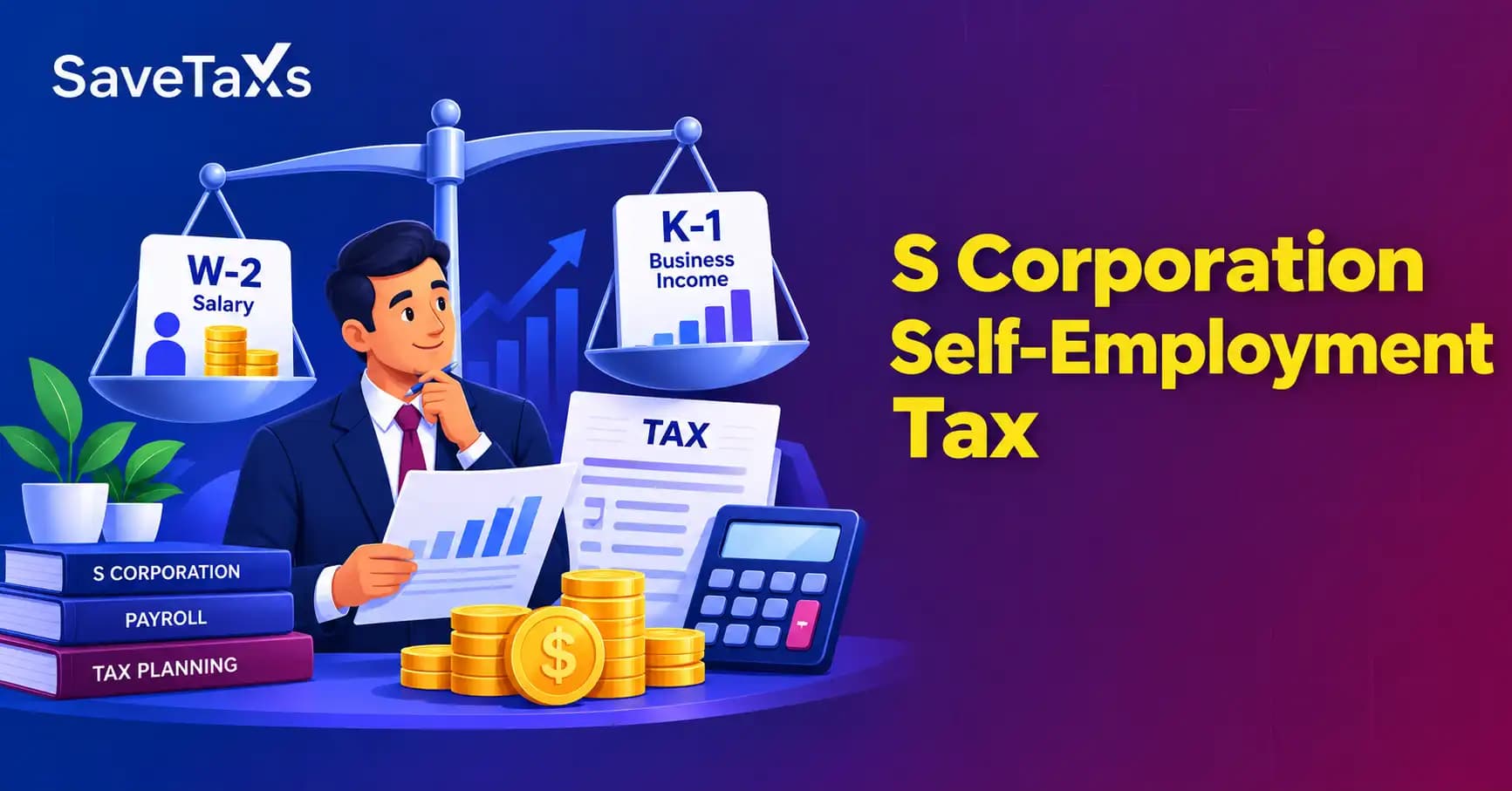
S Corporation owners often choose this business structure because it allows business income to pass through to shareholders without generally subjecting that income to self-employment tax. However, this does not mean an S Corporation owner can avoid all employment-related taxes.
The tax treatment depends on how the owner receives money from the business. A shareholder’s allocated share of S Corporation income generally is not subject to self-employment tax, while wages paid to a shareholder-employee are generally subject to Social Security and Medicare payroll taxes.
Understanding this distinction can help business owners report income correctly and avoid common tax compliance mistakes.
Generally, S Corporation shareholders do not pay self-employment tax on their allocated share of S Corporation business income. This differs from the usual treatment of net earnings from self-employment for sole proprietors and many partners.
An S Corporation is generally a pass-through entity for federal income tax purposes. Its income, losses, deductions, and credits are allocated to shareholders and reported on Schedule K-1 (Form 1120-S), subject to applicable tax rules.
A shareholder may need to report their allocated taxable income on their individual federal tax return even if the corporation retains the money rather than distributing it.
However, an owner who works in the business may also receive wages. Those wages are generally subject to employment taxes, regardless of whether the shareholder also receives pass-through income or distributions.
Need help managing your S Corporation tax filing and compliance? Get professional support to handle your business tax reporting accurately.
The distinction between pass-through income and self-employment income is central to understanding an S Corporation owner's tax obligations.
| Type of payment or income | General federal tax treatment |
|---|---|
| Allocated S Corporation business income | Generally subject to individual income tax, but not self-employment tax |
| Wages paid to a shareholder-employee | Generally subject to Social Security and Medicare payroll taxes |
| Shareholder distributions | Generally not subject to self-employment tax. Non-dividend distributions generally reduce stock basis, and amounts exceeding applicable basis may result in taxable gain. Other tax rules and payroll obligations may apply. |
| Income from a separate sole proprietorship | Generally subject to self-employment tax on net earnings, subject to applicable rules |
These are general rules. The actual treatment depends on the payment's nature, the corporation's circumstances, and applicable tax law.
Generally, no. A shareholder's allocated share of ordinary S Corporation business income is not treated as self-employment income merely because the shareholder owns the business or participates in its operations.
For example, an owner may receive a Schedule K-1 showing business income. That income may be taxable for federal income tax purposes, but it generally is not included in the owner's self-employment tax calculation simply because it came from the S Corporation.
This does not exempt the income from all taxes. Federal income tax and any applicable state taxes may still apply.
Wages paid to a shareholder-employee generally are not reported as self-employment income. Instead, they are processed through payroll and generally subject to Social Security and Medicare taxes under the Federal Insurance Contributions Act (FICA).
The corporation generally withholds the employee's share of applicable Social Security and Medicare taxes and pays the employer's share, subject to applicable wage limits and exceptions. Federal income tax withholding and other payroll obligations may also apply.
Therefore, saying that S Corporation income generally is not subject to self-employment tax does not mean that an owner who works for the company can receive compensation without employment taxes.
S Corporation owners may have more than one tax obligation, depending on how they participate in the business and how they receive income.
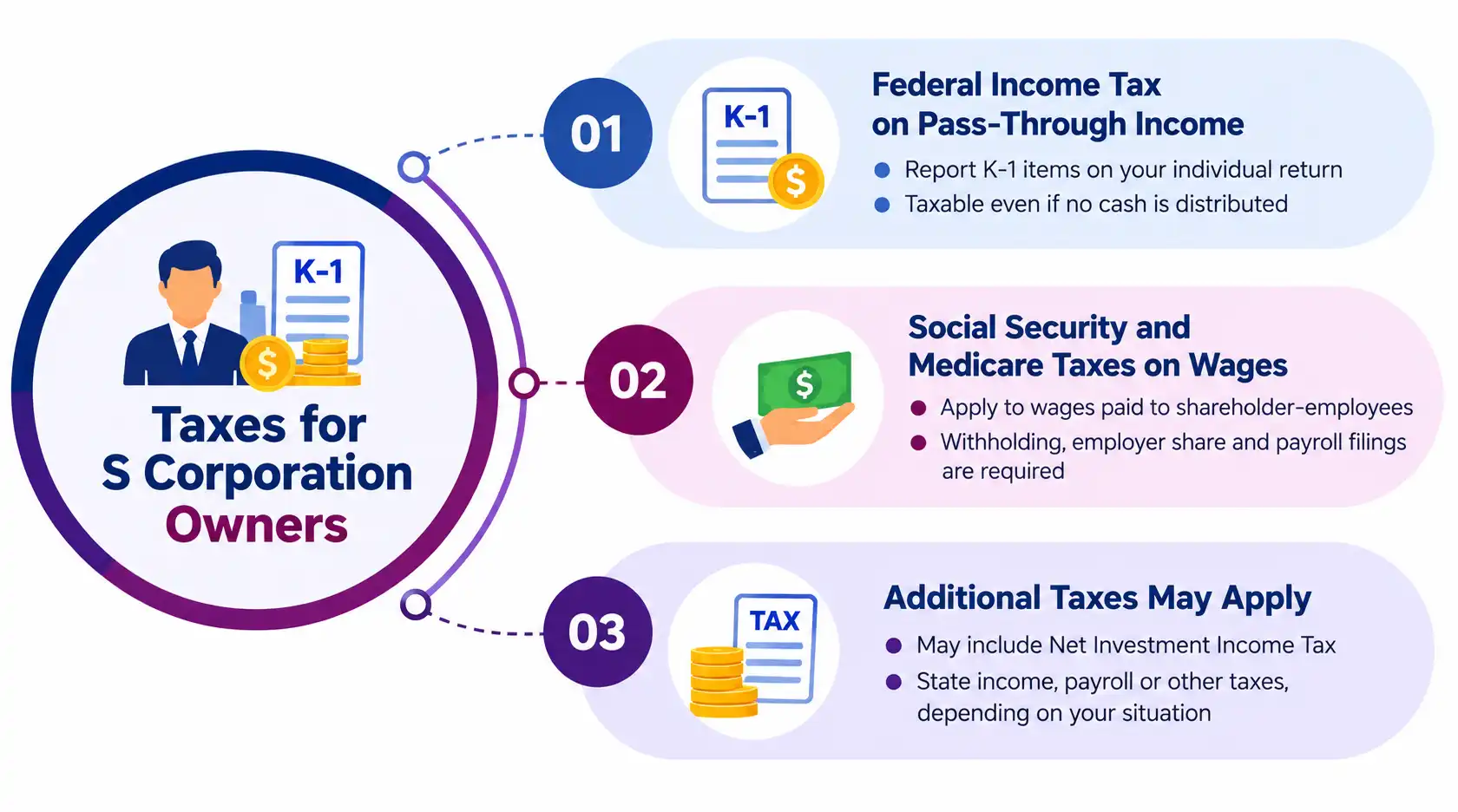
An S Corporation generally passes its taxable income through to its shareholders. Shareholders report applicable items from Schedule K-1 on their individual returns, even if the corporation does not distribute an equivalent amount of cash.
The income tax consequences depend on the nature of the reported items and the shareholder's overall tax situation.
When an S Corporation pays wages to a shareholder-employee, those wages are generally subject to Social Security and Medicare taxes, subject to applicable wage limits and rules.
The corporation is generally responsible for withholding the employee's share, paying the employer's share, depositing payroll taxes, and filing required payroll returns.
Depending on the shareholder's circumstances, other taxes may be relevant. For example, the Net Investment Income Tax may apply to certain investment income when the taxpayer meets the applicable income thresholds and other conditions. State income, payroll, or other taxes may also apply.
These taxes have their own rules and should not be confused with self-employment tax.
No. Taking distributions instead of wages does not automatically eliminate payroll tax obligations.
The IRS generally requires an S Corporation to pay reasonable compensation to a shareholder-employee for services performed before making non-wage distributions to that shareholder-employee. If the corporation pays little or no wages despite the owner's work, the IRS may reclassify distributions or other payments as wages.
That reclassification can result in additional employment taxes, interest, and potentially penalties.
For example, an owner who regularly manages operations, serves customers, and performs the company's main revenue-generating work should not assume that all payments can be classified as distributions merely to avoid payroll taxes.
The appropriate compensation depends on the services performed and the facts of the business. There is no universal salary amount or fixed salary-to-distribution ratio that automatically satisfies IRS requirements.
For the detailed rules on setting compensation, read S Corporation Reasonable Compensation. For the differences between owner wages and distributions, see S Corporation Salary vs. Distributions.
Suppose an S Corporation has one shareholder who actively works in the business. During the year, the shareholder receives:
Assume the $80,000 wage amount is reasonable for the services performed and the $40,000 is properly allocated business income.
The general federal tax treatment is:
This example illustrates the distinction between the two tax treatments. It does not calculate the shareholder's total tax liability or establish that $80,000 is reasonable compensation for every business.
The actual result depends on the shareholder's circumstances, applicable wage limits, other income, deductions, and current tax rules.
Understand how pass-through income, owner wages, and payroll taxes apply to your business. Savetaxs can help you navigate your S Corporation tax obligations.
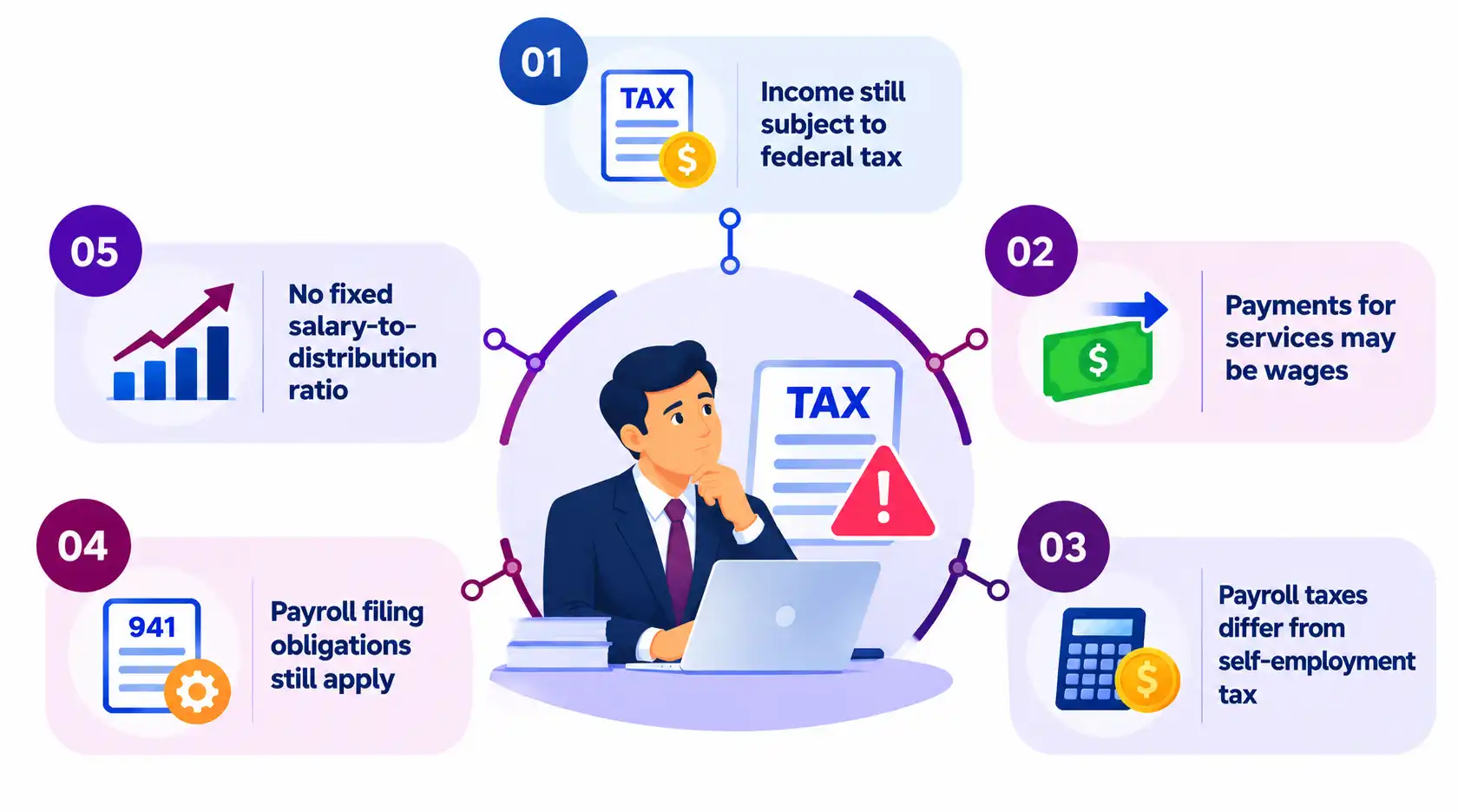
Pass-through income generally is not subject to self-employment tax, but it may still be subject to federal income tax. Shareholders should review their Schedule K-1 and report the relevant items correctly.
Payments for services may need to be treated as wages. Calling a payment a distribution does not determine its tax treatment.
Self-employment tax generally applies to qualifying net earnings from self-employment. Payroll taxes generally apply to employee wages. Both systems involve Social Security and Medicare taxes, but their reporting and payment rules differ.
An S Corporation that pays wages generally must withhold, deposit, and report payroll taxes using the applicable IRS forms. Not owing self-employment tax on pass-through income does not remove these obligations.
There is no universal percentage that makes an owner's compensation compliant. Compensation should reflect the services performed and the facts of the business.
Understanding the difference between self-employment tax and payroll taxes helps S Corporation owners report income correctly and manage their tax responsibilities. Review your compensation, distributions, and tax reporting with your business's actual circumstances in mind.
Savetaxs can help with U.S. business tax filing and compliance. Visit our S Corporation services page to learn more.
This article is for general informational purposes only and does not constitute tax, legal, financial, or investment advice. Laws, regulations, rates, and procedures may change over time and may vary based on individual circumstances.
While SaveTaxs makes reasonable efforts to keep the information accurate and up to date, readers should verify applicable rules with official authorities or consult a qualified professional before making decisions based on this information.
Hatim Dudhiyawala is a Certified Public Accountant (CPA) with SaveTaxs and specializes in Indian and NRI taxation. He advises individuals, NRIs, and businesses on income tax filing, capital gains taxation, DTAA benefits, fund repatriation, and tax compliance. With experience in cross-border tax matters, Hatim helps taxpayers understand complex regulations and make informed decisions. Through his articles, he shares practical insights to help readers stay compliant and manage their tax obligations with confidence. See Full Bio

Want to read more? Explore Blogs