US Tax Filing and Compliance
S Corporation Health Insurance for 2% Shareholders: Tax Rules and DeductionsS Corporation Health Insurance for 2% Shareholders: Tax Rules and Deductions
Written by Shubham Jain

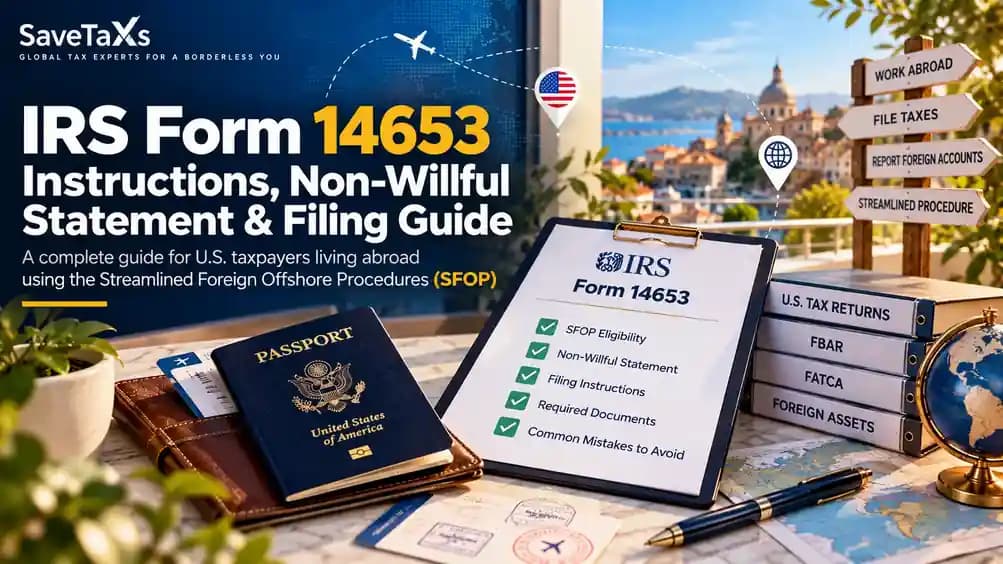
IRS Form 14653 is the certification form eligible U.S. taxpayers use to apply for the Streamlined Foreign Offshore Procedures (SFOP). It allows qualifying taxpayers residing outside the United States to explain why they failed to report foreign income, pay the associated tax, or file required international information returns and Foreign Bank Account Reports (FBARs) because of non-willful conduct.
Form 14653 is more than an administrative form. The certification requires a truthful explanation of the circumstances that caused your reporting failures, supported by the tax returns and financial reporting submitted with your application.
Eligible taxpayers who satisfy the program requirements may qualify for relief from specified penalties. However, submitting Form 14653 does not guarantee acceptance, and the IRS may examine a submission.
This guide explains what Form 14653 does, who may qualify, how to prepare the non-willful statement, which documents to submit, how to file, and what to expect afterward.
Official form: IRS Form 14653 PDF
Important: This article provides general information, not individualized tax or legal advice. Your eligibility and the appropriate disclosure procedure depend on your circumstances, filing history, conduct, and applicable IRS requirements.
Form 14653 is titled Certification by U.S. Person Residing Outside of the United States for Streamlined Foreign Offshore Procedures. It is used by eligible taxpayers applying for SFOP to certify their eligibility and explain why their tax and foreign financial reporting failures resulted from non-willful conduct.
The IRS defines non-willful conduct as conduct resulting from negligence, inadvertence, or mistake, or conduct resulting from a good-faith misunderstanding of the requirements of the law.
The form requires you to explain the facts behind your noncompliance. A statement that you did not know about FBAR requirements may be insufficient if it does not address your personal circumstances, the source and use of your foreign accounts, and your understanding of your U.S. filing obligations.
| Question | Answer |
|---|---|
| What is Form 14653 for? | Certifying eligibility and explaining non-willful conduct under SFOP |
| Who may use it? | Qualifying individual U.S. taxpayers and estates of individual U.S. taxpayers |
| How many tax years are covered? | Generally the three most recent years for which the applicable return due date has passed |
| How many FBAR years are covered? | Generally the six most recent years for which the FBAR due date has passed |
| Is a non-willful statement required? | Yes |
| Does SFOP eliminate tax owed? | No. Tax and applicable interest remain payable |
| Are penalties automatically waived? | No. Relief depends on eligibility and compliance with the procedures |
| What is the listed form revision? | March 2025; verify the current version before filing |
Official source: IRS Streamlined Foreign Offshore Procedures.
Form 14653 is used for the Streamlined Foreign Offshore Procedures. Form 14654 is used for the Streamlined Domestic Offshore Procedures (SDOP).
The appropriate procedure depends on the applicable residency test, filing history, conduct, and other eligibility requirements.
| Feature | Form 14653 — SFOP | Form 14654 — SDOP |
|---|---|---|
| General audience | Eligible taxpayers meeting the applicable foreign non-residency requirement | Eligible taxpayers who do not meet the SFOP non-residency requirement but meet SDOP requirements |
| Prior tax returns | May submit qualifying delinquent original returns or amended returns, as applicable | Must have previously filed required U.S. tax returns for the covered years |
| Covered tax years | Generally three | Generally three |
| Covered FBAR years | Generally six | Generally six |
| Miscellaneous offshore penalty | No miscellaneous offshore penalty for eligible taxpayers who properly use SFOP | Generally a 5% miscellaneous offshore penalty calculated under IRS rules |
| Certification | Form 14653 | Form 14654 |
The SDOP penalty is not necessarily 5% of every foreign asset you own. The IRS applies specific rules to determine the penalty base, including the relevant assets and the taxpayer's financial interest in them.
For a detailed comparison, see SaveTaxs Streamlined Filing Compliance Procedures guide and SDOP: Complete 2026 Guide.
Form 14653 is intended for taxpayers who qualify for SFOP. Living abroad, holding a foreign bank account, or missing an FBAR does not automatically establish eligibility.
Generally, the taxpayer must satisfy the applicable non-residency requirement, have qualifying failures involving income from a foreign financial asset and associated tax, and establish that the failures resulted from non-willful conduct. Other eligibility conditions also apply.
The test depends on your U.S. tax status.
U.S. citizens and lawful permanent residents
In at least one of the most recent three years for which the U.S. tax return due date, including a properly applied extension, has passed, you must have had no U.S. abode and been physically outside the United States for at least 330 full days.
Both conditions must be met for the qualifying year.
Taxpayers who are not U.S. citizens or lawful permanent residents
The applicable requirement generally depends on whether you met the substantial presence test under the relevant rules in at least one of the three covered years.
Joint return filers
Both spouses must meet the applicable SFOP non-residency requirement.
The IRS defines the relevant residency requirement specifically for these procedures. Do not assume that foreign tax residency or a particular number of days abroad automatically qualifies you.
Official guidance: IRS SFOP eligibility and filing instructions.
SFOP is designed for qualifying failures involving foreign financial assets and related tax obligations. Depending on your circumstances, the submission may need to address unreported foreign income, unpaid tax, delinquent FBARs, and missing international information returns.
The exact forms required depend on your assets, transactions, ownership interests, and filing history.
The reasons for your reporting failures must fit the applicable non-willfulness standard. A genuine misunderstanding or inadvertent error may be relevant, but the conclusion depends on the facts as a whole.
The IRS states that the streamlined procedures are not available when a qualifying civil examination or criminal investigation disqualifies the taxpayer under the applicable rules.
If you have received IRS correspondence, are under investigation, or are uncertain about your eligibility, obtain individualized advice before submitting a certification.
For a deeper eligibility assessment, read SaveTaxs SFOP Eligibility Guide.
The distinction between non-willful and willful conduct is central to deciding whether SFOP is appropriate.
The IRS describes non-willful conduct as conduct caused by negligence, inadvertence, mistake, or a good-faith misunderstanding of the law. Willfulness involves a different analysis and can include conduct that demonstrates intentional violation of a known duty or sufficiently serious disregard of that duty.
Depending on the evidence and surrounding circumstances, relevant facts may include:
You genuinely misunderstood your U.S. filing obligations while living abroad.
You believed, incorrectly, that paying tax in your country of residence satisfied all U.S. filing requirements.
You did not understand that an inherited foreign account could create reporting obligations.
You relied on professional advice and can accurately explain the advice, the engagement, and your reliance on it.
You took corrective steps after discovering the missed obligations.
None of these facts automatically establishes non-willfulness.
A qualified professional should carefully evaluate circumstances such as:
Previous IRS warnings about foreign reporting obligations.
Evidence that the taxpayer knew about a reporting requirement but deliberately ignored it.
Intentional concealment of accounts or assets.
Inaccurate statements made to financial institutions or tax authorities.
Continued noncompliance after the taxpayer learned of the relevant obligations.
These facts do not automatically determine the legal outcome, but they can affect the assessment of whether SFOP is appropriate.
Important: Do not attempt to make your circumstances fit a non-willful narrative. If the facts may indicate willfulness, seek advice about the appropriate disclosure route before signing Form 14653 under penalties of perjury.
The narrative statement explains why your reporting failures occurred. The IRS asks for the whole story, including favorable and unfavorable facts, your personal and financial background, the source of funds in foreign accounts and assets, how you used those accounts, and relevant professional advice.
A useful statement should answer these questions:
Where did you live and work during the relevant period?
What foreign accounts or assets were involved, and how were they funded?
What did you understand about your U.S. tax and reporting obligations?
Why did the failures occur?
Did you receive professional advice, and what did that advice cover?
How and when did you discover the problem?
What corrective steps did you take?
| Weak explanation | More useful factual explanation |
|---|---|
| "I did not know I had to file an FBAR." | Explain when the account was opened, what you understood about reporting, whether anyone advised you, and how you learned about the requirement. |
| "My accountant made a mistake." | Describe the scope of the engagement, what information you provided, the advice received, and what you understood at the time. |
| "I fixed the issue when I found out." | Explain when you discovered the problem, what prompted the discovery, and the steps you actually took afterward. |
A more detailed explanation is not automatically a better explanation. Accuracy, relevance, consistency, and completeness matter more than length.
The following is a structure to help organize the facts, not a statement to copy or submit without tailoring:
Background: Describe your residence, employment, and relevant filing history.
Accounts and assets: Explain how the relevant accounts or assets were acquired or funded and how they were used.
Understanding of the law: Explain what you understood about U.S. filing requirements during the relevant years.
Reasons for noncompliance: Describe the actual events, misunderstandings, mistakes, or other circumstances that caused the failures.
Discovery and corrective action: Explain when you discovered the issue and what you did afterward.
Additional relevant facts: Address professional advice, unfavorable facts, and any differences between spouses submitting a joint certification.
Every statement must reflect the taxpayer's real circumstances. Do not invent dates, omit material facts, or claim that corrective actions have been completed if they remain outstanding.
For the IRS's specific narrative requirements, see the official Form 14653 FAQs.
A complete submission generally includes the following items, as applicable to your circumstances.
| Document or item | Purpose |
|---|---|
| Form 14653 | Certifies eligibility and explains non-willful conduct |
| Form 1040 | Used for qualifying delinquent original federal income tax returns |
| Form 1040-X | Used for qualifying amended federal income tax returns |
| International information returns | Corrects required reporting for relevant foreign assets, entities, trusts, or transactions |
| Delinquent FBARs | Reports foreign financial accounts for the applicable six-year period |
| Tax and interest payment | Pays outstanding tax and applicable statutory interest |
| ITIN application, if required | Addresses the taxpayer identification requirement when the taxpayer is not eligible for an SSN and lacks an ITIN |
| Supporting records | Helps the taxpayer prepare an accurate, consistent statement and filing package |
International information returns may include Forms 3520, 5471, 8938, or other forms, depending on the facts. Not every taxpayer needs every form.
The IRS also provides special instructions for certain treaty-based retirement or savings-plan elections and for reporting relevant Section 965 transition-tax matters. These requirements are situation-specific.
Do not assume that a generic document checklist identifies every reporting obligation that applies to you.
Review the applicable non-residency test, the nature of the reporting failures, the non-willfulness requirement, and any circumstances that could affect eligibility.
If the facts may indicate willful conduct or you have received IRS examination or investigation notices, obtain professional advice before proceeding.
For each of the three most recent years for which the U.S. tax return due date, including a properly applied extension, has passed:
If the required return has never been filed, prepare a complete and accurate delinquent Form 1040, where permitted under SFOP.
If a return was previously filed, prepare a complete and accurate amended Form 1040-X, as applicable.
Include the required international information returns even when those forms would ordinarily be filed separately from the federal income tax return.
Use the current form and complete the required certification and statement of facts.
The certification is signed under penalties of perjury. Make sure the narrative is truthful, specific, and consistent with the returns, financial records, and FBARs.
Submit the original signed certification and attach copies to each tax return and information return included in the streamlined submission.
Do not attach Form 14653 to the FBARs.
Write "Streamlined Foreign Offshore" in red at the top of the first page of each applicable delinquent or amended tax return and each information return included in the submission.
Follow the current IRS instructions carefully. Incorrect labeling or missing items may prevent the submission from receiving the intended streamlined treatment.
File required delinquent FBARs electronically through the FinCEN BSA E-Filing System.
For the six most recent years for which the FBAR due date has passed, file the required reports and follow the instructions for explaining the late submission:
Select "Other" as the reason for filing late.
Enter "Streamlined Filing Compliance Procedures" in the explanation field.
FBARs are not mailed as part of the paper Form 14653 package. Retain the filing confirmations and relevant records.
For additional guidance, read SaveTaxs Missed FBAR Filing Guide.
Pay the tax due as reflected on the submitted returns and all applicable statutory interest on late-paid amounts.
SFOP may provide relief from specified penalties for eligible taxpayers who comply with the procedures. It does not eliminate the underlying tax liability or applicable interest.
Follow the current IRS payment instructions and include your taxpayer identification number on your check, where applicable.
If you are not eligible for a Social Security number and do not already have an ITIN, the IRS instructs you to submit an ITIN application with the required streamlined returns and supporting documents.
Review the official IRS ITIN guidance and SFOP instructions before filing.
The IRS publishes the following address for SFOP submissions:
Internal Revenue Service
3651 South I-H 35
Stop 6063 AUSC
Attn: Streamlined Foreign Offshore
Austin, TX 78741
The streamlined tax-return and certification package must be submitted in paper form. Electronic submissions are not accepted for this package.
Verify the current address and instructions on the official IRS SFOP page before mailing. Keep a complete copy of the package, payment records, and proof of delivery.
Using the wrong procedure: Form 14653 is for SFOP; Form 14654 is for SDOP. The choice depends on the applicable rules, not simply the location of a foreign bank account.
Writing an overly generic statement: Explain the actual circumstances, your understanding of the requirements, the source and use of foreign accounts, and how you discovered the problem.
Omitting unfavorable facts: The IRS requests the whole story. Relevant facts should not be omitted simply because they are difficult to explain.
Forgetting international information returns: A federal income tax return alone may not satisfy every reporting obligation.
Missing the separate FBAR filing requirement: FBARs are filed electronically through FinCEN rather than included in the mailed Form 14653 package.
Assuming penalty relief is guaranteed: Eligibility and compliance with the filing instructions are essential. A certification does not guarantee a particular IRS outcome.
Ignoring possible willfulness: If the facts suggest intentional concealment or knowing disregard of reporting obligations, evaluate other disclosure options before filing.
Submitting Form 14653 does not guarantee a particular processing time or outcome.
After you mail the package, the IRS processes the submitted returns under its procedures. The IRS may review the submission, request additional information, or examine the returns. A submission under SFOP does not prevent the IRS from examining a return.
Retain a complete copy of:
The signed Form 14653 and the accompanying narrative.
All tax returns and international information returns submitted.
FBAR filing confirmations.
Financial records supporting the reported amounts and narrative.
Payment confirmations and proof of mailing or delivery.
Any subsequent IRS correspondence.
Do not assume that you can ignore an error in a streamlined submission. The IRS's SFOP FAQs address corrections to prior submissions, including circumstances in which amended returns or an amended Form 14653 may be needed.
The correct response depends on the error and whether the returns are under examination. Consult the official IRS Form 14653 FAQs before submitting corrections.
If the IRS requests additional information or determines that the submission does not qualify for streamlined treatment, the appropriate next step depends on the facts and the notice received. Consider obtaining qualified tax representation before responding, particularly if the issue concerns non-willfulness or eligibility.
Preparing an SFOP submission requires more than completing a form. You need to determine whether you qualify, identify the required filing years and information returns, prepare an accurate narrative, and ensure that the tax-return package and FBARs are submitted correctly.
SaveTaxs can help you understand the relevant requirements and evaluate the next steps for your U.S. tax compliance.
Start with our SFOP Eligibility Guide or Streamlined Filing Compliance Procedures overview.
Any recommendation should be based on your individual circumstances and the applicable IRS rules.
IRS Form 14653 is a central part of the Streamlined Foreign Offshore Procedures, but the certification is only one component of the filing process. Eligible taxpayers must meet the applicable requirements, explain their non-willful conduct truthfully, submit the required tax and information returns, file delinquent FBARs separately, and pay outstanding tax and interest.
Before filing, verify your eligibility and review the current IRS instructions. If your reporting history is complex or the facts may indicate willfulness, obtain individualized advice before choosing a disclosure route.
This article is for general informational purposes only and does not constitute tax, legal, financial, or investment advice. Laws, regulations, rates, and procedures may change over time and may vary based on individual circumstances.
While SaveTaxs makes reasonable efforts to keep the information accurate and up to date, readers should verify applicable rules with official authorities or consult a qualified professional before making decisions based on this information.
Hatim Dudhiyawala is a Certified Public Accountant (CPA) with SaveTaxs and specializes in Indian and NRI taxation. He advises individuals, NRIs, and businesses on income tax filing, capital gains taxation, DTAA benefits, fund repatriation, and tax compliance. With experience in cross-border tax matters, Hatim helps taxpayers understand complex regulations and make informed decisions. Through his articles, he shares practical insights to help readers stay compliant and manage their tax obligations with confidence. See Full Bio

Want to read more? Explore Blogs