US Tax Filing and Compliance
S Corporation Self-Employment Tax: Do Owners Have to Pay?S Corporation Self-Employment Tax: Do Owners Have to Pay?
Written by Hatim Dudhiyawala

Health insurance for an S Corporation owner has special federal tax rules when the owner holds more than 2% of the company's stock or voting power. Unlike health insurance benefits provided to many other employees, premiums paid for these shareholder-employees generally must be included in Form W-2 wages, even when the shareholder may qualify for an individual health insurance deduction.
Understanding these rules helps S Corporation owners report premiums correctly, coordinate corporate payments with payroll, and determine whether they can claim the deduction on their individual federal income tax return.
For these health insurance tax rules, a 2% shareholder generally means a shareholder who owns more than 2% of the S Corporation's outstanding stock or stock possessing more than 2% of the total combined voting power.
The distinction matters because the special treatment applies to shareholder-employees who cross this ownership threshold, rather than automatically applying to every S Corporation owner.
For example, an owner who holds 10% of an S Corporation and works as an employee may be subject to these rules. The IRS definition and applicable ownership rules should be reviewed when determining whether an individual qualifies.
The rules concern the federal tax treatment of health and accident insurance premiums paid on behalf of these shareholder-employees. They affect how the corporation handles the premiums and how the shareholder reports the related amounts.
An S Corporation can generally deduct qualifying health and accident insurance premiums paid on behalf of a shareholder-employee who owns more than 2%, subject to the applicable rules.
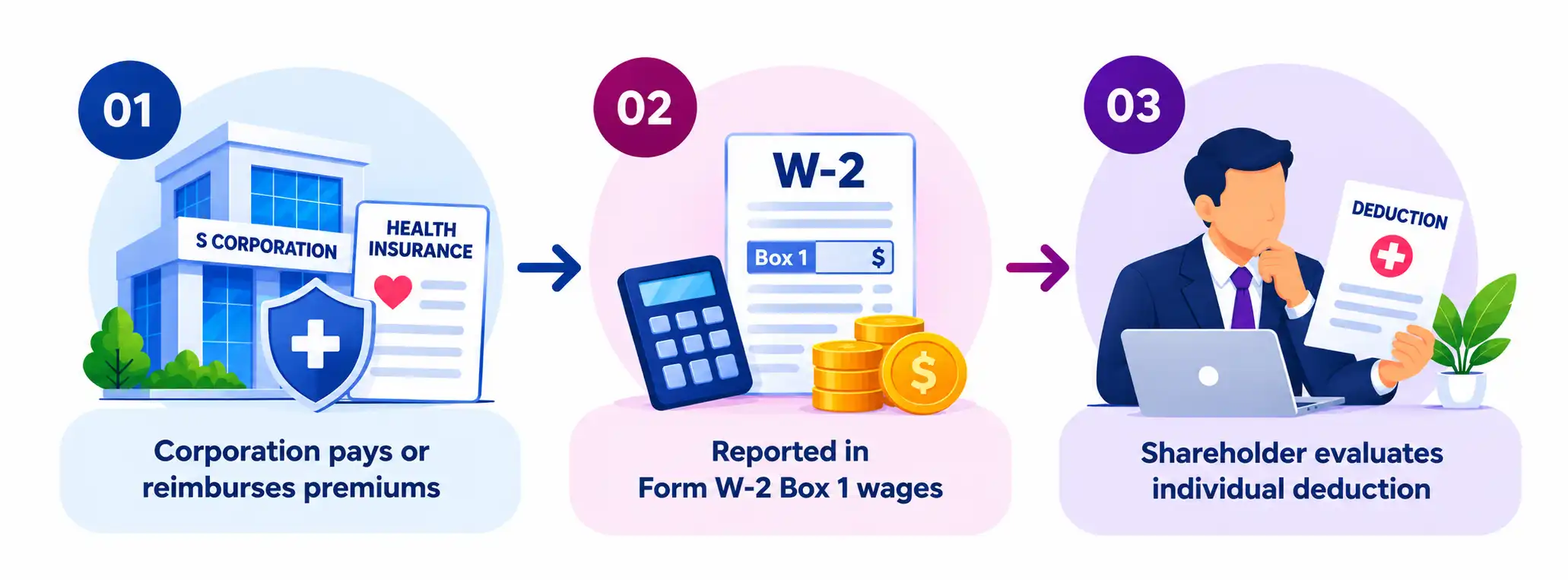
However, the premiums receive special treatment for federal income tax and payroll reporting. They are generally included in the shareholder-employee's Form W-2 Box 1 wages rather than being treated exactly like tax-free health insurance benefits for other employees.
The usual process is:
This treatment allows the corporation to account for the qualifying insurance cost while the shareholder separately evaluates eligibility for the individual deduction.
Correct W-2 reporting is central to the special health insurance rules for S Corporation shareholder-employees.
Under IRS guidance, qualifying premiums paid on behalf of a shareholder-employee who owns more than 2% are generally reported as wages in Box 1 of Form W-2.
When the applicable requirements for the employee benefit arrangement are met, these premiums generally are not included in Box 3 (Social Security wages) or Box 5 (Medicare wages and tips).
The income tax and employment tax treatment therefore differs from ordinary cash salary. The corporation should not assume that the premium amount is excluded from all wage reporting simply because it represents health insurance
Suppose an S Corporation pays $6,000 in qualifying health insurance premiums for a shareholder-employee during the year.
If the applicable requirements are satisfied, the corporation generally includes the $6,000 in Box 1 of the shareholder's Form W-2. The amount generally is not included in Boxes 3 and 5 under the special rules.
This example illustrates the reporting treatment only. The shareholder's eligibility to deduct the premiums on their individual return must be assessed separately.
The corporation should reconcile the premium payments, reimbursement records, and payroll reporting before issuing Form W-2.
Understand how shareholder health insurance premiums should be reported on Form W-2 and what records to maintain.
A shareholder-employee who owns more than 2% of an S Corporation may qualify for the self-employed health insurance deduction on their individual federal income tax return.
The deduction is generally claimed on Schedule 1 (Form 1040), subject to the applicable requirements and limitations. Form 7206 may be required to calculate the deduction.
The deduction is not automatic. The shareholder must satisfy the relevant requirements, including the rule concerning eligibility for subsidized health coverage through an employer.
A shareholder generally cannot claim the deduction for a month if the shareholder or their spouse was eligible to participate in a subsidized health plan maintained by an employer for that month, under the applicable rules.
Other limitations can also affect the allowable deduction, including the shareholder's earned income from the relevant business. The premiums must qualify under the applicable rules, and the same expense cannot be deducted twice.
Before claiming the deduction, the shareholder should verify the applicable Form 7206 instructions and individual tax return requirements for the tax year.
An S Corporation shareholder may purchase health insurance in their own name. However, personally paying the premium does not, by itself, satisfy the requirements for the self-employed health insurance deduction under the S Corporation rules.
Generally, the S Corporation must reimburse the shareholder for the qualifying premiums and report the reimbursed amount in Box 1 of Form W-2.
For the insurance plan to be treated as established under the business, the corporation's payment or reimbursement and W-2 reporting must meet the applicable requirements
Suppose a shareholder purchases a qualifying health insurance policy personally and pays $4,800 in premiums during the year.
To follow the special rules, the shareholder should provide the premium records to the corporation. The corporation should reimburse the qualifying amount and include it in the shareholder's Box 1 wages as required.
The shareholder can then determine whether the premiums qualify for the individual deduction.
If the shareholder pays the premiums personally and the corporation neither pays nor reimburses them, the shareholder generally cannot claim the deduction under these S Corporation rules on that basis alone.
Keep the insurance policy, premium statements, proof of payment, reimbursement records, and payroll documentation.
More-than-2% S Corporation shareholder-employees are not treated identically to regular employees for every health benefit arrangement.
For example, the IRS states that a 2% shareholder-employee is not eligible to participate in a Qualified Small Employer Health Reimbursement Arrangement (QSEHRA).
Special rules also apply to Section 125 cafeteria plans and certain health reimbursement arrangements. A shareholder should not assume that an arrangement available to other employees can be applied to their own benefits in the same way.
Because these arrangements have specific requirements, an S Corporation should review the plan structure and applicable IRS guidance before offering or reimbursing health benefits for a shareholder-employee.
Review the eligibility requirements and reporting rules that apply to your S Corporation shareholder status.
S Corporation owners and payroll administrators should pay particular attention to these errors:
Accurate records and coordination between the shareholder, payroll administrator, and tax preparer help reduce these errors.
S Corporation health insurance for shareholders who own more than 2% requires careful coordination between premium payments, payroll reporting, and individual tax deductions. The corporation generally must pay or reimburse qualifying premiums and report them correctly on Form W-2 before the shareholder claims the deduction, subject to applicable eligibility requirements and limitations.
Review your payment records, W-2 reporting, and deduction eligibility before filing. If you are unsure how the rules apply to your situation, consult a qualified tax professional.
This article is for general informational purposes only and does not constitute tax, legal, financial, or investment advice. Laws, regulations, rates, and procedures may change over time and may vary based on individual circumstances.
While SaveTaxs makes reasonable efforts to keep the information accurate and up to date, readers should verify applicable rules with official authorities or consult a qualified professional before making decisions based on this information.
Shubham Jain is the Founder of SaveTaxs and has extensive experience in Indian and NRI taxation. He advises individuals, NRIs, and businesses on tax filing, tax planning, capital gains, DTAA benefits, fund repatriation, and compliance matters. He regularly writes about taxation and related financial topics. His focus is on making complex tax concepts easy to understand. Through his articles, he helps taxpayers stay informed, avoid common mistakes, and stay compliant with Indian tax laws. See Full Bio

Want to read more? Explore Blogs