US Tax Filing and Compliance
S Corporation Health Insurance for 2% Shareholders: Tax Rules and DeductionsS Corporation Health Insurance for 2% Shareholders: Tax Rules and Deductions
Written by Shubham Jain

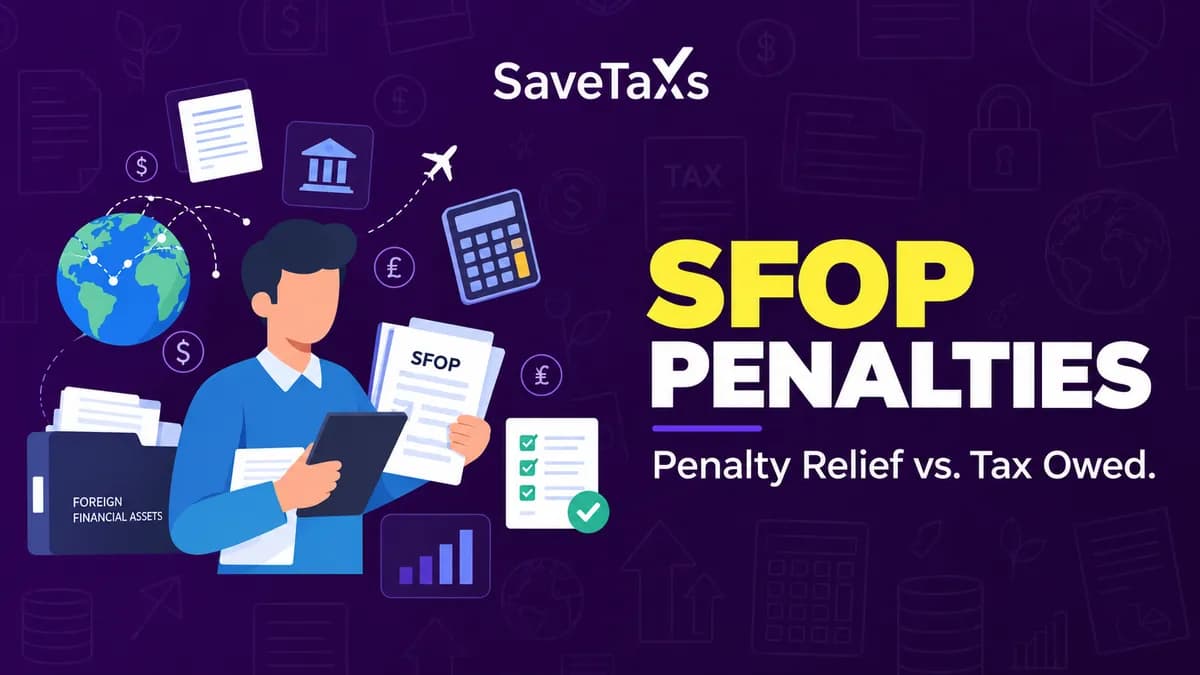
If you are a U.S. taxpayer living abroad and discover that you failed to report foreign income, file required FBARs, or submit international information returns, the Streamlined Foreign Offshore Procedures (SFOP) may help you correct past noncompliance without certain IRS penalties.
Eligible taxpayers who comply with SFOP generally receive relief from specified failure-to-file, failure-to-pay, accuracy-related, information-return, and FBAR penalties. However, the procedure does not eliminate the underlying federal income tax or applicable interest. Previously assessed penalties are not automatically removed, and certain examination findings can affect the relief available.
Your eligibility depends on your residency, the circumstances behind your reporting failures, whether your conduct was non-willful, and whether you satisfy the IRS submission requirements.
Under the IRS's official SFOP guidance, eligible taxpayers who follow the procedure receive relief from specified penalties associated with qualifying returns and reporting obligations.
| Penalty category | General SFOP treatment |
|---|---|
| Failure-to-file penalties | Relief generally applies to qualifying covered returns |
| Failure-to-pay penalties | Relief generally applies to qualifying covered returns |
| Accuracy-related penalties | Relief generally applies to amounts reported on qualifying covered returns |
| International information-return penalties | Relief generally applies under the procedure's terms |
| FBAR penalties | Relief generally applies to qualifying covered FBAR failures |
These protections apply only when the taxpayer qualifies and follows the applicable instructions. Submitting late returns or FBARs outside the procedure does not automatically provide the same treatment.
For example, a U.S. citizen living in Germany might have omitted interest from a foreign bank account and failed to file required FBARs. If the taxpayer meets the SFOP requirements and properly corrects the covered filings, the procedure may provide relief from the associated penalties.
The key distinction is that SFOP provides specified penalty relief, not blanket immunity from every tax liability or legal consequence.
Generally, yes. Eligible taxpayers who properly complete SFOP receive relief from FBAR penalties covered by the procedure.
An FBAR is filed electronically with the Financial Crimes Enforcement Network (FinCEN) using FinCEN Form 114. It is separate from a federal income tax return.
A taxpayer may have an FBAR reporting obligation even if a foreign account generates little or no taxable income. Similarly, reporting foreign interest on a corrected tax return does not automatically satisfy a separate FBAR filing obligation.
Suppose a U.S. citizen living in the United Kingdom discovers that they omitted interest from a foreign savings account and failed to file required FBARs. If the reporting failures were non-willful and the taxpayer satisfies the other SFOP requirements, the procedure may provide relief from the covered penalties.
However, if an examination determines that an FBAR violation was willful, the specified FBAR penalty protection does not apply.
For the underlying reporting requirements, consult FinCEN's official FBAR guidance.
SFOP does not eliminate the underlying federal income tax liability or applicable interest on unpaid tax. You must generally pay the additional tax and interest associated with the corrected returns.
Your remaining financial obligation may include:
Additional federal income tax: Tax due on previously unreported income after applying the relevant tax rules.
Applicable interest: Interest associated with unpaid tax, calculated under the applicable rules.
Separate liabilities: Obligations that fall outside the relief provided by SFOP or arise from other circumstances.
Foreign tax credits and treaty provisions may affect the final calculation if you qualify for them. Their availability depends on the income, taxes paid, applicable treaty, and other relevant facts.
Suppose a taxpayer discovers that they omitted foreign bank interest from previous U.S. tax returns. After correcting the returns, the taxpayer calculates $4,000 in additional federal income tax and $600 in applicable interest.
Assume the taxpayer qualifies for SFOP and receives the relevant penalty relief.
| Item | Hypothetical amount |
|---|---|
| Additional federal income tax | $4,000 |
| Applicable interest | $600 |
| Covered penalties under the assumed SFOP treatment | $0 |
| Total tax and interest payable | $4,600 |
This simplified example is illustrative, not a prediction of an actual IRS assessment. It assumes no additional deficiencies or separate liabilities.
The practical takeaway is straightforward: penalty relief can reduce the cost of correcting past reporting failures, but it does not necessarily eliminate the amount you owe.
The Streamlined Foreign Offshore Procedures and Streamlined Domestic Offshore Procedures (SDOP) apply to different taxpayer residency situations.
| Feature | SFOP | SDOP |
|---|---|---|
| Residency | Must meet the applicable foreign-residency test | Must meet the applicable domestic-procedure requirements |
| Miscellaneous offshore penalty | Generally none | Generally 5% |
| Certification form | Form 14653 | Form 14654 |
| Tax and applicable interest | Generally remain payable | Generally remain payable |
| Filing history | May accommodate eligible taxpayers who need to file delinquent original returns | Requires previously filed U.S. returns for the relevant covered years, if required |
The SDOP penalty is generally calculated at 5% of the highest aggregate amount included in the applicable penalty base. The IRS determines which foreign financial accounts and assets are included and how their values are calculated.
It is not automatically 5% of every foreign asset a taxpayer owns.
The procedures are not interchangeable. Residency, filing history, non-willfulness, and the other applicable eligibility requirements determine which route may be available.
For the official calculation rules, see the IRS's SDOP guidance.
SFOP's penalty protections have specific conditions and exceptions. Four situations deserve particular attention.
SFOP is intended for qualifying non-willful conduct. The IRS describes non-willfulness as conduct resulting from negligence, inadvertence, mistake, or a good-faith misunderstanding of legal requirements.
If an examination determines that the original tax noncompliance was fraudulent or that an FBAR violation was willful, the specified SFOP penalty protections do not apply as described in the IRS guidance.
A taxpayer should not characterize deliberate concealment as an innocent mistake to obtain relief. The facts and circumstances matter, and potentially willful conduct requires careful professional assessment.
Taxpayers concerned about willful noncompliance should obtain qualified tax and legal advice before submitting a certification. The IRS's Criminal Investigation Voluntary Disclosure Practice is a separate option that may be relevant in appropriate circumstances.
Taxpayers generally cannot use the streamlined procedures if the IRS has initiated a civil examination of their returns for any taxable year or if they are under criminal investigation by IRS Criminal Investigation.
The examination does not have to concern foreign accounts to affect eligibility.
If you have received an examination notice, review its nature and status with a qualified adviser before assuming that SFOP is available.
A later SFOP submission does not automatically remove penalties previously assessed for the relevant years.
This is particularly important if you previously submitted delinquent or amended returns outside the streamlined procedures, sometimes called a quiet disclosure.
Before estimating potential savings, identify previous assessments, notices, payments, and corrective filings. Do not assume that using SFOP will reverse an existing penalty assessment.
The IRS may select an SFOP submission for examination and verify its accuracy against information received from financial institutions, advisers, and other sources.
If the IRS identifies additional tax due beyond the amounts reported on the submitted returns, it may assert applicable additions to tax and penalties relating to that additional deficiency.
This is distinct from penalties on amounts properly reported through a qualifying submission. SFOP does not guarantee that every issue in a taxpayer's international tax history has been resolved.
The IRS explains these limitations in its official streamlined filing compliance guidance.
Before relying on SFOP, review the reporting failures and eligibility requirements together.
The three-year tax-return period and six-year FBAR period are based on applicable due dates, not simply the last three and six calendar years.
An SFOP submission generally requires complete and accurate delinquent or amended returns, required information returns, delinquent FBARs where applicable, payment of tax and interest, and the appropriate certification.
The certification is Form 14653. It requires the taxpayer to certify eligibility and non-willful conduct and provide a narrative explaining the reasons for the reporting failures.
That explanation should be truthful and specific. The IRS instructs taxpayers to describe relevant personal and financial background, the source of funds in foreign accounts or assets, account activity, and interactions with professional advisers. Include relevant unfavorable facts rather than relying on a generic statement that you did not know about the reporting requirements.
For more detailed guidance, see SaveTaxs SFOP eligibility guide, how to file under SFOP, and IRS Form 14653 guide.
SFOP can provide significant relief from specified IRS penalties for eligible taxpayers who correct qualifying non-willful foreign reporting failures. It does not eliminate unpaid tax, applicable interest, previously assessed penalties, or every possible consequence of noncompliance.
Before proceeding, verify your eligibility, identify missing returns and reporting forms, calculate the remaining tax and interest, and review any previous IRS notices or assessments. If your circumstances involve possible willfulness or existing enforcement activity, obtain qualified tax and legal advice before submitting a certification.
This article is for general informational purposes only and does not constitute tax, legal, financial, or investment advice. Laws, regulations, rates, and procedures may change over time and may vary based on individual circumstances.
While SaveTaxs makes reasonable efforts to keep the information accurate and up to date, readers should verify applicable rules with official authorities or consult a qualified professional before making decisions based on this information.
Hatim Dudhiyawala is a Certified Public Accountant (CPA) with SaveTaxs and specializes in Indian and NRI taxation. He advises individuals, NRIs, and businesses on income tax filing, capital gains taxation, DTAA benefits, fund repatriation, and tax compliance. With experience in cross-border tax matters, Hatim helps taxpayers understand complex regulations and make informed decisions. Through his articles, he shares practical insights to help readers stay compliant and manage their tax obligations with confidence. See Full Bio

Want to read more? Explore Blogs