
NRI Income Tax Compliance

India France DTAA: What it is, Benefits, TDS Rates & Capital Gains

Hatim Dudhiyawala
Updated on: July 6, 20267 mins Editorial Standards
DTAA between India and France

The DTAA or Double Taxation Avoidance Agreement between India and France is a formal treaty introduced to prevent businesses and individuals from paying taxes twice on the same income in both countries. The India-France DTAA is vital for NRIs, companies, and investors working across these two nations.

The agreement provides a clear set of taxation rules, offers tax credits or exemptions, and lowers TDS rates on certain income types. This further encourages smoother investment and trade flow and ensures a predictable and transparent tax environment for involved parties. Additionally, the bilateral convention is the keystone of the economic relations between the two countries, providing clarity and stability for taxpayers.

Want to know more about the DTAA between India and France in detail? Read the blog and gather all the information.

Key Takeaways
  • The India-France DTAA helps taxpayers to avoid paying taxes twice on the same income in both countries.
  • The DTAA rules remain the same for all residents (including NRIs) and businesses of both countries.
  • Taxes covered in the DTAA between India and France include income tax with advance payment or prepayment, wealth tax, corporation tax, and income tax, along with applicable surcharge and surtax.
  • Income such as interest, royalties, and more face a lower withholding tax, i.e., 10%.
  • Taxation on capital gains depends on the asset type and where it is located. 

India-France DTAA Amendment- What Changed and Why It Matters

  • Capital gains from share sales are not taxable in the country where the company has a permanent establishment.
  • Under the DTAA, the Most-Favoured Nation (MFN) clause has been removed. It impacts how certain treaty benefits apply and is one reason, before filing, you should check the current CBDT circulars.
  • For shareholders holding a minimum of 10% of the capital of the company, their dividend income is now taxed at 5% and 15% for everyone else. 

What is the Double Taxation Avoidance Agreement Between India and France?

The India-France DTAA came into effect from August 1, 1994. It contains 31 articles, each covering a specific income category or principle that states how taxation is shared between the two countries. Here is how the DTAA works. For instance, you are an Indian resident working in France and pay tax there. Now back in India, the income tax department of India allows you a tax deduction for the amount you have already paid in taxes to the French government. Here, you do not pay tax twice on the same income. 

Additionally, the 31 articles mentioned in the DTAA cover a wide range of topics, including definitions, business profits, contracting state rules, dividends, interests, and more. Considering this, for NRIs with mixed income sources across the two nations, the agreement provides a clear map of what income gets taxed where.

This was all about the Double Taxation Avoidance Agreement between India and France. Moving ahead, let's know the benefits of this agreement for both countries. 
DTAA Benefits for Both Countries

DTAA Benefits for Both Countries

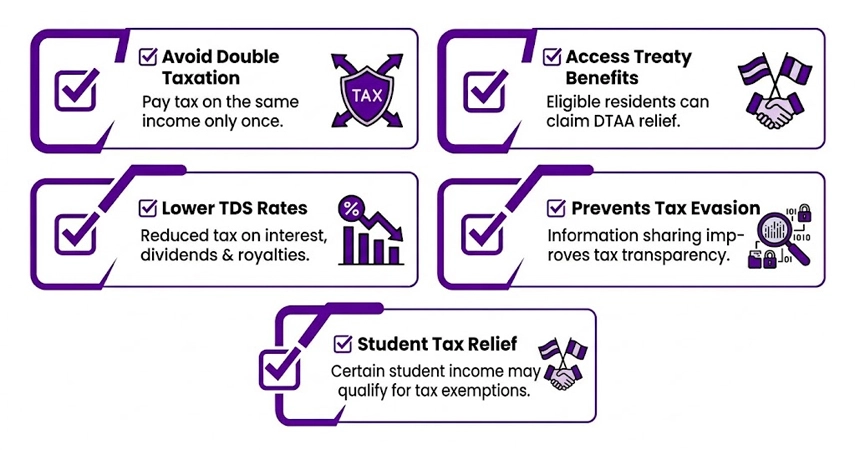
The India-France DTAA in terms of tax and investments is equally beneficial for residents of both countries. Considering this, to provide you with an idea, here are some key benefits that taxpayers of both contracting states get:

  • No burden of double taxation. You pay tax on the income stream in one country, not both. It is the core purpose of the agreement, and it significantly makes the cross-border investment more attractive.
  • The agreement ensures that genuine residents of both nations receive the treaty benefits. Considering this, it is not available to everyone, which is also what makes DTAA credible. 
  • TDS on interest, dividend, and royalty income paid to a resident of the other country is limited, not charged at the standard tax rate. This means you receive more of your actual earnings.
  • The agreement reduces the scope of tax evasion as the governments of both countries exchange information. So it is difficult for income earned in one country not to be declared in the other. 
  • Article 21 of the DTAA between India and France specifically covers students studying at universities in the other contracting state. It exempts certain types of income, so studying overseas does not create tax trouble for them.

This is how DTAA benefits taxpayers of both India and France. Moving further, let's know the taxes covered under the agreement. 

Taxes Covered Under DTAA Between India and France

Article 2 of the DTAA between India and France states the taxes covered under this agreement. It is vital to know what is included before assuming coverage. Considering this:

  • In France, the DTAA treaty covers:
    • Impôt sur le revenu (income tax), along with any withholding tax, prepayments (précompte), or advance payments
    • Impôt de solidarité sur la fortune (wealth tax)
    • Impôt sur les sociétés (corporate tax), including withholding taxes and prepayments
  • In India, the DTAA treaty covers
    • Income tax, along with any applicable surcharge
    • Surtax
    • Wealth tax

The DTAA also includes any new taxes that are similar to those mentioned, introduced by the contracting states after the agreement was signed. If it happens, then the governments of both countries need to notify each other so that the DTAA does not freeze; it adapts to changes in the domestic tax laws. 

Now, moving forward, let's know the India-France DTAA TDS rates. 

India-France DTAA TDS Rates

When an NRI receives a payment from the other countrating states, they are liable to pay tax deducted at source. Here, the TDS rate depends on the India-France DTAA, not on the standard tax rate imposed in each country. Considering this, under the agreement, the withholding TDS rate is limited to 10%. It applies to main income categories such as interest, royalties, and technical service fees. So, what you are earning, TDS on these income categories will not be more than 10% of the gross value.

However, here the 10% TDS rate is not universal across the entire treaty network. The TDS rate may vary with DTAA with other countries. So, if you are an NRI receiving royalty income from India, your guaranteed gross payment will not be reduced by more than 10% TDS. It is a meaningful mechanism, as at domestic rates, you pay higher TDS rates.

This was all about India-France DTAA TDS rates. Moving ahead, let's know the taxation on capital gains under this agreement. 

Taxation on Capital Gains Under DTAA

Article 14 of the DTAA between India and France mentions the taxation on capital gains. The taxation rules differ depending on the type of asset you are selling and its location. Considering this:

  • Immovable Property (Including Forestry and Agricultural Land): If a resident of one contracting state earns a capital gain from property physically located in the other state, then it is taxable in the country where it is taxable. For instance, if an NRI living in France holds a property in India, as per the DTAA on NRI property income, he is liable to pay tax in India. Here, the location drives the tax jurisdiction.
  • Moveable Property Used in Business: Income generated from movable assets used for business in the other contracting state is taxable there, not in the home country of the seller.
  • Ships and Aircraft in International Traffic: Capital gains generated from ships or aircraft across borders, or from movable property associated with those operations, are taxed in the resident country of the owner. Here, the residential status of the owner determines tax obligation.
  • Shares in Property-Holding Companies: If a resident owns company shares whose assets are directly or indirectly held in immovable property in the other state. In this scenario, capital gains generated from those shares are taxable in the country where the property is located. 
  • Shares Above the 10% Threshold: Capital gains generated from a stake of 10% or more in a company are taxable in the country where the company is resident. It is one of the changes stated by the amendment.
  • Other Assets: For property types not included by the above-mentioned specific rules, capital gains generated from them are taxable in the resident country of the seller. The default rule favors the home country of the taxpayer.

So, this was all about the DTAA benefits on capital gains received by individuals and businesses. 

Get NRI Property & DTAA Benefits

From property management to legal support and tax compliance at Savetaxs, we ensure your investments are handled efficiently.

Schedule A Call Today

Final Thoughts

Lastly, the India-France DTAA is one of the cleaner bilateral tax agreements of India. It contains 31 articles, a clear 10% withholding TDS limit, and a straightforward documents process of claiming tax relief. As an NRI or a business corporation, if you are earning in both countries, with proper documents by your side, you can receive the benefit of tax exemption under the DTAA. Apart from this, the process to claim DTAA benefits is also simple.

However, sometimes navigating the complexities of DTAA between India and France can be challenging, specifically for NRIs managing investments or properties. Considering this, Savetaxs provides you with specialized NRI taxation services to simplify the process. So, connect with us and fulfill your tax obligations without any hassle. 

Note: This guide is for information purposes only. The views expressed in this guide are personal and do not constitute the views of Savetaxs. Savetaxs or the author will not be responsible for any direct or indirect loss incurred by the reader for taking any decision based on the information or the contents. It is advisable to consult either a CA, CS, CPA or a professional tax expert from the Savetaxs team, as they are familiar with the current regulations and help you make accurate decisions and maintain accuracy throughout the whole process.

About Author
Hatim Dudhiyawala
Hatim Dudhiyawala Certified Public Accountant (CPA)

Hatim Dudhiyawala is a Certified Public Accountant (CPA) with SaveTaxs and specializes in Indian and NRI taxation. He advises individuals, NRIs, and businesses on income tax filing, capital gains taxation, DTAA benefits, fund repatriation, and tax compliance. With experience in cross-border tax matters, Hatim helps taxpayers understand complex regulations and make informed decisions. Through his articles, he shares practical insights to help readers stay compliant and manage their tax obligations with confidence. See Full Bio

FREE Assistance
NRI Tax Consultation

Get expert assistance with ITR filing, DTAA benefits, and tax compliance in India.

Get Assistance
source bage
Need Personalized Tax Advice?

Every NRI's tax situation is different. Connect with our experts for guidance tailored to your income, investments, and residency status.

Recent Post

Want to read more? Explore Blogs

Frequently Asked Questions

A person can take advantage of the India-France DTAA whenever they qualify as a tax resident of one or both nations and earn income in the other jurisdiction. However, for this, they need to have mandatory documents by their side.

Yes, the India-France DTAA covers salary income. It contains specific articles, often Articles 15 to 19, that showcase which country has the primary right to tax your salary income, helping you to claim tax credits in your residence country to avoid double taxation.

Yes, a Tax Residency Certificate (TRC) is mandatory to claim DTAA benefits in India. Under sections 90(4) and 90A(4) of the Income Tax Act, you are not allowed to claim a DTAA tax treaty without obtaining a TRC from your country of residence.

Yes, income from property is covered under the DTAA. Generally, the rental income from immovable property is taxable in the country where the property is located.

Yes, freelancers can use DTAA benefits. Considering this, if you work with the global clients, DTAA ensures you do not pay tax twice on the same income in both your home country and the residence country of your client.