

NRI Income Tax Compliance

Your Complete Guide to India-Germany DTAA

Hatim Dudhiyawala
Updated on: July 6, 20268 mins Editorial Standards
India-Germany DTAA

The double taxation agreement with India and Germany is formally known as the Agreement for the Avoidance of Double Taxation (DTAA). It is the most important instrument for anyone earning cross-border income between the two countries. The India-Germany DTAA helps eliminate tax-related obstacles, such as double taxation, and encourages cross-border trade and investment. 

Want to know more about India-Germany DTAA? Read the blog and gather all the information about it. 

Key Takeaways
  • The India-Germany DTAA prevents double taxation on the cross-border income and provides a mutual tax relief tool for individuals and companies.
  • The Double Taxation Avoidance Agreement between India and Germany operates through mechanisms, i.e., by providing taxing rights and granting tax relief. 
  • In a financial year, if an individual is considered a resident of both Germany and India, the strict tie-breaker rule applies.
  • The DTAA treaty caps the TDS on interest, royalties, dividends, and fees for technical services at a flat tax rate of 10%.
  • Under the DTAA between India and Germany, capital gains are generally taxed based on the asset type and its location. 

What is DTAA Between India and Germany?

The India-Germany DTAA was signed in 1995 and came into effect on October 26, 1996, replacing all prior articles. The rules stated in this agreement apply to residents of both "Contracting States", i.e., India and Germany. The DTAA between India and Germany comprises 29 articles that focus on the avoidance of double taxation of foreign income.

The agreement also considers whom the taxation system applies to and which types of income are exempt. Under this DTAA, taxpayers can claim tax benefits on foreign income through returns and exemptions. 

In simple words, the DTAA between India and Germany works through two mechanisms:

  • Allocating Taxing Rights: It states which country has the primary right to tax the income of each category. For instance, interest, capital gains, and dividends. 
  • Granting Relief: If both countries impose tax on the same income, your residence country allows a tax credit for the tax you already paid overseas. 

This was all about the DTAA between India and Germany. Moving ahead, the residency rule under DTAA.

Tax Residency Rule Under DTAA

The first step in the DTAA is to determine which country you are a tax resident of. In case, during a financial year, you are considered a tax resident in both Germany and India, the agreement uses a tie-breaker to select one country for treaty purposes. 

Confused? For instance, if you live in India, but in a financial year spend a significant time in Germany, for tax purposes, the tie-breaker will help in choosing which country will treat you as its resident. It follows a sequence:

  • Permanent Home: Country where you have a permanent home.
  • Center of Vital Interest: Country in which you have strong personal and economic relations.
  • Habitual Abode: Where you frequently stay.
  • Nationality: If this issue is still unresolved, the citizenship of the country applies.
  • Mutual Agreement: It is used in rare cases where tax authorities of both countries mutually decide. 

Understanding the residency rule is important as it helps in applying DTAA benefits to residents of one of the treaty nations. Now, moving further, let's know the importance of this agreement between the two countries. 

Importance of DTAA Between India and Germany

The Double Taxation Avoidance Agreement between India and Germany was created to ensure that citizens of both countries pay fair taxes. Considering this, the India-Germany DTAA is important for both countries for various reasons:

  • Under this agreement, both countries are eligible to claim tax benefits. It helps countries to be fair with their citizens regarding income taxation. 
  • Since the DTAA agreement offers fair taxation, it encourages taxpayers to be more consistent and pay taxes on time.
  • Additionally, the DTAA helps residents of both countries engage freely with each other in professional fields without worrying about double taxation.
  • On income tax rates, the DTAA imposes a bilateral relief system. Therefore, through tax exemptions, deductions, or tax credits, it offers tax relief.
    • Section 90 applies to taxpayers who want to claim tax benefits under the DTAA between India and Germany. Considering this, it imposes the bilateral relief system on individuals who are Non-Resident Indians (NRIs) earning income in Germany.
  • This agreement also includes students living in Germany. Under Article 20 of the India-Germany DTAA, they can get tax benefits on their income from Germany.

DTAA relief applies only to the types of income specifically covered under the agreement. Additionally, it also results in fewer economic conflict changes between the countries. 

Now moving forward, let's know the taxes covered under the DTAA between India and Germany. 

Taxes Covered Under DTAA Between India and Germany

Under the India-Germany DTAA, several income sources are included for tax relief. It includes income that comes under the tax slab of Germany, India, or both countries. Considering this, here are the different types of taxes covered under this agreement:

  • In the Federal Republic of Germany (German Tax):
    • Capital tax
    • Income tax
    • Corporation tax
    • Trade tax
  • In the Republic of India (Indian Tax):

Apart from this, any other taxes that fall under similar income categories are covered by the India-Germany DTAA. Moving ahead, let's know India-Germany DTAA TDS rates. 
India-Germany DTAA TDS Rates

India-Germany DTAA TDS Rates

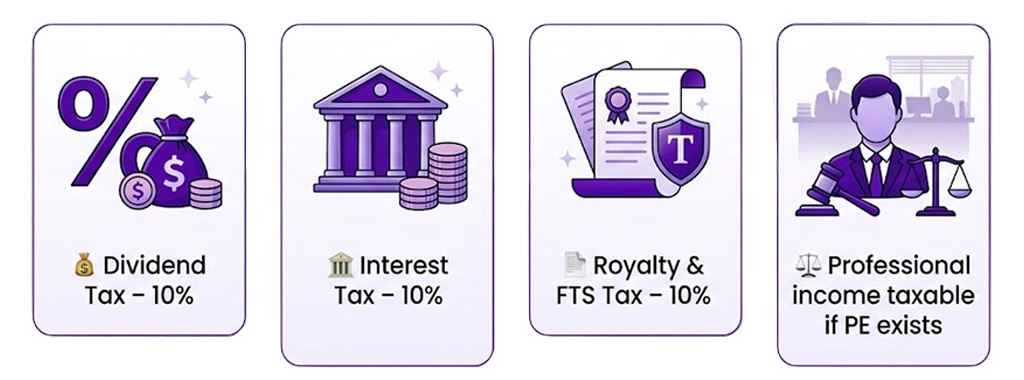
Here are the tax rates for different types of income sources under the India-Germany DTAA:

  • Dividend Income: Under Article 10 of the DTAA between India and Germany, dividend income is the income earned from shares. It includes share income, mining shares, rights shares, and founders' shares. Considering this, if an individual receives the dividend as the owner of the share and a German resident, then the tax rate should not be more than 10% of the total dividend value.
  • Fees for Technical Services and Royalty: According to Article 12 of the India-Germany DTAA, royalties may be defined as earnings received in consideration for the use of any patent, copyrighted literary work, trademark, and more. Royalties earned in India by a resident of Germany are taxed at 10% in India. However, if the income is received through a permanent establishment, it is taxed at the applicable income slab rate, i.e., 40%. 
  • Interest: Under Article 11 of the DTAA agreement between India and Germany, interest income includes income from debentures/bonds, premiums, government securities, and prizes associated with such securities. However, it does not include the penalty charge for late payment. Considering this, in India, Interest income effectively connected with a Permanent Establishment in India may be taxed as business income at applicable rates.
  • Independent Personal Services: Article 14 of the India-Germany DTAA defines professional services as artistic, teaching, and literary activities that are performed by lawyers, physicians, engineers, teachers, and more. A German resident will be liable to pay tax in India for their professional services if they have a permanent establishment in the country and fulfill the residential status criteria.

This was all about India-Germany DTAA TDS rates. Moving further, let's know the taxation and DTAA benefits on capital gains under this agreement. 

Taxation of Capital Gains Under India-Germany DTAA

Under Article 13 of the India-Germany DTAA, the taxation rules for capital gains are as follows:

  • Any capital gains arising in the Contracting States from immovable property will be taxed by the state only. For instance, if a Germany-based NRI has sold Indian property, as per the DTAA on NRI property income, it is taxable in India. 
  • Any capital gain associated with aircraft and shipping is taxed only in the state where the managerial office of the company is situated. 
  • In cases of movable properties, the Contracting State with a permanent base is accountable for collecting taxes. 

Moreover, if there is a tax exception in any of these cases, the Contracting State of the taxpayer, where they are resident, will be liable to collect the taxes. 

Facing Issues in Claiming DTAA Benefits?

Get in touch with our experts at Savetaxs and claim your DTAA benefits without any issue.

Schedule A Call Today

Final Thoughts

Lastly, the India-Germany DTAA is a useful tool for NRIs or anyone who has a foreign income on their side. This agreement helps in maintaining equality and fairness in both countries when it comes to tax payments. Additionally, in the income tax structure, it also creates uniformity that further helps in avoiding double taxation on the same income. 

Furthermore, it can be hard for you to understand this complex law. Hence, it is best to consult a tax expert, like Savetaxs. We have a team of qualified CAs who help you with your ITR filing and claiming DTAA benefits. Connect with us today and simplify your NRI taxation journey in India. 

Note: This guide is for information purposes only. The views expressed in this guide are personal and do not constitute the views of Savetaxs. Savetaxs or the author will not be responsible for any direct or indirect loss incurred by the reader for taking any decision based on the information or the contents. It is advisable to consult either a CA, CS, CPA or a professional tax expert from the Savetaxs team, as they are familiar with the current regulations and help you make accurate decisions and maintain accuracy throughout the whole process.

About Author
Hatim Dudhiyawala
Hatim Dudhiyawala Certified Public Accountant (CPA)

Hatim Dudhiyawala is a Certified Public Accountant (CPA) with SaveTaxs and specializes in Indian and NRI taxation. He advises individuals, NRIs, and businesses on income tax filing, capital gains taxation, DTAA benefits, fund repatriation, and tax compliance. With experience in cross-border tax matters, Hatim helps taxpayers understand complex regulations and make informed decisions. Through his articles, he shares practical insights to help readers stay compliant and manage their tax obligations with confidence. See Full Bio

FREE Assistance
NRI Tax Consultation

Get expert assistance with ITR filing, DTAA benefits, and tax compliance in India.

Get Assistance
source bage
Recent Post

Want to read more? Explore Blogs

Frequently Asked Questions

You can avoid double taxation in Germany through a Double Tax Treaty (DTT). It helps in preventing double taxation by tax-exempting foreign income while offering some progression in tax rates. Additionally, foreign income taxes can be credited against your German income tax only if the applicable DTT offers a tax credit or if there is no DTT.

Being an NRI, the money you transfer to India from Germany is not taxable in India. However, if the individual who is receiving the money in India if they are a resident in India, they will face Indian tax implications.

Yes, capital gains on foreign real estate qualify for DTAA relief. Under most tax treaties, the country where the property is located has the primary right to tax the capital gains. In case your resident country also imposes capital gains, you can prevent double taxation through tax exemptions or credits.

Yes, under the India-Germany DTAA, you can claim lower TDS benefits on several cross-border income streams. Considering this, under the DTAA, the maximum withholding tax rate on specialized and several passive income streams is 10%.

Yes, you can claim a foreign tax credit for taxes paid in Germany to prevent double taxation. With the DTAA agreement, you can generally offset your tax liability of the home country by the amount of your German income or withholding paid tax on that same income.