US Tax Forms
IRS Form 8233: Eligibility, Instructions & India–US Tax Treaty
Written by SaveTaxs Editorial Team
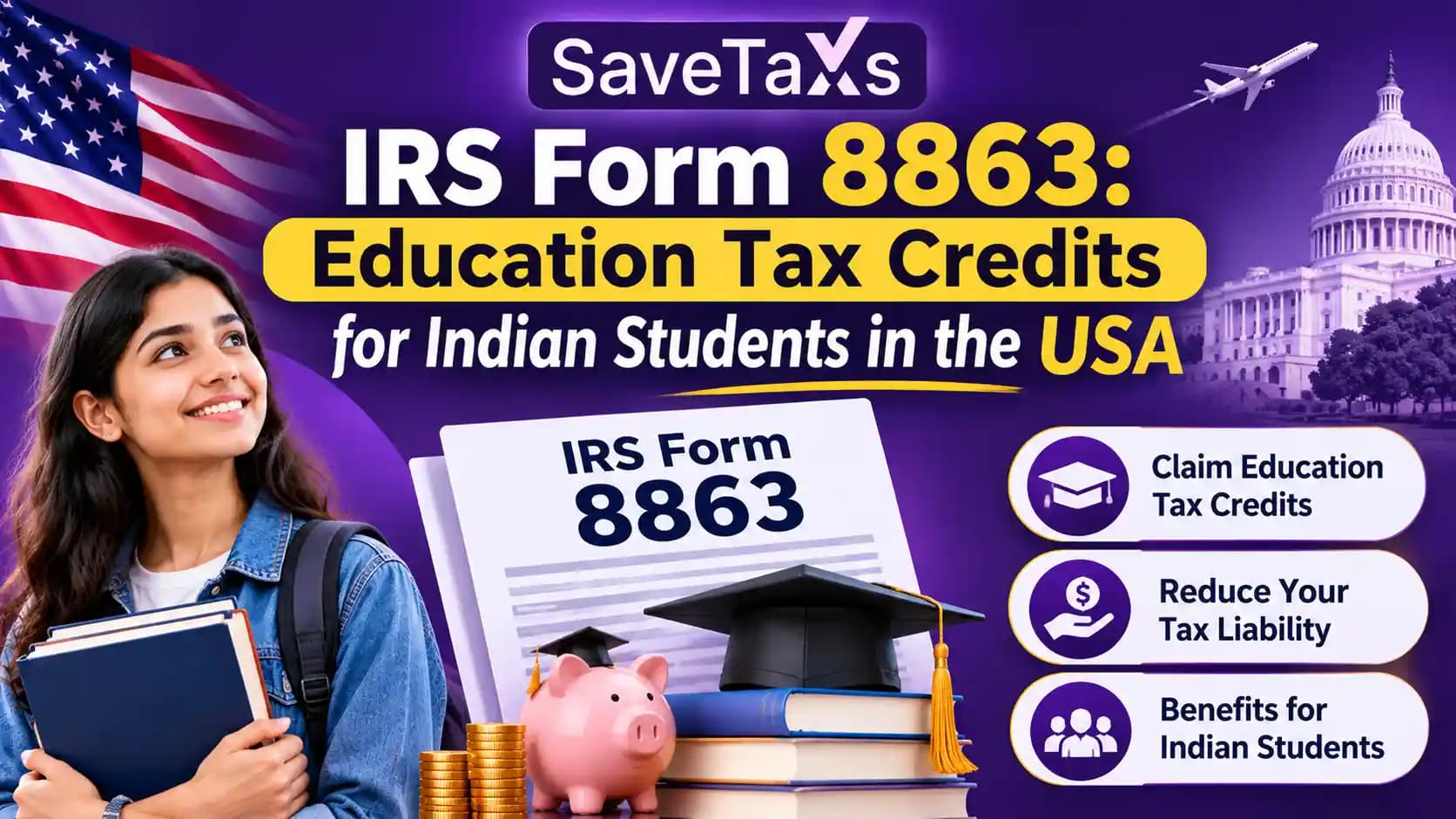
Paying college tuition in the United States can be expensive, but eligible taxpayers may reduce their federal income tax through education tax credits. The IRS offers two major benefits: the American Opportunity Tax Credit (AOTC) and the Lifetime Learning Credit (LLC).
However, most Indian students studying in the USA on F-1 visas are initially classified as nonresident aliens and generally cannot claim these credits on their own tax returns.
Having an F-1 visa, paying tuition or receiving Form 1098-T does not automatically establish eligibility.
This guide explains IRS Form 8863, education credit eligibility, F-1 student tax residency, qualified expenses and important 2026 tax rules.
IRS Form 8863, officially called Education Credits (American Opportunity and Lifetime Learning Credits), is used to calculate and claim eligible education tax credits on a U.S. federal income tax return.
The form covers two education benefits:
You generally attach Form 8863 to Form 1040 or Form 1040-SR when claiming these credits.
For example, an eligible resident alien paying tuition for an undergraduate degree may qualify for AOTC if all applicable requirements are satisfied.
You can download the latest IRS Form 8863 from the official IRS website. Always select the form matching your tax year.
IRS Form 8863 matters because it calculates education tax credits that can reduce the federal income tax of eligible students and families.
The two credits provide different benefits:
For example, an eligible taxpayer receiving the maximum $2,500 AOTC may receive up to $1,000 as a refundable credit, subject to the applicable eligibility and refundability rules.
However, paying college tuition does not automatically qualify someone for either benefit. Tax residency, filing status, student eligibility and other IRS requirements must also be satisfied.
Most Indian students in the USA on F-1 visas cannot claim AOTC or LLC because they are generally treated as nonresident aliens during their initial exempt-student period.
This distinction is extremely important. An F-1 visa, tuition payment, or Form 1098-T does not automatically make a student eligible for education credits.
Under U.S. tax rules, F-1 students generally qualify as exempt individuals for substantial presence test calculations during their first five calendar years as students.
This means their days of presence in the USA are generally excluded when determining whether they meet the substantial presence test during that period.
For example, an Indian student who first entered the USA on an F-1 visa in August 2022 may generally exclude qualifying student days during 2022–2026.
After the applicable five-calendar-year period, the student generally starts counting days toward the substantial presence test, subject to exceptions and special rules. Becoming a resident alien is not automatic.
Students who qualify for exempt-individual treatment generally need to file Form 8843 to claim the applicable exclusion of days.
For more information, see our guide to U.S. tax filing requirements for Indian F-1 students.
An Indian student may qualify when they meet the applicable U.S. tax residency and education credit requirements.
Important situations include:
The IRS generally prohibits nonresident aliens from claiming education credits, subject to these limited exceptions.
Important: Being an Indian citizen, NRI, F-1 student, or ITIN holder alone does not determine education credit eligibility. Your specific U.S. tax classification and filing circumstances matter.
Form 8863 calculates two education credits with different eligibility and expense requirements.
|
Feature |
AOTC |
LLC |
|---|---|---|
|
Maximum credit |
$2,500 per eligible student |
$2,000 per tax return |
|
Refundable portion |
Up to 40% |
None |
|
Education level |
Generally first four years of undergraduate education |
Undergraduate, graduate and job-skills courses |
|
Duration |
Maximum four tax years per student |
No fixed year limit |
|
Expense calculation |
100% of first $2,000 and 25% of next $2,000 |
20% of first $10,000 |
|
Enrollment |
At least half-time |
At least one eligible course |
Both credits have modified adjusted gross income (MAGI) limitations.
|
Filing status |
Phaseout begins |
Credit unavailable at |
|---|---|---|
|
Single and other applicable non-joint filers |
$80,000 |
$90,000 |
|
Married filing jointly |
$160,000 |
$180,000 |
AOTC also requires the student to pursue a degree or recognized educational credential, have no disqualifying felony drug conviction and meet the four-year postsecondary education and previous-claim limitations.
You cannot claim both credits for the same student in the same tax year. Different students on the same return may qualify for different credits.
For complete details, see the IRS education credit eligibility guide.
Qualified education expenses are eligible tuition, required enrollment fees and certain course materials paid during the relevant tax year.
The rules differ between AOTC and LLC.
Eligible AOTC expenses generally include:
An important difference is that eligible AOTC books, supplies and equipment do not necessarily need to be purchased directly from the educational institution.
Eligible LLC expenses generally include:
The following expenses generally cannot be included:
Before completing Form 8863, collect the following documents:
Generally, Form 1098-T is required to claim AOTC or LLC.
However, certain educational institutions are not required to issue it in specified circumstances, including when a student is a qualified nonresident alien or particular scholarship and billing exceptions apply.
A taxpayer may still claim a credit without Form 1098-T when the IRS exception applies, provided enrollment and qualified payments can be substantiated.
Receiving Form 1098-T does not automatically make an otherwise ineligible nonresident alien eligible for education credits.
Form 8863 contains three main parts. Complete Part III for each eligible student before completing Parts I and II.
Step 1: Complete Part III – Student Information
Enter the student's identifying information, educational institution details and applicable education expenses. Complete a separate Part III for each student.
Step 2: Calculate Adjusted Education Expenses
Determine eligible expenses after accounting for applicable scholarships, grants, refunds and other tax-free educational assistance.
Step 3: Complete Part I – Refundable AOTC
Calculate the refundable portion of AOTC. Up to 40% may be refundable, subject to applicable age and support restrictions.
Step 4: Complete Part II – Nonrefundable Education Credits
Calculate the nonrefundable portion of AOTC and the eligible LLC, applying the relevant income and credit limitations.
Step 5: Attach Form 8863 to Your Tax Return
Transfer the calculated amounts to the appropriate sections of Form 1040 or Form 1040-SR. Follow the instructions for the correct tax year.
The IRS has introduced an important identification requirement beginning with tax year 2026.
A valid Social Security number is generally required to claim AOTC or LLC.
The SSN must:
For joint returns, only one spouse needs a qualifying SSN. If the student is a dependent other than the taxpayer or spouse, the dependent student must also have a valid SSN.
An ITIN alone does not satisfy the new 2026 SSN requirement.
As of November 20, 2026, the IRS has published its 2026 Form 8863, but the corresponding 2026 instructions remain marked DRAFT – NOT FOR FILING.
Check the final instructions before submitting your 2026 federal tax return in 2027.
For previous-year returns, use the corresponding tax-year forms and instructions.
Official resources:
Suppose an eligible resident-alien taxpayer has $4,000 in adjusted qualified education expenses for an undergraduate student and meets all AOTC requirements.
The potential calculation is:
|
Calculation |
Amount |
|---|---|
|
First $2,000 × 100% |
$2,000 |
|
Next $2,000 × 25% |
$500 |
|
Maximum AOTC |
$2,500 |
|
Potential refundable portion |
$1,000 |
This is an illustration, not a guaranteed refund. Income, dependency, age-related restrictions and other eligibility requirements can affect the final amount.
An F-1 student classified as a nonresident alien generally cannot claim this credit on their own return unless an applicable exception applies.
Before claiming an education credit:
If you are a nonresident alien, you generally cannot claim education credits unless an applicable exception or election applies. Depending on your circumstances, you may need to file Form 1040-NR and Form 8843.
IRS Form 8863 helps eligible taxpayers claim the American Opportunity Tax Credit and Lifetime Learning Credit. However, Indian students must first determine their U.S. tax residency and satisfy the applicable education credit requirements.
Most F-1 students are initially treated as nonresident aliens and generally cannot claim these credits on their own returns. The new 2026 SSN requirements also make it important to review current IRS instructions before filing.
Verify your eligibility, collect the necessary documents and use the correct tax-year forms. When tax residency or visa status creates uncertainty, consult a qualified U.S. tax professional.
This article is for general informational purposes only and does not constitute tax, legal, financial, or investment advice. Laws, regulations, rates, and procedures may change over time and may vary based on individual circumstances.
While SaveTaxs makes reasonable efforts to keep the information accurate and up to date, readers should verify applicable rules with official authorities or consult a qualified professional before making decisions based on this information.

Want to read more? Explore Blogs