US Tax Forms
IRS Form 1042-S: What It Means, Who Receives It & What to Do
Written by SaveTaxs Editorial Team
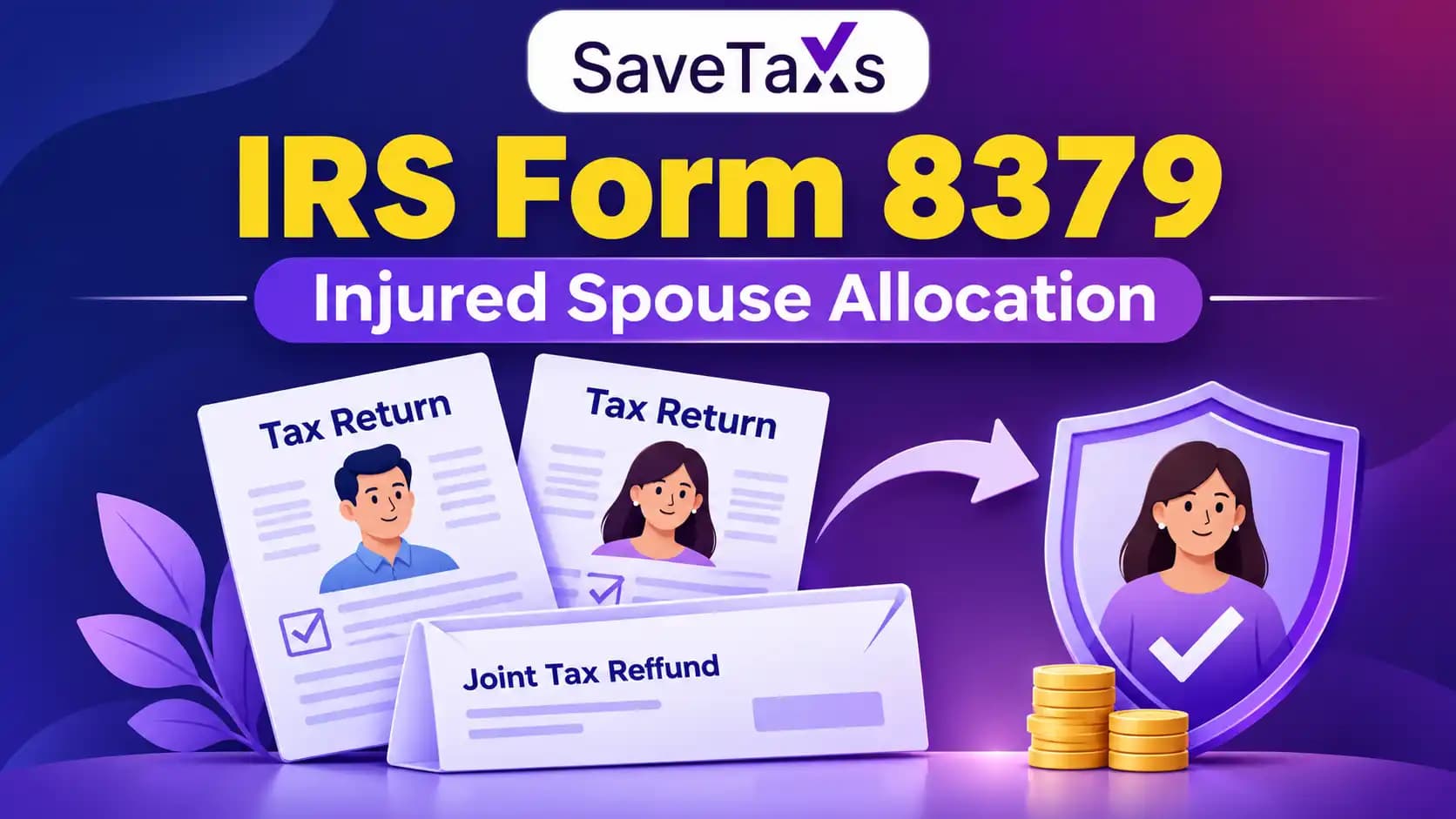
When you file a joint tax return, the IRS may apply your refund toward your spouse's past-due debts, such as unpaid taxes, child support, or certain federal loans. However, you may still be entitled to your share of that refund if you are not legally responsible for the debt.
IRS Form 8379, Injured Spouse Allocation, allows an eligible spouse to request their portion of a joint tax refund that has been, or is expected to be, offset against the other spouse's qualifying debts.
In this guide, you'll learn who qualifies for injured spouse relief, how to complete and file Form 8379, what documents you need, and how long it takes to receive your refund.
IRS Form 8379, Injured Spouse Allocation, is used by one spouse to request their share of a joint federal tax refund when the refund has been, or is expected to be, applied to the other spouse's legally enforceable past-due obligations.
When married taxpayers file a joint federal income tax return, their refund may be used to pay certain debts owed by either spouse. These may include:
If the debt belongs to your spouse and you are not legally responsible for it, you may be able to recover the portion of the joint refund attributable to you.
Form 8379 allows the IRS to calculate each spouse's share of the overpayment. It does not cancel your spouse's debt or automatically guarantee a refund.
You can download the form and review the official requirements on the IRS Form 8379 page.
IRS Form 8379 and Form 8857 provide different types of tax relief.
|
Form 8379 |
Form 8857 |
|---|---|
|
Injured Spouse Allocation |
Innocent Spouse Relief |
|
Helps recover your eligible share of a joint tax refund |
Requests relief from certain joint tax liabilities |
|
Applies when a spouse's debt affects a joint refund |
Applies when you should not be held responsible for certain joint tax liabilities |
Which form should you file?
Use Form 8379 if your spouse's past-due debt has affected your share of a joint tax refund. Use Form 8857 if you believe you qualify for relief from certain taxes owed on a joint return.
A tax refund offset occurs when the government uses some or all of your expected federal tax refund to pay an eligible past-due debt.
For example, if you and your spouse file a joint tax return and your spouse has unpaid child support or past-due federal taxes, your joint refund may be reduced to cover that obligation.
The Treasury Department's Bureau of the Fiscal Service operates the Treasury Offset Program (TOP), which handles many federal nontax debt offsets.
If your refund has been reduced, your offset notice should generally identify the original refund amount, the amount applied to the debt, and the agency receiving the payment.
To find out whether a debt has been referred for an offset, contact the Treasury Offset Program at 800-304-3107. For questions about the debt itself, contact the agency that reported it.
If the debt belongs only to your spouse, Form 8379 may help you request your share of the joint refund.
You may qualify to file Form 8379 if:
Special eligibility rules apply if your permanent home was in a community property state during the tax year. In those circumstances, the IRS generally requires that you not be legally responsible for the debt, rather than requiring the usual tax-payment or refundable-credit condition.
Simply filing a joint return does not automatically make you eligible. The IRS evaluates your individual circumstances and applicable state laws.
You should file Form 8379 as soon as you become aware that your share of a joint refund has been, or is expected to be, applied toward your spouse's qualifying past-due debt.
According to IRS instructions, the general filing deadline is:
Certain circumstances may affect this deadline.
You must submit a separate Form 8379 for each tax year for which you are requesting injured spouse relief.
Completing IRS Form 8379 requires you to provide personal information and allocate income, deductions, credits, and payments between both spouses.
Before completing the form, gather:
When filing Form 8379 separately, attach the required W-2, W-2G, and withholding-related 1099 documents. Do not attach a copy of the previously filed joint return.
Suppose John and Sarah file a joint tax return and receive a $4,000 refund. John owes past-due child support, so the IRS applies the refund toward his debt.
Sarah is not legally responsible for John's debt. She may qualify to file Form 8379 and request her eligible share of the refund.
The IRS reviews both spouses' income, withholding, deductions, and credits to determine how much Sarah can recover.
Note: The refund is not automatically divided equally. The IRS follows specific allocation rules when calculating the eligible amount.
Follow these steps to prepare your injured spouse allocation request:
Step 1: Complete Part I – Eligibility
Answer the questions to determine whether you qualify as an injured spouse. Provide the requested information about your joint return, the past-due obligation, and your eligibility.
Step 2: Provide Your Personal Information
Enter the requested taxpayer information, including names, Social Security numbers, address, and relevant tax-year details.
Step 3: Complete Part III – Allocation Between Spouses
Allocate the financial information reported on your joint return between yourself and your spouse.
This generally includes:
For example, wages reported on an individual spouse's W-2 generally belong to the spouse who earned that income. However, deductions, credits, and jointly held items must be allocated according to IRS instructions.
Do not automatically divide every amount equally. The IRS applies specific allocation rules, and community property laws may change the calculation.
Step 4: Review and Sign
Check all entries against your supporting documents. If you are filing Form 8379 separately, complete the required signature section before submitting it.
You can submit Form 8379 through different filing methods depending on whether you have already filed your joint return.
|
Filing situation |
Submission method |
|---|---|
|
With your original joint return |
Attach Form 8379 to your joint return. |
|
After filing your original return |
Submit Form 8379 separately. |
|
Electronically without amending your original return |
Use the IRS-approved electronic Form 1040-X attachment method. |
When attaching Form 8379 to your original joint return, write "Injured Spouse" in the upper-left corner of the first page.
The IRS issued a 2026 clarification allowing Form 8379 to be electronically attached to Form 1040-X even when you are not amending your tax return.
For current filing instructions, consult the IRS Form 8379 instructions and the 2026 IRS clarification.
The IRS Form 8379 processing time depends on your filing method and whether your original joint return has already been processed.
According to the IRS, the general processing estimates are:
|
Filing method |
Estimated processing time |
|---|---|
|
Paper-filed joint return with Form 8379 |
About 14 weeks |
|
Electronically filed joint return with Form 8379 |
About 11 weeks |
|
Form 8379 filed separately after the joint return is processed |
About 8 weeks |
|
Form 8379 attached to Form 1040-X |
Up to 20 weeks |
These are general IRS estimates, not guaranteed refund dates. Incomplete information, missing documents, or allocation errors can increase processing time.
After submitting Form 8379, you may want to know when your refund will arrive.
Here are the steps to follow:
Where's My Refund? does not provide detailed tracking for Form 1040-X amended returns. You may need to contact the IRS directly for information about your injured spouse claim.
Community property laws can significantly affect how the IRS calculates an injured spouse refund.
The nine community property states are:
If you and your spouse lived in a community property state during the relevant tax year, special allocation rules may apply.
In these states, income, payments, and joint overpayments may be treated differently under applicable state law. In certain circumstances, a joint refund may be considered community property and may be subject to offset for a debt owed by either spouse.
The IRS therefore considers the relevant state laws when calculating the injured spouse's eligible refund.
Small filing errors can delay your injured spouse refund request. Review these common mistakes before submitting:
IRS Form 8379 provides a way for eligible taxpayers to recover their share of a joint federal tax refund applied toward their spouse's past-due obligations.
Before filing, review your eligibility, gather the necessary documents, allocate income and tax payments correctly, and follow the latest IRS filing instructions.
Remember, injured spouse relief protects your eligible portion of a joint refund; it does not eliminate your spouse's outstanding debt. If your situation involves complex tax allocations or community property rules, consider consulting a qualified US tax professional.
Need help with U.S. tax filing or IRS-related matters? SaveTaxs provides guidance on tax compliance and cross-border tax requirements. Connect with our team to understand your tax obligations and explore the right support for your situation.
This article is for general informational purposes only and does not constitute tax, legal, financial, or investment advice. Laws, regulations, rates, and procedures may change over time and may vary based on individual circumstances.
While SaveTaxs makes reasonable efforts to keep the information accurate and up to date, readers should verify applicable rules with official authorities or consult a qualified professional before making decisions based on this information.

Want to read more? Explore Blogs