US Tax Forms
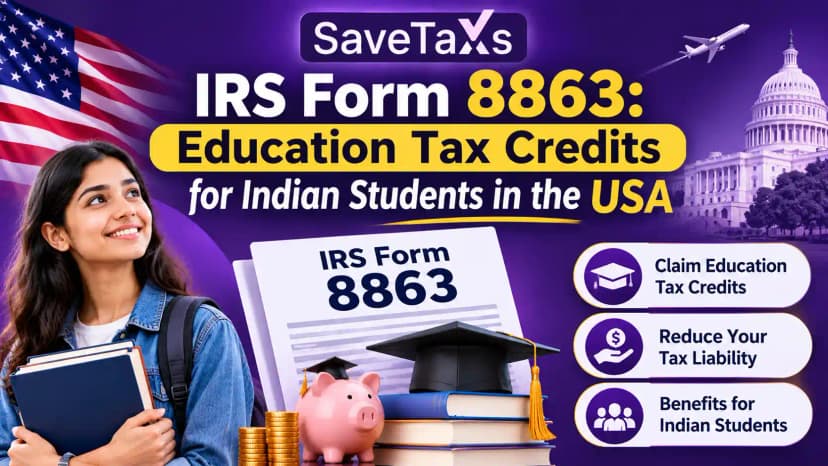
IRS Form 8863: Education Tax Credits for Indian Students
Written by SaveTaxs Editorial Team

If you are an Indian professional, employee, student or researcher receiving compensation in the United States, you may wonder whether US federal income tax must be withheld from your payments. Certain nonresident aliens can claim treaty-based withholding exemptions through IRS Form 8233. However, Indian citizenship or Non-Resident Indian (NRI) status alone does not establish eligibility.
The India–US Double Taxation Avoidance Agreement (DTAA) provides different tax benefits for independent professionals, employees, students, teachers and researchers. This guide explains IRS Form 8233 eligibility, applicable treaty provisions, submission instructions and what to do if US tax is still withheld.
IRS Form 8233, officially titled Exemption From Withholding on Compensation for Independent (and Certain Dependent) Personal Services of a Nonresident Alien Individual, is a withholding certificate used by eligible nonresident aliens to claim tax treaty exemptions on qualifying compensation.
It informs a US employer, university or other withholding agent that certain payments may qualify for reduced or eliminated federal income tax withholding under an applicable treaty.
For example, an Indian research scholar visiting a recognised US university may qualify for an exemption on eligible research compensation under Article 22 of the India–US tax treaty.
Important: Form 8233 is not an annual income tax return. It addresses tax withholding at the payment stage and does not automatically eliminate your final US tax liability.
You can access the official IRS Form 8233 and its instructions.
A nonresident alien individual who is the beneficial owner of qualifying compensation and meets the requirements of an applicable tax treaty may submit Form 8233.
Eligibility generally involves three important considerations:
Treaty residency requirements differ. Employment and independent-service claims generally require residence in the treaty country when claiming the benefit. Student, teacher and researcher provisions generally use residence immediately before or at the time of entry into the United States.
Indian students, employees, consultants and researchers should not assume that an Indian passport or F-1/J-1 visa automatically qualifies them for an exemption.
Noncompensatory scholarships generally follow different withholding rules and normally use Form W-8BEN for treaty claims. Form 8233 may cover both scholarship and personal-service income from the same withholding agent when treaty exemptions are claimed for both.
Source: IRS Instructions for Form 8233.
The India–US DTAA contains separate provisions for professionals, employees, students and visiting academics.
|
Treaty article |
Applicable category |
Main tax provision |
|---|---|---|
|
Article 15 |
Independent personal services |
Fixed-base and 90-day tests |
|
Article 16 |
Employment income |
Three conditions, including the 183-day test |
|
Article 21 |
Students and apprentices |
Education-related exemptions and tax benefits |
|
Article 22 |
Teachers and research scholars |
Qualifying teaching and research exemption for up to two years |
Article 15 generally allows qualifying professional income earned by an Indian treaty resident in the US to be taxed only in India unless:
For example, an Indian consultant working temporarily in the United States without a fixed base may qualify for treaty relief if the 90-day condition is also satisfied.
Article 16 covers employment income, including salaries and wages. An Indian employee working temporarily in the US may qualify for an exemption when all three conditions are met:
All three conditions must be satisfied. Meeting only the 183-day requirement is insufficient.
Article 21 provides specific benefits for eligible Indian students and business apprentices who were residents of India immediately before visiting the United States for education or training.
One important benefit is eligibility for the US standard deduction when filing Form 1040-NR, provided the individual meets the treaty requirements and does not claim itemized deductions.
Qualifying students may also claim an additional withholding allowance for the standard deduction through Form W-4.
This is not a blanket exemption from wage withholding through Form 8233. Student-specific deductions and withholding allowances are separate from treaty-based exemptions on personal-service compensation.
Article 22 provides a tax exemption for qualifying Indian teachers and researchers visiting recognised US educational institutions.
An individual may qualify when they:
The exemption cannot exceed two years from the date of the first qualifying visit. Research must also be undertaken in the public interest rather than primarily for the benefit of a private person or persons.
Qualifying Indian teachers and researchers must attach the applicable India-specific statement from Appendix B of IRS Publication 519 to Form 8233.
Read the official India–US Income Tax Treaty and IRS Publication 519 for the complete conditions.
Completing Form 8233 requires accurate personal, employment and treaty information.
Follow these steps:
You generally need an SSN or ITIN. If you have applied but have not received one, the IRS instructions allow supporting evidence of your SSN or ITIN application, such as a copy of Form SS-5 or Form W-7.
The IRS requires a separate Form 8233 for each tax year, each withholding agent and each type of income.
Download the official Form 8233 and review the latest instructions.
Submit the completed Form 8233 to your US withholding agent, such as your employer, university or research institution. You do not normally send it directly to the IRS.
After receiving the form, the withholding agent:
When accepted, the exemption applies retroactively to the first payment covered by Form 8233, subject to IRS objection and eligibility requirements.
If the IRS rejects the claim or the withholding agent discovers that the eligibility conditions are not satisfied, withholding may be required.
Source: IRS Instructions – Withholding Agent Responsibilities.
These IRS forms serve different purposes, and selecting the correct one depends on the income and tax position.
|
Form |
Primary purpose |
|---|---|
|
Form 8233 |
Claims eligible treaty withholding exemptions on qualifying personal-service compensation. |
|
Form W-8BEN |
Establishes foreign individual status and claims eligible treaty benefits on certain other income. |
|
Form 8833 |
Discloses certain treaty-based positions taken on a US tax return when disclosure is required. |
|
Form 1040-NR |
Reports taxable income and calculates the annual US tax liability of a nonresident alien who must file. |
For additional guidance, explore out guide W-8 Form Guide, IRS Form 8833 guide and IRS Form 1040-NR guide.
Submitting Form 8233 does not guarantee that tax withholding will stop immediately. Your employer may continue withholding if eligibility cannot be established or supporting documents are incomplete.
If you believe you qualified for treaty relief but tax was withheld:
Depending on your circumstances, you may be able to recover overwithheld tax through the annual filing process.
For further guidance, read our guide for IRS Form 1042-S Guide and India–USA DTAA Guide.
IRS Form 8233 provides a way for eligible nonresident aliens to claim treaty-based withholding exemptions on qualifying personal-service compensation.
However, eligibility depends on US tax status, treaty residence, income classification and the applicable India–US treaty article. Completing the form does not automatically make every payment tax-free or remove annual tax-return requirements.
Before submitting Form 8233, verify your treaty eligibility, gather the required documentation and coordinate with your withholding agent. When the treaty interpretation is unclear, consult a qualified US tax professional to avoid incorrect withholding claims.
This article is for general informational purposes only and does not constitute tax, legal, financial, or investment advice. Laws, regulations, rates, and procedures may change over time and may vary based on individual circumstances.
While SaveTaxs makes reasonable efforts to keep the information accurate and up to date, readers should verify applicable rules with official authorities or consult a qualified professional before making decisions based on this information.

Want to read more? Explore Blogs