US Tax Forms
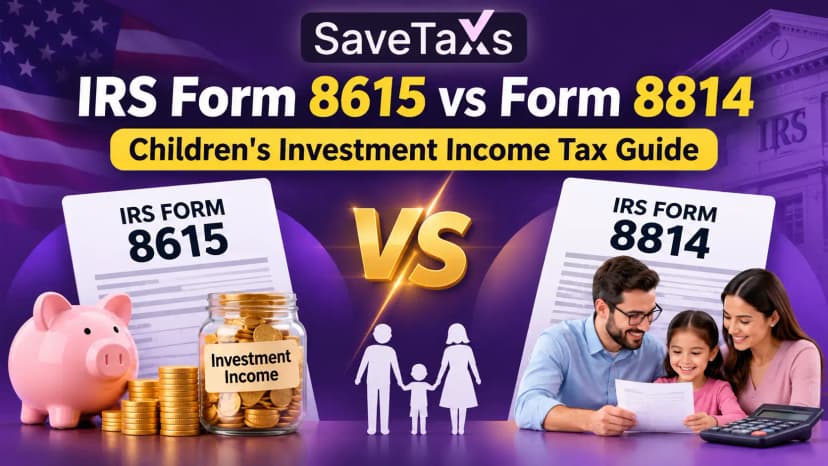
IRS Form 8615 vs Form 8814: How Children's Investment Income Is Taxed
Written by SaveTaxs Editorial Team
Have you received IRS Form 1042-S from a US university, bank, brokerage firm or another organisation? You may be wondering why you received it, whether the income is taxable and whether you need to file a US tax return.
Form 1042-S reports certain US-source income paid to foreign individuals and entities, along with applicable federal tax withholding. It is commonly issued to nonresident aliens receiving taxable scholarships, investment income, royalties and other reportable payments.
Receiving this form does not automatically mean you owe additional tax or must file a tax return. Your obligations depend on your US tax residency, income type, withholding and applicable tax treaty benefits.
This guide explains what Form 1042-S means, who receives it, how to read its important boxes and what steps to take after receiving it.
IRS Form 1042-S, officially titled "Foreign Person's U.S. Source Income Subject to Withholding," is an information return used to report certain US-source payments made to foreign persons and related withholding.
It helps the IRS track income paid to nonresident aliens, foreign corporations and other foreign entities. The form identifies the income type, gross amount paid, applicable withholding rate and federal tax withheld.
For example, a US university may issue Form 1042-S to an international student receiving taxable scholarship income. A US brokerage firm may also issue it to a foreign investor receiving reportable US-source dividends.
Important: Form 1042-S is not a tax bill or a personal income tax return. The withholding agent files the applicable information with the IRS and provides a copy to the recipient.
You can view the official IRS Form 1042-S and its instructions.
Form 1042-S is generally issued to foreign persons receiving income subject to applicable US reporting and withholding requirements.
Common recipients include:
You do not necessarily need to have tax withheld to receive this form. Certain payments may be reported even when an exemption or reduced withholding rate applies.
No. NRI status under Indian tax law and nonresident alien status under US tax law are different classifications.
The IRS determines US tax residency using rules such as the Green Card Test and Substantial Presence Test, along with applicable exceptions.
An Indian citizen living or studying in the United States should determine their US tax residency before deciding how to report income.
Read our guide to US tax rules for nonresident aliens for more information.
Form 1042-S can report different categories of US-source income, depending on applicable IRS reporting requirements.
Some common income codes include:
|
Income code |
Income category |
Example |
|---|---|---|
|
01 |
Interest paid by US obligors |
Certain interest income |
|
06 |
Dividends |
Dividends from US corporations |
|
10 |
Industrial royalties |
Industrial property rights |
|
12 |
Other royalties |
Certain copyright payments |
|
16 |
Scholarship or fellowship grants |
Taxable scholarship payments |
|
17 |
Independent personal services |
Certain professional services |
|
18 |
Dependent personal services |
Certain employment compensation |
|
19 |
Teaching compensation |
Qualifying teaching payments |
|
20 |
Studying and training compensation |
Certain training-related payments |
These are examples, not a complete list. The correct income code depends on the payment and applicable IRS instructions.
Not every payment from a US-based organisation is automatically US-source income. For example, compensation for personal services is generally sourced according to where the services are physically performed.
International students, particularly those in F-1 and J-1 status, may receive Form 1042-S from their university when they receive taxable scholarship or fellowship income.
However, not every scholarship payment is taxable.
Under Section 117 of the Internal Revenue Code, a degree candidate may generally exclude qualified scholarship amounts used for:
Scholarship amounts used for room, board, travel and other personal expenses are generally taxable. Payments representing compensation for teaching, research or other services may also be taxable under different rules.
For example, suppose an eligible degree student receives a scholarship of $35,000:
|
Scholarship expense |
Amount |
General tax treatment |
|---|---|---|
|
Tuition and required fees |
$25,000 |
Generally qualified |
|
Required books and supplies |
$1,000 |
Generally qualified |
|
Room and board |
$9,000 |
Generally taxable |
|
Total scholarship |
$35,000 |
$9,000 potentially taxable |
The university may report the taxable portion on Form 1042-S.
A 14% withholding rate may apply to qualifying taxable scholarship or fellowship grants paid to nonresident aliens temporarily present in the United States under F, J, M or Q status.
For degree candidates, the 14% rate generally applies to the taxable portion of qualifying scholarship grants that are not compensation for services.
For non-degree candidates, additional conditions apply. Generally, the grant must support study, training or research in the United States and come from an eligible organisation or government body.
If these requirements are not met, the general 30% withholding rate may apply, subject to any available treaty benefits.
Payments representing compensation for services are subject to different withholding rules.
For further information, refer to IRS Publication 515 and IRS Publication 519.
Indian students should also review the relevant India-US tax treaty provisions.
Read our guide on F-1 student visa tax filing for Indian students.
International students and foreign workers may receive Form 1042-S, Form W-2 or both, depending on their income and tax circumstances.
|
Feature |
Form 1042-S |
Form W-2 |
|---|---|---|
|
Main purpose |
Reports certain income paid to foreign persons |
Reports employee wages |
|
Common recipients |
Nonresident aliens and foreign entities |
Employees |
|
Typical income |
Taxable scholarships, investment income and qualifying payments |
Salary and wages |
|
Who issues it? |
Withholding agent or payer |
Employer |
|
Tax withholding |
Depends on income and applicable rules |
Generally follows employee withholding rules |
For example, an F-1 student may receive Form W-2 for campus employment and Form 1042-S for taxable scholarship income.
Therefore, receiving one form does not automatically eliminate the possibility of receiving the other.
Form 1042-S contains several boxes that help identify the reported income and related withholding.
|
Box |
Information |
What it means |
|---|---|---|
|
Box 1 |
Income code |
Identifies the income type |
|
Box 2 |
Gross income |
Shows the gross amount reported |
|
Box 3 |
Chapter indicator |
Identifies Chapter 3 or Chapter 4 treatment |
|
Box 3a |
Chapter 3 exemption code |
Identifies the relevant exemption |
|
Box 3b |
Chapter 3 tax rate |
Shows the applicable withholding rate |
|
Box 4a |
Chapter 4 exemption code |
Identifies the relevant exemption |
|
Box 4b |
Chapter 4 tax rate |
Shows the applicable withholding rate |
|
Box 5 |
Withholding allowance |
Shows an eligible treaty-based withholding allowance |
|
Box 6 |
Net income |
Shows income after the applicable allowance |
|
Box 7a |
Federal tax withheld |
Shows tax actually withheld |
|
Box 8 |
Tax withheld by other agents |
Reports withholding by other agents |
|
Box 9 |
Overwithheld tax repaid |
Reports qualifying withholding adjustments |
|
Box 10 |
Total withholding credit |
Combines the applicable withholding amounts |
Important: Box 7a shows the actual federal tax withheld, not the withholding percentage. The applicable rate is shown separately in Box 3b or Box 4b.
Always check the instructions for the specific tax year because reporting requirements can change.
Receiving Form 1042-S does not automatically mean you must file Form 1040-NR. Your filing requirement depends on your US tax residency, income type, withholding and individual circumstances.
A nonresident alien may generally need to file Form 1040-NR if they:
Nonresident alien students and scholars generally must file a US tax return if they have taxable scholarship or fellowship income, income exempt under an applicable tax treaty, or other taxable income.
The IRS does not set a minimum dollar amount of income that automatically removes the filing requirement for nonresident alien students and scholars.
Students who have only certain exempt income may have different filing obligations. Form 8843 may also be required depending on their circumstances, even if they have no taxable income.
If you need to understand your filing obligations, read our guide to IRS Form 1040-NR.
The United States and India have a tax treaty that provides certain benefits to eligible Indian residents who temporarily visit the United States for education or training.
Under Article 21(1), an individual who was a resident of India immediately before visiting the United States primarily for education or training may qualify for an exemption on certain payments arising outside the United States for maintenance, education or training.
Article 21(2) provides additional benefits for eligible students and business apprentices, including access to certain exemptions, reliefs or reductions available to residents of the United States. IRS guidance recognises the standard deduction benefit for qualifying Indian students and apprentices.
However, these benefits are not automatic. Eligibility depends on prior tax residency, the purpose of the visit, income type and applicable treaty conditions.
Being an Indian citizen or NRI does not automatically make every US scholarship or payment tax-exempt.
For further information, consult IRS Publication 901 – US Tax Treaties and the official India-US tax treaty.
You can also read our guide to the India-US Double Taxation Avoidance Agreement (DTAA).
Before making certain payments to foreign persons, a withholding agent may need documentation to establish the recipient's tax status and determine the correct withholding treatment.
Common forms include:
The correct form depends on the payment type, recipient's tax classification and applicable IRS rules.
Explore our guides on IRS Form W-8BEN and the difference between W-8 and W-9.
If you receive Form 1042-S, review it carefully before preparing your tax return or deciding whether to claim a refund.
Follow these steps:
If you notice an incorrect income amount, income code, withholding rate or personal detail, contact the university, bank or other withholding agent that issued the form.
Explain the error and request a review. If a correction is necessary, ask the withholding agent to provide an amended Form 1042-S.
Do not change the reported figures yourself. Use the corrected information when preparing your tax return.
You may receive multiple Forms 1042-S if you have different types of reportable income or payments subject to different withholding rates.
For example, a student may receive one form for scholarship income and another for a separate reportable payment.
Review each form carefully and ensure all relevant income and withholding amounts are considered when preparing your tax return. Avoid counting the same payment or withholding credit twice.
Yes. You may be eligible to claim a refund if the tax withheld is higher than your actual US federal income tax liability.
For example, a withholding agent may have applied the standard rate even though you qualified for a reduced treaty rate. Your final tax liability may also be lower than the amount withheld.
If eligible, you may claim excess withholding by filing Form 1040-NR and reporting the applicable withholding credit.
The withholding credit should generally be reconciled using the relevant Form 1042-S information, including Box 10.
However, refund eligibility depends on your income category, treaty provisions, filing requirements and individual circumstances. A refund is not automatic simply because you received Form 1042-S.
IRS Form 1042-S is an important tax document for foreign individuals and entities receiving certain US-source income. It reports the income paid, applicable withholding treatment and federal tax withheld.
If you are an international student, nonresident alien or Indian recipient, understanding this form can help you identify taxable income, review withholding, understand potential treaty benefits and determine whether you need to file Form 1040-NR.
Receiving Form 1042-S does not automatically mean you owe additional tax or qualify for a refund. Your US tax residency, income type and applicable tax rules determine your actual obligations.
If you are unsure how to report your income, understand treaty benefits or claim eligible withholding credits, consider consulting a qualified US tax professional before filing.
This article is for general informational purposes only and does not constitute tax, legal, financial, or investment advice. Laws, regulations, rates, and procedures may change over time and may vary based on individual circumstances.
While SaveTaxs makes reasonable efforts to keep the information accurate and up to date, readers should verify applicable rules with official authorities or consult a qualified professional before making decisions based on this information.

Want to read more? Explore Blogs