

US Tax Forms
IRS Form 8962 for NRIs: Premium Tax Credit and APTCIRS Form 8962 for NRIs: Premium Tax Credit and APTC
Written by Shubham Jain

To prevent double taxation on the same income in two countries, claiming a tax treaty benefit is a good option. You only have to cite the treaty article, reduce your tax, and it is done. Sounds simple? Well, now let's come to the practical world.
Considering this, to claim the tax treaty benefit in the US, you need to submit documents to the IRS to prove that your claim is legitimate, and that is what Form 8833 does for you.
IRS Form 8833 is a Treaty-Based Return Position Disclosure. The form serves as an official notification to the US tax officials when a taxpayer asserts a position on their income tax return that depends on the provisions of a U.S. income tax treaty to modify or override a provision of local tax law.
Want to know more about IRS Form 8833 and how it helps NRIs and other foreign nationals to avoid double taxation? Read the blog and get all the information.
Form 8833, Treaty-Based Return Position Disclosure under Section 6114 OR 7701(b). It is the IRS disclosure form that you attach when you take a treaty-based tax position that changes how normal US tax rules apply.
Instead of thinking of it as a tax calculation form, consider it more as a document. It does not change how much you owe tax but explains and justifies a position you have already taken elsewhere on your tax return.
This matters because tax treaties, including the India-U.S. Double Taxation Avoidance Agreement (DTAA), often let you pay less than your standard tax obligation through this form.
In simple words, Form 8833 is required when you claim a reportable benefit under an income tax treaty that overrides or modifies the normal tax provisions of the Internal Revenue Code (IRC).
This was all about IRS Form 8833. Moving ahead, let's know who should fill out this form.
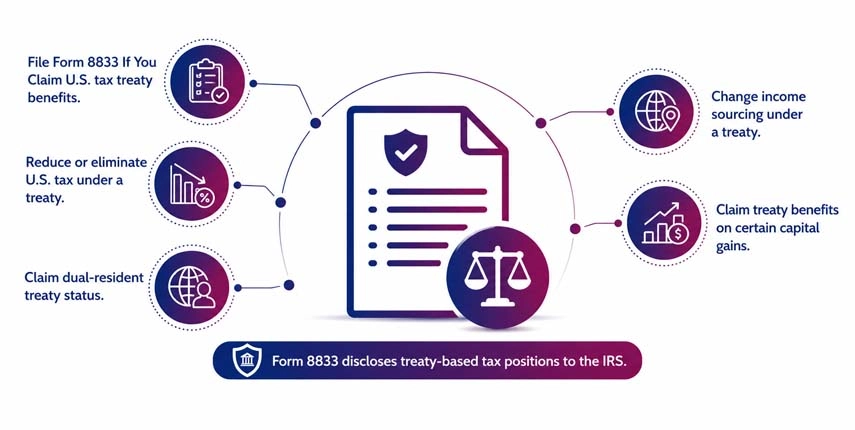
Taxpayers who claim tax treaty benefits or take a treaty-based position that impacts their federal tax obligation need to file IRS Form 8833. It applies to both U.S. residents and non-residents who leverage tax treaties for reduced rates, exemptions, or other benefits. Additionally, dual-resident taxpayers also file Form 8833 annually when relying on a tax treaty provision to prevent double taxation or resolve their tax residency. This is how IRS Form 8833 helps taxpayers:
Here, dual-resident taxpayers have a specific mention. If you meet the U.S. residency test but instead claim tax treaty residence in India, you need to fill out Form 1040-NR with Form 8833. It also affects how much of your global income is taxable in the U.S.
So, here is who should file IRS Form 8833. Moving further, let's know when this form is required.
Connect with Savetaxs; we handle all types of tax cases, including complex international and offshore tax compliance.
You need to fill out Form 8833 if:
This is when you need to fill out Form 8833. Moving forward, let's know how to fill out this form.
Here are the common steps for preparing and filing Form 8833 for NRIs:
If you are disclosing multiple treaty-based positions, follow the current IRS Form 8833 instructions to determine whether they may be reported together or require separate disclosure. Considering this, if you are claiming tax treaty articles under two different income types, you need to fill out two IRS Form 8833. Now, let's know the filing deadline for the form.
The filing deadline of Form 8833 is the same as your income tax return filing deadline in the US, i.e., April 15. Form 8833 is not submitted alone. Considering this, it should be attached to your regular federal income tax return, like Form 1040 or Form 1040-NR.
If you qualify for an automatic extension (common for taxpayers living outside the US), the tax deadline shifts to June 15. However, if you owe any taxes, the interest accrues from the original April date. Further, using Form 4868 if you file for an extension, Form 8833 also follows the extended deadline.
*Practical Tip: Whenever possible, file Form 8833 with your original tax return deadline. Although amending a tax return later to include a missed Form 8833 is doable, it takes longer and attracts more scrutiny from the IRS.
So, this is how you can file Form 8833. Now, moving ahead, let's look at when you do not need to submit this form.
Common exceptions where Form 8833 is not required are as follows:
Confused? Let's better understand this with an example.
For instance, Meera is a non-resident alien in the US who holds a small brokerage account and from it receives a $600 dividend income yearly. Based on her filed W-8BEN under the India-US tax treaty, her broker, while making the payment, withholds only 15% tax. Here, her treaty position is limited to a reduced tax withholding rate, and her broker already handles it; in this scenario, she does not need to file Form 8833 separately.
Now, in the US, Meera also worked as an independent contractor for a U.S. company while she was living in India, and from that she earned $18,000. On this income, she wants to claim a tax exemption in the US under a specific treaty article covering independent personal services. Here, this position overrides standard IRC treatments, including an amount of more than $10,000, and it is not one of the routine excused categories. She needs to file Form 8833 along with Form 1040-NR, mentioning the treaty article and the facts supporting her tax exemption claim.
Here, the difference was not in the treaty. It is whether her tax position conflicts with the standard tax rate or crosses the reporting threshold.
This is when you do not need to file out Form 8833. Moving further, let's know the penalties for not filing out this form.
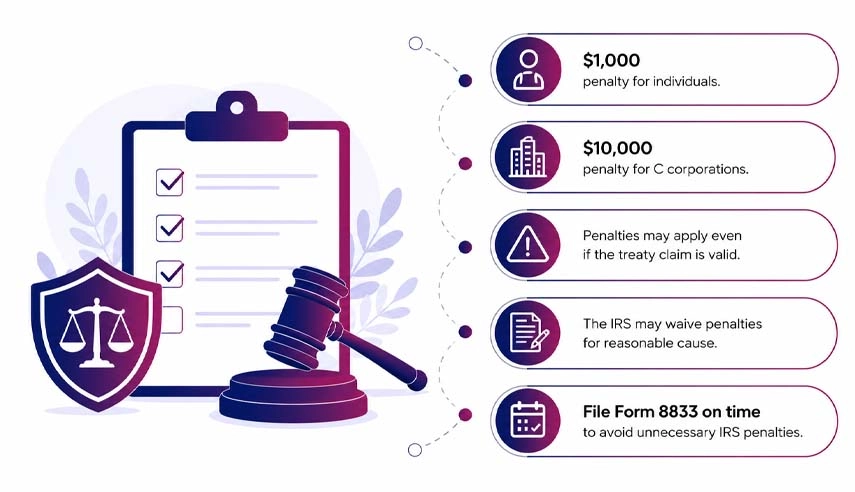
Under IRC Section 6712, is $1000 per failure for individuals and $10,000 for C corporation is the penalty for failing to disclose a treaty-based return position on Form 8833. The tax penalties apply even if:
Further, the IRS may also waive your tax penalty if you provide a reasonable cause for the failure, such as first-time tax filing as an expat, not being aware of the requirement, or reliance on professional tax advice. If you missed filing the IRS Form 8833 last year, promptly correct it and provide a reasonable explanation to avoid an IRS penalty.
We've got your back. Book a call today and get expert guidance.
Lastly, understanding and accurately filing Form 8833 is vital for NRIs to comply with international tax regulations. Proper disclosure of treaty-based return position helps in avoiding penalties and double taxation. For NRIs relying on the India-US tax treaty for reduced withholding, residency tie-breakers, or income exclusions, knowing when this disclosure applies exactly protects both their treaty benefits and compliance records.
Further, need help with US tax issues? Connect with Savetaxs and get personalized guidance as per your tax situation in the US and plan your taxes accordingly.
This article is for general informational purposes only and does not constitute tax, legal, financial, or investment advice. Laws, regulations, rates, and procedures may change over time and may vary based on individual circumstances.
While SaveTaxs makes reasonable efforts to keep the information accurate and up to date, readers should verify applicable rules with official authorities or consult a qualified professional before making decisions based on this information.
Vipul Jain is the Co-Founder of SaveTaxs and a tax expert with experience in Indian and NRI taxation. He advises individuals, NRIs, and businesses on tax filing, tax planning, capital gains, DTAA, and compliance matters. He focuses on making complex tax concepts simple and helping taxpayers make informed, compliant decisions. See Full Bio

Want to read more? Explore Blogs
_1786539671275.webp&w=828&q=75)