US Tax Forms
Form 2350 vs Form 4868 for Taxpayers AbroadForm 2350 vs Form 4868 for Taxpayers Abroad
Written by Shubham Jain
If you are a freelancer in India receiving payments from US clients, earning dividends from US stocks, investing in US stocks from India, or anyone outside the US receiving payments from a US company, you have almost certainly been asked to complete a Form W-8BEN.
A lot of you all would end up filing it quickly without really understanding what you are certifying for, and that is where the mistake happens. In this guide, we will explain what Form W-8BEN is, who needs it, how to fill it out accurately, and what will happen if you get it wrong.
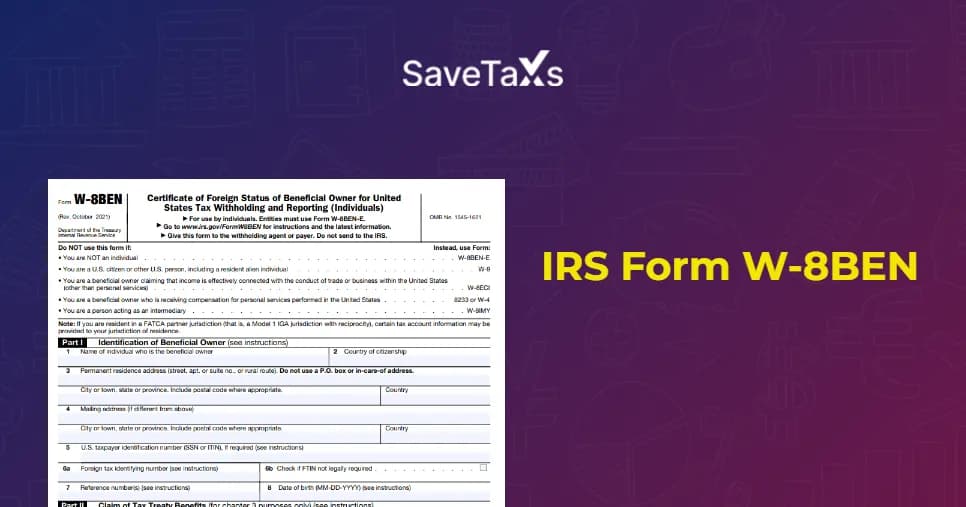
The Form W-8BEN stands for "Certificate of Foreign Status of Beneficial Owner for United States Tax Withholding & Reporting (Individuals)". It is an IRS form that non-US individuals use to submit to their US broker or financial institution to certify their foreign status, claim the reduced withholding tax under the India-USA DTAA tax treaty, and establish their foreign identity so the broker can report the income to the IRS correctly.
In simple terms, this form is your declaration to a US company or financial institution that you are not a US individual for tax purposes. The single form determines whether the US payer withholds 30% of your payment as a default tax, or a lower rate, or nothing at all.
Ensure that Form W-8BEN is for an individual only. If you are a business, company, or LLP receiving the US payments, the correct form for you is W-8BEN-E.
The US tax payments made to foreign individuals differ from the payments made to US persons. Without Form W-8BEN on file, the US company is legally required to withhold 30% for any payment to you and remit it to the IRS, regardless of whether you actually owe US taxes.
By submitting a valid W-8BEN, you will certify your non-U.S. status and, where applicable, be eligible to claim a reduced withholding rate under the India-U.S. tax treaty. This protects you from unnecessary over-withholding of income you have legitimately earned.
Here is a quick and simple answer: W-8BEN is not a tax filing form; it is more of a certification form submitted to the payer, not to the IRS. You have never send it directly to the IRS yourself.
Savetaxs provides end-to-end assistance in filing for Form W-8BEN.
The following individuals shall submit the IRS Form W-8BEN:
As an NRI, if you are investing in US markets through Indian platforms such as Vested, INDmoney, or others, you will be asked to complete the W-8BEN during your account setup. The platform would handle submission to the US custodian on your behalf.
Indian freelancers working with US clients on platforms like Upwork, Fiverr, Toptal, or directly with US companies need to submit a Form W-8BEN to certify that they are not US persons.
Without a valid Form W-8BEN, the platform may apply withholding where required under US tax rules or delay payments until your tax documentation is completed. Most major platforms will require a W-8BEN either during onboarding or when you first withdraw earnings above a threshold.
Important distinction regarding Form W-8BEN for Indian freelancers: The W-8BEN covers passive income and royalty-type payments. For active service income, where you are strictly providing services to a US client under a contract, a W-8BEN will still certify your foreign status, but the withholding implications may differ. Most of the service income paid to freelancers in India is not subject to US withholding if it is accurately documented, but ensure you confirm it with a tax advisor if you are receiving large payments from a single US client.
Indian residents investing in US equities via platforms such as Vested or INDmoney are beneficial owners of those securities. When those stocks pay dividends, the US applies a default 30% withholding.
With a valid Form W-8BEN claiming benefits under the India-US DTAA, the dividend withholding rate is reduced to 25% under Article 10 of the DTAA. This is not a dramatic reduction, but for a dividend portfolio it adds up, and claiming it is simply a matter of submitting the correct form.
The capital gains earned from the sale of US stocks are generally not subject to US withholding for non-US persons; they are treated under US domestic law, which typically exempts Indian residents from US capital gains taxes on securities that are traded publicly.
Most Indian individuals complete Part I, Part II (where treaty benefits are claimed), and must sign Part III (Certification) for the form to be valid.
Part I- Identification Of Beneficial Owner
Part II- Treaty Claim (Optional But Important)
This section is where you can claim a reduced withholding rate under the India-US DTAA.
In the special rates and the conditions box at Line 10, you can write something like "Income consists of [dividends/royalties/interest]. Under Article [10/12/11], paragraph [abc], of the US-India income tax treaty, the withholding rate is reduced to [25%/15%].
You must sign the form, print your name, and date it. The date must be in the format of MM-DD-YYYY. Because the typed name alone is not enough, the form requires a handwritten or electronic signature unless the platform explicitly accepts it electronically.
A Form W-8BEN is not submitted directly to the IRS. It goes to the payer or withholding agent, meaning the US company, platform, or financial institution making payments to you.
The platform will prompt you to complete Form W-8BEN in its tax information sections during onboarding or when you first withdraw. The most popular platforms will accept electronic completion; you will just have to fill in the fields on their website, and from there they will handle the rest.
For investment platforms (Vested, INDmoney, Winvesta): The platform collects your W-8BEN as part of the account setup. It is then submitted to the US custodian (DriveWealth, Alpaca, or a similar provider) on your behalf.
If you are a freelancer working directly for a US company without a platform intermediary, the company's finance or accounts payable team will send you the form or a link to their tax documentation portal. Submit the complete form directly to them by email or through their system.
If you are directly holding the US stocks through a US brokerage, they will then collect a Form W-8BEN as part of your account KYC.
The validity period of Form W-8BEN is typically 3 calendar years from the year it was signed, unless your circumstances change.
For example, if you sign Form W-8BEN on March 15, 2025, it generally remains valid through December 31, 2028, unless there is a change in circumstances.
You must renew Form W-8BEN in the following circumstances.
Most platforms need a reminder when the expiry date of your Form W-8BEN approaches. It is advisable for you not to wait for the reminder; if your circumstances have changed, please update the form immediately.
If your W-8BEN expires and you haven't submitted a new one in a timely manner, the payer is obligated to apply a 30% default withholding until you file a valid form.
Ananya is an NRI living in Dubai who provides freelance UI/UX services to a US-based company, receiving monthly payments from them through the legitimate platform Wise. When she was first onboarded by the client, the client's finance team sent her a W-8BEN form to fill out.
Ananya filed Part I of the form with her foreign tax identifying number, her Indian residential address, and her Indian citizenship. For Part II, she claimed the India-US tax treaty benefit under Article 15 (Independent Persons Services), noting that, as a resident of India providing services from India, she was not subject to US withholding on service income under the tax treaty.
The client's fiancé accepted the form Ananya filed, and he received her full invoice amount without any US withholding. She now sets a calendar reminder for three years to sign the form to renew it before it lapses.
The following are the mistakes you must avoid while filing Form W-8BEN:
Savetaxs CA & CPA experts provide end-to-end NRI tax consultation.
Form W-8BEN is a simple, straightforward document that carries real financial consequences if filled out incorrectly or left incomplete. For Indian freelancers and NRIs receiving US income, it's the single form that determines whether you receive your full payment or incur a 30% withholding tax.
Fill in your name, Indian address, and PAN carefully. Ensure you claim the India-US treaty benefit in Part II if any withholding is applicable to your income types. Sign it properly and set a reminder to renew the form every 3 years.
If your income from US sources is significant, particularly if you have multiple income sources, complex treaty positions, or large dividend portfolios, a brief consultation with a tax advisor familiar with cross-border NRI taxation is worth the investment. Getting W-8BEN right from the start avoids the much more complicated process for recovering overwithheld tax through the US return.
At Savetaxs, we help you determine the appropriate tax documents and ensure that all personal or corporate details, such as legal names, addresses, and foreign tax identification numbers, match the claimant's official documents. Further, our experts also provide tax treaty analysis, guide clients through Part II of the form to verify eligibility for the tax treaty benefit, review the completed form for common errors, and more.
Connect with us as we serve our clients 24/7 across all time zones.
This article is for general informational purposes only and does not constitute tax, legal, financial, or investment advice. Laws, regulations, rates, and procedures may change over time and may vary based on individual circumstances.
While SaveTaxs makes reasonable efforts to keep the information accurate and up to date, readers should verify applicable rules with official authorities or consult a qualified professional before making decisions based on this information.
Shubham Jain is the Founder of SaveTaxs and has extensive experience in Indian and NRI taxation. He advises individuals, NRIs, and businesses on tax filing, tax planning, capital gains, DTAA benefits, fund repatriation, and compliance matters. He regularly writes about taxation and related financial topics. His focus is on making complex tax concepts easy to understand. Through his articles, he helps taxpayers stay informed, avoid common mistakes, and stay compliant with Indian tax laws. See Full Bio

Want to read more? Explore Blogs