US Tax Forms
Form 2350 vs Form 4868 for Taxpayers AbroadForm 2350 vs Form 4868 for Taxpayers Abroad
Written by Shubham Jain
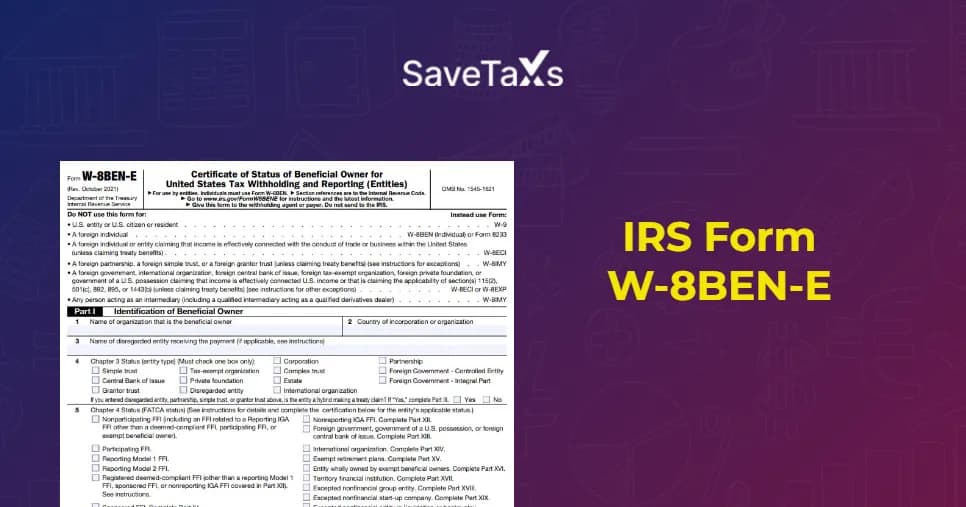
IRS Form W-8BEN-E is used by foreign businesses and NRIs to certify their status as a beneficial owner for US tax purposes. It is called a Certificate of Status of Beneficial Owner for United States Tax Withholding and Reporting (Entities). This form is used by foreign companies that get payment from US companies to claim beneficial tax treaty rates, reductions, or exemptions on income subject to US withholding tax. Considering this, if you are an NRI and your Indian company, business entity, or LLP receives payments from a US platform or client, you need to complete Form W-8BEN-E.
Filling out Form W-8BEN-E correctly is vital for foreign businesses. It helps them avoid unnecessary penalties and taxes. Want to know more about this form? This blog provides an overview of this form, including its purpose and requirements. So read on and gather all the information.
Form W-8BEN-E, Certificate of Status of Beneficial Owner for United States Tax Withholding and Reporting (Entities), is a document issued by the IRS. It serves as proof of a foreign entity as a beneficial owner for US tax purposes. Additionally, the form is used to determine the eligibility of a foreign entity for treaty benefits or exemptions from withholding tax under the Internal Revenue Code (IRC). This form is submitted to the withholding payer or agent, not to the IRS directly.
The Form W-8BEN-E is generally completed by foreign entities, such as partnerships, Indian companies, and other entities that earn income from US sources. The form allows these entities to claim reduced or exempted tax rates according to tax treaties between the USA and their home country. Missing it triggers 30% withholding on gross income.
This was all about IRS Form W-8BEN-E. Moving ahead, let's know who has to fill out this form.
Any non-US, Indian, or foreign company or entity that conducts business with a US-based company or entity should file a Form W-8BEN-E. The form should be filled out by the withholding agent before the first payment is ever collected or received. The form is not sent to the IRS; it is used by the withholding agent for payment and withholding regulations. Further, for Indian businesses and NRI-owned companies, this includes:
Moreover, if you are working as a sole proprietor or individual freelancer instead of Form W-8BEN-E, you need to fill out Form W-8BEN. Now, moving further, let's know when you need to fill out Form W-8BEN-E in the US.
With Savetaxs, accurately file your US taxes, maximize your tax benefits, and stay compliant with the IRS.
Non-resident aliens are liable to pay US tax at a 30% rate on income generated from US sources. Considering this, Form W-8BEN-E is used to claim treaty benefits or exemptions on the following income:
This is when, being a non-resident alien, you need to fill out Form W-8BEN-E to avoid paying 30% withholding taxes. Now, moving forward, let's know when this form is used.
IRS Form W-8BEN-E is used for three specific purposes. These are as follows:
This is when Form W-8BEN-E is necessary. Moving ahead, let's know how to fill out this form.
Form W-8BEN-E contains several parts, each requiring different information from the foreign entity. To provide you with an idea, here is a breakdown of each part.
This section of the form requires the foreign entity to provide general information about itself. This includes:
Part II of the IRS Form W-8BEN-E is only for disregarded entities and branches receiving payments. You only need to fill out this section if the reporting entity is a disregarded entity or branch of an FFI getting withholdable payments.
Fill out Part III if your resident country has a DTAA with the US government. It helps you claim tax treaty benefits such as royalties, dividends, or interest from US sources.
If you have chosen Active NFFE in Part I Line 5, check the box stating your entity is an Active NFFE. It means it is a foreign entity with less than 50% passive income and passive assets.
The form should be signed by an authorized representative of the foreign entity, i.e., a director, partner, or authorized signatory. The signer states that the information mentioned in the form is accurate under penalty of perjury.
An undated or unsigned Form W-8BEN-E is invalid. Considering this, most US payers will reject it and revert to a 30% withholding tax until they receive a complete signed form.
Additionally, if your Indian company is simply offering services such as software development, consulting, and the income is from active business services, in the first place, withholding does not apply.
This is how you can fill out Form W-8BEN-E. Now, let's better understand the importance of this form through an example.
Considering this, the CA of the company filled out the form. The CA mentioned the company as an Indian corporation classified as an Active Non-Financial Foreign Entity (NFFE) in the form. Since the earnings here were from active sources, under US laws, no withholding tax was applied. Additionally, the managing director signed the form and returned it to the US client.
The US client accepted the form, payments started, and the Indian company received its complete invoiced amounts. After a few months, the Indian company licensed some of its proprietary software to its second US client.
Since the payments were treated as royalty income, the CA of the company evaluated the applicable provision of Article 12 of the India-US DTAA and claimed the tax benefits. It further reduced the 30% withholding tax rate applied in the US.
So, here is how this form helps foreign companies reduce their withholding tax rates in the US under the tax treaty. Now, moving further, let's know the difference between Form W-8BEN and Form W-8BEN-E.
The table below showcases the difference between Form W-8BEN and Form W-8BEN-E:
| Basis | Form W-8BEN | Form W-8BEN-E |
|---|---|---|
| Who files it | Foreign individuals | Foreign entities such as companies, LLPs, trusts |
| Form length | 5 pages | 29 pages |
| FATCA classification required | No | Yes |
| Common for | Foreign/ NRI investors, freelancers | Indian/foreign companies, businesses, LLPs |
| Entity type field | Not applicable | Required: corporation, trust, partnership, etc. |
| GIIN field | Not applicable | Required for a financial institution |
| Most common FACTA Status | Not applicable | Active NFFE for Indian conducting businesses |
In simple terms, you need to fill out Form W-8BEN if you run a business as a sole proprietor or freelancer and fill out Form W-8BEN-E if you are receiving payment as a registered entity such as an LLP, partnership, or company. Moreover, filling out the wrong W-8 form results in payment delays and resubmissions.
Now, moving forward, let's know how long Form W-8BEN-E is valid for.
IRS Form W-8BEN-E from the year it was signed generally remains valid for three calendar years. For instance, if you sign the form in 2026, then your form is valid through December 31, 2029. Considering this, you need to fill out the form after three years, i.e., 2030. However, if there are any changes to the information about the foreign entity during that time, the submitted form becomes invalid. Considering this, in the following circumstances, you need to submit a new Form W-8BEN-E before receiving further payments:
Furthermore, submitting a new form also resets the expiration date. So this was all about the validity of the IRS Form W-8BEN-E. Moving ahead, let's know what happens if you do not submit Form W-8BEN-E.
If you do not provide a valid Form W-8BEN-E, the payer may generally apply the default 30% withholding under the applicable U.S. withholding tax rules (such as IRC Sections 1441 and 1442), unless another rule applies. Additionally, you may also not be able to claim applicable DTAA benefits. In some cases, invalid or missing documentation can also trigger additional withholding requirements and compliance risk for you.
This is what happens when you do not submit Form W-8BEN-E. Moving further, let's know the common mistakes to avoid while filling out this form.
At Savetaxs, get professional and tailored assistance from US tax experts and fill out Form W-8BEN-E without any issues.
Here are some of the common mistakes you should avoid while filling out Form W-8BEN-E:
So avoid the above-mentioned mistakes and enjoy tax treaty benefits through Form W-8BEN-E.
Lastly, Form W-8BEN-E is an essential document for foreign and Indian entities generating income from US sources. By understanding and properly filling out this form, entities can take the benefit of reduced tax rates and stay compliant with US tax laws. Additionally, it is vital to stay informed of any changes in US tax laws and regulations that may impact the status or eligibility of the entity for treaty benefits or exemptions.
Furthermore, if you are looking for professional advice when dealing with US taxes, connect with Savetaxs. We have a team of CPAs who help you manage and organize Form W-8BEN-E from your recipients, offering a streamlined process to claim treaty benefits or tax exemptions on payments made by you to them.
This article is for general informational purposes only and does not constitute tax, legal, financial, or investment advice. Laws, regulations, rates, and procedures may change over time and may vary based on individual circumstances.
While SaveTaxs makes reasonable efforts to keep the information accurate and up to date, readers should verify applicable rules with official authorities or consult a qualified professional before making decisions based on this information.
Vipul Jain is the Co-Founder of SaveTaxs and a tax expert with experience in Indian and NRI taxation. He advises individuals, NRIs, and businesses on tax filing, tax planning, capital gains, DTAA, and compliance matters. He focuses on making complex tax concepts simple and helping taxpayers make informed, compliant decisions. See Full Bio
Want to read more? Explore Blogs