


US Tax Forms
Form 2350 vs Form 4868 for Taxpayers AbroadForm 2350 vs Form 4868 for Taxpayers Abroad
Written by Shubham Jain

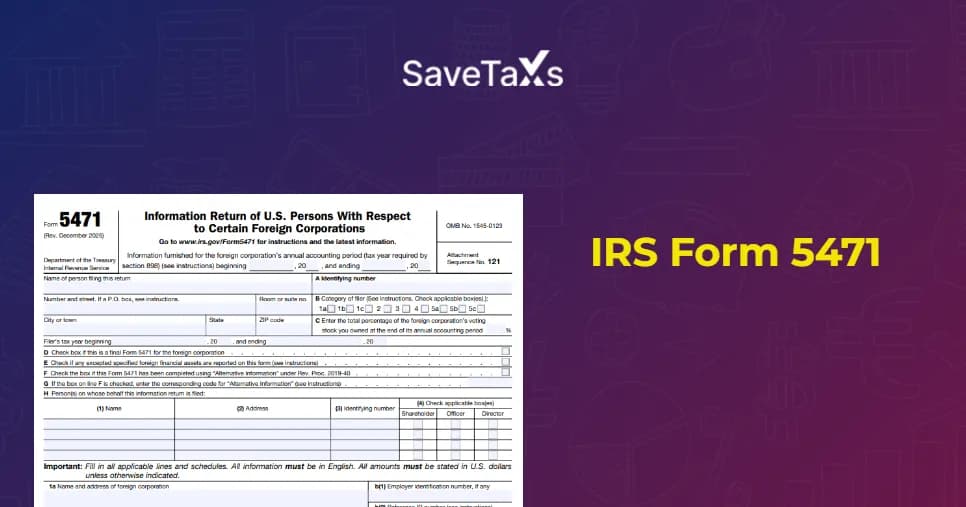
If you are a US citizen, green card holder, resident, or an NRI who owns or has control over an Indian or any other foreign business, you need to fill out Form 5471 with your annual tax return. The IRS Form 5471 requirements are not optional in the US it is essential. Non-compliance with it leads to high penalties.
Confused and want to know more about this form? This blog walks you through the purpose of this form, who needs to file it, its different filing categories, and requirements. So read on and stay compliant with US international tax obligations.
Form 5471 is officially known as "Information Return of US Persons With Respect to Certain Foreign Corporations." It is an IRS form that US taxpayers need to file if they have significant control or ownership over an Indian or foreign business. This form works as a vital tool for the IRS to see the offshore business activities. Additionally, the form also ensures compliance with the tax laws of the US, as mentioned in specific sections of the Internal Revenue Code, including sections 6038, 6046, and 958.
So, being a US-based NRI, if you are also a shareholder, officer, or director in an Indian company and meet the ownership requirements, then you need to file Form 5471. Also, in the form, provide them with the information about your structure, income, and financial activities of your Indian company.
The IRS released a December 2024 revision of Form 5471 with new updates that apply to your 2025 tax year (filed in 2026). These are as follows:
The IRS Form 5471 filing requirements for foreign corporations are as follows:
This was all about IRS Form 5471. Moving ahead, let's know who needs to fill out this form.
With Savetaxs, get expert guidance and file your US taxes with confidence and on time.
Being an NRI in the US, you need to fill out Form 5471 if you are a US taxpayer who falls into the following categories mentioned below. Each of them targets different aspects of the involvement of a US person in Indian or foreign corporations.
Each of the above-mentioned categories has different Form 5471 filing requirements regarding what needs to be mentioned, ranging from changes in ownership to financial transactions and income details within the foreign corporation. Apart from this, if your business is wrongly classified as a PFIC (Passive Foreign Investment Company), filing Form 5471 ensures your company is classified correctly.
Additionally, you may need to file under multiple categories. For instance, if you come under category 5 filer (10%+ shareholder of a CFC) and during the years, you also have additional stock, you also come under category 3.
|
*Note: A Controlled Foreign Corporation (CFC) is a foreign corporation where a US shareholder acquires more than 50% stock ownership. In simple terms, it means that if the majority of the voting powers or stock value of the corporation is in the hands of US shareholders, under tax laws, it qualifies as a CFC. It is vital for determining the CFC status as it impacts the tax and reporting obligations of the involved US individual. |
Now, moving further, let's know the Form 5471 filing requirements.
The IRS Form 5471 filing requirements, as mentioned earlier, require detailed information about the foreign corporation and your involvement in it. Considering this:
| Schedules | What It Covers |
|---|---|
| Schedule A | Stock ownership details and the share percentage you hold |
| Schedule B | Information on all US shareholders |
| Schedule C | Income statement of the foreign corporation |
| Schedule E | Taxes paid or accrued by the foreign corporation |
| Schedule F | Balance sheet: liabilities, assets, shareholder equity |
| Schedule G | Transactions between US shareholders and the corporation |
| Schedule H | Current profits and earnings |
| Schedule H-1 (New 2024) | CFC's adjusted net income for CAMT purposes |
| Schedule I | Summary of income of each US shareholder from the CFC |
| Schedule J | Accumulated earnings and profits of a CFC |
| Schedule M | Transactions between a CFC and related persons |
| Schedule O | Organisation or reorganisation of the foreign corporation |
| Schedule P | Previously taxed profits and earnings |
| Schedule Q | CFC income by country- for GILTI and Subpart F calculations |
| Schedule R | Distributions from a CFC |
Further, for NRIs with shareholding in Indian companies, Schedules C, E, F, and I are generally required. In case your Indian company has generated Subpart F income or GILTI, Schedule Q becomes important.
This was all about Form 5471 filing requirements. Moving forward, let's know the due date to fill out this form.
The standard deadlines for filing out Form 5471 are as follows:
Additionally, if you need extra time, you can request an extension. Considering this:
Further, US expats living overseas get a two-month extension automatically until June 15, without a submission request. Now, moving ahead, let's know how to file Form 5471.
Filing Form 5471 includes several important steps. Here is how you can complete and submit your form:
Determine, based on your situation, which filer category applies to you. Your filing category states which schedule you need to complete. Some tax filers fall into multiple categories and need to fill out all the applicable schedules.
Gather the financial records of the foreign corporation, including income statements, balance sheets, and ownership details. You also need to submit the transaction records between you and the foreign corporation, plus details about other shareholders and the profits and earnings of the corporation.
Fill out the requested information in the form. It includes the basic details about the foreign corporation, such as its name, country of incorporation, address, and your connection to it. Additionally, in the form, also mention information on stock ownership and note any ownership changes during the tax year.
According to your filer category, fill out the involved schedules. As per your situation, it might include schedules such as Schedule A, Schedule B, Schedule C, and others. For 2025, if your CFC is subject to corporate alternative minimum tax, fill out the new Schedule H-1 and lines 20a and 20b for any Top-up Tax.
Form 5471 should be submitted with your tax return, i.e., Form 1040 for individuals or Form 1120 for corporations. Fill out the form on its due date or by extending the deadline (if applicable). Additionally, keep copies of the completed form and all supporting papers for at least six years in case the IRS asks for an audit.
This is how you can fill out the Form 5471. Confused? Let's better understand this with an example.
For instance, Rahul, an Indian origin software developer living on a green card in San Jose. In 2018, before moving to the US, in Bengaluru, he co-founded a software service company, and there he holds 60% of the shares.
In 2024, Rahul took the help of a CPA to review his tax situation. There, he determined he needed to fill out Form 5471 in Category 4 as he holds more than 50% of the company shares in India. Apart from this, since he is the only US person with 10% or more ownership, his company qualified as a Controlled Foreign Corporation (CFC), and as a specified US shareholder, he was also required to file under Category 5.
In the past six years, he has never filed Form 5471. To correct this thing, his CPA used the IRS Streamlined Filing Compliance Procedures for missed Form 5471s with a reasonable explanation for why he hadn't filed before. In each form, the CPA includes complete schedules, financial statements, and calculations of any paid taxes in India. This correction process takes several months.
Moving forward, now Rahul annually files Form 5471 along with his Form 1040. Additionally, under the India-US Tax Treaty, he claims a foreign tax credit for the taxes he paid in India. Apart from this, he keeps an eye on the income of the company for Subpart F and GILTI implications every year.
Moving further, let's know the difference between Form 5471 and 5472.
Both forms, i.e., Form 5471 and Form 5472, are used to report foreign transactions; however used for different purposes and apply to different US taxpayers. Confused? The table below showcases the difference between the two forms.
| Feature | Form 5471 | Form 5472 |
|---|---|---|
| Who Files | US taxpayers with an interest in foreign corporations | Foreign-owned US corporations or foreign corporations in the US business |
| Purpose | This form reports ownership and transactions of US persons in a foreign company | This form reports transactions between foreign owners and their US entity |
| Ownership Threshold | 10% ownership of a foreign corporation | 25% foreign ownership of a US corporation |
| NRI Scenario | NRIs in the US who own Indian company shares | A foreign investor who owns 25%+ of a US corporation or LLC |
| Filed With | Form 1040 or Form 1120 | Form 1120 or Form 1120-F |
| Penalty for Not Filing Form | $10,000 per form, up to $50,000 | $25,000 per failure |
This was all about the difference between the two forms. Moving forward, let's know the penalties for not filing Form 5471.
Non-compliance with Form 5471 led to substantial IRS penalties. To provide you with an idea, here is a breakdown of the penalties:
Additionally, you may also face criminal penalties for non-compliance with Form 5471 filing requirements. Moreover, in some cases, taxpayers may reduce or avoid these penalties by stating "reasonable cause," such as unexpected situations that are beyond their control, that prevented filing the form on time. However, for reasonable cause, you need proof that complies with IRS requirements.
Now, moving ahead, let's know the exceptions for filing Form 5471.
Own a foreign business and ned help in filing Form 5471? We have got you covered.
The exceptions to filing Form 5471 include:
These are some of the scenarios where you are exempt from filing Form 5471 in the US.
Lastly, Form 5471 filing requirements are among the most important and commonly overlooked US international tax compliance requirements for taxpayers with interests in foreign corporations. Considering this, if you are an NRI living in the US and own at least 10% of an Indian corporation, are a director or officer, or are involved in certain transactions with an Indian entity, you need to fill out this form.
Further, preparing Form 5471 can be difficult, specifically when you have several foreign interests. If you are facing issues with income reporting, detailed ownership structures, and need help navigating Form 5471, connect with Savetaxs. We have a team of financial experts who assist you in resolving all your issues and filing the form on time.
This article is for general informational purposes only and does not constitute tax, legal, financial, or investment advice. Laws, regulations, rates, and procedures may change over time and may vary based on individual circumstances.
While SaveTaxs makes reasonable efforts to keep the information accurate and up to date, readers should verify applicable rules with official authorities or consult a qualified professional before making decisions based on this information.
Shubham Jain is the Founder of SaveTaxs and has extensive experience in Indian and NRI taxation. He advises individuals, NRIs, and businesses on tax filing, tax planning, capital gains, DTAA benefits, fund repatriation, and compliance matters. He regularly writes about taxation and related financial topics. His focus is on making complex tax concepts easy to understand. Through his articles, he helps taxpayers stay informed, avoid common mistakes, and stay compliant with Indian tax laws. See Full Bio
Want to read more? Explore Blogs



The five categories of Form 5471 filers are as follows:
A Controlled Foreign Corporation (CFC) is any foreign corporation where US shareholders hold more than 50% of the total value or voting power. Additionally, you are considered a US shareholder if you own 10% or more interest. When your foreign company qualifies as a CFC, it alters your Form 5471 filing requirements;