


US Tax Forms
IRS Form 8962 for NRIs: Premium Tax Credit and APTCIRS Form 8962 for NRIs: Premium Tax Credit and APTC
Written by Shubham Jain
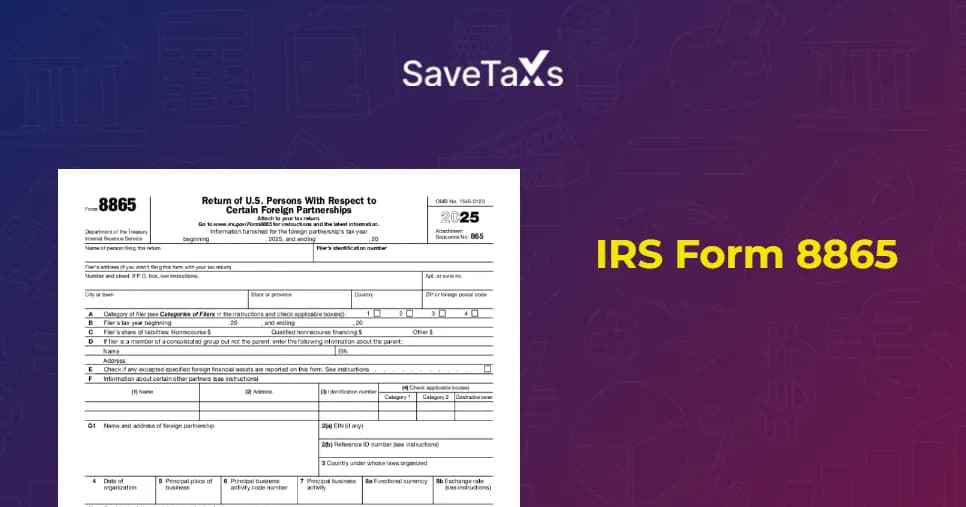
As a US taxpayer with ownership in a foreign partnership, you will often face complex reporting requirements under US tax law. Hence, one of the most important documents for you is Form 8865, formally titled "Return of US Persons With Respect to Certain Foreign Partnerships".
In this blog, we will discuss in detail what the form is, who is required to file Form 8865, how the form's four categories work, and what Form 8865 penalties apply for noncompliance.
The Form 8865 is an IRS form used by U.S. persons to report their interests in certain foreign partnerships. The form ensures that the income, losses, and other transactions of foreign entities are properly disclosed to the IRS.
In simpler terms, Form 8865 reports your interests in a foreign partnership to the IRS. It is applicable if you are a US citizen or a green card holder with significant ownership, control, or recent transactions involving a partnership based outside the United States.
It works somewhat like Form 1065 (the US domestic partnership return), except that it is filed by the individual US partner rather than the firm itself, and the form is attached to your personal tax return.
A detail that might surprise you is that this form doesn't indicate whether you owe the extra tax. It is more about disclosure requirements. You can file it correctly and still owe nothing. But if you plan to skip, the penalties will apply regardless of the point you skip.
You might need to file the Form 8865 if you are a U.S. person, a citizen, a green card holder, or someone who meets the substantial presence test with an ownership interest, financial involvement, or recent transaction in a partnership formed outside the United States.
The "US Person" is a key phrase here. Quite a lot of NRIs living in India hold an green card from years they have spent working in the US, or they are dual citizens. If either of these applies to you and you are seeking any of the Indian partnership firms, this form is relevant for you regardless of where you currently reside.
That aside, persons required to file Form 8865 include:
If you fail to meet the filing obligations as an eligible candidate, you may face steep penalties, so identifying when you are required to file the form is important.
From federal tax returns to international reporting, Savetaxs ensures accurate and compliant US tax filing.
There are four categories of filers under Form 8865, depending on the level of involvement or control in the partnership. Every category has its own unique reporting requirements.
Category 1 applies to a U.S. person who immediately controls their foreign partnership during the tax year. The control means owning more than 50% of the partnership interests, directly or through constructive ownership. This is known as a controlled foreign partnership, and the file shall provide complete financial reporting, including balance sheets and income statements.
The second category applies when a U.S. person owns at least a 10% interest in the partnership and another U.S. person controls it. This ensures that the IRS has visibility into situations in which no single taxpayer controls the partnership, but several taxpayers collectively have a greater interest in it.
The category applies when a US person contributes property to a foreign partnership in exchange for an interest in the partnership. If the value of the contributed property exceeds the $100,000 threshold during the tax year, the filer must disclose it. The gain-deferred method and related deferred-method rules are applicable. This overall prevents taxpayers from shifting appreciated assets abroad without disclosure.
Category 4 applies when a reportable event occurs, such as an acquisition, a disposition, or a change in proportional interests. For example, if a person in the US sells a portion of their interest in the partnership, or if the partnership's assets are significantly restructured, they must file Form 8865. This captures acquisitions, dispositions, and changes in ownership that may otherwise escape the IRS's attention.
The following is a table to demonstrate better:
| Category | Who Must File | Ownership/Event Threshold | Reporting Requirements | Example |
|---|---|---|---|---|
| Category 1: Controlled Foreign Partnerships | US persons who control a foreign partnership immediately during the tax year. | More than 50% of the partnership ownership interest (directly, indirectly, or via constructive ownership). | Complete disclosure of the financials, including balance sheets, income statement, and detailed schedules. | A U.S person owns 60% of a foreign partnership. |
| Category 2: 10% or Greater Interest | US persons who own at least 10% of a foreign partnership that is controlled or overseen by another US person. | 10% or greater ownership but not controlling. | Must file or disclose the ownership details and the persons involved. | A U.S. taxpayer owns 15%, while another US person controls 55%. |
| Category 3: Contributions Of Property (Gain Deferral Method) | A U.S. person who contributes the property to a foreign partnership. | Contributions of property exceeding the $100,000 tax threshold, or contributions of property with built-in gains using the gains deferral method. | You must report the fair market value of property contributed and then disclose the gain. | A US expat contributes property valued at $200,000. |
| Category 4 | US person with regard to certain foreign property who experiences changes in ownership. | Any acquisitions, dispositions, or changes in the proportional interest. | Must report reportable events, such as sales restrictions or significant changes in ownership. | A US investor sells 15% of their partnership interest. |
Please note that the percentages mentioned here aren't always just your direct holding. With respect to the constructive ownership rules, interests held by your spouse or certain related entities can be added to yours, which can push you into filing the category you did not expect.
For most NRIs with a family business or professional partnerships in India, you will fall into Category 1 or Category 2; these cover ongoing ownership and control and are not just one-time events.
A few real-world triggers:
You have inherited or were gifted a majority stake in your family's partnership in India.
You and your US-person sibling's collection own more than half of the portion of a firm that your parents started
You have contributed to the capital, property, or equipment worth over $100,000 to the firm during the year.
You sold part of your stake or brought in a new partner, diluting your stake by 10% or more.
If any of the aforementioned applies to your situation, you are likely to have a Form 8865 obligation for that tax year, a separate form, and an additional Indian tax filing for the same firm.
Category 1 and 2 filers often face a heavy reporting load. The following are pointers on what a domestic US partnership return would ask you for.
Category 3 filers also complete Schedule O (property transfers), and Category 4 filers complete Schedule P (changes in ownership interest).
The principal friction point is that Indian partnership firms generally keep books under Indian accounting standards, which are maintained in rupees for the financial year running from April to March. Converting that into US GAAP-style reporting, in US dollars on a calendar-year basis, is the most time-consuming part of the entire filing process. It is highly advisable to seek help from a professional CA and CPA expert who is well-versed in NRI and cross-border taxation, because even the slightest error here could lead to problems later.
The following is the Form 8865 reporting process.
You will need a separate Form 8865 for each foreign partnership in which you have an interest; a single form cannot cover multiple partnerships.
Form 8865 follows the same due-date pattern as your personal US tax return.
Assume that Sri is a green card holder who has moved back to Bengaluru in 2019 to help run his family textile trading partnership. His father transferred at least 55% ownership to him in 2024, making him the majority partner in the firm.
Because he is a US person (a green card holder) with more than 50% control of a foreign partnership, Sri is a Category 1 filer. He needs to file Form 8865 with his US return every year he holds the stake, reporting the firm's full and complete balance sheet, income statements, and his own share of profits, all converted into USD, regardless of whether the partner owes any additional U.S. tax once foreign tax credits apply.
If his brother, who is also a US citizen, separately owns 20% of the same firm, he will typically qualify as a Category 2 filer in the year there's no Category 1 filer. But since Sri already controls more than 50%, he will file a simpler statement instead of a full firm return; Sri's filing.
As an NRI, you must know that there are penalties for not filing the form that can catch you off guard, because these penalties are applicable whether or not any US tax was actually due.
Categories 1, 2, and 4: $10,000 penalty per foreign partnership per year for late or missing filing. If you do not correct anything within the first 90 days of an IRS notice, an additional $10,000 applies for every 30 days you remain non-compliant, up to $50,000 more, for a total of $60,000 per partnership per year.
Category 3: 10% of the fair market value of the property your contract covers, capped at $100,000 unless the failure looks intentional, in which case there is no cap.
Foreign tax credit reduction: If you are claiming the credit for Indian taxes paid by the firm, a late or missing Form 8865 can shrink the credit.
No statute of limitations protection: Under the IRS section 6501(c)(8), the IRS's window to assess tax on the related items does not start running until you actually file the form. If you never file, that exposure has no expiration date.
The following are the common Form 8865 filing mistakes:
Assuming Indian tax compliance covers it, Form 8865 is a completely separate US tax obligation unrelated to anything filed with the Indian tax authorities.
Stop stressing over the complex tax code; our certified CPAs provide hyper-personalized, year-round tax planning and financial advisory services to NRIs in the USA.
If you are a US person with a stake in an Indian partnership firm, for you, Form 8865 is not optional paperwork; it is a recurring, category-specific disclosure subject to some of the steepest information-return penalties in the US tax system. The ownership thresholds, constructive ownership rules, and schedule requirements are technical enough that DIY filing carries real risk, especially once family ownership changes or new partners come in.
It is advisable to work with a CPA experienced in both US international tax rules and NRI cross-border situations to file your Form 8865 accurately. Savetaxs CPA helps you determine the specific category of the filer, provides assistance in preparing the form, data gathering, and analysis, Schedule K-2/K-3 compliance, and coordination, filing, and deadline management.
Connect with us as we serve our clients 24/7 across all time zones.
This article is for general informational purposes only and does not constitute tax, legal, financial, or investment advice. Laws, regulations, rates, and procedures may change over time and may vary based on individual circumstances.
While SaveTaxs makes reasonable efforts to keep the information accurate and up to date, readers should verify applicable rules with official authorities or consult a qualified professional before making decisions based on this information.
Vipul Jain is the Co-Founder of SaveTaxs and a tax expert with experience in Indian and NRI taxation. He advises individuals, NRIs, and businesses on tax filing, tax planning, capital gains, DTAA, and compliance matters. He focuses on making complex tax concepts simple and helping taxpayers make informed, compliant decisions. See Full Bio

Want to read more? Explore Blogs
_1786539671275.webp&w=828&q=75)