-for-401(k)_1790057066765.webp&w=828&q=75)
US Tax Filing and Compliance
Net Unrealized Appreciation (NUA) for 401(k): A Guide for NRIs Moving to IndiaNet Unrealized Appreciation (NUA) for 401(k): A Guide for NRIs Moving to India
Written by Vipul Jain

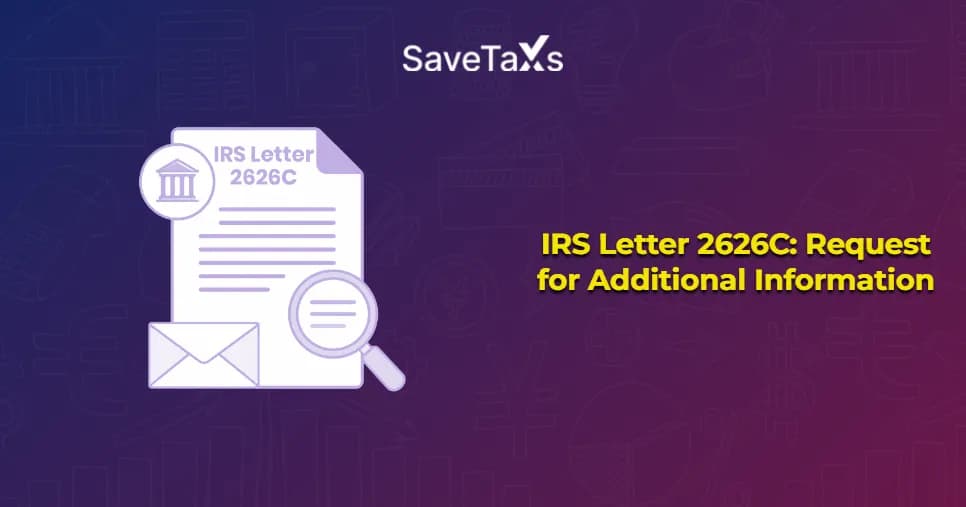
Let us assume you were served with an IRS notice, reviewed the notice, addressed the issue, mailed in all the requested documents that support your case, and thought you had done all that was asked, so your case would be marked closed with the IRS authorities. But then one fine random day, IRS Letter 2626C shows up and request for additional information. Letter 2626C is issued by the Automated Underreporter Units of the IRS, and the purpose of the letter is to inform you that further explanation or a request for additional information is required to finalize the examination process of your underreported income case.
Specifically for NRIs' US tax filing obligations, this letter is sent to ask for information or explanations related to residency status, DTAA treaty claims, or mismatched income. However, there's nothing to be scared of with this letter, as once you understand what the IRS is asking you for, everything becomes easy to explain and provide.
In this blog, we will understand how you can read the received IRS Letter 2626C, respond to it, and beyond.
The simple answer is that IRS Letter 2626C is a follow-up letter requesting that you provide the IRS with additional documentation or information on your ongoing underreported income case. Since it is a follow-up letter, it is generally sent after you have already responded to an earlier IRS notice or questioned IRS authorities about your IRS tax accounts. Your IRS tax account is your record with the IRS that shows every payment, balance, and filing.
Think of this letter as the IRS saying, "Hey, we have reviewed what you have sent with the earlier notice, and one specific thing is unclear or missing; we need one more piece of information before we can close the case." So don't panic; this letter is neither a tax bill nor an audit letter.
For NRIs and other U.S. taxpayers, there are certain circumstances that alert the IRS to roll out IRS Letter 2626C:
As mentioned above, for NRIs specifically, IRS Letter 2626C is triggered by tax treaty claims, income mismatches, or required questions and explanations related to your residential status for the years you changed your visa or moved between countries.
Savetaxs helps you file your US tax return accurately and with confidence.
The kind of explanation or the information the IRS will request varies based on the individual's case. However, the following are some of the common requests for additional information.
Revised or additional third-party IRS forms such as Form 1099, Form W-2, and Form 1042-S.
With respect to a treaty claim, the IRS may ask for supporting tax documents to substantiate your treaty position.
Note: Form 8833 (Treaty-Based Return Position Disclosure) is only required for specific treaty positions under Section 6114, such as: claiming a reduction in gain/loss from U.S. real property based on a treaty, changing the source of income based on a treaty, or claiming foreign tax credits not allowed by the Internal Revenue Code. Most common treaty claims (like reduced withholding on interest or dividends) do not require Form 8833, but you should still maintain documentation supporting your treaty eligibility (e.g., Tax Residency Certificate, visa status, days of presence in U.S.).
The IRS may ask for clarification on your residency status, specifically in years when you moved between different countries or obtained visas.
Brokerage statements or bank account statements confirming the amounts that did not match your IRS records.
In a few cases, you might also have to provide the IRS with a consent form . However, this generally happens in cases where the letter asks you to agree to proposed changes to your return.
The following is a step-by-step process to accurately respond to Letter 2626C.
To start, gather all supporting documents and organize them in the order the authorities would like to review them. Ensure that documents precisely fulfill the need of what the IRS is asking; nothing should be left unclear because such vague responses will lead to dragging the case longer than it needs to be. Now, if your specific situation has a treaty claim or a residential status question in place, then with the help of a tax consultant, it is better to provide the IRS with a clear written explanation along with the documents.
The IRS response deadline for the letter is printed on the letter itself, and the days for the deadline are documented from the date when the notice was issued. For NRIs who are currently not in the USA, this deadline should be taken care of, especially because of the international mail timeline.
Here's a tip: If you need more time than the deadline provided to arrange the requested documents or information, call the number printed on the letter before the deadline passes. If you call after the deadline has passed, no changes can be made. Oftentimes the IRS grants an extension. Now, if the authorizer provides you with an extension via call, just ensure to get the confirmation written officially for your future records because phone conversations are not considered reliable and cannot be proven later on if there's a situation of a dispute.
The following are the consequences of you missing the received IRS Letter 2626C:
As a US taxpayer, you have to understand that ignoring IRS letter 2626C or any official letter, for that matter, does not make the underlying issue disappear. Ignorance or negligence will only push you into a much stricter, less flexible pit with legal deadlines.
An NRI Providing Clarification On A Residency Status Question
Deepshika is an NRI who moved to the United States on an H-1B visa in the middle of the year. She had earlier been served with a CP2000 notice due to a mismatch in the income she reported to the IRS and her employer's year-end filing. However, Deepshika responded to the IRS with a short, clear written note explaining that she had only worked for part of the year and thought that this one note was enough to settle the issue.
But no, that note was not enough, and a month later we were served with IRS correspondence Letter 2626C. The IRS did review the note and found that her explanation was in reference to the change in residency status mid-year, but along with the note she did not provide any documentation or proof that supports or shows when she arrived in the US, or provides clarification on whether she should have filed as a dual-status filer rather than someone who is a full-year resident.
Deepshika hired a professional tax consultant to help her in the case. The consultant pulled together entry date records, performed a day count calculation, and calculated her time when she was in the United States that year and drafted another explanation of her dual-status filing position. Deepshika submitted everything before the deadline, fulfilling every IRS information request, and the matter was closed without any further follow-up letters or an escalation of the case.
Savetaxs provides expert guidance to help you plan, structure, and manage your US tax obligations.
In a nutshell, the IRS rolls out Letter 2626C because it is their way to let the taxpayer know that the case isn't closed and further explanations or documentation are required. All you have to do as a taxpayer is simply answer what the IRS asks you for within the deadline.
If you are in a situation where treaty claims or residential status questions are involved, or you are not confident enough in how to respond with the requested information, it is strongly recommended to have a cross-border tax advisor review your case.
Use such a tax professional at Savetaxs. Our experts bridge the gap between the IRS requirements and plan what IRS document requests and explanations are required. The experts also help explain residential status or treaty position-related questions. Further, Savetaxs works with NRIs to review letters like 2626C, determine the accurate IRS document request, and frame a IRS letter response with respect to what the IRS is asking for.
Connect with us as we serve our clients 24/7 across all time zones.
This article is for general informational purposes only and does not constitute tax, legal, financial, or investment advice. Laws, regulations, rates, and procedures may change over time and may vary based on individual circumstances.
While SaveTaxs makes reasonable efforts to keep the information accurate and up to date, readers should verify applicable rules with official authorities or consult a qualified professional before making decisions based on this information.
Shubham Jain is the Founder of SaveTaxs and has extensive experience in Indian and NRI taxation. He advises individuals, NRIs, and businesses on tax filing, tax planning, capital gains, DTAA benefits, fund repatriation, and compliance matters. He regularly writes about taxation and related financial topics. His focus is on making complex tax concepts easy to understand. Through his articles, he helps taxpayers stay informed, avoid common mistakes, and stay compliant with Indian tax laws. See Full Bio

Want to read more? Explore Blogs