-for-401(k)_1790057066765.webp&w=828&q=75)
US Tax Filing and Compliance
Net Unrealized Appreciation (NUA) for 401(k): A Guide for NRIs Moving to IndiaNet Unrealized Appreciation (NUA) for 401(k): A Guide for NRIs Moving to India
Written by Vipul Jain
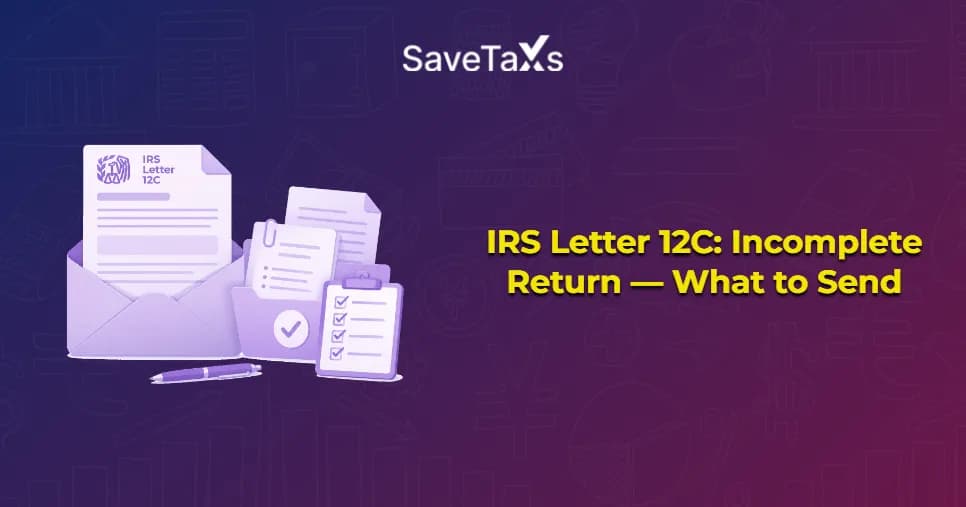
Imagine you filed your US tax return and you are waiting for a tax refund, but instead, you get an IRS Letter 12C. Like other taxpayers, you will also get tense, as receiving a tax notice is not a good thing. But there is nothing to worry about. The Letter 12C means the IRS is simply asking you for additional information or documents to process your filed tax return.
There will be several questions in your mind, such as why the IRS is asking for additional information, what documents you should send, and how to respond. Want to know about all these? Read the blog and get all your answers.
IRS Letter 12C, titled "Request for Information—Individual Return," is sent when the IRS has received your individual income tax return but needs additional information, forms, schedules, or verification to process it accurately. Rather than rejecting your return, the IRS temporarily holds its processing while it requests the additional information, forms, schedules, or verification needed to complete the return. Receiving Letter 12C does not necessarily mean you made a mistake on your tax return.
This was all about IRS Letter 12C. Moving ahead, let's know why you receive this letter.
With Savetaxs, understand your US tax situation and pay them on time with complete accuracy.
Here are some common reasons why you receive IRS Letter 12C:
*A specific note to NRIs: Premium Tax Credit eligibility depends on your tax residency, filing status, Marketplace coverage, and applicable IRS rules. Many nonresident aliens cannot claim the credit, but certain Form 1040-NR filers may qualify under specific exceptions. For example, certain students or business apprentices may qualify under Article 21(2) of the U.S.-India tax treaty. If you receive Letter 12C requesting Form 8962, check whether you were eligible to claim the Premium Tax Credit for that tax year. If your U.S. tax residency changed during the year, review your eligibility for the Premium Tax Credit and the filing requirements that applied to you for that tax year.
These are some common reasons why you receive IRS Letter 12C. Moving further, let's know the information or documents the IRS needs.
The Letter 12C itself states the documents or information that you need to provide to the IRS. Considering this, here are some documents that are commonly requested:
Send the information and documents specifically requested in your Letter 12C, along with any relevant supporting documents needed to substantiate your response. Avoid sending unrelated documents. Moving forward, let's know how to respond to IRS Letter 12C.
Here is how you should respond to IRS Letter 12C:
*Practical Tip for NRIs: If you need to mail your response from outside the U.S., follow the mailing instructions and address provided in your Letter 12C. You may consider using a trackable delivery service so you can keep proof that your response was sent.
This is how you should respond to IRS Letter 12C. Moving ahead, let's know about Form 8962 and the Advanced Premium Tax Credit.
IRS Form 8962 is a tax form that helps you determine your actual premium tax credit and adjust it with any advance payments you received during the calendar year. Additionally, the premium tax credit, often known as PTC, is a tax credit that offsets your annual health insurance premiums. One unique feature of PTC is advanceable. This means before you file your tax return, you receive an estimated tax credit.
If you receive advance payments of the Premium Tax Credit, you generally use Form 8962 when filing your federal tax return to calculate your actual Premium Tax Credit and reconcile it with the advance payments made during the year. If Form 8962 is required for your return but was not included, the IRS may request it before completing the processing of your return.
If you receive Letter 12C because Form 8962 is missing, follow the instructions in the letter and provide the requested Form 8962 and any other required information, such as Form 1095-A. Do not ignore the letter, even if you disagree with the request.
So, this was all about IRS Form 8962 and the advance premium tax credit. Moving further, let's know what happens if you do not respond to Letter 12C.
Not responding to the IRS Letter 12C within the given deadline results in the following consequences:
This is why you should respond to Letter 12C within the stated deadline. If you disagree with the IRS request, still respond with a clear explanation and any relevant supporting information. If you do not respond, the IRS may continue processing your return using the information available to it and adjust your account. Let's better understand with an example.
Nikhil is an Indian citizen temporarily living in the U.S. who remains a nonresident alien for U.S. federal tax purposes. He filed Form 1040-NR to report income from a short-term U.S. assignment and U.S.-source dividend income that was not effectively connected with a U.S. trade or business. A few weeks later, after filing his tax return, he received IRS Letter 12C. It stated that he had omitted Schedule NEC from his Form 1040-NR. Schedule NEC is used to report certain income that is not effectively connected with a U.S. trade or business, including applicable U.S.-source FDAP income such as certain dividends, interest, rents, and royalties. Because the dividends were U.S.-source income that was not effectively connected with a U.S. trade or business, they were generally reported on Schedule NEC.
To rectify the issue, he completed Schedule NEC as requested and submitted the required supporting information within the deadline. If he qualified for benefits under the India-U.S. tax treaty and met all applicable requirements, he applied the treaty rate to the relevant income. He responded to Letter 12C with the requested information and supporting documents. The IRS was then able to continue processing his return. If a refund was due, the IRS generally advises taxpayers to allow about six to eight weeks after it receives the response.
Now, moving forward, let's know the common mistakes to avoid.
Here are some common mistakes you should avoid when replying to IRS Letter 12C:
These are some common mistakes that you should avoid when replying to IRS Letter 12C.
Connect with Savetaxs and simply respond to your IRS notice on time without any issue.
Lastly, IRS Letter 12C is a simple request that the IRS made to its taxpayers for additional or missing information. With a careful review and timely response, you can provide the IRS with the information it needs to continue processing your return. If a refund is due, the IRS advises allowing about six to eight weeks after it receives your response.
Further, if you need any assistance in replying to the IRS notice, connect with Savetaxs. We have a team of tax experts who can help you understand the notice, prepare the required response, and submit the requested information on time. Considering this, whether you need help understanding the implications of the notice, exploring payment options, or disputing adjustments, we are here to provide you with assistance as per your tax situation.
This article is for general informational purposes only and does not constitute tax, legal, financial, or investment advice. Laws, regulations, rates, and procedures may change over time and may vary based on individual circumstances.
While SaveTaxs makes reasonable efforts to keep the information accurate and up to date, readers should verify applicable rules with official authorities or consult a qualified professional before making decisions based on this information.
Shubham Jain is the Founder of SaveTaxs and has extensive experience in Indian and NRI taxation. He advises individuals, NRIs, and businesses on tax filing, tax planning, capital gains, DTAA benefits, fund repatriation, and compliance matters. He regularly writes about taxation and related financial topics. His focus is on making complex tax concepts easy to understand. Through his articles, he helps taxpayers stay informed, avoid common mistakes, and stay compliant with Indian tax laws. See Full Bio

Want to read more? Explore Blogs