US Tax Filing and Compliance
Depreciating Indian Rental Property on a US Tax ReturnDepreciating Indian Rental Property on a US Tax Return
Written by Shubham Jain

-for-NRIs_1784011339179.webp&w=3840&q=75)
If you have worked in the US for several years, contributed to US retirement accounts, and have since moved back to India, your US retirement account doesn't disappear. Instead, the IRS requires you to start withdrawals at some point. These mandatory withdrawals are known as required minimum distributions or RMDs.
RMD is the minimum amount that you need to withdraw from your tax-deferred retirement account every year after you reach a certain age. It is a mandatory requirement, and you cannot overlook it as it can lead to severe penalties. Every retirement account funded with tax-deductible contributions is subject to RMDs, except Roth IRAs.
Moreover, you will be subject to US RMD rules regardless of where you live. RMD withdrawal amount is calculated by dividing your account balance as of December 31 of the prior year by a life expectancy factor. Also, RMDs for NRIs who manage finances across two countries may have additional layers that most standard retirement guides may not cover.
In this guide, we will cover everything you need to know about RMDs - meaning, when they start, how they are taxed, and mistakes to avoid.
A required minimum distribution for an NRI is the minimum amount that the IRS requires you to withdraw from your tax-deferred retirement account each year. This rule applies after you reach a certain age.
You must be thinking why, so the logic is very clear behind this. When you contribute to a traditional IRA or 401(k), you receive a tax deduction at that time. The IRS only postpones taxation on such funds, but they do not eliminate it, and RMDs are basically the method through which the government eventually collects this deferred tax. Hence, you must mandatorily withdraw a minimum amount each year and pay ordinary income tax on it to ensure the IRS receives its portion.
In short, RMDs are mandatory withdrawals from US retirement accounts that must be taken every year. Also, it is taxed as ordinary income in the year you withdraw it.
Keep in mind that RMDs do not apply to Roth IRAs during the lifetime of the original owner. It is because contributions to Roth accounts are made with after-tax dollars*. So, it avoids the mandatory withdrawal requirement from the IRS.
*After-tax dollars: These are funds on which income tax has already been paid. Contributions made using after-tax dollars do not qualify for an upfront tax deduction.
Now that we know that Roth IRAs don't require RMDs, we will discuss the accounts that require an RMD.
Any retirement account that is funded with tax-deductible contributions is generally subject to RMDs, except Roth IRAs. Here is a detailed breakdown of the retirement accounts that require an RMD and accounts that don't require an RMD:
**Important Note for NRIs: If you have multiple IRA accounts, you can combine your RMD calculations across all of them. Then, you can choose to withdraw the entire combined amount from just one of your IRAs or a few of those accounts rather than taking a separate distribution from every single account. Moreover, calculate and withdraw RMD separately for each 401(k) plan.
So, it's clear now which accounts require RMDs and which don't. Moving further, let's now discuss when the RMD for an NRI starts.
Contact Savetaxs to avoid any errors or penalties and ensure accurate NRI ITR filing.
The starting age for RMDs has undergone two major changes in recent years. So, NRIs who last managed their US accounts a few years ago may be working with outdated information. Consider the table below to learn about the current RMD starting ages after the SECURE 2.0 Act:
| Birth Year | RMD Starting Age |
|---|---|
| Born before July 1, 1949 | 70½ (old rule) |
| Born July 1, 1949 – 1950 | 72 |
| Born 1951 – 1959 | 73 |
| Born 1960 or later | 75 |
According to the SECURE 2.0 Act, signed into law in December 2022, the starting age has been adjusted to 73 for those born between 1951 and 1959. Additionally, to 75 for those born in 1960 or later. This is a significant shift in US retirement regulations that directly impacts NRIs who moved to India and need to start taking their US retirement distributions.
Moreover, you may delay your very first RMD withdrawal until 1st April of the following year. However, it means that you will have to take two RMDs in the second year, one RMD for the initial year and another for the subsequent year. This will end up increasing your taxable income significantly for that year and put you into a higher tax bracket. Hence, it is advised to take your first RMD in the due year itself until there's a very strong reason to postpone it.
Moving further, we will discuss what IRC Section 401(a)(9) is.
IRC Section 401(a)(9) is the provision in the IRS (Internal Revenue Service) that governs the regulations of RMD. This includes starting ages, calculation methods, and distribution categories for qualified retirement plans.
According to Section 401(a)(9), the RMD amount is determined by dividing your account balance as of December 31 of the prior year by a life expectancy factor. You can find the life expectancy factor from the IRS uniform lifetime table or the joint and last survivor table.
The IRS updates these tables periodically. So, with the latest updates in 2022, it reflects longer life expectancies and lower RMD amounts than previously calculated. It means that more funds will remain in your account to grow before you are obliged to withdraw them.
Now, you must be thinking that if you relocate to India, your RMD responsibility will be nullified. This is one common misconception that many NRIs have. Let's clear this.
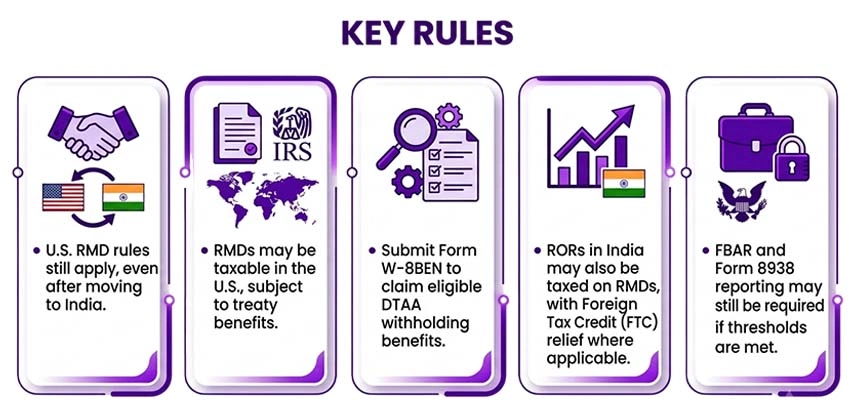
Moving to India doesn't avoid the obligations you have for your US retirement account. Instead, it adds an extra cross-border element that requires careful planning. Here are some of the common rules regarding RMD for NRIs who relocate to India:
Regardless of your resident status or the place you reside, you will still be subject to comply with US RMD regulations. The IRS mandates everyone who holds a US retirement account and has reached the RMD starting age to make the required withdrawal each year. If they fail to do it, they will incur a penalty.
Distributions from traditional IRAs and 401(k) are subject to US withholding tax when it is paid to a non-resident alien (NRA). However, the typical withholding rate on pension and annual income paid to Indian residents can be decreased under the India-US tax treaty. The applicable U.S. withholding rate depends on the relevant provisions of the India-US DTAA, the nature of the retirement distribution, and whether valid treaty documentation such as Form W-8BEN has been submitted.
To claim the benefits of the treaty and avoid the default 30% withholding rate, you must submit Form W-BEN to your custodian or plan administrator.
Once you become an Indian tax resident, mainly once you reach the ROR (Resident and Ordinarily Resident) status, your worldwide income becomes taxable in India. It also includes US retirement distributions.
But don't worry, you get the option to claim a credit for US taxes withheld by claiming the benefits of the India-US Double Taxation Avoidance Agreement (DTAA). It means you will not be taxed on the same income twice. However, remember that you may still be liable to pay the difference. It applies if the tax rate in India on that income is higher than the amount withheld in the US.
If your US retirement accounts exceed the applicable thresholds, you may still have to file FBAR (FinCRN Form 114) and Form 8938. This obligation depends on your US tax filing status and account balances.
You should consult a US CPA to confirm whether these requirements apply to you after you move to India. Next, we will learn about RMD taxation rules for NRIs in India and the US.
To ensure proper planning for retirement income, you need to understand how RMDs are taxed on both sides:
Distributions from traditional IRAs and 401(k) are taxed as ordinary income in the US. For NRIs who are classified as non-resident aliens for US tax purposes:
Once you become an Indian tax resident:
Practical Tax Planning Consideration: NRIs returning to India can benefit from RNOR (Resident but not Ordinarily Resident) status for 2-3 years after their return. It allows foreign pension income, including retirement distributions from the U.S., to be non-taxable in India during this period. This creates an opportunity where only US tax applies to required minimum distributions (RMDs). Those who can structure large distributions to fall within the RNOR window may experience a lower overall tax burden.
Let's consider an example to illustrate this.
Suresh retired from a technology company in California at 65 and moved back to India in 2022. With a traditional IRA valued at approximately $380,000 and a former employer 401(k) worth $220,000, and being born in 1953, his RMD starting age is 73, reaching this milestone in 2026. Now, when his US CPA calculates his first-year RMD, he gets the following results:
Suresh needs to take this withdrawal in 2026. So, he submits Form W-8BEN to both his IRA custodian and the 401(k) plan administrator to claim the reduced withholding rate under the India-US treaty. As a result, his IRA custodian withholds 15% ($3,396) from the IRA distribution. Meanwhile, the 401(k) plan applies standard withholding until the W-8BEN is processed.
Now, in India, Suresh's CA includes the full $22,642 as foreign income on his Indian income tax return (ITR). Then, he calculates the applicable tax at his slab rate and claims a foreign tax credit for the US tax withheld, which will reduce his Indian tax liability by that amount.
At the same time, he files a US Form 1040-NR to report the US source retirement income, verify the accuracy of the withholding rate, and request a refund if excess withholding has occurred.
His advisors in both countries coordinate the calculations to ensure accuracy. This will allow for the foreign tax credit to be applied properly and prevent double taxation of the income.
Moving further, we will see the common mistakes NRIs make regarding RMD.
Here are some of the common mistakes that NRIs make with required minimum distributions (RMDs):
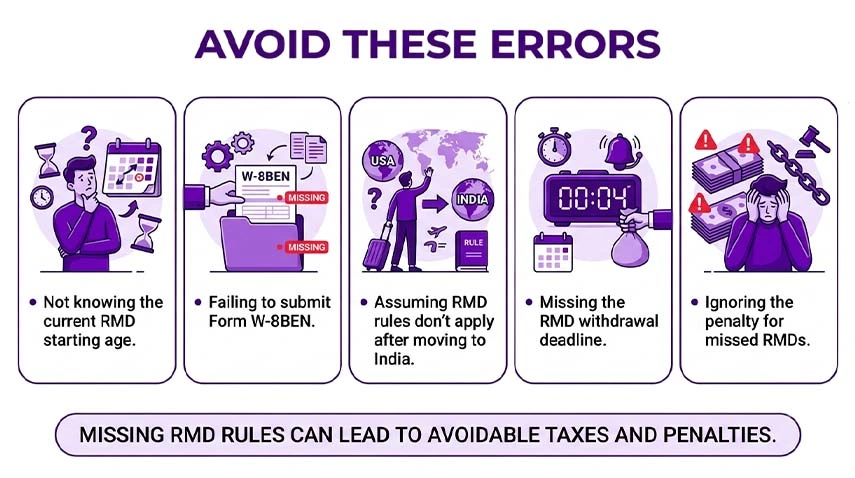
Many NRIs who left the US before the SECURE 2.0 Act was enacted in 2022 may still think that the starting age for RMDs is 70½ or 72.
However, the new ages are 73 or 75 based on the year of birth. It means that some NRIs might not need to start withdrawals as early as they think. Similarly, some NRIs may have unintentionally missed their start date.
Not having a valid W-8BEN on file leads to custodians withholding at the default rate of 30%. For NRIs living in India who are eligible for a treaty rate reduction, this results in considerable over-withholding that must be reclaimed through a US tax return instead of being retained in the account.
NRIs are not exempt from RMDs based on their location of residence. So, if an individual has a US tax-deferred retirement account and has reached the starting age, the RMD obligation still stands, regardless of residency.
Generally, RMD must be withdrawn by the 31st of December each year. The only exception is the first RMD year, which allows withdrawal until April 1 of the following year. However, taking two RMDs in one year will have its tax consequences. Similarly, missing the December 31 deadline in any subsequent years will incur a penalty.
The excise tax for failing to take the required minimum distribution is 25% of the amount due. This may be reduced to 10% if corrected within a two-year window per SECURE 2.0. Remember that this is in addition to any income tax on that distribution.
Let Savetaxs experts take care of your ITR filing to ensure you have peace of mind.
Required minimum distributions are a mandatory aspect of holding US retirement accounts, and relocating to India does not exempt one from this requirement. However, what changes is the tax picture because it involves two countries, different filing responsibilities, a treaty credit system, and a window of RNOR status which can be used strategically.
The key priorities are clear: your RMD starting age depends on current regulations, submit Form W-8BEN to your plan custodian to secure the proper treaty withholding rate, ensure RMDs are taken by 31 December each year, and also coordinate US and Indian tax filings effectively. This will ensure that the foreign tax credit can be claimed accurately.
Moreover, NRIs who have significant US retirement accounts, especially those near the RMD starting age or recently moved to India, must connect with an expert at Savetaxs. At Savetaxs, we have a team of CAs and CPAs who are expert with cross-border taxation, finance, and other rules. Our team can help you stay compliant and file your taxes accurately by ensuring you stay compliant with the legal requirements. Connect with us right away, as we are working 24/7 across all time zones.
This article is for general informational purposes only and does not constitute tax, legal, financial, or investment advice. Laws, regulations, rates, and procedures may change over time and may vary based on individual circumstances.
While SaveTaxs makes reasonable efforts to keep the information accurate and up to date, readers should verify applicable rules with official authorities or consult a qualified professional before making decisions based on this information.
Vipul Jain is the Co-Founder of SaveTaxs and a tax expert with experience in Indian and NRI taxation. He advises individuals, NRIs, and businesses on tax filing, tax planning, capital gains, DTAA, and compliance matters. He focuses on making complex tax concepts simple and helping taxpayers make informed, compliant decisions. See Full Bio

Want to read more? Explore Blogs