-for-401(k)_1790057066765.webp&w=828&q=75)
US Tax Filing and Compliance
Net Unrealized Appreciation (NUA) for 401(k): A Guide for NRIs Moving to IndiaNet Unrealized Appreciation (NUA) for 401(k): A Guide for NRIs Moving to India
Written by Vipul Jain
As an NRI or overseas American, if you receive Social Security or expect to someday, 2026 is not a quiet year. There have been seven changes in effect, and based on where you are in life, they could either put more money in your pocket, increase your tax bill, or change when and how much you receive.
Now, for NRIs, overseas Americans, and Indian-origin professionals who have worked in the US, these updates are more relevant than many people realize. You must ensure that Social Security is not your concern the moment you leave America. If you have contributed to the system in any way, those contributions belong to you, and the rules around them change every single year.
In this blog guide, we will explore the 7 major Social Security changes, what they mean in practice, and what NRIs should specifically be thinking about.
Before we dive into the details, here are some quick social security updates:
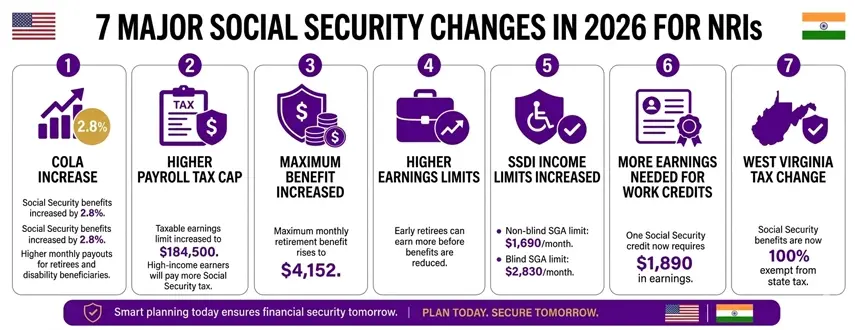
Every tax year, Social Security benefits are adjusted for inflation through a Cost-of-Living adjustment. For 2026, the increase is by 2.8%.
If we consider real numbers, the average monthly benefits for retired workers have increased by approximately $56 to around $2,071 per month. For the disability beneficiaries, the average monthly payment increased by $44 to approximately $1,630.
What has made the 2026 COLA historically significant is that it is the fifth consecutive year benefits have risen by at least 2.5%, and the first time that has happened in nearly three decades.
However, this is worth knowing: The Medicare Part B premiums are now at 9.7% for 2026, and inflation in medical care and shelter, two major expense categories for retirees, remains elevated. This simply means that the real purchasing power of a Social Security dollar may still edge downward even after the raise.
What NRIs Must Know: The 2.8% increase applies to your benefit, regardless of which country you live in. There is no action needed; the adjustment is automatic. However, the actual value you receive is based on the USD exchange rate at the time of transfer. A stronger dollar amplifies your benefit in rupee terms, and a weaker one shrinks it. If you are transferring your Social Security (SSN) payments from your US bank account to India, please factor in current exchange rates and wire transfer fees when calculating your effective monthly income. Over the course of a year, even a low rate of movement on a $ 2,000+ monthly benefit adds up significantly.
NRIs file your ITR in India with Savetaxs expert guidance.
Social Security's main funding source is a 12.4% payroll tax on earned income, wages, and salaries only, not on investment returns. Every tax year, a threshold determines how much of your income is subject to this tax.
In 2025, that cap was $176,100. For 2026, it increases to $184,500.
So what does it mean in dollars? The self-employed individuals who reach the threshold face up to $1,041.60 in additional payroll tax liability for 2026. Employees whose employers split the 12.4% may owe up to $520.80. Somewhere around 6% of workers in the US are expected to hit this threshold this tax year.
What an NRI Should Know: As an NRI working in the US on an H-1B, L-1, or O-1 visa and earning above the $184,500 threshold, this increase directly affects your take-home pay. You are contributing to Social Security even though you are not sure whether you will ever collect benefits, and Social Security contributions generally count toward future benefit eligibility and benefit calculations once the applicable eligibility requirements, including work credits, are met.
An important point to remember is that India and the US do not have a Totalization agreement. Meaning your SSN contribution to the USA cannot be combined with any of the Indian provident and pension contributions to meet the eligibility requirements. Here, each system operates independently. If you are approaching the earnings threshold, please factor this into your 2026 financial planning as additional tax liability. Furthermore, ensure to consult a US CPA or cross-border tax advisor if your situation becomes complex.
For retirees who are maximizing their earnings throughout their careers, the top monthly benefit available at your full retirement age rises to $4,152 in 2026, up $132 from $ 4,018 in 2025.
To reach this maximum requires three things:
What Should NRIs Know: Before returning to India, if you have spent part of your career working in the US, your Social Security benefit is calculated based on your 35 highest inflation-adjusted earnings years.
Years with no US earnings here are treated as zeros in the computation, which in turn lowers your average. If you have worked in the US for the last 15 to 20 years and have been back in India since then, your benefits will certainly reflect those zero-earning years unless you return to US employment.
A key takeaway: Log in to your My Social Security account at SSA.gov and check for your current estimated benefits. Doing so is free and will take only five minutes of your time, but afterward you will have a clear picture of what you have built so far and, financially, how many additional US working years will be worth to you.
If you have claimed your Social Security before reaching full retirement age and are still earning income, the retirement earnings test will determine how much the SSA can withhold from your benefit.
For the year 2026, the threshold caps have been increased.
For a Social Security early filer who will not reach the full retirement age by this year, the annual withholding threshold rises from $23,400 to $24,480. The SSA withholds $1 for every $2 earned beyond this level.
For the early filers who will attain their full retirement age at any time during 2026, the threshold increases from $ 62,160 to $65,160 annually. Above this level, the $1 is withheld for every $3 in earnings.
Now, once you have attained the full retirement age, these thresholds will no longer apply, and you can earn any amount without affecting your benefits.
What Should NRIs Know: This change is important for NRIs who have claimed their social security early, perhaps even before leaving the United States, and have since returned to the US employer or are earning any US source income monthly. If your US source earnings exceed the new thresholds, a part of your monthly benefits might be withheld.
Essentially, investment income, rental income from US property, and pension distributions will not be counted toward these earnings limits; only wages and self-employment income will be. If your US income is primarily from rental properties, retirement account distributions, or dividends, the earnings test will not affect your Social Security payments. Whereas for NRIs with a mix of earned and passive US income, understanding exactly what counts and what does not is essential and must be provided by a tax advisor with expertise in cross-border taxation.
Social Security disability beneficiaries are allowed to earn a limited amount of income without losing their benefits, a threshold known as Substantial Gainful Activity (SGA).
For 2026, non-blind workers with disabilities can now earn up to $1690 per month, which is up to $70 from the 2025 limit of $1620. For a worker who is blind with a disability, the limit increases from $2700 to $2830 per month.
What Should NRIs Know: For NRIs living outside the US who are receiving Social Security Disability Insurance (SSDI), these SGA limits can still apply to any earned income, including remote work for US employers or self-employment income, regardless of where you are physically located.
There is one essential point that many NRI disability recipients do not always realize: SSDI can generally be paid to beneficiaries living abroad, and SSA has specific international payment rules, and Social Security benefits can generally be paid to eligible beneficiaries residing in India, subject to SSA requirements. However, the SSA conducts periodic disability reviews and needs an ongoing proof of continued eligibility. If you have relocated to India and are receiving SSDI, keep your SSA account details, mailing address, and other contact information up to date, as any missed reviews will trigger payment suspensions that take time and effort to reverse.
To qualify for Social Security retirement benefits, you need 40 lifetime work credits, with a maximum of 4 credits earned each year. Per year, earnings are required to obtain one credit, which is adjusted upward.
For 2026, earning one work credit will require $1,890 in wages or self-employment income, up from $80 from $1810 in 2025. To earn all four credits for the year, you will need $7560 in total earned income.
What Must NRIs Know: For NRIs who worked in the US for a certain number of years, this is the most overlooked issue. If you're not sure whether you have accumulated your 40 credits, check in now at ssa.gov - it takes two minutes and could save you from an unpleasant surprise when you eventually try to claim.
If you are close to the 40-credit threshold and still have US source earned income, or are considering a return to the US for work, a few additional earning years will push you over the eligibility line. Given that India and the US do not have a totalization agreement, there is no way to combine your Indian and US work years to meet the cap. You will either have 40 US credits or you won't. Knowing the current credit count will give you more time to plan.
Starting in 2026, West Virginia residents will pay no tax on their Social Security benefits, regardless of their income. This completes the phaseout that began with legislation signed in early 2024.
Previously, residents above a certain income threshold had 65% of their benefits exempted from 2025. From 2026, the exemption is 100% for everyone. The change benefits more than 476,000 Social Security recipients in the state.
What NRIs Must Know: If you are planning to repatriate to the US for retirement, state-level Social Security taxation directly affects how much of your benefits you can keep. Not all states tax Social Security, and those that do vary significantly in their approaches.
States with no income tax at all, such as Texas, Florida, Nevada, and Washington, effectively offer a full Social Security tax exemption by default. West Virginia now fully exempts Social Security benefits from state taxation, although it continues to levy state income tax on other taxable income. If you are mapping out a US retirement plan and Social Security will be a meaningful part of your income, choosing the right state to settle in is a legitimate financial decision, not just a lifestyle one. Along with this, a few thousand dollars in state tax savings every year compound meaningfully over a long retirement.
Get your NRI bank account opened in India effortlessly, under Savetaxs' expert guidance
Social security is not just an American domestic issue. For the millions of Indian origin professionals who have worked in the US, whether for 5 years or 35 years, it is a real retirement asset that will continue to evolve.
These seven changes we just discussed in 2026 range from immediate income increases to long-term eligibility adjustments. Staying on top of them will help you make better financial decisions: when to claim, how much to expect, how your US benefits align with your Indian income, and how to minimize unnecessary tax exposure on both sides.
The three things every NRI with a US work history must do right now.
First up, log in to the ssa.gov and check your work credit count and the estimated benefit. It is free and hardly takes five minutes.
Second, make sure your SSA contact details, mailing address, and bank account information are up to date, especially if you are already receiving benefits or approaching your claim age.
Third, if your situation involves any cross-border income, DTAA considerations, or questions about the optimal time to claim, speak to a financial advisor or CPA with genuine expertise and experience with NRIs. The decisions you make regarding the Social Security claiming age and stage can affect your total lifetime earnings by tens of thousands of dollars, and they deserve proper attention.
Savetaxs is the name to trust when it comes to speaking to a financial advisor or a CPA with NRI or expat experience. Connect with us as we service our clients 24/7 across all time zones.
This article is for general informational purposes only and does not constitute tax, legal, financial, or investment advice. Laws, regulations, rates, and procedures may change over time and may vary based on individual circumstances.
While SaveTaxs makes reasonable efforts to keep the information accurate and up to date, readers should verify applicable rules with official authorities or consult a qualified professional before making decisions based on this information.
Vipul Jain is the Co-Founder of SaveTaxs and a tax expert with experience in Indian and NRI taxation. He advises individuals, NRIs, and businesses on tax filing, tax planning, capital gains, DTAA, and compliance matters. He focuses on making complex tax concepts simple and helping taxpayers make informed, compliant decisions. See Full Bio
Want to read more? Explore Blogs