-for-401(k)_1790057066765.webp&w=828&q=75)
US Tax Filing and Compliance
Net Unrealized Appreciation (NUA) for 401(k): A Guide for NRIs Moving to IndiaNet Unrealized Appreciation (NUA) for 401(k): A Guide for NRIs Moving to India
Written by Vipul Jain

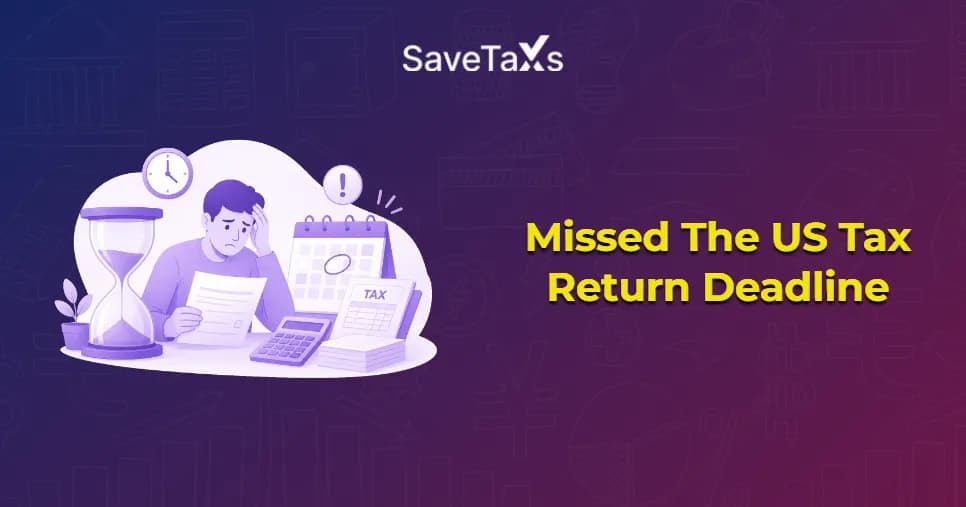
As a US taxpayer, if you have missed the April 15 deadline for filing your IRS tax return, then you are not alone in this game. Every year, thousands of taxpayers, including H-1B visa holders, NRIs, green card holders, and US residents living abroad, end up filing late for many reasons.
However, the good news is that the IRS has a way to help you catch up later. What matters most is what you do next after missing the deadline and how fast you do it.
This guide will take you through what to do after a missed deadline, how to file accurately, and how to avoid turning a simple tax filing delay into a costly problem.
Here is a quick answer that is: if you miss the deadline, file as soon as possible, even if you cannot pay in full. Filing late will cost far less than not filing at all. If you owe tax refunds, there will be no penalty imposed for filing late; just know that you have three years from the original due date to file the return and claim the tax refunds after the deadline.
Once the filing deadline passes without a filed return or a valid extension, the IRS may begin charging a late filing penalty. If you also owe tax that was not paid by the payment due date, late payment penalties and interest may apply. Along with this, there will be daily compounding interest on anything you owe.
Here is something worth remembering: the US tax late filing penalty runs about ten times higher than the late payment penalty. That is why the best move after a missed deadline is to file immediately, even if you cannot pay in full yet, because filing the return will stop the more expensive penalty from continuing to grow.
If you are due a refund, none of this applies to you, as there is no penalty for filing late when the IRS owes you money.
Yes, the IRS still accepts the late return at any time; there is no cutoff that blocks you from filing. What changes is the cost and, in some cases, your eligibility for refunds or certain other benefits.
Here are a few things to know before you file:
File your taxes fast, accurately, and securely with your trusted tax preparation service today.
Filing a late US tax return follows almost the same steps as filing your return on time; the only difference here is that accuracy and speed matter a lot more now.
This problem is much more common than people assume, specifically for the NRIs who have moved between countries or the US residents who will simply fall behind after having a major life change.
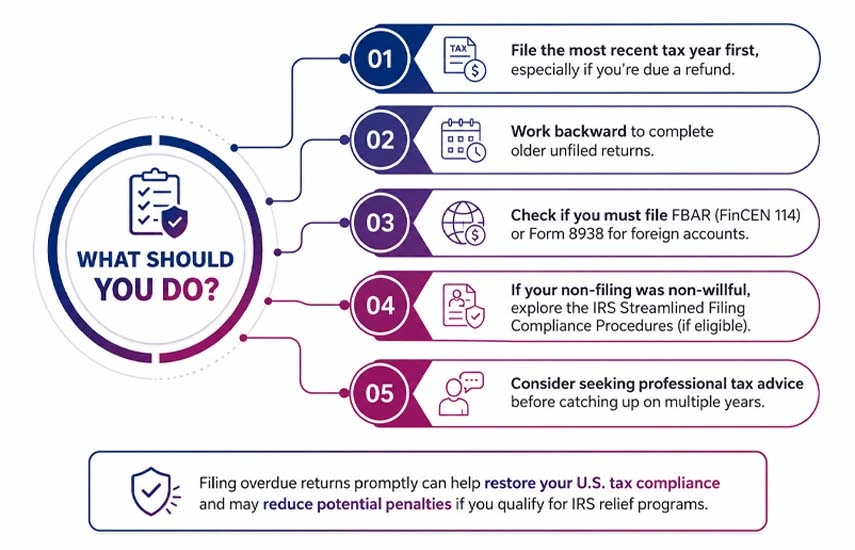
The IRS will generally require the last six years of returns to be considered "in good standing," though it can request more in the case where fraud or substantial underreporting is involved. Practically speaking, many taxpayers catching up should:
For NRIs with unfiled US returns and unreported foreign accounts, the Internal Revenue Service Compliance Procedures may be worth exploring for you. This specific program is designed for the taxpayer whose non-filing was non-willful and was a genuine oversight, not deliberate avoidance; they can significantly reduce or eliminate the penalties if qualified. It is a compliance track, not a loophole; eligibility depends on your specific facts, so this is a good area to get a tax professional's opinion before filing.
Yes, you can claim the tax refund if you are eligible for it; however, there is a hidden delay inside this one too. You generally have three years from the original filing deadline to claim a refund. If you miss this timeline and the refund reverts to the United States Treasury, it will be there permanently. There will be no appeals for the refunds claimed too late.
This catches quite a lot of people off guard more than you'd think, particularly those who assumed there would be no penalty for late refunds.
Once you have filed your IRS return, you should take a few practical steps that can lower what you ultimately owe.
The following are the common mistakes that NRIs must avoid while filing their IRS taxes.
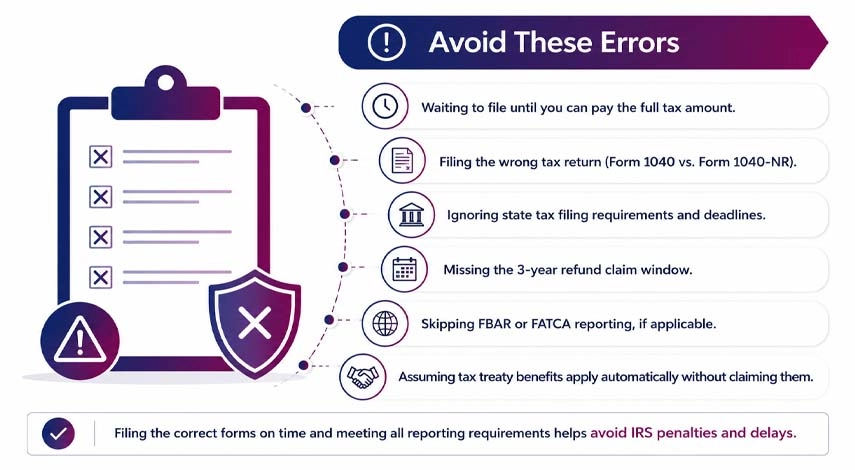
Let us understand this concept with an NRI example:
Consider Prachi, an Indian software engineer who worked in the US on an H-1B visa for part of the year and then returned to India. But with the relocation, she missed the April 15 deadline for filing her US returns.
After determining her U.S. tax residency under the applicable IRS residency rules, she concluded that she was required to file Form 1040-NR for that tax year, not the standard Form 1040. She also has a small US bank account that she forgot to report.
Once she realized that the deadline had passed, she filed her 1040-NR immediately and avoided waiting to gather every document and more. She paid the estimated tax due with the return and then contacted a cross-border tax professional about the forgotten account. Now, because her omission was a genuine oversight and she did not do it intentionally, she was able to address it under the Streamlined Compliance Process, which helped her avoid any steep penalties associated with willful non-disclosure.
Her case highlights a pattern that is most common among the NRIs; the tax return itself is easy to prepare. It is just the layers of residency status, tax treaty benefits, and foreign account reporting that require extra attention and care.
Simplify your cross-border wealth with expert NRI tax solutions today. Manage NRE/NRO accounts, tax returns, and capital gains with ease.
If you happen to miss the US tax deadline, this is alright; such oversights happen. But how you respond to this oversight in the following weeks can make the difference in your final tax bill. File as soon as you can, pay your tax liability right away, and do not let a missed deadline turn it into missed years of tax filing.
If your situation involves foreign income, multiple filings over a year, or non-resident status, it is worth seeking professional assistance from a tax professional who is well-versed in cross-border cases.
If you are seeking professional assistance with IRS tax filings, Savetaxs is the name to trust. We help NRIs, Indian nationals in the United States, and foreign nationals prepare and file their IRS tax returns. Further, the experts will help you calculate missed tax liabilities, penalties, and interest, and navigate compliance rules using IRS guidelines. Our team of expert CPAs and CAs will review your tax history, prepare the latest return(s), calculate the penalties, and explain the IRS notice, compliance options, and penalty abatement procedures to you.
Connect with us as we serve our clients 24/7 across all time zones.
This article is for general informational purposes only and does not constitute tax, legal, financial, or investment advice. Laws, regulations, rates, and procedures may change over time and may vary based on individual circumstances.
While SaveTaxs makes reasonable efforts to keep the information accurate and up to date, readers should verify applicable rules with official authorities or consult a qualified professional before making decisions based on this information.
Vipul Jain is the Co-Founder of SaveTaxs and a tax expert with experience in Indian and NRI taxation. He advises individuals, NRIs, and businesses on tax filing, tax planning, capital gains, DTAA, and compliance matters. He focuses on making complex tax concepts simple and helping taxpayers make informed, compliant decisions. See Full Bio

Want to read more? Explore Blogs