



US Tax Forms
IRS Form 8962 for NRIs: Premium Tax Credit and APTCIRS Form 8962 for NRIs: Premium Tax Credit and APTC
Written by Shubham Jain
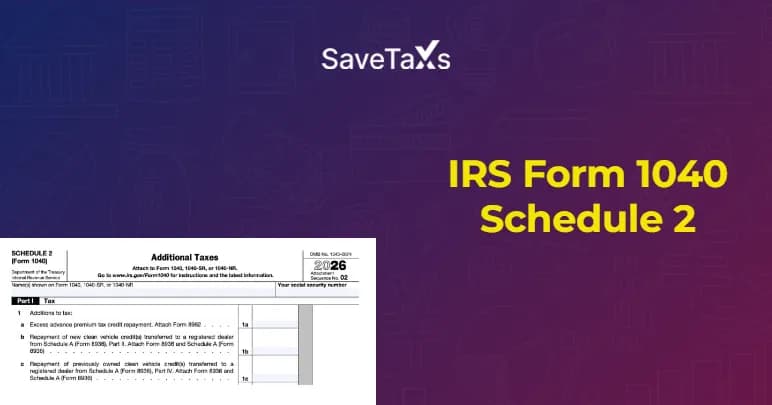
When filing U.S. taxes, people tend to focus more on the main Form 1040. However, for many taxpayers, the main form alone doesn't cover everything, which is when Schedule 2 is used. If you owe certain additional tax beyond regular income tax or if you are claiming credits that offset those taxes, you must use Schedule 2. For NRIs, U.S. citizens living abroad, and Indian professionals working in the US, it's important to understand Schedule 2.
In this guide, we will cover everything you need to know about the IRS Form 1040 Schedule 2 tax form.
IRS Form 1040 Schedule 2 tax form is an additional form attached to your main Form 1040, Form 1040-NR, or Form 1040-SR. It is required when you owe additional taxes beyond regular income tax. It reports two categories of additional taxes that don't fit on the main return, which are:
The final total from Schedule 2 is carried to the applicable tax line on Form 1040 for the relevant tax year. It is then added to your overall tax liability.
understand it better, think of it like this:
Form 1040 captures your regular income tax, while Schedule 2 covers everything else the IRS wants to collect from you. It can include taxes that apply in specific situations based on your income type, employment situation, or life stage. This is what Form 1040 means. Let's understand who needs to file Schedule 2.
Not everyone is required to file Form 1040 Schedule 2. If even one of the taxes or adjustments it covers applies to your situation, you must attach it. File Schedule 2 tax form if you:
Several of these provisions may apply to Indian-origin taxpayers who become US tax residents via a green card or by passing the substantial presence test. It mainly includes self-employment tax, NIIT, and AMT. Now that we know who needs to file, let's see what is reported on Schedule 2.
The Form is divided mainly into two parts: Part I (Taxes) and Part II (Other taxes). Here is what both parts cover:
This part covers two main items:
AMT is designed to ensure that high-income taxpayers pay at least a minimum amount of federal tax, regardless of the deductions and credits they claim under the regular tax system.
The regular tax liability and AMT liability are calculated separately. After which, if the AMT is higher, you need to pay the difference. It is then formally reported as an additional tax on Schedule 2. For inflation, AMT exemption amounts are adjusted every year and start to phase out at higher income levels.
AMT is most commonly applicable to taxpayers who have:
Taxpayers must refer to the applicable IRS limits for the relevant tax year.
If you have received advance payments of the premium tax credit to help pay health insurance premiums through the marketplace. But if your actual income for the year is higher than estimated, you may need to repay some or all of the advance payment. This repayment is reported here.
Line 3 represents the sum of Lines 1 and 2, which is the total of your AMT liability plus any repayment of excess premium tax credits. This figure carries over into the overall tax computation on your Form 1040. It serves as a summary line rather than a distinct tax category. However, it plays a crucial role in calculating your total tax liability. Hence, it must be accurately totalled before moving to Part II.
In Part II, most of the additional tax items are reported:
If you are self-employed and your net self-employment income exceeds $400, you are liable to pay self-employment tax at a rate of 15.3%. This tax covers both the employee and employer portions of Social Security (12.4%) and Medicare (2.9%). Also, it is different from income tax, applying to you regardless of your income tax bracket.
This section is for reporting any wages from which the social security or medicare tax was not properly withheld. For example, from a foreign employer that doesn't have a US withholding agreement.
Line 7 is frequently applicable to taxpayers who have made early withdrawals, excess contributions, or failed to take required minimum distributions from retirement or tax-favoured accounts. Specifically, Line 7 covers:
For non-resident Indians (NRIs) who move back to India and leave their retirement accounts in the U.S., it is important to determine when and how to withdraw the funds. Also, identify whether they'll face a 10% penalty for early withdrawal or claim an exception. It is an important part of planning, but is often overlooked.
There are exceptions to this 10% penalty, such as disability, certain medical costs, and certain payment methods under Section 72(t).
Additional Tax on IRAs and Retirement Plans - Line 8
If you take money from retirement accounts before turning 59½, you usually have to pay a 10% penalty. This must be reported on Schedule 2. However, there are exceptions like disability or first-time home purchases. But you need to keep proper records.
If you hire household employees like a nanny, caregivers, etc., and pay them cash wages over a specific IRS limit. Then, you might need to pay household employment taxes, including Social Security and Medicare taxes on those wages. Line 9 will report this.
This line reports the repayment of the first-time homebuyer credit, which was available for homes bought from 2008 to 2010. The 2008 credit needed to be repaid like a loan, usually $500 a year for 15 years. If you took this credit and still owe money, you report that amount here.
The credits from 2009 and 2010 didn't usually need to be paid back unless you sold the home or stopped living there, as your main home before a certain time.
There's an extra Medicare tax of 0.9% to wages and self-employment income over $200,000 for single filers and $250,000 for married filing jointly. This is charged in addition to the standard medicare tax already taken out of your earnings.
If your net investment income or modified adjusted gross income exceeds $200,000 (single) or $250,000 (married filing jointly). Then, you need to pay a 3.8% tax on the smaller of these two amounts. Investment income covers things like interest, dividends, capital gains, rental income, and income from passive business activities.
These lines deal with less common tax situations:
Other Additional Taxes - Line 17 and 17z
This area includes other less common taxes, including education credits, golden parachute payments, and trust distributions.
Line 18 sums up all the amounts from Lines 4 through 17z in Part II. It shows the total additional taxes you owe beyond AMT and premium credit repayment.
This line is currently empty and saved for potential future tax changes.
Line 20 combines amounts from Part 1 (Line 3) and Part II (Line 18) to provide the total of all taxes from Schedule 2. This total is added to your regular income tax on Line 17 of your IRS Form 1040 to calculate your overall tax bill.
Savetaxs helps NRIs file their ITR accurately and easily
Schedule 2 tax form is a two-page form, and here is how you can file it:
Read each line on Schedule 2 Form 1040 and identify which taxes are relevant to you for the tax year, as per your situation. You don't need to attach the form if none of the taxes apply.
If your income exceeds the AMT exemption threshold or you have tax preference items, you must complete Form 6251 first. The result flows to Line 1 of Schedule 2.
Complete Schedule SE first if you are self-employed. The self-employment tax amount transfers to Line 4 of Schedule 2.
Complete Form 8960 if your investment income and modified Adjusted Gross Income ( AGI ) are above the thresholds. The result will go to Line 12 of Schedule 2.
Consider the amounts from both Part I and Part II and add them. The combined total will go to line 17 of your Form 1040.
When you file your return, Schedule 2 is submitted as a part of your complete tax filing package, regardless of whether you apply online or by paper.
Most tax software fills out Schedule 2 automatically based on the information you provided in your tax return. If you are filling out manually or working with a tax professional, ensure to complete any necessary supporting forms before you fill in Schedule 2. It can include Schedule SE, Form 6251, or Form 8960. That's how you can file Schedule 2, but it must be filed within the specified deadline. Moving further, we will see the deadline for filing Schedule 2.
Schedule 2 must be submitted by the same deadlines as your Form 1040. The table below lists the deadlines for filing Schedule 2 based on the filing situation:
|
Filing Situation |
Deadline |
|---|---|
| Standard filing deadline |
15th April |
| Automatic extension (Form 4868) |
15th October |
| US citizens and residents living abroad | 15th June (this extension is automatic, no form needed) |
| Extension for overseas filers | 15th December (requires written request) |
Remember, the extension to file doesn't mean you get extra time to pay any taxes owed. If you think you'll owe taxes, make sure to estimate and pay by April 15 to avoid interest and underpayment penalties. It must include, especially, those reported on Schedule 2.
Now, we'll discuss some important points that NRIs must consider while filing Schedule 2.
Schedule 2 is mainly important for NRIs who have become U.S tax residents, whether through a green card or by passing the substantial presence test. It is because they often have to consider both U.S. and Indian tax rules together.
If an NRI runs a business in the U.S. as a sole proprietor or single-member LLC, they need to pay self-employment tax on their net business income. This often goes unnoticed. Self-employment tax includes social security and medicare taxes.
The social security part can apply up to the annual wage base limit set by the IRS. As a result, it can significantly increase a person's total U.S. tax burden beyond the regular income tax. To understand this easily, let's take the help of an example.
Rajesh is an Indian software consultant who moved to the U.S. on an H-1B visa. He later got a green card, and now he runs his own IT consulting business. His income for 2025 is $120,000. Besides federal income tax, Rajesh will also owe about $16,956 in self-employment tax, which is calculated 15.3% of 92.35% of his earnings.
This amount is reported on Schedule 2, Part II , Line 4. Also, it adds to his total federal tax liability. He can deduct half of this self-employment tax when filing his Form 1040, which helps reduce his overall tax burden.
NRIs who are U.S. tax residents and earn money from investments like dividends from Indian stocks or profits from Indian real estate. Then they may have to pay a 3.8% net investment income tax (NIIT) if their total income exceeds certain limits.
This is when the Double Taxation Avoidance Agreement (DTAA) between India and the U.S becomes relevant. The DTAA provides some relief from being taxed twice, but it usually doesn't help with NIIT. So, Indian investment income might be taxed in both countries. It's wise to seek professional advice before filing.
NRIs who receive incentive stock options (ISOs) from U.S. employers should keep in mind the potential impact of AMT. Exercising these stock options could trigger AMT, even if you don't owe regular income tax. It is a scenario that surprised many employees in the tech industry. Consulting a U.S. CPA before exercising stock options can help understand how it affects taxes.
U.S. tax residents with income from India can often use a foreign tax credit (Form 1116) to reduce U.S. taxes on income that's already been taxed in India. However, this credit doesn't apply to self-employment tax on NIIIT, which is reported on Schedule 2. So, even if you claim credit for taxes paid in India, there may still be amounts owed on Schedule 2.
Hire an expert at Savetaxs and get answers to all your queries.
Schedule 2 is a part of your IRS Form 1040 that covers taxes that the main form doesn't include. It might not be relevant for typical employees with straightforward income. However, for NRIs, self-employed individuals, and investors with more complicated financial situations, it's likely an important part of your tax filing.
Moreover, if your financial situation involves Indian income, stock options, or significant investments, seek assistance from an expert at Savetaxs.
At Savetaxs, we have an entire team of experts who can help you with issues that NRIs face. Our team can help you with ITR filing, understanding residential status, PAN card application, repatriation, and much more. Contact us right away and take the burden of NRI issues off your shoulders.
This article is for general informational purposes only and does not constitute tax, legal, financial, or investment advice. Laws, regulations, rates, and procedures may change over time and may vary based on individual circumstances.
While SaveTaxs makes reasonable efforts to keep the information accurate and up to date, readers should verify applicable rules with official authorities or consult a qualified professional before making decisions based on this information.
Vipul Jain is the Co-Founder of SaveTaxs and a tax expert with experience in Indian and NRI taxation. He advises individuals, NRIs, and businesses on tax filing, tax planning, capital gains, DTAA, and compliance matters. He focuses on making complex tax concepts simple and helping taxpayers make informed, compliant decisions. See Full Bio
Want to read more? Explore Blogs
_1786539671275.webp&w=828&q=75)